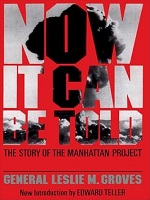
Now It Can Be Told: The Story of the Manhattan Project – General Leslie R. Groves

grovesOn May 8, 1945, Allied forces celebrated Victory in Europe Day (V-E Day) marking the surrender of the German armed forces in World War II. In the Pacific, the war against Japan continued to rage forcing Allied commanders to face the grim reality of a ground invasion which became the basis of the proposed Operation Downfall. The invasion would have resulted in a large number of casualties on both sides but ending the war was priority number one. Unbeknownst to troops in the field, Washington had been working diligently on a new weapon that had the potential to end the war. On August 9, 1945, the United States Air Force executed a mission which dropped the atomic bomb named “Little Boy” on Hiroshima, Japan. Three days later on August 9, “Fat Man” was dropped on Nagasaki. The impact was devastating and on August 15, 1945, Japan surrendered, bringing World War II to an end. For those who worked on the Manhattan Project, the success of the bombs was both a blessing and a curse. But no one could deny the hard work and dedication which turned the project from a vision into a reality. And here to explain how it came into existence and succeeded is Gen. Leslie R. Groves (1896-1970), the man in charge.

If you have seen the film ‘Oppenheimer‘ starring Cillian Murphy as the famed scientist, you will recall Groves who is played by Matt Damon. The film was a hit and the type of production we have to expect from director/filmmaker Christopher Nolan and brilliantly captured the suspense and uncertainty surrounding the creation and testing of the bomb. And although the film does not portray the events which conclude World War II, it brought the past to life as the American military and scientists found themselves in a race against time. Groves wrote this book in 1962 ,and the Kindle version was republished in 2009. The story of the project is far more complete today, but Groves’ account is still a fascinating look into the magnitude of the project and secrecy required to ensure its success. But it was not without its challenges.

Groves starts at the beginning when the project receives the green light and is placed under his control. He had been given an assignment but needed to assemble the manpower to get it done. Step by step, he covers the coordination and the factors which went into each decision. There are interesting revelations, and the initial challenge with the enrichment of Uranium at Oak Ridge, Tennessee, highlights the complexity of atomic energy which confronted the scientists. Further, the various hardware components presented their own logistical challenges, but Groves was committed to his assignment, and he thoroughly explains how problems arose and were then resolved. However, the biggest challenges they faced were espionage and maintaining absolute secrecy.

In hindsight, we know that there were spies in Los Alamos. Groves discusses this and in particular, the betrayal by German theoretical physicist Klaus Fuchs (1911-1988) who supplied nuclear secrets to the Soviet Union. There were other threats as well, and Groves explains the need for stringent security and secrecy, even from members of Congress. In fact, on more than one occasion in the book, an issue with a curious politician becomes a threat to the project’s operation. The project was not exposed publicly but  the incident heightened the anxiety of those involved. In regard to the people selected to work at Los Alamos, the groups of people who lived there during the project’s duration endured upheaval in their personal lives which has gone unnoticed. Groves pays close focus to the role of women at Los Alamos and how essential it was to assist those who were not in the military and expected to endure unusual living conditions. But while America was protecting secrets at home, it also needed to know if Germany was building a bomb of its own.

World War II historians will be familiar with the name of U.S. Army Counter Intelligence Officer Borish Pash (1900-1995). To say that he was responsible for one of the most important missions of the war would be an understatement. His role and that of the Alsos Mission were critical to America’s success and the Groves provides the goods. The story is incredible and highlights the lengths to which Allied forces went to bring down the Axis powers. Pash’s name is forgotten today but his role in World War II should never be overlooked. Groves pays homage to him and cements his legacy as he explains the importance of the Alsos mission and how it changed the outcome of the war. The intelligence operations in Germany also revealed the scope of the Third Reich’s attempt to harness nuclear power and its intended use. The German scientists captured by the Allied forces reveal interesting facts about Germany’s project in the story, but none proved to be smoking guns.

While the development of the bomb moves forward, Groves also has to contend with the sharing of intelligence with America’s allies Britain and France. The matter was complicated, and the author explains the difficulties they faced in safeguarding the secrecy of the project while maintaining strong ties with the countries supporting the Allied mission to win the war. As readers will learn, even allies can be a thorn in one’s side. And at home, tough decisions were made in regard to the amount of classified intelligence to be shared with foreign governments. But everything changes when the scientists inform military brass that they are ready for a test of the bomb’s efficacy.

The military needed to evaluate the bomb, but where? Groves explains the debate surrounding a testing site and the decision to conduct it at the Alamogordo Bombing Range known as Jornada del Muerto. The suspense builds as the date approaches. Nolan’s film brilliantly captures the events surrounding the test and as I read, images from the movie crept into my mind. After building up to the moment of truth, the results come in and Groves’ first-hand account reveals the joy and horror found among the scientists. But the military had no time to waste, and the matter was brought before President Harry S. Truman (1884-1972) whose order to proceed changed history. The decision to drop the atomic bombs remains controversial and Groves is aware of that. His account is not a discussion on the moral aspect of its use, but rather the rush to end the war in the Pacific. And in order to use the bomb, the United States Air Force enters the story.

Both bombs were ready for use but arming and loading them on to an aircraft proved to be a logistical challenge as explained by the author. We know that the air force was able to load the planes and use the weapons but the movements behind the scenes were equally turbulent. This section in the book was intriguing, and Groves thoroughly explains the selection of targets, the difficulty with selecting the right aircraft and even the flight formation. Familiar names enter the story such as Gen. Paul Tibbets (1915-2007) and Gen. Curtis E. Lemay (1906-1990). All hands were on deck as Fat Man and Little Boy were put to use. The bombs were successful in forcing Japan to surrender, but the war had cost millions of lives around the world. The war was over but what happened to the Manhattan Project? Groves walks us through the war’s end and the shift of atomic energy from a military project to a government issue to be overseen by the newly created Atomic Energy Commission.

The book concludes as the war fades away, and there is no mention of the battle Oppenheimer faced with his opposition to further use of atomic weapons. Nolan’s film captures the saga which engulfed the famed scientist and there are articles online about it. But I would like to point out that while Oppenheimer was instrumental in the success at Los Alamos, we cannot forget the importance Dr. Vannevar Bush (1890-1974) who is a footnote to history.  He was far more important than is acknowledged, and Groves gives him his due here. It is often said that World War II changed the planet, and the effects of the war can still be seen today. In the spring of 1945, Allied commanders found themselves faced with the reality that ending the war would not be as simple as people thought. There would be more bloodshed and heartache to bring the Japanese empire to its knees. The developments at Los Alamos proved to be a necessary tool but its creation, usage and existence has continued to haunt us with critical questions which will be asked for an eternity. But if you want to learn about the Manhattan Project from the man who was in charge, this is it.

“In answer to the question, “Was the development of the atomic bomb by the United States necessary?” I reply unequivocally, “Yes.” To the question, “Is atomic energy a force for good or for evil?” I can only say, “As mankind wills it.” – Leslie R. Groves

ASIN ‏ : ‎ B009SC1LZY
Publisher ‏ : ‎ Da Capo Press (August 11, 2009)

George Marshall: Defender of the Republic – David L. Roll

MarshallIf you were to ask me to find one word to describe the late Gen. George C. Marshall (1880-1959), the word that comes to mind is unsung. In comparison to the larger-than-life figures who served in World War II such as President Dwight D. Eisenhower (1890-1969) and Gen. Matthew B. Ridgeway (1895-1993), Marshall remained behind the scenes and helped formulate the plans behind the missions that sustained and propelled the Allied effort. When I saw this book on sale, I decided to take a look into Marshall’s life to learn more about the man whose name was given to the “Marshall Plan“. And what I learned has improved my understanding of World War II, the existential threat from  Adolf Hitler’s (1889-1945) Third Reich, and the conflict’s impact to this day.
Marshall’s story begins in Uniontown, Pennsylvania, a city known for its role in the Underground Railroad, which was supported by the staunch abolitionists who resided there. Among them was Marshall’s mother Laura. The family is typical of what one would expect in late 1800s America. Marshall grows into a fine young man and finds his calling at the Virginia Military Institute. It is here that his introduction to the armed forces begins and is the first step on a journey that took him across the world and made him a part of history. The story picks up in pace after he marries his first wife Lily, but also takes an unexpected turn as we learn of the relationship between Marshall and his older brother Stuart, who disappears from the remainder of the story for reasons explained by the author. Life was good for the young couple in the years that followed, but in 1914, World War I would change everyone’s lives.

The first world conflict was a turning point in history and Marshall was on the front lines to see its effect. His service in the war is discussed by the author and we learn that he performed admirably and earned the respect of those who knew him. But it is not long before commanders realize that Marshall is far more effective as a planner of campaigns. His tutelage under the late Gen. John J. Pershing (1860-1948) would advance his career in ways no one could have imagined. Marshall returns home from the war and resumes his career in the armed forces. The war was over, but he had become convinced that America needed to improve its military for future threats. As can be seen in the book, it becomes an uphill battle before events in Europe begin to change the minds of Americans. In 1927, Marshall would face his first experience with personal tragedy as he confronts his wife Lily’s mortality. Her story is heartbreaking, and it is clear throughout the story that Marshall never fully recovered. A second wife named Katherine enters the story and their life-long romance is included as back drop to main story, which is Marshall’s life in the military which changed yet again on September 1, 1939, when the Third Reich invaded Poland and ignited World War II. On that same day, Marshall was appointed as chief of staff of the U.S. Army and was determined that America would face any threat and win.

Undoubtedly, World War II where the book gains momentum and the suspense increases as Marshall fights for military spending, a draft and sounds the alarm about the growing German threat. However, there was another threat as we see in the book, which later came back to haunt Marhsall and his subordinates. Tensions between the United States and Japan had been increasing before the attack on Pearl Harbor and this was not lost on the Army Chief of Staff or the White House. Roll revisits the weeks before the attack to examine what commanders did know and which actions, they performed to warn commanders at Pearl Harbor of a Japanese operation. And though there is no “smoking gun” that gave precise details of the upcoming attack, there were warning bells that the military should have been on heightened alert. The author does not explore any conspiracy such as President Franklin D. Roosevelt (1882-1945) “allowing” the attack to happen. If Roosevelt knew for certain and did nothing, then that is information he surely took with him to his grave. The author does explore what is know about the Japanese communications which had been decrypted by the military. Once the attack happened, all of that was out the window as America had become drawn into World War II, and Marshall would have to rise to the occasion. The war would touch him in many ways, including personally, as he and wife Katherine suffered their own loss. Further, the war also opened Marshall’s eyes to the experiences of Black soldiers who faced rampant discrimination, segregation, and violence. His faults at understanding the issue of race are presented by the author, and Marshall himself later makes statements about his failures to take needed actions. While it easy to condemn Marshall, I also understood how he viewed things from a military perspective and not a civilian or political vantage point.

There are few words I can say about the savagery of World War II that have not already been said. It remains the most brutal conflict in world history. The Allied victory was won through enormous sacrifice and the brilliant minds of Marshall, subordinate Dwight Eisenhower, and scores of legendary military leaders who fought in America’s defense. Interestingly, without Marshall, Eisenhower may not have made a name for himself in Europe. Their relationship is explored in the book, and I wondered what would have happened if Marshall had taken control of the European Theatre. He may have succeeded Truman as president. But Marshall was not a political person and his aversion to politics is clear in the book. His goals were to defend the nation and improve the military. While reading the section regarding World War II, I noticed that the author streamlined the narrative beautifully. We are given enough information to understand the military operations being launched and the behind-the-scenes interactions with the British who sorely needed American support and the Soviet Union. The relationships were not without friction but what is clear is that without American intervention, the war in Europe may have concluded very differently. In the Far East, China was a simmering hot plate as the battle between Chiang Kai-Shek (1887-1975) and Mao Zedong (1893-1976) heated up. And sitting back examining all aspects was the Soviet Premier Joseph Stalin (1878-1953) whose Red Army helped turn thetide against Nazi Germany. If you love World War II history, this part of the book will have you glued to the pages. At some point we know Germany’s defeat is imminent, and it does come. Following the European victory, we reach the Pacific’s climax with the introduction of the Atomic bomb, and its use on the Japanese cities of Hiroshima and Nagasaki. Following the collapse of the Axis powers, Marshall focused on rebuilding Europe and his vision which became the Marshall Plan, remains a critical part of world history. But, his work was far from done and President Harry S. Truman (1884-1972) would call him back into service again as Asia heated up.

On June 25, 1950, the North Korean military invaded the South and kicked off the Korean War. Marshall would once again find himself involved with a conflict that threatened world peace. Compounding his frustrations and those of Truman, was the tense situation between Washington and Gen. Douglas McArthur (1880-1964). The late general had become both a legendary and mythical figure. But as we see in the book, his unilateral actions, contradictory to White House policy, caused fear and panic that America would be drawn into World War III. The unbelievable story plays out here again but the full story has been covered thoroughly by author H.W. Brands in ‘The General v. The Present: McArthur and Truman at the Brink of Nuclear War. Today we know with hindsight that a world war did not happen, and an armistice was signed on July 27, 1953. But the possibility of a wider war was very real, and Marshall had no illusions of Chinese and Soviet intervention. The Chinese did get involved, forcing several American retreats but the Soviets did not. The world had dodged a bullet. For Marshall, there was not much left to do as he had aged, Mao Zedong had established the People’s Republic of China and the DMZ was created in Korea. He returns to private life following the Korean conflict and the story reaches its own sad conclusion with his passing in 1959. The book is a remarkable account of an incredibly important figure that is sometimes a footnote in history. Marshall is truly an unsung hero. This biography is invaluable in learning about the life of the man who changed the United States Armed Forces.

ASIN‏ :‎ B07JYQV52N

The War State: The Cold War Origins of the Military Industrial Complex and the Power Elite – Michael Swanson

SwansonOn January 17, 1961, United States President Dwight D. Eisenhower (1890-1969) gave his farewell address to the nation as it prepared to inaugurate the incoming president, John F. Kennedy (1917-1963). During his address, Eisenhower warned of the “military industrial complex” and its influence over foreign policy. Four years later, America was on the path to war in Vietnam. Following World War II, the world felt relieved as the fighting ended and the planet began the lengthy process of rebuilding what had been lost. But what was not seen at the time publicly, were the growing hostilities between Washington and Moscow which began to form the nexus of the Cold War. But an important question is why did the Cold War take place? While it is true that it was not a traditional war in that troops were on the ground fighting, the world came close to the brink of nuclear war and had those weapons been used, I might not be sitting here today writing this blog post. Today, the United States military is both feared and admired, and the national defense budget for the year 2023 stands at eight hundred eight-six billion dollars. The figure is shocking, but it was not always this way. In fact, the national defense budget was far smaller as presidents sought to reduce military spending and focus on other domestic programs. But at some point, that changed and the money going towards America’s defense took on a life of its own. Author Michael Swanson explains the reasons why in this book that explores the Cold War’s origins, the military industrial complex and the powerful figures behind the scenes that influenced Capitol Hill and the White House as America locked it sights on the Soviet Union and exerting the United States’ influence around the world.

The author provides a primer early in the book to set the stage for the coming discussion, focusing on the financial costs of both World War I and World War II. While reading this section, I made note of a fact he provides about the collection of income tax that will surprise readers. As the second world war raged, American officials were eager to bring the war to a conclusion and prevent more casualties. Their wishes were granted in the form of two bombs that mankind had never seen before. But there were also other effects of the bomb that did not relate directly to its ability to cause destruction. In Moscow, all eyes focused on Japan as Hiroshima and Nagasaki were destroyed, and Soviet Premier Joseph Stalin (1878-1953) knew that things between the two nations had changed forever. As Swanson puts it:

“The detonation of the atomic bomb on Japan marked the beginning of the Cold War, because it posed an existential threat to the Soviet Union.”

In America, the Soviet Union was also seen as an existential threat to the nation’s safety. However, the country lacked an effective method of gathering intelligence. That all changed during the administration of Harry S. Truman (1884-1972), informally known as the “accidental president”. Truman held concerns about a Soviet arms buildup and knew that it would increase its weapons arsenal. He had to act and approved two key events that changed American foreign policy permanently. On September 18, 1947, Truman signed into law the National Security Act which paved the way for the creation of the Central Intelligence Agency (“CIA”). But he was not done there and as relayed by the author:

“Harry Truman ordered a reappraisal of national security policy. Completed on April 14, 1950, this report, titled National Security Council Report 68 (NSC-68), became one of the most important documents of the Cold War. It set the stage for a massive arms race and advocated intervention throughout the entire world.”

Frankly, the arms race was on, and every president after Truman would have to fight elements within their own government as fears of a “Red invasion” and “nuclear holocaust” spread across America. Radicals in the American government were convinced that there was a “missile gap” and that more weapons were needed. As Eisenhower enters the story, the pace of the book picks up due to the Cold War becoming a reality. In fact, the conflict forms the bulk of the book which finishes before the debacle in Vietnam. Eisenhower was a famed Allied commander during World War II and seen behind the scenes as an effective leader who preferred to move in silence when possible. But he was not naive to the growing influence of the military and powerful figures in Washington who wanted America to flex its military muscle. Today it seems surreal, but it is important to remember that during this time, there were people who deeply believed a pre-emptive strike against the Soviet Union was warranted and that war would eventually come no matter what. Eerily, they accepted the fact that millions of people in both countries would perish in less than an hour during a nuclear exchange. The unbelievable story is told here again, and readers will shake their heads in disbelief. But the story reaches an even higher level of insanity when America elected its first Irish-Catholic president.

John F. Kennedy remains highly popular to this day although he only served one thousand days in office before his murder in Dallas, Texas on November 22, 1963. But during his time in office, multiple crisis brought the United States and Soviet Union close to all-out war. He had inherited the Cold War and a Russian adversary named Nikita Khrushchev (1894-1971). And the pawn in the chess match between America and the Soviet Union was the small island of Cuba which came close to being the starting point for the next world war. Swanson revisits the two events that placed everyone on high alert:  The Bay of Pigs Invasion and the Cuban Missile Crisis. Readers familiar with both will read this section slightly faster but as someone who had read multiple books on the subject, Swanson version is also good. In fact, I found it to be a very condensed version that is easy to follow without reducing the suspense needed to convey the seriousness surrounding both historical events. As for Kennedy and Khruschev, both men found themselves in a similar position within their governments and shared the same vision for peace. However, both also had to contend with the fact that hardliners in their governments were eager for conflict and might go to any lengths to make it a reality. The author’s discussion of the final weekend in October 1962 will show the concern on both sides about a coup to remove people from positions of power. Thankfully, cooler heads prevailed, and nuclear war did not happen. But in Washington, that was not enough for the military industrial complex, and Southeast Asia was placed on its radar. Kennedy died before finalizing his plans for Indochina but his successor, Lyndon B. Johnson (1908-1973) made it clear that he would not reduce America’s presence and by the time the war ended in 1975, fifty-eight thousand American troops died in Vietnam. But that is a story for another time and another book.

Readers may be tempted to wonder why this story is important today if the Cold War is over. Well, the reason is that defense spending has never been reduced and continues to increase. But we must ask why? Which nation is an existential threat to America today? This section by Swanson towards the end of the book sums up the thinking that almost caused a third world war with nuclear weapons perfectly:

“In the 1950s, air force General Curtis LeMay said he had the ability to order SAC bombers to attack the Soviet Union and destroy all of its war-making capabilities “without losing a man to their defenses.” Americans were completely safe, but they lived in constant fear.”

The past is always prologue, and though the Soviet Union no longer exist, the ideological differences between Russia and America remain. But peace should be the goal and there is enough room on the planet for us all if we place value on our lives which are not guaranteed. This is a good discussion about American history and the dark directions the nation took under misguided fanatical warriors who warmly embraced what could have been Armageddon.

“Cold War? Hell, it was a hot war!” – Robert S. McNamara (1916-2009) (The Fog of War, Sony Pictures 2003)

ASIN:‎ B00EWLGXHW

Embers of War: The Fall of an Empire and the Making of America’s Vietnam – Fredrik Logevall

LoevallOur resistance will be long and painful, but whatever the sacrifices, however long the struggle, we shall fight to the end, until Vietnam is fully independent and reunified. ” – Ho Chih Minh (1890-1969)

On March 29, 1973, the last American military unit left Vietnam as the war between the United States and North Vietnamese army moved towards its dramatic conclusion. For the first time, America had failed to reach its objective and suffered over fifty-eight thousand casualties. Vietnamese losses were counted at over two million and the nation also faced the challenging task of rebuilding its cities and villages. Millions of veterans on both sides faced a difficult journey as they rebuilt their lives upon return to civilian life. Ho Chih Minh, who died before the war’s conclusion, was vindicated in his belief that Vietnam would one day be reunited. In retrospect, we are faced with the question, why did the Vietnam War take place? Fredrik Logevall, author of JFK: Coming of Age in the American Century (1917-1956), tells the story of the French defeat and how that loss shaped the future conflict between Washington and Hanoi.

Readers should be aware that this book is lengthy, with slightly over nine hundred pages of text. But contained within these pages is the story I should have learned in school. Regarding the Vietnam War, it is accepted that the conflict began with the events in the Gulf of Tonkin between August 2-4, 1965.  However, America’s role in Indochina has a long and complicated history as the author shows here. To set the stage, the author revisits World War II and the Allied effort. This is critical because that conflict changed the world and gave way to future wars in Korea and later Vietnam. The Japanese defeat left a power vacuum which Ho Chih Minh and the Indochinese Communist Party (“ICP”) capitalized on. The ICP was later dissolved in November 1945 after the founding of the Democratic Republic of North Vietnam.  France was alarmed at Hanoi’s actions and embarked on a campaign to reassert its influence over Indochina. Logevall brings the past roaring to life in this account that highlights the early success and the failures that resulted in defeat. But before we reach the conclusive battle at Dien Bien Phu, we must first understand how and why France failed to recapture Vietnam in the First Indochina War (1946-1954).

The story as told by Logevall is filled with critical recreations of the moments that shaped French policy for better and worse. And as the story develops, it becomes clear that the Vietnamese would seek independence at all costs. There were those in France determined to see Ho Chih Minh fail and were willing to look past the ideology that filled the hearts and minds of the Vietnamese.  Curiously, Washington was also watching Indochina closely without taking any direct action. Agents of the Office of Strategic Services (“OSS”) were aware of the doom Vietnam spelled for any country who entered militarily. One of its operatives, A. Peter Dewey (1916-1945), whose story is told here, became an early casualty in a bitter struggle between Western Democracy and Eastern Communist beliefs. Dewey saw the writing on the wall and attempted to sound the alarm. Another OSS officer, Archimedes Patti (1913-1998), also sounded the alarm and takes a significant step in alerting Washington that may have changed history had it been responded to. As I read the story, I could see that experienced officers and politicians knew that Vietnam was a disaster, and the French were going to fail. One of these people was a young politician named John F. Kennedy (1917-1963) who later as president, inherited the Indochina problem from his predecessor Dwight D. Eisenhower (1890-1969). Kennedy appears sporadically throughout the book, and before he is elected to office in 1960.  Eisenhower receives more of the spotlight after taking reigns from Harry S. Truman (1884-1972) whose stance of Indochina remains firmly in place long after his departure early in the story.

As the French and Vietnamese engage in heavy combat, Washington chooses it side and throws it support behind the French. However, the involvement of the United States remains limited and a premonition of how the later battle between American personnel and North Vietnam played out. But the French do have success in the book which had the North Vietnamese on the defensive. The battlefield scenes are on display and the author takes us through them as history plays itself out before the reader’s eyes.  But what the French did not expect is the assistance to Ho Chih Minh by the man who is credited with the French defeat: Võ Nguyên Giáp (1911-2013).  The role of this strategist deeply trusted by Ho Chih Minh should not be overlooked.  His decisions and actions helped to seal France’s fate and the incredible story is told in all the dramatic detail by Logevall who has a knack for adding the right amount of suspense as the story flows. And like the first volume of his biography of Kennedy, the story here flows easily as well, and kept me engaged from start to finish.

It is imperative to keep in mind that the events taking place in the book occur over a period of nine years from 1946 to 1954.  A swift defeat did not happen for reasons explained by the author and the turning tide of French opinion towards Vietnam should have raised alarm bells everywhere including in Washington.  But the truth is that Vietnam was an extension of the Cold War and the obsession with Communist expansion.  The Soviet Union and Chinese Communist Party are also part of the story, and the Korean War is addressed. But despite fears, neither country entered the conflict to fight the French. But they did provide support for North Vietnam in other ways. In the South, the situation is far from ideal, and this is another aspect of the Vietnam War that is critical to the debacle that ensued. Throughout the story, it is apparent to scores of people that South Vietnam lacked a stable government. The decision to install Ngo Dinh Diem (1901-1963) and his brother as the leaders of South Vietnam was doomed from the start and the tense relationship between Diem and Washington never reached a level where he could completely rely on Washington. And nor did Washington have unwavering faith in the brothers who held on to power only through America’s support. Readers may be wondering how those in power missed so many signs that showed Vietnam would be a terrible mistake. There are reasons not discussed in the book, but the short answer is profit and horrible foreign policy. Even as French losses mounted, Washington continued to increase spending. But it was not enough to stop the final French defeat at Dien Bien Phu in 1954. Two years later in 1956, the last French troops withdrew ending France’s involvement with its former possession. But the story was far from over. Ho Chih Minh and his administration had succeeded in removing the French, but they knew that America was lurking in the distance. During his exit speech, Eisenhower warned of the military industrial complex. Vietnam was undoubtedly on his mind. Detractors will point out that he did not stop or reverse involvement of the United States. Between 1954 and 1964 tensions continued to mount and unification remained the goal of the North. Diem became increasingly unpopular in the South, setting the stage for the Second Indochina War (1955-1795).

The actions by Diem are shocking and horrifying and will cause readers to recoil in shock. Opposition continued to grow, and the warning signs were plenty that the Diem regime would collapse at some point in time. But he continued to receive support even as it became clear that the South could not stand on its own. Communist infiltration and disgruntled factions in the South had increased the threat around the Diem regime.  Nevertheless, Washington had committed to supporting Diem based on the “Domino Theory” which never did pan out. The paranoia about communist expansion applied blinders to the eyes of policy makers and it was decided that Vietnam could not fall. However, they failed to see that the fall had already taken place and the North Vietnamese Army would never surrender. By the time Washington understood this, thousands of American troops died on battlefields across Vietnam and unrest at home plagued two presidents to whom Vietnam became a source of embarrassment and consternation.  America eventually did get out of Vietnam but with damage done to its reputation and generations of people both domestic and abroad scarred for life with memories of warfare. The French experience had provided the necessary blueprint, but it is true that those who do not study their history are doomed to repeat it. This is the story of the French defeat in Vietnam and the beginning of America’s involvement in the most unpopular war it has ever fought. Highly recommended.

ASIN:‎ B007EED4P8

Donovan: America’s Master Spy – Richard Dunlop

DonovanIn December 1963, one month after the assassination of U.S. President John F. Kennedy (1917-1963), former President Harry S. Truman (1884-1972) authored an op-ed piece in the December 22, 1963, edition of the Washington Post about the Central Intelligence Agency (CIA) and its role in America. While reflecting on what the CIA had become, he stated “there is something about the way the CIA has been functioning that is casting a shadow over our historic position and I feel that we need to correct it.” The agency had been established through the National Security Act of 1947 which was intended to both centralize and simplify national defense and the intelligence apparatus. Five years before the National Security Act was signed into law, President Franklin D. Roosevelt (1882-1945) had also addressed the need for foreign intelligence and through Executive Order 9128 on July 13, 1942, he formally established the Office of Strategic Services (OSS). And to lead the new agency, he turned to former director of the Coordination of Information (COI), the legendary William Joseph “Wild Bill” Donovan (1883-1959). Though he was never director of the CIA, Donovan is credited as being the father of intelligence. Author Richard Dunlop examines Donovan’s life in this intriguing biography and historical account of how the intelligence community came to exist.

Dunlop provides a thorough discussion of Donovan’s early life in Buffalo, New York, and it soon becomes clear that Donovan is a person of action and determination. His life changes with the start of World War I, a conflict in which Donovan would play a direct role as soldier in the U.S. Army. His exploits on the battlefield and recognition by others give credence to the name Wild Bill as readers will learn. Following his service in the military, Donovan returned home to resume his law practice. But as he would see, fate had other ideas for his life. After being appointed U.S. Attorney for the Western District of New York, Donovan became a rising star in Washington circles as a prosecutor with an impeccable record. But unbeknownst to American citizens, a dark cloud was forming over Europe in the form of a young Austrian name Adolf Hitler (1889-1945) and his political party, the National Socialist German Workers’ Party (N.S.D.A.P.). As the Nazi threat became real, Washington realized that it needed information about Europe and the truth about its future. Donovan had foreseen things to come and as Dunlop explains:

“Donovan was convinced in the late 1920s that Poland would be the first European nation to be torn apart by the next war in Europe.”

As part of his duties as a traveling businessman, Donovan came face to face with individuals who later played crucial roles in World War II. One meeting in Berchtesgaden will catch the attention of readers. America did not formally enter the war until December 1941 but prior to that the White House was deeply concerned with the events unfolding. Roosevelt knew that America could not ignore the conflict. And this action he took as explained by Dunlop set the stage for the future of intelligence:

“On July 11, 1941, President Roosevelt established the Office of the Coordinator of Information (COI), making Donovan its chief. When the COI was transformed into the Office of Strategic Services (OSS) in 1942, Donovan continued as America’s wartime intelligence master.” 

On the surface it was just what America needed but as the author shows, not everyone was on board with a central agency. Readers with an affection for U.S. history will know that no one escaped the wrath of former Federal Bureau of Investigation (FBI) Director J. Edgar Hoover (1895-1972). The tension between the two is on full display and exemplifies Hoover’s thirst for power and obsession with controlling every aspect of gathering intelligence both domestically and abroad. To say that Hoover was displeased with the new intelligence agencies would be an understatement. And his threats to the Republican party that he would release damaging information is a move all too familiar. I found this passage by the author regarding events after the attack at Pearl Harbor to be a perfect example of the disdain held by Hoover towards any type of intelligence apparatus:

“On Tuesday, December 9, Roosevelt ordered Donovan to coordinate all North American intelligence agencies, including the recalcitrant FBI. The lesson of Pearl Harbor was fresh in his mind: The welter of conflicting intelligence agencies had contributed to the tragic unpreparedness in the Pacific. But when J. Edgar Hoover refused to cooperate with Donovan, Roosevelt backed off and on December 23 lamely reaffirmed the authority of the FBI.” 

Hoover could not control the war and regardless of his personal ambitions, the war mandated a different approach to intelligence and Donovan was the man Roosevelt and Truman turned to. Dunlop discusses the triumphs of the OSS but does not fall into the trap of going into too much detail. There is sufficient information to provide readers with an understanding of its importance without taking the story away from Donovan who is the central figure. And while leading the OSS, he provided the blueprint for the CIA. His agents came from all social classes and the OSS conducted missions that were unbelievable. Donovan was far ahead of his time and realized that intelligence was a vital component if America were to remain secure and powerful.

Following the defeat of Germany, Italy and Japan, the days of the OSS were numbered. However, Donovan knew that his work and that of others following his path was far from over. Truman knew that intelligence was vital and that there was no turning back. Another war was possible, and America could not afford to be caught off guard. Donovan’s importance cannot be overstated, and his legacy is captured with the author’s remark that:

“When on September 18, 1947, almost two years to the day after his OSS had been abolished, the Congress authorized the Central Intelligence Agency, Donovan was delighted. The new CIA in most important respects followed the blueprint that he had submitted to Franklin Roosevelt three years before.” 

In the wake of the dissolution of the OSS, Donovan returned to his private life but remained connected to the intelligence community, issuing warnings and advice. His statement about Vietnamese icon Ho Chih Minh (1890-1969) and his communist organization sent chills down my spine. When Donovan died on February 8, 1959, America lost one of its greatest intelligence assets. The former intelligence chief was far from perfect and the information about his personal life stands in contrast to his professional life. Tragedy, marital issues, and time away from home, took their toll on Donovan at times. But he never wavered in his service to America. This book by Dunlop is an important story that needed to be told about a man who helped change American history.

ASIN: B00I2G6RJM

The Accidental President: Harry S. Truman and the Four Months that Changed the World – A.J. Baime

TrumanOn January 15, 1953, President Harry S. Truman (1884-1972) gave his farewell address after serving as the Thirty-Third President of the United States. He had taken office on April 12, 1945, after the death of President Franklin D. Roosevelt (1882-1945). At the time of Roosevelt’s death, allied forces were pushing further into German territory to bring the Third Reich to its knees. In the Pacific, the war against Japan continued to rage but in less than six months, it too surrendered after the devastation left by two atomic bombs. In the first four months that Truman was in office, the entire world changed in ways no one could have imagined. Had Roosevelt lived, the war might have ended differently, and domestically, America might have moved forward at a different pace. He did not live to see his post-war plans come to light and for Truman, the title of president was thrust into his lap. He had never wanted the presidency but due to circumstance, he had become what author A.J. Baime calls the accidental president.
In contrast to a standard biography, the focus of the book is on the four months between Truman taking office and the surrender of Japan. The story begins with Roosevelt’s last day alive. Following his death, all eyes become fixed on Truman who is largely unknown to the American people. Washington insiders knew of his background but even within those circles, he was somewhat of a mystery. His unassuming look and plain-spoken Midwest nature made him appear as just another person in the room. But little did anyone know that the next president would usher in a new era in warfare and set the course for future domestic programs and U.S. foreign policy.

Before entering the lengthy discussion of the war and Truman’s role in it, Baime provides a short biography about his early life in Independence, Missouri, and his entry into politics that culminates with his arrival in Washington. One aspect that stood out is Truman’s military service in World War I which is often not discussed. I believe his experiences in combat surely helped his ability to make decisions during World War II. After we learn of Truman’s unusual entry into politics and nomination for vice-president, the author shifts gears and takes us right into the war with a heavy focus on Japan where the U.S. Air Force is conducting firebombing raids under the legendary and controversial General Curtis E. LeMay (1906-1990). Despite the fierce allied attacks, Japan would not surrender but in Europe, the Third Reich was on life support. Adolf Hitler’s (1889-1945) dream of a master Aryan nation spread across continents had collapsed and the tyrant himself was hiding in his bunker. The Red Army was closing in and the German people knew that retribution from the Soviets was not something any of them wanted to experience. On April 30, 1945, Hitler met his demise and escaped punishment at Nuremberg. Washington breathed a sigh of relief at the German defeat but knew that Soviet leader Joseph Stalin (1878-1953) could not be fully trusted. The seeds of the Cold War had been firmly planted as World War II reached its shocking and brutal conclusion. With Germany no longer a threat, the story moves to the war in the Pacific where allied forces are determined to crush the Japanese military.

As the book progresses, it really splits into two stories; the race to finish the bomb and the negotiations at the Potsdam, Cecilienhof conference between Truman, Stalin, and British leader Winston Churchill (1874-1965). The debate over whether Truman should have used the bomb will continue but the author does a good job of showing what was being discussed behind the scenes. Truman knew the decision he had to make was unlike anything a president had faced before. He also knew that he would be judged throughout history for it. Baime summarizes Truman’s historical recognition with this accurate statement:

“Truman is remembered first and foremost for his decision to employ atomic weapons—Little Boy and Fat Man, the only two nuclear bombs ever used against human targets. More than seventy years later, this decision remains almost certainly the most controversial that any president has ever made.” 

However, the war with Japan needed a conclusion, and allied forces had already begun to plan the full-scale invasion of the island on November 1, 1945. The bomb was the ace up Truman’s sleeve, but until a test was conducted, questions surrounding its efficacy remained. All of that changed on July 16, 1945, in Los Alamos, New Mexico when the first successful test was conducted and the outcome of World War II began to take shape.

Remarkably, throughout the reports of carnage, the tension surrounding the bomb program, and interactions with the Soviets, Truman always comes across as incredibly calm. And what we see is that for a man who was the accidental president, he rose to the occasion and showed no hesitation when action was required. The power of the bomb was not lost on Truman or others with knowledge of its existence. Lead scientist J. Robert Oppenheimer (1904-1967) also makes an appearance in the story as the full gravity of the bomb’s creation comes down on all of them. No one knows for certain exactly when Truman decided to use the bomb and as Baime explains, there is no written record of it. Eventually, the moment in the book we know is coming arrives on August 6 when the city of Hiroshima receives the first atomic bomb. Three days later, Nagasaki suffered similar devastation which finally convinced the Japanese Emperor Shōwa (Hirohito) (1901-1989) that to continue the war would mean Japan’s ultimate destruction.

Finally, the war was over but the destruction and death that ensued were permanently seared into the memories of all who witnesses man’s savagery. Truman personally observed Berlin for himself and the experience is revisited in the book. Survivors of the nuclear bombs provide additional feedback regarding the immediate impact of the detonation. Their words provided a chilling effect to the introduction of atomic weapons. Back in America, Truman’s popularity soared and the little-known senator from Missouri became an American hero. This stands in stark contrast to his wife Bess (1885-1982) whose disdain and avoidance of the public spotlight are also part of the story. The book concludes after the formal surrender of Japan but Baime provides an epilogue that takes a closer look at Truman’s time in office following the war. He never again reached the level of popularity that he enjoyed during the war era but he remains one of the most important leaders in world history. Few knew who he was when took control of Washington on April 12, 1945, but in just fourth months, he cemented his legacy and showed that even an accident president can be just what the country needs.

 “No President could ever hope to lead our country, or to sustain the burdens of this office, save as the people helped with their support. I have had that help–you have given me that support–on all our great essential undertakings to build the free world’s strength and keep the peace. Those are the big things. Those are the things we have done together. For that I shall be grateful, always.” – Harry S. Truman, January 15, 1953

ASIN: B01MQVT9TG

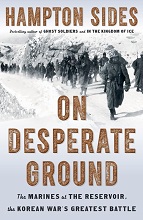
On Desperate Ground: The Marines at The Reservoir, the Korean War’s Greatest Battle – Hampton Sides

slidesOn June 8, 2020, the Democratic People’s Republic of Korea (North Korean Government) cut all lines of communications with the Republic of Korea (South Korean Government). Eight days later, an explosion destroyed the joint liaison building which had been used to host meetings between the two governments. The bombing was instantly seen as an act of aggression by North Korea and prompted a sharp response from its South Korean counterpart. Fears of an armed conflict gripped neighborhood countries as tensions continued to rise. Many eyes in both China and the United States were watching for the events very well could have led to the re-ignition of the Korean War (1950-1953), a conflict that never officially ended. I am constantly amazed at the expressions of surprise people display upon learning this fact. It seems surreal but the fact is that the Korean is still an “open” conflict that is only contained by the 39th Parallel and the watchful eyes of several foreign countries over North and South Korea. The war itself is often reserved for military buffs and overshadowed by both World War II and the Vietnam War. However, the reality is that the conflict in Korea nearly evolved in World War III. Author Hampton Sides is here to tell us about the role of the United States Marines and their experience in the Battle of the Chosin Reservoir.

When the North Korean army under the command of Kim Il-Sung (1912-1994) invaded South Korea on June 25, 1950, the United States came to the aid of its ally and engaged the North Korean army in fierce combat. As the conflict intensified, President Harry S. Truman (1884-1982) turned to the legendary Gen. Douglas McArthur (1880-1964) to assess the situation in Korea. Assured that the North Koreans could not win and would beaten back shortly, Truman breathed a sigh of relief. McArthur in turn, looked to the military to handle the growing need for combat troops. And the time had come for the United States Marine Corps to show what it was made of.  Under the direction of Gen. Oliver Prince Smith (1893-1977), the First Marine Division was dispatched to aid South Korea and push the North Koreans back to Pyongyang. The landing by the First Marine Division and steady advance of infantry soldiers had nearly everyone convinced that Korea would be a short campaign that would barely last several months. But America soon learned that there was more to meet the eye and the People’s Republic of China under Chairman Mao Zedong (1893-1976) would leave its mark on Korean soil and the minds of the Marines who survived hell on earth.

Several individuals in the Marines’ chain of command were confident that the Marines would face little resistance as they marched across Korea. General Edward Mallory “Ned” Almond (1892-1979) as among them and pressed his subordinate Gen. Smith to advance and continue pushing the North Koreans back all the way to their capital city.  Almond makes several appearances in the story and on occasion proves to be nearly as dangerous as the Koreans the Marines were fighting.  The mission starts off well until the Marines make a shocking discovery and learn that the Chinese military has come to the aid of the North Koreans.   The realization that China had now entered the conflict sent shockwaves through Washington. It was seen as the biggest intelligence failure in recent memory. But was it really a failure? Hampton Sides explores the issue and what he explains just might cause some readers to shake their heads in disbelief.

The conflict that had started out as a fast moving campaign had now turned into a diplomatic and military nightmare on both sides. Marines found themselves embroiled in fierce combat and began to realize that their mission was by no means “simple”. The tide had now turned and Korea became a hotbed of savage combat. The battles scenes come back to life in the book and we are provided with a ring-side seat as the Marines are forced to fight opposing troops and a winter climate that nearly renders them completely immobile. The words of the veterans who lived through the war are included here and it can easily be seen that many years later, they are still the proud Marines they were in the early 1950s.

General Smith knew that the conflict would rage longer than Washington wanted and decided that the base of operations would be located in Hagaru, the only space in the Reservoir that could accommodate an airstrip which would desperately needed to bring in supplies, troops and evacuate casualties. The Marines had been given their orders to push forward into the Chosin Reservoir and destroy the enemy.  And in the process, hundreds of young Marines were sent to a place of no return.  Waiting in the distance for them was Mao’s Red Army whose only goal was to kill Americans.  The Marines’ entry into the depths of the Reservoir and actions of Mao’s army are the focus for the second half of the book in which we see the Marines faced with tough decisions with very little time as wave upon wave of Chinese soldiers advanced on American posts. The fighting is savage and some of the soldiers we meet do not ride off into the sunset. Their ordeal is a sobering reminder that war is hell, Marines fight and they also die. However, the threat of death does not stand in their way and they come to life when needed in a nightmare that must seemed like a welcoming party for entry into Valhalla.

Commanders at X Corps soon realize that the Reservoir is a natural trap and the Chinese have severed key arteries that facilitate the movement of troops and supplies. The Marines are literally surrounded and must get out of the Reservoir. But the task is easier said than done and time is of the essence. The final part of the book is devoted to the controlled and strategic withdrawal by the Marines back to South Korea. And this is by far, the most uplifting part of the story as the battle-hardened troops rotate back to South Korea in route to the United States. But none of them would ever forget the Reservoir and how it became a death trap for the Marines taking on the communist threat from North Korea and China.

There are those who feel that the Reservoir was nothing short of a debacle. While it is true that the Marines suffered heavy losses, Mao’s Red Army fared just as bad if not worse. The battle is important not because of a win or loss but the psychological effect it had on the troops that served and in popular opinion. The full story can be found inside in this book which will surely delight students of history that have always wanted to learn more about an often forgotten war in America’s past. Highly recommended.

ASIN: B078VWRSXM

The General vs. the President: MacArthur and Truman at the Brink of Nuclear War – H.W. Brands

On June 25, 1950, 75,000 soldiers from the North Korean People’s Army marched across the 38th Parallel and into the Republic of South Korea.  In the wake of World War II, the country had been split between the Communist North under Kim Il-Sung (1912-1994) and the Democratic South under Syngman Rhee (1875-1965).  The 38th Parallel served as the demilitarized zone between the two nations and remains in place to this day.  In response to the growing North Korean advance, South Korean Troops with the assistance of the United Nations and the Unite States, mounted a counter-offensive to repel the invasion.  As a tactical measure, President Harry S. Truman (1884-1972), appointed Gen. Douglas McArthur (1880-1964), to lead the resistance against the communist advance.  As the conflict unfolded, Korea became ground zero in the struggle for peace and a pawn in the brewing Cold War between the United States and Soviet Union.

The North Korean advanced surprised the South but the tide of the war was soon turned as American troops marched on and captured Pyongyang.  To all it seemed as if the conflict would soon be over and for Syngman Rhee, it appeared that his dream of reunification would come to pass.  However, in October, 1950, all of that changed as the Chinese People’s Liberation Army crossed the Yalu River, lending their support to North Korean troops.  In Washington, alarm bells sounded and it soon became known and accepted that the Korean War would not a “short” conflict.  Instead, the war nearly turned into World War III and the world found itself on edge wondering if the United States would once again use an atomic weapon.  Behind the scenes, Washington was doing its best to remain calm while avoiding another world conflict while its top commander in field was doing the opposite.  This their story, told beautifully by H.W. Brands in this book that it sure to leave you astounded.

Truman, largely unpopular across the country, finds himself at odds with the most popular general in America.  To the public, McArthur was a legendary figure beyond reproach, committed to the safety of the United States at home and around the world.  To the White House, he was a rogue soldier, interfering in foreign policy and possibly providing the spark that would ignite the next world conflict through public statements and unauthorized expansion into Chinese territory.   To understand these two powerful and dynamic figures, it is necessary to understand their backgrounds. Brands provides a brief autobiography of the two, giving readers a complete picture of each and their importance to the story at hand.   As the war rages, they take their place as opponents in a power struggle that coincided with the loss of large numbers of U.S. military personnel and a Congress salivating at the thought of punishing the White House for what it believed to be unauthorized military action on foreign soil.  

The book is written in a thoroughly engaging style and once I began I could not put it down. Readers familiar with the Korean War from either reading about it or living through it will recall many of the facts in the book. But where the book excels is in its deep analysis of the battle between Truman and McArthur, and the political maneuvers occurring in Washington to prevent Chinese escalation, retain the territory of Formosa  and possible involvement by the Soviet Union.   Some parts of the book are absolutely chilling and the late Franklin Roosevelt (1882-1945) is vindicated in his belief that McArthur was at that time, the most dangerous man in America.   Brands includes quotes directly from the central players, giving the book the authentic feel that is has.  It is not simply the author telling the story, but the major players giving their side of the story.  And through their words, we can come to understand McArthur’s belief in his actions which could have escalated the war and the administration’s response in relieving him of his command and substituting him with Gen. Matthew B. Ridgeway. And the result is a roller coaster ride that begins with a Korean invasion and ends with an armistice under President Dwight D. Eisenhower (1890-1969) and the downfall of a military legend.  Truman did not seek reelection but remained a powerful voice in American politics up until the time of his death.

It will soon be sixty-five years since the armistice was signed, and the 38th Parallel continues to be a source of tension between North and South Korea with both sides on high alert at all times for possible escalation and even invasion. The story of the two Korean nations is a long and tragic story, beginning with occupation by the Japanese military during World War II.  The division of the country by the Soviet Union and the United States was a scene that played out in many nations following the defeat of the Axis powers.  Peace became a central goal across the world but in 1953, North Korea decided that there was more at stake than civility.  But due to the efforts of leaders who understood the dangerous nature of the conflict, the world was given a brief reprieve until the United States and Soviet Union once again clashed during the Cuban Missile Crisis in October, 1962.  That conflict would also be resolved, due in part to the efforts of the administration of President John F. Kennedy (1917-1963). 

The story here is at times mind-blowing and shows just how close the world came to Armageddon.  There were no scripts and the central figures were not actors on a studio in Hollywood.  The events were frighteningly real and if we are to prevent future conflicts from going down the same path, we owe it to ourselves to remember the conflict by use of books such as this one by H.W. Brands.  Those who are students of history and in particular the Korean War, will thoroughly enjoy and appreciate Brands’ work. 

ISBN-10: 0385540574
ISBN-13: 978-0385540575


This Kind of War: The Classic Military History of the Korean War-T.R. Fehrenbach

rokIt is sometimes called the forgotten war, the conflict which remains in the background as World War I, World War II and Vietnam take center stage as the wars that defined the United States Military and U.S. foreign policy.  Unbeknownst to many Americans, the Korean war never officially ended.  An armistice was signed on July 27, 1953 bringing a halt to the firing from all sides. But the armistice did not permanently resolve the conflict and to this day the 38th parallel, instituted after World War II, remains as the dividing line between the Communist North and the Democratic South.  Recently, U.S. President Donald J. Trump attended a peace summit with the leader of North Korea, Kim Jong Un.   Washington claimed the summit a success but only time will tell if the Korean War will officially come to an end and peace is finally obtained.  For veterans of the conflict, feelings run deep and mixed thoughts on the summit are bound to exist.  Two years ago, a veteran of the war close to my family died after several years of declining health.  Curiously, he never spoke of the war, preferring to keep his thoughts and feelings to himself for more than 50 years.   And as he went to his grave, he took with him, knowledge of the war and memories that most people would never want to have.  But the questions still remain, what caused the conflict and why did war wage for three years? Furthermore, why did the fighting eventually cease?

Author T.R. Fehrenbach (1925-2013) served in the Korean War and was later head of the Texas Historical Commission.  In 1963, this book was published, ten years after the fighting had ceased.  His memories are crisp and the reporting second to none.  He takes us back in time as history comes alive, letting us step inside the war beginning those fateful days in June, 1950 when the North Korea People’s Army invaded its southern neighbor.  Under the direction of Kim Ill Sung (1912-1994),  North Korea initiated the opening salvo in a war that claimed over two million lives.   News of the invasion sent shock waves through Washington and President Harry S. Truman (1884-1972) was faced with a decision that would change the course of history.  On June 30, 1950, he ordered ground troops into South Korea to assist the Republic of Korea Armed Forces (ROK).  At the time no one could have imagined what lay in store.

From the beginning the story pulls the reader in as Fehrenbach recounts the Japanese occupation of Korea and the long-lasting effects of Japanese rule on Korean society. In fact, to this day, influences of Japanese culture can still be found in Korea.  Following the falls of the Japanese Army in World War II, Korea found itself in a position to chart a new course.  But similar to Germany and Japan, the country became a pawn in the chess match between the United States and the Soviet Union.  Unsure of what to do with South  Korea, the nation remained in a vulnerable position until the North made its move.  And once the fighting began, the speed picked up and refused to die down.  North Korean and U.N. forces lead by the United States, engaged in deadly combat that saw casualties climb exponentially on both sides.  but what was clear from the beginning as we see in the book, is that Korea was an entirely new type of conflict for America.

Savage is the adjective that comes to mind to describe the fighting between opposing nations and ideologies.  Beyond brutal, the Korean conflict was akin to hell on earth for all of its participants.  And just when we think that the war might swing in the favor of the U.N. forces, the war takes a darker and more dramatic turn as the People’s Republic of China enters the fray changing the scope and the rules of the Korean War.  At the time China enters the story, the fighting has already claimed thousands of casualties.  But it is at this point that the battle reaches a higher and more deadly level.  Quite frankly, the world stood on the verge of the next holocaust.   Today we know that did not happen.  But why? America had the troops and the money to fund the war but what was it that held back the United States from entering into a full-scale ground assault?  The answers are here and this is the crux of the book.  Following World War II, American attitudes towards war began to change and Korea was the first testing ground for the gaining influence of politics over armed conflict.

What I liked most about the book is that aside from the statistics of casualties and the descriptions of the deaths that occur in the book and POW internment camps is that Fehrenbach explains how and why events progressed as they did and also why Washington was committed to fighting on a limited scale.  The fallout from the atomic bombs dropped on Japan was still fresh in the minds of nations across the world.  President Truman gave the order to drop the bombs and I believe no one doubted his willingness to use them again if necessary.   Whether he would have eventually given the order is unknown as his time in office came to an end and Gen. Dwight Eisenhower succeeded him.  But for the new president, the conflict still raged and opinion towards the war had become negative.  And while peace did come during his term, the body count climbed up until the very last day.

The story of the Korean War is one that is rarely mentioned in textbooks and never discussed today.   But this book by Fehrenbach truly is a classic study of the war.   In a meticulous and chronological order, he tells the story from start to finish and along the way, incorporates relevant parts of American society and world history into the story.   Although not a “textbook” in the classic sense, the book very well could be for it gives a concise explanation for the causes and effects of the war and how it was eventually resolved. If you are interesting in expanding your knowledge of the Korean War, this is the perfect place to start.

ISBN-13: 978-1574883343
ISBN-10: 1574883348
ISBN-13: 978-0028811130
ISBN-10: 0028811135
ASIN: B00J3EU6IK