Blood and Treasure: Daniel Boone and the Fight for America’s First Frontier – Bob Drury and Tom Clavin

In two weeks, the United States will celebrate Thanksgiving Day, with family dinners, the National Football League on television, and memories to last a lifetime. History books used in schools long held the notion that the meetings between Native Americans and European settlers were harmonious and full of warmth. The image its projects is heartwarming and removes the dark truth behind a clash of cultures which saw horrific violence, death, destruction, and the extinction of Indigenous people. Settlers courageous enough to venture in unsettled areas faced life or death decisions daily, and in some cases, they paid the ultimate price for their curiosity. Among these settlers in search of new territory was Daniel Boone (1734-1820), a frontiersman who is credited with westward expansion resulting in the settlement of what is known today as the State of Kentucky. This book is a discussion of his life and the turbulent continent of North America by authors Bob Drury and Tom Clavin. And to call it eye-opening would be an understatement. This book is must-read.

Boone’s name is known in American history. However, the full story is far more complex than the snippets provided in textbooks. The story told here is not a “feel good” account but a raw and unfiltered look at hardships of life during the 1700s and the deadly battles which raged as white settlers pushed further west. I must warn readers that this book is vivid, containing graphic descriptions of battlefield injuries and post-mortem desecration by both Native Americans and the new explorers. Scalping is a well-known custom of Native tribes but the extent to which remains were altered surpasses the depravity of the head wounds one would receive on the losing end of a conflict. Boone would come to have his own experiences battling Native tribes but before we reach the part of the book where blood is spilled, we are provided with a recap of the Boone family and Daniel’s upbringing.

A sizeable portion of the story takes place before the creation of the United States of American on July 4, 1776. Of course, the war is discussed, but it is a back story to Boone’s account. The North America examined by the authors was a land of open territory home to Native Americans. However, the Indigenous people who lived here had a vastly different view of land, and this difference in cultures would set the stage for the bloody battles to follow. I had previously read books which focused on the American frontier and the expansion of the United States, and while those stories were eye-opening, this book is just as gripping, and there were sections of the story which gave me chills. 

As I read, I noticed that the version of Boone we have come to know is different from the real Daniel Boone. We see in the story that the real Danie Boone did not see himself as a folk hero but as a frontiersman with a deep understanding of the complexities of Native American tribes and the dangers of being captured by the Indians. Proof of this comes from Boone’s own ordeal following his capture by a Native Americans. The surreal story is revisited, and it provides us with an inside look at the experiences of people taken as property. Boone lived to tell his tale, but others did not. Grisly fates awaited those chosen for death, and those scenes rival the battlefield atrocities we learn of as the story progresses. And both the tensions and acts of vengeance increase tenfold through the Battle of Point Pleasant in 1774 and Battle of Blue Licks in 1782. Boone was not at the first battle, but the latter would have tragic consequences for Boone and his family. The role of Boone’s brother Squire (1744-1815) was a curveball I did not see coming and left me speechless. The same applies with brother Edward “Neddie” Boone (1740-1780). And at home was Boone’s wife Rebecca (1739-1813) who increases their family size repeatedly throughout the story. This is significant because the amount of time Boone and other explorers were away from home was extensive, and without the aid of telephones and other means of quick communication, information traveled slowly, sometimes taking months to arrive. Frankly, Rebecca was left at home and more than once believed Boone had died. Today it seems unthinkable but in the 1700s, this was the reality of life as an explorer.

Eventually, the American colonists declare war on their British rulers, and the movement for independence kicks into high gear. Although the story here does not focus on the war extensively, it is a factor in the story. Further, the settlement of Boonesborough comes into focus, and the showdown Boone has with Native American tribes lead by the Shawnee in September 1778. It is a pivotal moment in the story, and it help to cement his legacy in American history. Additionally, there are other figures in the story who were also in charge of campaigns against the native tribes, and their roles in the reshaping of North American should not be overlooked such as Richard Henderson, the man behind the ill-fated Transylvania Purchase in March 1775 and Brigadier General George Rogers Clark (1752-1818) of the Virginia Militia. 

Following the Treaty of Paris in 1783, the story winds down and Boone life enters the final stages in the 1820s. Surprisingly, for a man who experienced a staggering amount of physical and emotional pain, he lived longer than most of the people around him but never forgot the pain which came from the tremendous losses his family suffered as North America was engulfed by conflict. The United States Government eventually succeeded in claiming lands once inhabited by Native Americans, and in the process, many became victims of extinction. These dark chapters in American history should not be forgotten and when we give thanks for the lives we have, we should remember those who died in violent conflicts across the continent. Highly recommended. 

ASIN: B08BYC44VP
Publisher ‏ : ‎ St. Martin’s Press, April 20, 2021


Overland Railroad: The Green Book and the Roots of Black Travel in America – Candacy A. Taylor

In March of this year, my family and I embarked on a road trip to Maryland for a cousin’s baby shower. On Interstate 95, we made a couple of expected stops for hungry stomachs and full bladders. The rest stops were filled with people from all backgrounds, stopping briefly before continuing to destinations across America. Sadly, there was a time when rest stops looked completely different, and for non-white travelers, the interstate highway system was frightening and dangerous. Jim Crow was alive and strong, and across the nation, change was coming but at a slow pace. However, that did not stop millions of people from driving across America, and to aid black Americans, a useful tool called the “Green Book” provided information which could save one’s life. Author Candacy Taylor looks at the Green Book and how it aided black people brave enough to set out on a classic American road trip. 

I was familiar with the Green Book but admittedly, there was much I did not know. So, I made the purchase and started reading instantly. Before I continue, I should point out that this book may cause you to feel angry and feel a sense of outrage. I say this because today it is unconceivable to think that a person of Indian or Chinese descent cannot use a rest stop on an interstate highway because of how they look. But, several decades ago they would have been forced to suffer indignity and humiliation due to restrictive laws which enforce segregation, and the threat of violence from people determined to maintain a social order they saw as being right for everyone. However, the United States was changing, and the movement for civil rights continued to grow. But until legislation guaranteed equal rights, creative tools were needed to navigate society. 

The Green Book was the creation of Victor Hugo Green (1892-1960), a gentleman I knew little about before reading the book. Taylor focuses on his life which begins in New York City. Green had realized that the automobile was going to change America, and black motorists needed both help and protection on the road. In 1936, the first Green Book was born but that was only the beginning. In fact, the author takes us a long journey which focuses not only on the book for travelers, but America’s past and how discrimination affected its citizens. And what she discusses enhances the importance of the book.

Undoubtedly, there are dark moments in the story, but there are bright spots as well. In fact, both white and black Americans played a role in affecting change, and the importance of Esso (ExxonMobil) gas stations and the foresight of the Chrysler Motor Company should not be overlooked. The Green Book is paramount in the account, and the information it provided was invaluable. Imagine wanting to take a road trip but having no idea whether an area is safe because of your ethnicity or needing a restroom and having to use the woods or drive an extra one hundred miles miles because every sign you see says, “no colored allowed”. It seems surreal today, but it should be a reminder of the freedoms we take for granted.

The automobile changed life for millions of Americans, but it also introduced new challenges and dangers which took time to resolve and answer. However, as the author tells the story of the lifesaving book, there is another element to the picture that should not be overlooked. Black Americans began to purchase automobiles, and it was a step up in class. But it did not go unnoticed and the reaction to upward mobility of blacks is a crucial aspect of the Green Book story and shows that America was not only confronting the issue of race but also the issue of class. Further, World War II had opened a door for blacks which they were determined to walk through. It should be noted that there were black people who did not want integration, but not for reasons one may suspect. 

Today, most of the locations in the Green Book are gone, and the book itself has been long out of publication. Its demise is due to several factors, and one adds a twist of irony to the initial need for it. Although the book is now gone, its role and importance in the lives of black people traveling America’s roads will never be forgotten. And if we continue to move forward, we will never need the Green Book again. But to do that, we must always remember where we came from and how far we have progressed. This book fills in the gaps that may be missing for some. 

ASIN ‏ : ‎ B07QDK1MFD
Publisher ‏ : ‎ Holiday House, January 28, 2020

The Assassination of Maurice Bishop – Godfrey P. Smith

Maurice

The 1980s was a decade unlike any other, both positive and negative. Hollywood had reached its pinnacle with movies that became eternal classics, the Soviet Union began its decline, NASA experienced a tragedy that haunts us today, and change was rapidly occurring around the world. The Caribbean island of Grenada had a population of less than 100,000 people in the month of October 1983. It is seen as a small island. But on October 19, 1983, that island made news around the world when the leader of the ruling New Jewel Movement (“NJM”), Maurice Rupert Bishop (1944-1984) was assassinated along with several others in a violent coup which plunged the country in chaos and resulted in the deployment of United States Marines by United States President Ronald Reagan (1911-2004). The involvement of American troops has overshadowed the events leading up to the events on October 19. But in order to understand Bishop’s downfall and its aftermath, a discussion regarding the events leading up to the tragedy is necessary. Godfrey Smith, a Belizean journalist, revisits the death of Bishop and the political climate in Grenada, in this book which is both informative and chilling.

Godfrey’s book is less than two hundred pages, but its contents tell a story that gave me a new perspective on the events in Grenada during that time. From the beginning, there is a dark omen over the story due to a meeting of the Central Committee which would have extensive ramifications. However, the subject of the meeting does not appear at first to be something that should have resulted in the death of Bishop and others. But a sad reality is that power is seductive and it corrupts. In the meeting of the Central Committee it is suggested that Bishop shares the duties of leader with Bernard Coard, second in command. The meeting expands into criticism of Bishop’s ruling style, but the matter is put on hold as Bishop wants to think about the party’s future and obtain Coard’s input. Coard was not present, and the talking is done by others. But this meeting would set into motion a chain of events that brought Grenada to the brink of anarchy.

Before we reach the fallout in October 1983, Godfrey provides a short biography of Bishop’s life and his rise in politics. It is a fascinating story, and easy to see why Bishop became the people’s favorite. However, he had his demons like other leaders. We learn of Bishop’s nonchalant manner in handling party issues, and his philandering which became an issue as his personal life became more complicated. His weaknesses provided the pretext needed for subordinates to usurp his authority. But they were not serious enough for death. The question that arises in what happened that caused the Central Committee to remove Bishop by force? The answer partly lies in a trip abroad that should have been routine.

The NJM had established itself as a left-wing government. Further, it had formed closed relations with Caribbean neighbor Cuba through its President Fidel Castro (1926-2016). This should come as no surprise because the NJM was based on Marxist-Leninist ideals and naturally aligned itself with nations founded on similar principles. But Washington was watching closely, and Bishop’s growing ties to Castro did not go unnoticed at home. In fact, as we see in the story, it backfired with deadly consequences. It also raised the issue of how much influence Cuba should have in Grenada’s affairs. Internally, Bishop’s avoidance of the bi-lateral power sharing agreement, planted the seeds of doubt in the minds of people who believed he needed to be removed. The fear of a tyrant was fresh in their minds due to the removal of a former president whose name is rarely mentioned in world history.

As a backstory to the fallout between Bishop and party leaders, we learn of the toppling of Prime Minister Eric Gairy (1922-1997) who was viewed as a dictator. For readers unaware of Gairy’s reign, this is a good primer. Of course, the full story is far more detailed, but for the purposes of this book, the amount of information is sufficient to set the stage for Bishop’s future battle within his own party. His trip abroad which included a visit to Cuba, set the stage for the conspirators to enact their plan. And when the party does meet with Bishop who is reluctant to change the power structure, we see the writing on the wall. A secret meeting without his knowledge proves to be a warning that something was not right. The moment we are waiting for eventually comes when Bishop and others are detained. But the conspirators did not anticipate that the people of Grenada loved Bishop and would not tolerate his incarceration on trumped up charges.

When the people learn that Bishop has been arrested, all hell breaks loose in Grenada. He is eventually freed and retreats to Fort Rupert along with the other officials unjustly detained. At first it seems as if Bishop will prevail, but this location would prove to be a scene of horrific events that are haunting. I must warn readers that the decision to seize the fort and capture its occupants is graphic. Frankly, it was nothing short of murder. As I read, I felt a sense of loss at Bishop’s death and how callous his executioners were in ending the lives of Grenadian officials. It is by far, the darkest moment in the book and I can only imagine the grief felt by Grenadians on that day. In Cuba, Castro was following the events, and his prophetic warning about U.S. involvement was about to come true.

The deployment of U.S. Marines has been labeled an “invasion”. It is true that battles did occur between the U.S. military and Grenadian army, but order was restored, and the October 17 group consisting of those who led the coup against Bishop received their comeuppance for what happened. The author explains the result of the arrival of U.S. troops and trials of conspirators. Today, those who survived their prison sentences are still alive, but they carry with them the memories of October 19, and the insanity which occurred. Bishop’s demise was tragic, and its impact was significant. It is further complicated by the controversy surrounding his grave which has no marker. Readers who find this book enjoyable, should take a look at a Washington Post podcast called ‘The Empty Grave of Comrade Bishop‘ by host Martine Powers. It is a fascination series of episodes which take a deep dive into the life of Maurich Bishop and the island of Grenada.

ASIN ‏ : ‎ B08JF29K7G
Publisher ‏ : ‎ Ian Randle Publishers (September 16, 2020)

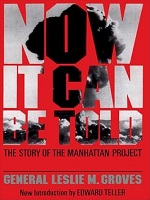
Now It Can Be Told: The Story of the Manhattan Project – General Leslie R. Groves

grovesOn May 8, 1945, Allied forces celebrated Victory in Europe Day (V-E Day) marking the surrender of the German armed forces in World War II. In the Pacific, the war against Japan continued to rage forcing Allied commanders to face the grim reality of a ground invasion which became the basis of the proposed Operation Downfall. The invasion would have resulted in a large number of casualties on both sides but ending the war was priority number one. Unbeknownst to troops in the field, Washington had been working diligently on a new weapon that had the potential to end the war. On August 9, 1945, the United States Air Force executed a mission which dropped the atomic bomb named “Little Boy” on Hiroshima, Japan. Three days later on August 9, “Fat Man” was dropped on Nagasaki. The impact was devastating and on August 15, 1945, Japan surrendered, bringing World War II to an end. For those who worked on the Manhattan Project, the success of the bombs was both a blessing and a curse. But no one could deny the hard work and dedication which turned the project from a vision into a reality. And here to explain how it came into existence and succeeded is Gen. Leslie R. Groves (1896-1970), the man in charge.

If you have seen the film ‘Oppenheimer‘ starring Cillian Murphy as the famed scientist, you will recall Groves who is played by Matt Damon. The film was a hit and the type of production we have to expect from director/filmmaker Christopher Nolan and brilliantly captured the suspense and uncertainty surrounding the creation and testing of the bomb. And although the film does not portray the events which conclude World War II, it brought the past to life as the American military and scientists found themselves in a race against time. Groves wrote this book in 1962 ,and the Kindle version was republished in 2009. The story of the project is far more complete today, but Groves’ account is still a fascinating look into the magnitude of the project and secrecy required to ensure its success. But it was not without its challenges.

Groves starts at the beginning when the project receives the green light and is placed under his control. He had been given an assignment but needed to assemble the manpower to get it done. Step by step, he covers the coordination and the factors which went into each decision. There are interesting revelations, and the initial challenge with the enrichment of Uranium at Oak Ridge, Tennessee, highlights the complexity of atomic energy which confronted the scientists. Further, the various hardware components presented their own logistical challenges, but Groves was committed to his assignment, and he thoroughly explains how problems arose and were then resolved. However, the biggest challenges they faced were espionage and maintaining absolute secrecy.

In hindsight, we know that there were spies in Los Alamos. Groves discusses this and in particular, the betrayal by German theoretical physicist Klaus Fuchs (1911-1988) who supplied nuclear secrets to the Soviet Union. There were other threats as well, and Groves explains the need for stringent security and secrecy, even from members of Congress. In fact, on more than one occasion in the book, an issue with a curious politician becomes a threat to the project’s operation. The project was not exposed publicly but  the incident heightened the anxiety of those involved. In regard to the people selected to work at Los Alamos, the groups of people who lived there during the project’s duration endured upheaval in their personal lives which has gone unnoticed. Groves pays close focus to the role of women at Los Alamos and how essential it was to assist those who were not in the military and expected to endure unusual living conditions. But while America was protecting secrets at home, it also needed to know if Germany was building a bomb of its own.

World War II historians will be familiar with the name of U.S. Army Counter Intelligence Officer Borish Pash (1900-1995). To say that he was responsible for one of the most important missions of the war would be an understatement. His role and that of the Alsos Mission were critical to America’s success and the Groves provides the goods. The story is incredible and highlights the lengths to which Allied forces went to bring down the Axis powers. Pash’s name is forgotten today but his role in World War II should never be overlooked. Groves pays homage to him and cements his legacy as he explains the importance of the Alsos mission and how it changed the outcome of the war. The intelligence operations in Germany also revealed the scope of the Third Reich’s attempt to harness nuclear power and its intended use. The German scientists captured by the Allied forces reveal interesting facts about Germany’s project in the story, but none proved to be smoking guns.

While the development of the bomb moves forward, Groves also has to contend with the sharing of intelligence with America’s allies Britain and France. The matter was complicated, and the author explains the difficulties they faced in safeguarding the secrecy of the project while maintaining strong ties with the countries supporting the Allied mission to win the war. As readers will learn, even allies can be a thorn in one’s side. And at home, tough decisions were made in regard to the amount of classified intelligence to be shared with foreign governments. But everything changes when the scientists inform military brass that they are ready for a test of the bomb’s efficacy.

The military needed to evaluate the bomb, but where? Groves explains the debate surrounding a testing site and the decision to conduct it at the Alamogordo Bombing Range known as Jornada del Muerto. The suspense builds as the date approaches. Nolan’s film brilliantly captures the events surrounding the test and as I read, images from the movie crept into my mind. After building up to the moment of truth, the results come in and Groves’ first-hand account reveals the joy and horror found among the scientists. But the military had no time to waste, and the matter was brought before President Harry S. Truman (1884-1972) whose order to proceed changed history. The decision to drop the atomic bombs remains controversial and Groves is aware of that. His account is not a discussion on the moral aspect of its use, but rather the rush to end the war in the Pacific. And in order to use the bomb, the United States Air Force enters the story.

Both bombs were ready for use but arming and loading them on to an aircraft proved to be a logistical challenge as explained by the author. We know that the air force was able to load the planes and use the weapons but the movements behind the scenes were equally turbulent. This section in the book was intriguing, and Groves thoroughly explains the selection of targets, the difficulty with selecting the right aircraft and even the flight formation. Familiar names enter the story such as Gen. Paul Tibbets (1915-2007) and Gen. Curtis E. Lemay (1906-1990). All hands were on deck as Fat Man and Little Boy were put to use. The bombs were successful in forcing Japan to surrender, but the war had cost millions of lives around the world. The war was over but what happened to the Manhattan Project? Groves walks us through the war’s end and the shift of atomic energy from a military project to a government issue to be overseen by the newly created Atomic Energy Commission.

The book concludes as the war fades away, and there is no mention of the battle Oppenheimer faced with his opposition to further use of atomic weapons. Nolan’s film captures the saga which engulfed the famed scientist and there are articles online about it. But I would like to point out that while Oppenheimer was instrumental in the success at Los Alamos, we cannot forget the importance Dr. Vannevar Bush (1890-1974) who is a footnote to history.  He was far more important than is acknowledged, and Groves gives him his due here. It is often said that World War II changed the planet, and the effects of the war can still be seen today. In the spring of 1945, Allied commanders found themselves faced with the reality that ending the war would not be as simple as people thought. There would be more bloodshed and heartache to bring the Japanese empire to its knees. The developments at Los Alamos proved to be a necessary tool but its creation, usage and existence has continued to haunt us with critical questions which will be asked for an eternity. But if you want to learn about the Manhattan Project from the man who was in charge, this is it.

“In answer to the question, “Was the development of the atomic bomb by the United States necessary?” I reply unequivocally, “Yes.” To the question, “Is atomic energy a force for good or for evil?” I can only say, “As mankind wills it.” – Leslie R. Groves

ASIN ‏ : ‎ B009SC1LZY
Publisher ‏ : ‎ Da Capo Press (August 11, 2009)