The Last Founding Father: James Monroe and a Nation’s Call to Greatness – Harlow Giles Unger

On September 3, 1783, representatives of United States, Great Britain, Spain, and France signed the Treaty of Paris which officially concluded the American Revolutionary War and recognized the newly formed nation of former British colonies. The founding fathers of the United States soon realized that a monumental task lay before them, and they wasted no time in creating the country they had envisioned as the movement for independence gained momentum. Among the men whose vision shaped the America we know today was James Monroe (1758-1831) who served as America’s fifth president. Having outlived his contemporaries, he is accurately referred to as the last founding father by author Harlow Giles Unger who returns with another engaging biography of an American leader. 

I previously reviewed Unger’s biography of President John Quincy Adams (1767-1848), a book which I could not put down as I read the life story of an American figure who helped change the course of history. Adams makes an appearance in this book as well, when President Monroe entrusts him with tasks crucial to America’s development. However, the focus of this story is on Monroe and his incredible life. I approached the book with limited information on Monroe. In school, his name was remembered for the policy which bears his name, the Monroe Doctrine. The story behind Monroe’s 1823 congressional address in which he laid forth the doctrine’s goals is told within, providing readers with an inside look into the thought process behind the actions of the Monroe Administration. 

Monroe’s story begins in Westmoreland County, Virginia in 1758 as American patriots are beginning to question British rule. The growing young man bears witness to British encroachment, and when the war for independence begins, Monroe joins the Continental Army under the leadership of America’s first President George Washington (1732-1799). The two would go on to have a lasting friendship which is discussed by the author. Monroe also found company in mentor and fellow President Thomas Jefferson (1743-1826) who remains a close confidant of Monroe through the rest of the book following their initial acquaintance. Sadly, the same cannot be said of former President James Madison (1751-1836) whose friendship with Monroe took an unexpected turn. The details are contained within, and it is interesting to see the bonds between the men who were responsible for shaping the nation known globally as the United States of America. 

While Monroe was making a name for himself in politics, he also believed in family. He and wife Elizabeth (1768-1830) were deeply in love and she was equally effective at foreign policy as her husband. Her actions regarding the pending fate of Adrienne de La Fayette (1759-1807) in France will surprise readers. She is also remembered as an elegant first lady, and the reasons why are explained in the story. As for James Monroe, building America was paramount, and in 1803, he played a prominent role in the Louisiana Purchase which tripled the size the of the United States overnight. Readers interested in the deal will appreciate this section of the book as the back door dealings spearheaded by Monroe result in a land grab that is still shocking to this day. But while America was growing, England had not forgotten its former colonies, nor its conflict with France, and all hell breaks loose during the War of 1812. The buildup to the conflict is important and Unger explains the events thoroughly and at the right pace. The suspense is gripping, and readers will see the conflict looming in the distance as Europe becomes more unsettled. It would not be the last time that a war in Europe brought America into the conflict. 

Following the war, Monroe returned to the State Department, and in 1816 he makes a decision that changes his life forever when he decides to run for president. With hindsight we know he was successful, and the focus here is on his presidency and his accomplishments as commander-in-chief. However, there is the elephant in the room in every story of America’s early days and that is the issue of slavery. Surprisingly, there is not much about it in the book and early administrations sought to avoid the issue altogether. However, Monroe would be forced to confront the matter during the Missouri Compromise of 1820. Monroe’s position on the matter was unsurprising because he was a slave owner himself just as several founding fathers were. Monroe did see slavery as a threat to the future of the nation and realized that freedom could not exist with enslaved people, but he also reaped the benefits from being a slave owner and believed in the rights of pro-slavery states. He did endorse one plan to rectify wrongs done to African slaves, and it explains the existence of Monrovia, Liberia. The issue of slavery would be decided forty-five years later when the first Republican president did what no leader before him had dared to do.

After departing the White House, Monroe’s life returned to a sense of normalcy, but he faded away from public light and found himself to be a symbol of a bygone era in American history. His legacy had been cemented but the United States was on a new course, chartered by President Andrew Jackson (1767-1845) who remains one of the most controversial leaders in American history. His story is a roller coaster ride on its own and I strongly recommend Jon Meachem’s ‘American Lion: Andrew Jackson in the White House‘ which is a good source of information about Jackson’s command of the United States. As time passes, Monroe’s life changes and on July 4, 1831, he takes his final breath in New York at the age of seventy-three, leaving behind a legacy which shaped American foreign policy for years to come. If you are searching for an enjoyable book regarding America’s founding fathers, this biography of James Monroe will be a fitting addition to your library.

The most beloved president after Washington, Monroe was the only president other than Washington to win reelection unopposed.

ASIN ‏ : ‎ B002RBWF26
Publisher ‏ : ‎ Grand Central Publishing, April 8, 2025 
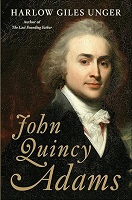
John Quincy Adams – Harlow Giles Unger

quincy

Every time I visit New England, I am amazed at the amount of history one can discover. My trips to Vermont, New Hampshire, Rhode Island, Maine, and Massachusetts have all left a mark as I learned more about the country in which I was born. However, there is still American history I have to learn, and when I saw this biography of former President John Quincy Adams (1767-1848), my curiosity piqued and I knew I had to read it. And what I found is a story every American should know, and we have author Harlow Giles Unger to thank for this remarkable biography of a president who is underrated.

Before starting the book, I was aware of Quincy’s time in office but my knowledge of his personal life and contributions to America’s development was in insufficient. I felt as if I was reading about him for the first time, which deepened my interest and enhanced my shock as I learned of his incredible life. The story begins in Braintree, Massachusetts in July 1767, when Quincy as he is known, is born to John Adams (1735-1826) and wife Abigail (1744-1818). His father served as the nation’s second president and was instrumental in his son’s personal life and political career. I noticed early in the story that Quincy had a strong bond with his parents which proved to be the foundation he needed throughout his journey. But the family was fiercely committed to education and self-improvement, themes which remained with Quincy for life.

Unger’s writing style kept me glued to the pages from beginning to end, and the narrative has an exceptionally smooth flow which maintains a steady pace as Quincy’s life moves forward. Within the first ten years of life, resistance against Britain intensified and culminated with the American Revolution for independence. The conflict, discussed in the book and witnessed by Quincy, had a profound impact on him. Although he was too young to fight the British, he witnessed the importance of independence and sacrifices by patriots resisting British rule. As he ages, the story shifts gears when he attempts to gain admission to Harvard. The saga surrounding his admission is interesting and resembles modern-day anxiety and struggles by students seeking entry into ivy-league institutions. In hindsight, we know he eventually did gain admission, and went on to complete law school. However, the legal field was not all it was thought to be but everything in the book changes when he is selected for government service by President George Washington (1732-1799).

Washington’s offer to Quincy to become America’s Minister to Holland, comes as a surprise but with the urging of his father, he accepts and embarks on a European journey that changes his life permanently. And while America had gained its independence, Europe was still embroiled in revolution and chaos. The unrest across the continent takes center stage, in particular France during the reign of King Louis XVI (1754-1793), who was overthrown and beheaded in 1793. Several years later, another ruler ascends to the throne and forces the world to recognize the name of Napoleon Bonaparte (1769-1821). He also appears later in the story as the United States expands to the south and west across North America. But there is another component to France’s story in the form of its raging war against England. I could not stop reading as the crisis plays out and challenges America’s foreign policy. What transpires is an eerie premonition of future events in which France requested United States involvement. There is also the issue of the British who have not forgotten the loss if England’s thirteen colonies. Their acts of aggression and the American response show how close we came to war with Britain for a second time.

During the period of 1974 to 1817, Adams traveled around Europe through government positions, and the details of each are too extensive to discuss here. The details are in the book and the stories are fascinating. He developed a lifetime of experience at a very young age but also found time for love which resulted in his marriage to Louisa Catherine Johnson (1775-1852) on July 26, 1797.  Their story is wholesome but the personal tragedies within the Adams family are heartbreaking. It seems for every success there was an equal tragedy which Quincy and Louisa are forced to confront. There are also issues within her family as well, emanating from her father Joshua who causes grief and chaos through his own financial failures. But destiny was waiting for Quincy and his return home in 1817 proved to be the change he needed.

In 1817, President James Monroe (1758-1831) chose Quincy to be his Secretary of State. This decision had monumental ramifications for Adams personally and the political landscape of America. His effectiveness  did not go unnoticed, and history buffs will instantly think of the Monroe Doctrine, which is discussed by the author. Quincy’s star continues to rise and rumors about a presidential campaign soon begin. Curiously, Louisa is not at all thrilled by Washington, and the description of the city by Unger leaves much to be desired. The physical state of Washington seems unthinkable today, but in the 1800s, it was the reality. In 1825, fate intervened, placing Adams in the White House for a single term. And instantly, opponents and opportunists move behind the scenes to secure their own political ambitions. It becomes clear that politics was never for the faint of the heart. The actions of Henry Clay (1777-1852) and John C. Calhoun (1782-1850) are questionable to say the least.

dams’ tenure in the White House is uneventful but opposing forces soon begin to form, throwing their weight behind Andrew Jackson (1767-1845). And it is here that we see the groundwork for the two political parties which dominate American politics today. Jackson is a controversial figure, and Adams was no fan. In fact, his comments about Jackson are similar to others who could not envision the “rascal” or “illiterate” in the White House. But that is exactly what happened. Quincy took his loss in stride but was far from finished with politics. And as a member of the House of Representatives he made his voice loud and clear as he argued for causes which lacked popular support.  I found this part of his story incredibly interesting and as it continues, Adams becomes more outspoken about his convictions which provoke censorship. His anti-slavery stance drew the wrath of pro-slavery congressmen and highlights the hotly contested matter of human bondage.

The outspoken congressman was forcing America to examine its moral fabric, and this won him more support than opposition. And as a gift from above, he finds himself involved in a legal case involving the Portuguese vessel Amistad, manned by slave hunters who had kidnapped Africans from Sierra Leone for transport to Cuba. Mutiny occurred and when it was over, the captain and crew lay dead. The slaves were arrested and sent ashore to the United States where they were tried in court. Adams takes up their defense and his legal training kicks into a high gear as he puts on a master class in what is known as oral argument in the legal field. Today it may absurd that a legal argument over kidnapped human beings was needed, but in 1839, slavery was both legal and encourage in parts of the world. The case and its conclusion cemented his legacy as a champion of human rights.

Behind the scenes, Quincy and Louisa go through their trials and tribulations with brief periods of distance. But she knew she could not keep him down. By January 1848, his health had significantly declined, but staying home was not an option. On February 23, he made his way to the Capitol as usual, but this day would not end like the others. In fact, what happened during the afternoon session left me speechless. But after reading the book, I could not see Adams departing any other way. He lived and died for the success and progression of the United States of America. Today he would be called “liberal” and “progressive” but in his time he was an advocate for the things we still debate today.  The amount of research required for this book could only have been staggering. The author’s beautifully compiled narrative is seductive from start to finish, and at no point in the book did I lose interest. I could not put it down and found myself eager to read more regardless of the time or location. If you are in search of a delightful book about an outstanding leader in America’s past, this is strongly recommended.

“It is of no use to discover our own faults and infirmities unless the discovery prompts up to amendment.”-  John Quincy Adams

ASIN ‏ : ‎ B008EMEH5A
Publisher ‏ : ‎ Da Capo Press (September 4, 2012)