
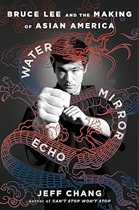
 During the short span of thirty-two years, martial arts expert and film star Bruce Lee (1940-1973) single-handedly changed the view we have of Asian action stars. His movements on camera left audiences speechless and his peers in awe of his speed and reflexes. His sudden death on July 20, 1973, sent shockwaves across the planet, and the void left by his departure has never been filled. I saw this biography by author Jeff Chang and knew instantly that I must read it. And having finished the book, I say with conviction that this is the Bruce I did not know. But I also have a deeper understanding of his trials, tribulations, and the complicated relationship America has had with immigrants from Asia.
We are introduced to Lee Hoi-Chuen (1901-1965) and Grace Ho (1907-1996), who have emigrated to the United States, making a home in San Francisco where their son Bruce is born on November 27, 1940. Bruce arrives as World War II is raging, and America has its Asian residents under surveillance as fears of Japanese sympathy have become a heightened concern. Chang explores the history of immigration laws aimed at Asian immigrants which range from highly restrictive to the complete exclusion of Chinese. The history is dark and includes facts that I was not aware of personally. However, I was aware the 1882 Chinese Exclusion Act which is by far the most shocking and disturbing piece of legislation. Today it seems unthinkable that such a law was passed but it happened and was official policy, extended through the Geary Act of 1924 before being repealed by Congress in 1943. This section of the book may be upsetting for readers, particularly those of Asian ancestry. Lee Hoi-Chuen and his family move back to Asia, settling in Hong Kong where Bruce’s childhood is on display. As I read, I could see his personality take shape complete with the tint of arrogance we see on scene, mischievous pranks, and the signs of a young man with enormous potential yet to be tapped into. There was one person who did see something in Bruce, and when he meets Yip Man (1893-1972), the Bruce we know begins to take shape.
The book shifts gears when Bruce is sent back to America, to comply with immigration law. And this is a part of his story which has been misunderstood for several decades. I have personally had conversations with friends who did not know Bruce Lee was born in the United States. Today we would call him an “anchor baby”, but American was his home by birth. He returns to the United States without his parents, and his life takes more twists and turns as he enters adolescence and confronts the realities of racial discrimination. We see the intimate side of Bruce as he moves from California to Washington State, makes friends, enrolls in college, falls in love and dives deeper into martial arts which becomes the center of his world. But the world-famous movie star is still years away.
When Bruce decides to begin teaching martial arts, the story becomes more interesting as his students are from all demographics. In fact, his first student and close friend may surprise readers. I smiled as I read the story and frowned when I read about Bruce’s moments when he feels down. Chang’s writing pulled me into Bruce’s life, and I could feel the emotions as the story moved forward. He also includes Bruce’s own words through journal entries, letters and comments to friends which help us form a complete picture of who he was and what drove him to success. There are two key moments in the book which take Bruce’s life in a different direction. The first major event in his life occurs when he meets Linda Emery who becomes one of the most important people in his life. The two married in 1964, but their relationship was complicated by several factors which Chang discusses. The second major event occurs in 1966, when the television show ‘The Green Hornet‘ premiers with Bruce starring as Kato. The show was short-lived, but it did get Bruce’s foot into the door of Hollywood. But the industry still struggled with Asian stars. Change dissects the problem of Hollywood and the section about the Charlie Chan films left me shaking my head. Frankly, it is a bad as “blackface”. Bruce is keen to this and understands that the film industry has a dysfunctional view of Asians.
Bruce’s purpose in life continues to take shape, but the book is haunted by his own premonitions that he would not live a long life. I was not aware that Lee had predicted his own early death. This sent chills down my spine and adds a sense of urgency to everything he does in the story. While teaching, he forms more friendships with Hollywood stars such as James Coburn (1928-2002), Steve McQueen (1930-1980) and Roman Polanski, which are important to his navigation of the entertainment industry. And the bond he had with basketball legend Kareem Abdul Jabbar is heartwarming. However, the stage is set for Bruce’s success when he decides to visit Hong Kong and meet with Raymond Chow (1927-2018), the president of Golden Harvest pictures. The two men envision a series of films to bring kung fu to audiences worldwide but have stiff competition in the Shaw Brothers Studio, a massive film empire created by brothers Run Run Shaw (1907-2014), Runme Shaw (1901-1985), and Runje Shaw (1896-1975). The cat and mouse game between the Shaws and Chow, over Bruce’s star potential plays out in the story and the success of the film ‘The Big Boss‘ (1971) only deepens the rivalry. For Bruce, it was a godsend because another aspect of his life hidden from the public is his financial struggles. In fact, there are several occasions in the book when the family is at rock bottom. But as Golden Harvest turned out films their fortunes improved and Bruce began to shape the film that cemented his legacy in film history.
As I continued reading, I was amazed at the difficulties Bruce faced in making ‘Enter the Dragon‘ which endures to this day as his masterpiece. The movie is all Bruce, yet producers still struggled with allowing stars creative control. Sadly, that issue exists today. But Bruce knew what he wanted to show on screen and explicitly stated so. Snippets of interviews he gave and heated discussions with studio executives confirm his commitment to changing the way audiences viewed Asian stars. In hindsight we know that Bruce prevailed, but we also see that physically he is in rough shape, and a back injury at home which is often overlooked may have marked the first stage towards his premature demise.
Following the success of the Big Boss, Bruce finally finds the stardom he had been searching for. But there is a dark cloud hovering over the story, and the stress and physical exhaustion become eerily apparent. On May 10, 1973, the alarm bells go off as Bruce has a severe medical incident on set requiring hospitalization. I felt a chill as I read of the confusion doctors had about his condition and the story gets much darker. Eventually July 20, 1973, arrives and it is Bruce’s last day alive. Chang approaches the end of his life with the right balance and sticks to what is known. Debates about how Bruce Lee died continue with conspiracy theories rampant. A detailed discussion of his death and the events of that day have been presented by the History Channel in a special which you can view on YouTube. After his death, I could feel the gravity of it while reading. The Bruce I came to know in the book was far more complex and misunderstood that I could have ever anticipated. And I understand the water mirror echo.
In the spring of 2023, the Tribeca Film Festival screened Enter the Dragon as part of a fiftieth anniversary celebration. The theater was jammed packed and we had a blast. After the film ended, the presenters that night surprised us with an in-person discussion with Angela Mao Ying who played Bruce’s sister in the film. It was a surreal moment and hearing her explain how Bruce selected her for the film and the friendship they formed stirred emotions both in the audience and on stage as Ying herself wiped away tears when discussing his legacy. Five decades after his death, he was as popular as ever and will remain an icon in pop culture. There have been imitators and rip-offs but there will never be another Bruce Lee. If you are a fan of Bruce Lee and curious about his life, this is the book you must read. I cannot recommend it enough.
“I have already made up my mind that in the United States I think something about the Oriental, I mean the true Oriental should be shown”. – Bruce Lee, The Pierre Burton Show – 9/12/1971
ASIN : B0DR8B82SZ
Publisher : Mariner Books, September 23, 2025
 FREETHINKING BIBLIOPHILE
You must be logged in to post a comment.