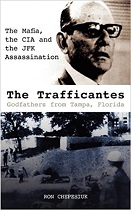
The Trafficantes, Godfathers from Tampa, Florida: The Mafia, the CIA and the JFK Assassination – Ron Chepesiuk

trafficante

The official story put forth by the Warren Commission is that President John F. Kennedy (1917-1963) was shot and killed by Lee Harvey Oswald (1939-1963) who fired three shots from the Texas School Book Depository in Dallas, Texas on November 22, 1963. However, Oswald’s guilt has long been in doubt and in 1976, the House Select Committee on Assassinations found a “probable conspiracy” in Kennedy’s murder. Some believe that the conspirators included members of the Italian American Mafia, notably mob bosses Santo Trafficante, Jr. (1914-1987) of Florida and Carlos Marcello (1910-1993) of New Orleans, Louisiana. We know for certain that Oswald was at the Book Depository as the assassination happened. However, events that played out following the shooting in Dealey Plaza indicated a darker and more sinister climate of danger that awaited Kennedy as he stepped off Air Force One at Love Field that morning. It is no secret that mobsters were not fans of Kennedy or his brother, Attorney General Robert F. Kennedy (1929-1968). But did the mob have the power to kill the president? Author Ron Chepesiuk explores this question and more in this short book about the Trafficante family and the role the mob may have played in Kennedy’s death.

Believers of the lone gunman theory will not entertain any theories about the mob, CIA, or others. And for good reason. If we do believe the mob was involved, then a conspiracy exists. However, the mob did have motive, and that aspect is addressed in the book. But before we get to the Kennedy assassination, the author primes us with background information on Trafficante and his father Santo Trafficante, Sr. (1886-1954) who were the undisputed rulers of the Tampa underworld. The book is not an extensive biography of the father or son but provides basic information to understand who they were. But what is of more interest are the connections between them and other underworld figures, and this is where the plot thickens.

Because the book is short, there is a lot of information that is highly condensed. Readers may benefit from other material on the Kennedy assassination, and I always recommend the late Jim Maars’ (1943-2017) ‘Crossfire: The Plot That Killed Kennedy‘ which provides a thorough analysis of the shooting in Dealey Plaza, the death of Dallas Police Officer J.D. Tippit (1924-1963) and numerous other components of the crime that will send chills down your spine.  Chepesiuk’s story is solely on the Mafia, but he does mention other players when necessary.  However, the story here remains centered around the Trafficantes, Marcello and the nexus of underworld crime figures who welded power in America. There are no “smoking guns”, but I did notice that anyone expected to appear before the House Select Committee on Assassinations seemed to meet a sudden death. Appearances are made in the story by Chicago mobster Salvatore “Sam” Giacana (1908-1975) and mobster Johnny Roselli (1905-1976). Their stories are surreal, especially Giancana’s direct link to Kennedy.

It is impossible to discuss the mob’s anger at Kennedy without acknowledging the impact of former Cuban President Fidel Castro (1926-2016). Prior to the Cuban Revolution, the Mafia had turned Cuba into a cash machine and playground for Americans looking for a quick getaway to have fun. Former Cuban President Fulgencio Batista (1901-1973) had allowed the mob open reign but on January 1, 1959, that all changed as Castro marched triumphantly down the streets of Havana. Mobsters who had the means to do so, left as soon as they could. But Trafficante Jr. had an interesting experience in Cuba which I had forgotten about. It is telling of what Castro through of the mob and sets the stage for the future alliance between the CIA, Mafia, and disgruntled Cuban exiles. Castro was serious and the only way the mob could enjoy Cuba was if the bearded leader were gone. This is the beginning of a dark rabbit hole which we cannot go into here. But the author gives us an idea of the sinister partnerships that existed for “mutual benefit”.

There is one more section of the book I want to address, as no discussion of Kennedy’s murder can be held without addressing the dark presence of Jack Ruby (1911-1967), whose actions that weekend following the assassination were strange to say the least. The Warren Commission insisted that Oswald and Ruby did not know each other. But is that the truth? As seen in the book there is compelling evidence that they did know each other, and I recommend readers watch the documentary ‘Rush to Judgment‘ by the late Mark Lane (1924-2016) who published the book of the same name.  Ruby’s mob connections cannot be ignored, and the author weaves them into the story at hand showing that powerful figures were watching Oswald.

The truth about Kennedy’s murder may never be known. And if it is, maybe not in my lifetime as author Anthony Summers says in his book regarding the murder.  Thousands of pages of records are still classified, and as time passes, those with knowledge of what did happen will pass on taking what they know with them to the grave. But I do believe that we have enough information to know that Oswald was only a small piece in a larger puzzle. The mob certainly wanted Kennedy gone and benefited from his death. It had the money and power, but to a certain extent. Removing a president from office is a concerted effort dependent on compartmentalization, a concept the Mafia knew well. The list of Kennedy’s enemies was long, and his death was nothing short of regime change. The mob was only one enemy, and its role is still up for debate. But what Chepesiuk shows is that the mob had a personal stake in seeing Kennedy eliminated. For a good understanding of the powerful crime figures who had turned sour on Kennedy, this is an informative read.

ASIN: B003BIGGQA
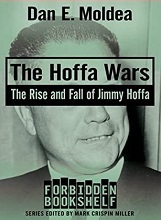
The Hoffa Wars: The Rise and Fall of Jimmy Hoffa – Dan E. Moldea

Hoffawars The disappearance of James Riddle Hoffa (1913-1975) still captivates audiences as shown by the success of Martin Scorcese’s The Irishman starring Robert Dinero as Frank Sheeran (1920-2003) and Al Pacino as Hoffa.  The film shows Scorcese at his best but the story told by Sheeran is known to be full of discrepancies.  Further, the Federal Bureau of Investigation (FBI) has never acknowledge Sheeran as being one of Hoffa’s killers.  Putting that aside, the movie is done very well and one of the rare times when Robert Dinero and Pacino have appeared on screen together.  But there is far more to the Hoffa story that is typically remember because of his fall from grace and disappearance on July 30, 1975.  I personally do not believe his body will ever be found and those who know what happened to him are either deceased or taking that secret with them to their graves.  However, in examining the Hoffa case,  we can focus on why he was killed which is just an important as how he might have been killed.  Dan Moldea has spent years covering the Hoffa case and is considered to be one of the best sources of information on the former leader of the International Brotherhood of Teamsters (“the Teamsters”).  And the result is a spellbinding story that peels the layers back uncovering a story that is nothing short of clash of the titans. 

I find that even today there is still a lot of confusion regarding the Teamsters and what exactly did happen when Hoffa was in power. In the preface to the book, we get a fitting summary that sets the tone for what is to follow:

“The Hoffa Wars tells an important story: how a potentially great force for good—the unionization of America’s truckers and warehouse laborers—was captured by gangsters and converted into a monster that robbed its members of their right to a fair wage and pension, robbed businessmen of their right to a free marketplace and clamped a high tax on American consumers every time they went to the cash register.”

When I first read these words, I admit that I had to reconcile them with the image I have had in my head of Hoffa who is typically portrayed as a benevolent figure that only wanted the best for Teamster members.  And while I have no doubt that he truly believed in the union, I also have to acknowledge that there was many dark secrets about the Teamsters hidden from public light.  As readers will see in the book, behind the scenes there was a power struggle taking place as the deposed king tried to reclaim his thrown.  Moldea leaves no stone unturned and the more unsavory facts about Hoffa’s reign come to light, shattering the myth of the “clean as a whistle”  union president who simply loves ice cream as portrayed by Pacino on screen.  The real Hoffa was a hard-nosed leader who had been through his share of battles in the process of unionization.  And the infiltration of organized crime and politicians proved to be too seductive even for him. The author untangles the complicated web so that we can see just how deep in bed the Teamsters found itself with the Italian-American  Mafia. 

Hoffa was in the process of writing his autobiography at the time of his death. I previously reviewed that book called Hoffa: The Real Story.  Therein, Hoffa does portray himself a fairly positive light. Moldea is not a fan of the book and views it as nothing more than a self-serving account.  I will leave it to readers to decide on their own but I can say that it is a good read to learn more about Hoffa’s early life.  What is clear here, is that Hoffa’s death removed any chance of him completing what surely would have been an explosive best-seller.  And it undoubtedly would have earned him even more enemies who wanted him removed from Teamster affairs permanently. 

The nexus of the book is Hoffa’s battles with Rolland McMaster (1914-2017) and Frank Fitzsimmons (1908-1981).  Moldea takes a close look at Local 299, which dragged Hoffa into an ugly power struggled that developed in the wake of Hoffa’s convictions for fraud by the U.S. Department of Justice.  The verdicts were the culmination of the “Get Hoffa Squad” organized by former United States Attorney General Robert F. Kennedy (1925-1968). The author provides a recap of their battle which was nothing short of savage.  McMaster, who had his own dark past, figures prominently into the story and provides valuable information to Moldea regarding what was happening as Hoffa became the tyrant who would not let go of power. And Hoffa’s successor, Fitzsimmons, has always been a person of high interest not only for taking over the Teamsters in Hoffa’s absence but also for his close alignment with the administration of President Richard M. Nixon (1913-1994), whose connections to the underworld are interesting to say the least. 

Historians are well aware of the bad blood between the Kennedys and Hoffa. And it has been suggested that Hoffa was part of the plot that took John F. Kennedy’s (1917-1963) life in Dallas, Texas on November 22, 1963.  And although there is no smoking gun to be found here, Hoffa was not sad to hear that Kennedy had been shot. Whether he actively participated in the plot to kill Kennedy will always be up for debate.  Much of the information revealed in this sotry comes from Ed Partin (1924-1990) whose testimony was once used to convict Hoffa.  And on an even darker note, Robert Kennedy was also the target of assassins, years before his murder on June 5, 1968 at the Ambassador Hotel in Los Angeles, California.  The story here by Moldea is quite disturbing and apparently, John Kennedy himself had been told of Hoffa’s thirst for revenge.  Exactly how Kennedy found out is not known but he did disclose it to reporter Ben Bradlee (1921-2014) as we learn in the book:  

“The President’s close friend, Benjamin Bradlee, who was then with Newsweek, noted in an entry in his journal for February 11 that the night before, at a private dinner party, the President had confided that Hoffa’s Teamsters had planned to send an assassin to Washington to kill his brother.” 

We know today that Robert Kennedy was not murdered while in Washington but the threat was very real. Robert Kennedy ultimately got his man and Hoffa was forced to stew in prison while the union he felt belonged to him, fell under the control of others.  And it was a position that Hoffa could not accept.  His obssesion with reclaiming the throne would have deadly repercussions later as Hoffa became suspicious of nearly all of his former subordinates. The list of enemies he had made continued to grow and dissent had resulted in splinter groups opposed to his dominance. Their stories are also included here as the story develops, showing that Hoffa was not idolized by all who knew him. 

The Hoffa story is further complicated by the association between the Central Intelligence Agency (CIA) and organized crime figures.  This part of the book may surprise some readers and as Moldea hints, it might have played a role in Hoffa’s death for reasons that have flown under the radar for years.  At this point in the book, we step into different waters as Jack Ruby (1911-1967), David Ferrie (1918-1967) and Sam Giancana (1908-1975) take center stage in plots to remove Cuban President Fidel Castro (1926-2016) from power.  There is a wealth of information but I feel that it is only the tip of the iceberg.  But Moldea did a good job of keeping the story streamlined and focused on Hoffa as the CIA-Mafia plot to kill Castro can easily be a book on its own.  This is Hoffa’ story and these events are only part of the full account. 

Readers should be prepared for many revelations about Hoffa’s life and the Teamsters.  And to be clear, there is no happy ending here.  This is a dark story filled with imposing figures whose lust for power and money knew no bounds. It is a story of paranoia, betrayal and murder.  And as Hoffa, McMaster and Fitzsimmons engage in their three-way dance, the Teamsters’ is forced to hold on while the saga plays out.   Unquestionably, Hoffa’s murder changed everything and Moldea goes through that day to piece together Hoffa’s final moments.  He does not profess to know who killed Hoffa but does explore possible scenarios.  Charles ‘Chucky” O’Brien (1933-2020) had been the focus of attention for decades after it was alleged he drove Hoffa to his final meeting where he was killed. O’Brien always maintained innocence and the jury is still out on whether he set up his former mentor.  Moldea explores his possible role as well but stops short of making accusations against O’Brien.  It is possible that the FBI knows who did kill Hoffa but has never said due to lack of physical evidence and a corpse. The Hoffa disappearance will never fade away as researchers continue to revisit the life of a man who cemented his place in American labor history.  If you are looking for a balanced report of the Teamsters, Jimmy Hoffa and his downfall, this is a good place to start.  Good read. 

ASIN : B00S7EFYRU