Operation Underworld: How the Mafia and U.S. Government Teamed Up to Win World War II – Matthew Black

black

I have often heard the saying that “desperate times call for desperate measures”. In times of war, I am sure it holds true on more occasions that can be counted. During World War II, the threat of German infiltration into American society was very real and sabotage a critical issue. Foreign enemies knew that the key to weakening America was covert tactics that allowed access to its shores. In New York City, the waters in and around the Big Apple were especially vulnerable and critical. But there was one problem. The military lacked crucial intelligence to stop foreign subversives from conducting their missions. That all changed with a plan that became known as “Operation Underworld“. To this day it is still taboo but as World War II raged, Allied commanders used every tool at their disposal to defeat the Axis powers. And part of that toolbox was organized crime figures whose legacies are cemented in history. 

The author provides a back story to the events to come by revisiting the actions of President Franklin D. Roosevelt (1882-1945) which focus on ethnic groups suspected of being loyal to Italy, Japan, and Germany. Military officials were aware of sabotage in waters along the Northeast coast but powerless to stop it and espionage. Soon all options are on the table and the story shifts gears when the Office of Naval Intelligence (“ONI”) steps up and introduces its top-secret plan that is executed by Commander Charles R. Haffenden. But first Haffenden needs a point of contact and finds his man in mobster Joseph “Socks” Lanza (1904-1968). The Luciano Crime Family enforcer also ran the Fulton Fish Market and his control over the area provided an ear to the streets which comes into play as the plan is put into action. His control over the rackets also provided an ear to the streets and the ONI was determined to use this asset. However, Lanza is not a mob boss and has limited power in his section of Manhattan. The ONI soon realizes that to aid the war effort and strike a blow against the Axis powers, it needs the help of the big names in the game. One of these people is Mafia titan Charles “Lucky” Luciano (1897-1962), who had been convicted on June 7, 1936, of compulsory prostitution and sentenced to thirty to fifty years in prison. However, even behind bars, Luciano still controlled the family that carried his name. But Haffenden could not walk into the prison and speak to him directly. The covert nature of the plan required shrewd ideas to provide cover and the ONI enlisted the help of Luciano’s lawyer Moses Polakoff (1896-1993) and the man known as the “Mob’s accountant”, Meyer Lansky (1902-1983). 

Black takes us back in time and behind the walls of the Clinton Correctional Facility in Dannemora, New York where we learn of the harsh conditions surrounding Luciano’s incarceration. The prison is dark, cold, and far removed from Luciano’s former residence at the Waldorf Astoria hotel. But a blessing arrives when Polakoff mentions that the government needs the mob’s help, and it might help Luciano get out of prison earlier than expected. But the gangster is still not fully convinced but Lansky’s presence and advice helps sway him to the Allied cause. And to his benefit, Luciano is moved to Great Meadows Prison in Comstock, New York, closer to New York City and in far better condition. After he agrees to help the ONI, the web of cooperation is formed that remains intact through most of the book. 

What is interesting about the book is while the war is raging, Luciano and the other mobsters are doing their part to help the ONI while at the same time conducting their usual mafia related business which includes murder, narcotics, and all sorts of mayhem. It could be argued that the book is not just a story about the secret ONI plan but also a good discussion of the mob’s presence in New York City during that time. Eventually the Axis powers collapse and the war ends. But Luciano remained in prison. The remaining parts of the book discuss his attempts to be released from prison by the same man who convicted him, former New York Governor, Thomas E. Dewey (1902-1971). Although the two had no personal connection, I found it interesting that they could not escape each other as their lives proceeded in different directions. But Black does show that Dewey had moved on from his prosecutor days and Luciano had become a memory for him. As for Luciano, Dewey would always be the man who wrecked his life and was the reason he eventually was deported back to Italy. The saga behind Luciano’s expulsion from America is re-told here in gripping detail with famous mobsters Joe Adonis (1902-1971) and Frank Costello (1891-1973) making an appearance in the story. And admittedly, it is hard not to like Luciano, but I also noted that he was a career criminal who had no issue giving orders for someone’s death and going against the code of the streets when needed such as in the feud with Vito Genovese (1897-1969). But his importance to the Allied effort cannot be overstated. 

As one would expect, the story of Luciano’s help leaks out, but I was not prepared to learn how far the ONI went to destroy any trace of government contact with the mob boss. The final days of Haffenden’s career left me speechless. And had it not been for a decisive action by Dewey to clear his own name and the actions of Manhattan District Attorney Frank Hogan (1902-1974), parts of the story may have been lost forever. Of course, some parts of Operation Underworld were lost forever but the record still stands, and the story told within is sure to be of interest to history buffs with an affinity for World War II.  The war has long been over, and Luciano has been gone since 1962, but it is an incredible story and part of New York City history. Highly recommended. 

ASIN:‎ B09RGLWNKW

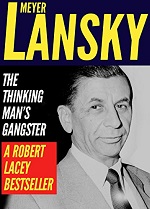
Meyer Lansky: The Thinking Man’s Gangster – Robert Lacey

LanskyIn September 1971, reputed mobster Meyer Lansky (b. Maier Suchowljansky)(1902-1983) was denied Israeli citizenship by Dr. Yosef Burg after a careful review of the evidence presented to him. Prior to his ruling, he had consulted with Prime Minster Golda Meir (1898-1978) who proclaimed, “no Mafia in Israel”. Lansky was dejected and continued to seek out ways to live abroad beyond the reach of the U.S. Government. His next stop was South America but there he refused entry and accepted his fate as he returned to the United States. When he arrived at Miami International Airport, I am sure onlookers wondered what the commotion was regarding one man who stood about five feet four inches. The media dubbed him “the Mob’s Accountant” due to his uncanny ability to process figures in his head. And rumors have persisted that he once had three hundred million dollars hidden from investigators. The allegations are grandiose, but the truth is that Lansky was a figure of his era, nothing more and nothing less. Robert Lacey first published this book in 1991 under the title ‘Little Man: Meyer Lansky and the Gangster Life‘. It was republished in 2016 under the current title and includes an updated account by the author. It is by far, a definitive biography of the late Lansky.

Mob aficionados will know Lansky’s story and readers who have viewed ‘The Godfather Part II‘ (1974) will recognize the inspiration for the fictional character “Hyman Roth” which was based on the real-life Lansky. Lee Strasberg (1901-1982) nailed the role and as Lacey discusses in the book, Lansky contacted the actor following the film’s release to discuss the portrayal of himself on screen. Lansky must have been thrilled to serve as an inspiration for a character in a film but the belief that he was a larger-than-life mobster who bankrolled La Costra Nostra may be misleading. In fact, the real story, as presented here, shows a complicated life that was anything but glamorous. There is more than meets the eye. Two marriages, a son with special needs and emotionally dysfunctional children are only parts of the Lansky story which begins in Grodno, Belarus in 1902. Like his contemporaries, Lansky emigrated to the United States as a child and the family settled in New York City. Max Lansky (1879-1939) found a new life for his family in the Brownsville section of Brooklyn. I took notice of this part because the author touches on a part of the borough’s long forgotten history. In comparison to the Brownsville that exist today, known for a high crime rate and low income, the area was once a hotbed for Jewish immigrants. However, the story is just beginning and the move to the Lower East Side in Manhattan changed all their lives for good.

The section about Meyer’s childhood in Manhattan is key for it is here that he forms the alliances he would keep for decades with other immigrants, Italian and Jewish, who learned the way of the streets and the money to be made. The most famous of these friends are Charles “Lucky” Luciano (1896-1962) and Benjamin “Bugsy” Siegel (1906-1947). Lacey takes us back in time to the era of prohibition and crime fighting politicians such as former Governor Thomas E. Dewey (1902-1971) and former New York City Mayor Fiorello LaGuardia (1882-1947). Luciano fell victim to Dewey’s administration and was convicted on prostitution charges on June 7, 1936, and subsequently incarcerated. But his story was far from over. In fact, the United States Government would later need Luciano as the war effort heated up. And at the center of the events was Lansky himself. The covert operation and Lansky’s role are covered in the book and show that when it came to defeating the Axis powers, all avenues were open.

As his underworld life evolved, Lansky also became a family man, and that story is far more complicated and unglamorous than his criminal exploits. His two marriages and the three children he had with first wife Anna (1910-1984) provide some of the most emotional parts of the story. The family’s struggle is nothing short of heartbreaking and the private side of Lansky’s life stands in stark contrast to the public facade of the seasoned mogul who helped build casinos and fill the Mafia’s coffers. Lansky’s oldest son Buddy has a story of his own in the book and the trials and tribulations of father and son are difficult moments. Second son Paul and daughter Sandra are equally chaotic, and Sandra plays another role in the book that will shock readers. And throughout the story is the importance of Judaism and Lansky’s adherence to his faith. It can be argued that his life was anything but Jewish and one that no believer would subscribe to. But in his defense, he was one of hundreds of Jewish mobsters in the early 1900s. There is never a shortage of gangsters in America.

On New Year’s Eve, January 1959, Cuban President Fulgencio Batista (1901-1973) fled the country, evading capture by Fidel Castro (1926-2016) and his Revolutionary Army. For Lansky and other gangsters, the source of income Cuba had become was now over. The events of that night were fictionalized for the Godfather Part II and Lacey provides additional facts about Batista’s last flight from the island which I was unaware of. I also noticed that after Castro seizes power in Cuba, there are no further moves by Lansky that could be considered “big”. In fact, I saw the opposite. Aside from investments and miscellaneous sources of income, there is nothing in the book that alludes to him being a financial mogul with streams of hidden income. Even when Lansky moves to Florida later in the book, the belief that he had hundreds of millions of dollars in unclaimed income continued to haunt him. The stress from relentless investigations combined with his failing health only added to the tragedy his life slowly became. His second wife Teddy (1907-1997) stayed by his side, but also found herself under the prying eyes of the press. Her response to the press upon her return to Miami International Airport following Meyer’s failed attempt to establish residence in South America, was captured by television cameras and must be seen to be believed.

Despite the increased pressure by investigators, Lansky evaded prosecution for major crimes and that is one of the ironies in the book. If he was a criminal mastermind, he shrewdly kept himself out of long prison sentences. The reality I gleaned from the book is that Lansky was not the person he was portrayed to be. He did have dealings with mobsters and earned significant amounts of cash, but the only section in the book that shows extravagance is when he took his second wife Teddy on a first-class European vacation. Lansky did have income and the author provides details of his earnings as the story progresses, but the figures are well short of what would be expected from the “mob’s accountant”. Added to Lansky’s financial woes in Florida are the struggles each of his children had throughout their lives. This is a sobering reality in the story; Lansky could control hardened gangsters but struggled with his own kids. And what we see in the book about the Lansky home is all too familiar in mobster stories. Long nights out, weeks away from home and secrets of the streets combine to strain even the most committed marriages and bonds between a father and his children.

Lansky’s life in Miami during his final years closes out the story, but before it is over, the decline of the aging mobster plays out in the final act. Years of chain smoking and stress took their toll, and the decades-long health issues he endured came to a head. He dutifully walked Teddy’s dog Bruzzer but on the inside, his body was slowly breaking down. Readers will see the writing is on the wall and that Lansky does not have much time left. But when death comes for him, there are no last words in the form of a confession but instead Lansky affirmation that he was ready to go. He lived and died on code as the thinking man’s gangster. This is the legacy and tragedy of Meyer Lansky.

ASIN:‎ B01CZXARGG

The Last Testament of Lucky Luciano- Martin A. Gosch & Richard Hammer

16057485-_uy200_January 26, 1962, Naples, Italy – Salvatore Lucania, also known as Charlie Luciano and Lucky Luciano, dies of a massive heart attack at Naples Airport at the age of 64.  The aging mobster had suffered several recent heart attacks and had arrived at the airport to meet film producer Martin Gosch, who was to adapt a screenplay of the legendary mobster’s life.  Luciano had resided in Italy since February, 1946 when he left New York Harbor for the last time.  The terms of his parole, granted after lending his help to the allied effort in World War II, required that he leave the United States and never return. Tragically, it wasn’t until death that he was allowed to come home when he was interned at St. John’s Cemetery in Middle Village, Queens, New York.

Luciano never wrote an autobiography and it is for this reason I’d like to point out that this is not his autobiography.  This book is based on notes from the conversations that Gosch (1911-1973) had with Luciano before his death during the years 1961-1962.  Gosch has long been deceased.  Richard Hammer is still alive and has commented on the criticism that the book received. He admits that the originals of the notes are no longer in existence and much of what Luciano said is hard to verify.  With that in mind, I think it is wise to remember that the book is a look at this life but not a word for word autobiography.   And since Luciano is also deceased, he is unable to verify its contents.  But I think on the whole, the book is a good look into the New York underworld of that era and the major players.  The major events in the book are true and have been well documented. The smaller day-to-day events, transactions are thoughts alleged to have come from Luciano himself are sometimes questionable.  Do I believe that all of the statements attributed to Luciano are true? No, but I do believe a large number are probably accurate.

It would have been great if Luciano could have either written this himself or given his approval but since neither is possible, this is the closest we have to any type of statement by Luciano about his life aside from the postcards, letters and other miscellaneous documents in his writing that are currently in existence. Mafia bosses have rarely written or verbally told their life story with the exception of Joseph Bonanno who broke from the norm publishing a book of his life in the mafia. But what we do know is that Luciano was in negotiations to have a movie based on his life produced.  His untimely death canceled any possible deal and the project has been lost to history.

His role in the reorganization of the American mafia can never be understated but it can be overstated.  To many he is the man who built the modern-day mafia but to others, just a smaller part of a big effort to change the  direction of organized crime in the United States.  Here is and his story is left up to the reader to cast judgment.  Frank Costello, Meyer Lansky, Bugsy Siegel, Thomas Dewey and all of the big names from the era make an appearance in the book resulting in an engaging tale that pulls the reader in from start to finish.  But it is important to remember that sometimes the line between fiction and non-fiction can become slightly blurred. Nonetheless, it’s a good look at the legendary figure.

ISBN-10: 1936274574
ISBN-13: 978-1936274574