
 On June 28, 1971, the Italian American Civil Rights League (“IACRL” held a “Unit Day” rally in Manhattan’s Columbus Circle. The league was co-founded by Joseph Colombo (1923-1978), the former boss of the Colombo Crime Family. The mafia don had become a public figure due to his criticism of the Federal Bureau of Investigation (“FBI”) and its actions against Italian Americans. During the rally, Colombo made his way to the podium to deliver a speech when he was shot and mortally wounded by Jerome Johnson (1946-1971) who had used fake press credentials to gain access to the guarded Colombo. Three shots struck Colombo who never regained consciousness. He remained in a coma for eight more years before dying on May 22, 1978, in Blooming Grove, New York. The shooting was shown in the 2019 film ‘The Irishman‘, which earned rave reviews. The film is good entertainment but contains inaccuracies from start to finish. Six years ago I read this book co-authored by Colombo’s son Anthony (1945-2017). I recently viewed a clip online which re-sparked my interest into the murder which never made sense. And upon reading this book a second time, I have come to see a darker unknown element at work which was determined to silence Colombo for good.
Unofficially, the murder was attributed to mobster Joseph “Crazy Joe” Gallo (1929-1972) who was known to dislike Colombo and wanted more power for himself and siblings within the family. Gallo never claimed responsibility for the murder and to this day, no mobster has ever gone on the record and tied him to the crime. The bad blood between Gallo and Colombo is no secret but no proof has surfaced that Gallo took their feud to the next level. And in this book, Colombo’s son Anthony provides even more information he learned himself after his father’s shooting that cast doubt on law enforcement’s widely accepted theory. But to understand why Colombo would have been a target, it is necessary to learn who he was as a person and that was one goal of this book. His son revisits the family’s life before the crime and peels back the layers encapsulating his father, Joseph Colombo, Sr.
I instantly took note of the family’s connections to organized crime and the fate of Joe Colombo’s own father Anthony in 1938. The events of that dark night in his father’s life, provides an eerie premonition of what comes later in the book. The tragedy was not lost on young Joe Colombo who went on to have several children of his own. Anthony recalls the day-to-day life in their home with a father determined to see his children succeed and stay out of “the life”. And with the help of Don Capria who provides snippets of historical events in each section, the book becomes an valuable tool for insight into family life within the mafia. The story is as normal as one could expect with Colombo being a dedicated family man. There are moments where he is overbearing and strictly adherent to his beliefs, but otherwise the home is stable. But when Colombo catches the attention of the FBI, everything changes and this is where the book picks up speed and never slows down.
The back story to the league’s creation is discussed and despite the accusations that it was sham and front for the mafia, the story within shows that the people behind the scenes were dedicated to the cause of civil rights for Italian Americans and the distinction between the mafia and hardworking Italians in America. However, as the FBI probed deeper in the Colombo crime family, the mafia boss went from public hero to a liability. And the FBI was determined to see him indicted and convicted by any means necessary. Readers may be both shocked and disturbed at the actions of its agents who try to get Anthony to provide them with information on his own father. Whether they believed he would do so or used it as another form of harassment I cannot say, but the term questionable to describe their antics would be an understatement. That is not to say that Colombo was an angel, far from it. We know that the mafia survived because violence was a tool often utilized to keep everyone in line. But that is why evidence is collected to prove crimes without any doubt. Without that evidence, the FBI could only harass Colombo who fought back through the IACRL. But everyone knew that the battle would one day come to a head.
In regard to the Colombo story, the pushback he was getting behind the scenes should not be overlooked. The threat of retaliation against him was high and the future of the IACRL was in question. But Colombo was determined to move forward and knew that behind the scenes, he had the support of other mobsters across the board. However, as Anthony shows, his father did receive warnings that something dark was coming but no one knew exactly what it was. In the days leading up to the rally, there were suspicious events that took place as shown in the book. And they force the reader to ask the question, who knew Colombo would be shot? What we learn cast serious doubt on Johnson being a crazed lone gunman. Inevitably, Unity Day arrives and the moment we dread takes place resutling in pandemonium. Johnson unleashed a hail of bullets on Colombo before being fatally shot himself. The long-standing explanation was that one of Colombo’s bodyguards had killed Johnson in response, yet that person was never identified. Further, the two people with Johnson escaped through the crowd, never to be seen again nor were they identified. And just when I thought thought the story could not get any stranger, Capria’s explanation of the forensic evidence sent chills up my spine. With each page I read, my personal belief that Colombo’s murder was not a “mob” hit was reaffirmed.
But if the murder was not a mob hit, then what did happen? Well, the authors explore that question here and what was discovered is sure to make the hair on your neck stand up. And it all starts with the background of Jerome Johnson, a career criminal with a highly suspicious record. The information provided on Johnson is surreal and if he was a lone gunman, he was the craziest that ever existed to have infiltrated Unity Day and murder a famous mafia boss. Capria and Colombo also address long-standing myths about Gallo’s “close ties” to Black gangsters. This murder is shrouded in mystery and none of them leads directly back to the mafia itself. Colombo was undeniably a powerful leader who courted alliances with Meir Kahane (1932-1990) of the Jewish Defense League (“JDL”) and other social activists, and this alone would have made him a target of both overt and covert investigations. Mention is also made in the book of the role Colombo Family hitman Gregory “The Grim Reaper” Scarpa (1928-1994) played in providing he FBI with crucial information about his underworld connections. To be clear, there is no accusation anywhere that Scarpa played a role in Colombo’s shooting. There is a lot to unpack in this book which will leave you with more questions than answers. And though we know how Colombo was shot, the why remains a mystery. The shooting changed New York City history and the lives of Colombo’s family, left to grieve the act of violence that took their father known as an activist, criminal figure and a person you could speak with to discuss any problem. And it is clear is that Anthony never recovered from his father’s death. The pain in his words is evident and there is a moment in the book where he tells his dad “we can always have another league, but I can only have one father”. The full truth about Colombo’s murder may never be known but the authors have shown enough here to remove any doubt that elements of the crime remain unsolved.
ASIN: B01B247LHW
 Recently, I was browsing Netflix and saw that Martin Scorcese’s classic film
  On July 10, 2013, the Hon. Nicholas G. Garaufis of the Eastern District of New York ruled that former Bonnano Crime Family boss Joseph Massino was to be
  January 26, 1962, Naples, Italy – Salvatore Lucania, also known as Charlie Luciano and Lucky Luciano, dies of a massive heart attack at Naples Airport at the age of 64. The aging mobster had suffered several recent heart attacks and had arrived at the airport to meet film producer Martin Gosch, who was to adapt a screenplay of the legendary mobster’s life. Luciano had resided in Italy since February, 1946 when he left New York Harbor for the last time. The terms of his parole, granted after lending his help to the allied effort in World War II, required that he leave the United States and never return. Tragically, it wasn’t until death that he was allowed to come home when he was interned at St. John’s Cemetery in Middle Village, Queens, New York.
 This book is not by any means, an investigative report into Scarpa’s activities. For the full story on his crimes, relationship with the FBI and its aftermath, the best book that comes to mind is Peter Lance’s ‘
 On December 19, 2005, Vincent “The Chin” Gigante, died at the age of 77 at the Medical Center for Federal Prisoners in Springfield, Missouri. The late mafia boss gained notoriety on the streets of Little Italy as he walked about in a bathrobe speaking incoherently to himself and those around him. He became known in the media at the “Oddfather”. His death marks the end of an era as the late Gigante is considered to be among the last of the old-fashioned Mafioso who controlled the streets of New York City. The former boxer, trigger man and boss remains a legend in organized crime history.
 DeMeo and his crew of psychopathic killers engaged in killing on a scale that rivaled the actions of the former crew of contract killers out of Brownsville, Murder, Inc., during the early half of the 1900s. And although he’s been deceased since 1983, his name and reign of terror remain legendary in mafia history. Gene Mustain and Jerry Capeci bring us their account of DeMeo’s reign of terror in this excellent investigative report that gives the full story of the rise and fall of one of the most violent street crews in New York City history. Carefully researched and aided by firsthand accounts of former associates and witnesses, the duo revisits the past and the early lives of Antonio “Nino” Gaggi, Roy DeMeo and Dominick Montiglio, the only surviving member from DeMeo’s crew.
 On June 4, 1994, Greg “The Grim Reaper” Scarpa died of AIDS related complications at the Federal Medical Center in Rochester, Minnesota. The former mobster is known as one of the most feared killers in mafia history. Joseph Valachi is thought to be the first made member of a La Costra Nostra family to shed light on the dark secrets held by the mafia. Following Scarpa’s death, it came to light that he had been an informant for the FBI as early as 1953 preceding Valachi by ten years. Unlike Valachi, he never testified and while an informant he continued to operate on the streets of New York with sometimes very deadly consequences. From all accounts, he took part in or played a supporting role in dozens of murders, some of which remained unsolved. His son, Greg Scarpa, Jr., is still incarcerated but has renounced his former life as a mobster and continues his quest to have his conviction reviewed and his jail time reduced. I was previously familiar with the author Peter Lance, having read his book ‘A Thousand Years For Revenge’ as a sophomore at the John Jay College of Criminal Justice. This book on Scarpa came as a recommendation from Amazon and I jumped at the chance to read this engaging and shocking expose. And while the cover of the book is highly enticing on its own, what’s contained is the pages of this book is nothing short of mind-boggling and will make you question everything you thought you knew about the trials and convictions of mobsters, most notably, John Gotti, Vic Orena, Sr., Sammy “The Bull” Gravano and Anthony “Gaspipe” Casso. And next to Scarpa, Casso figures prominently throughout the book and his relationship with the government is just as fascinating.
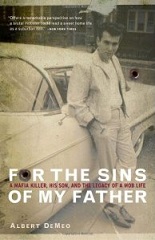 On January 18, 1983, New York City Police Detectives were called to the scene of a grisly murder all too common in the streets battles of organized crime. An abandoned Cadillac was found with a surprise in its trunk, the body of mobster Roy DeMeo, the homicidal enforcer for the Gambino crime family. He had been brutally shot several times before his tragic demise. During his career, it is believed that he participated in dozens of murders, running a modern-day version of Murder, Inc. His death came as no surprise to some in law enforcement who know very well that many in that life eventually leave it in a body bag. But for DeMeo’s family, his disappearance and death, shook the family to its core.
 FREETHINKING BIBLIOPHILE
You must be logged in to post a comment.