Hellhound on his Trail: The Electrifying Account of the Largest Manhunt in American History – Hampton Sides

At 6:05 p.m., on April 4, 1968, Dr. Martin Luther King, Jr. (1929-1968) was standing on a second-floor balcony of the Lorraine Hotel in Memphis, Tennessee when witnesses say they heard a sound like a car backfire. To the members of his entourage, the reality was far more terrifying and instantly grim. The civil rights icon had been shot by a high-powered rifle and was clinging to life as he was rushed to a local hospital. He later succumbed to his wounds, leaving behind his grieving widow Coretta Scott King (1927-2006) and four children. In Washington, D.C., President Lyndon B. Johnson (1908-1973) was briefed on the situation and at the Justice Department, Attorney General Ramsey Clark (1927-2021) made it clear to Federal Bureau of Investigation (“FBI”) director J. Edgar Hoover (1896-1972) that the bureau must take control over the investigation into the murder. Fears of nationwide unrest gripped officials, and law enforcement realized that the killer must be apprehended as soon as possible. The roads leading to that fateful evening in Memphis, and the worldwide manhunt for James Earl Ray (1928-1998) form the crux of this national bestseller that will have you at the edge of your seat.

The first half of the book is composed of two timelines. We are introduced to Eric S. Galt, Ray’s persona as he crosses from Mexico back into the United States. Instantly we can see that Galt is an unlikeable figure who drifts from one place to the next. The author does a masterful job at retracing his steps and presenting them in the smooth narrative format found in the book. As I read, I could see that Galt is strange and nothing good follows him. The second timeline revisits the final months in Dr. King’s life. The tremendous strain his work had on his personal life and health is evident. Further, scrutiny by the FBI was persistent, and J. Edgar Hoover was determined to expose the man he called a “fraud”. The reasons for Hoover’s animosity towards King are examined in the book and left up to the reader to decide. I can say that Dr. King had his flaws like everyone else. But he did not know that a drifter using the stolen identity of Eric Galt was also making his way to Memphis, Tennessee and that they both had a date with destiny.

As Sides moves between the two timelines, you can see that they are bound to intersect. And like dominoes falling, one event after another sets the stage for April 4. I must warn readers that the shooting and aftermath are graphic and will be unsettling. In fact, what Sides explains will send chills down your spine. The murder of Dr. King was nothing short of brutal and cold-blooded. However, that is far from the end of the story. In the wake of the gunfire, Dr. King’s aides scramble to make sense of what happened, and emergency personnel do their best to aid the fallen leader. But his wounds proved to be too severe and after reading the book, death was likely the better option for him. The author’s description of the bullet’s impact will clarify the severity of the wounds. As Dr. King lay dying in the emergency room, the FBI was gearing up for the largest manhunt in American history. And the author takes us on the journey from Memphis to the United Kingdom.

In the middle of all that is happening, there is still the story of America at that time. Sides revisits our nation’s history during a turbulent time when change was both needed and scary. Sides discusses the political climate including Johnson’s decision in March 1968 not to seek or accept his party’s nomination for president of the United States as the Vietnam War becomes an anchor around his neck. The entry of Senator Robert F. Kennedy (1925-1968) into the presidential race became Johnson’s worst nightmare and gave millions of Americans a new found hope for the future. But the push for civil rights and an end to the war in Vietnam had America on edge, and what becomes clear is that the 1960s was a dangerous time in the United States. Eric Galt, whom authorities would learn was James Earl Ray, nearly sent an entire country over the edge with one rifle shot. Within hours, the FBI was on the case.

After the FBI assumes the lead role in the investigation, the book shifts gears as the bureau engages in an all-out effort to find the killer. It is one of the FBI’s shining moments. I was speechless at the savvy skills of special agents and the speed at which they accumulated evidence and added information in an era before modern-day technology. Readers who love crime investigations will find this section of the book irresistible. I was rooting for the agents as they turned over new leads and pieced together the life of James Earl Ray. The information they uncover regarding his family history is crucial and should not be overlooked. I previously was unaware of these details and learning the new facts provided a better sense of how and why James Earl Ray grew into the person that he was. That in no way excuses his actions, and Ray was his own worst enemy. And though he had a head start on the bureau, he engineered his own downfall across the Atlantic Ocean.

In America, mourners focused on paying their respects to Dr. King, whose funeral was a monumental event in the nation’s history. But it was not without its detractors, and no story about Dr. King or the movement would be complete without a word on former Alabama Governor George C. Wallace (1919-1998). He appears in the story, but this is not a biography of him, but rather a discussion of how Wallace’s rhetoric helped create people like James Earl Ray. In later years, Wallace changed his tune and disavowed his former segregationist stance. But others did not, and some of them appear in the story but only briefly. The focus remains on capturing Ray who first fled to Canada before landing in Portugal. But it was the United Kingdom where his train to freedom was derailed.

I could only shake my head as I read of Ray’s time in the United Kingdom under a fake name and passport. Lack of money and a concrete exit plan take their toll, and a series of actions by him on the streets of London are insane. I honestly could not believe anyone could be either that bold or careless, but such is the case here. His sloppiness and eagle-eyed British investigators help bring the international saga to an end but even while in custody, Ray proves to be more moronic. In fact, investigators are surprised at his off-the-cuff statements and cannot believe the cognitive dissonance. The book concludes as he returns to America after losing the fight against extradition. His trial and conviction are not discussed here, the author’s focus was on the events leading up to the crime, the crime itself and the manhunt. But as an added bonus, the epilogue contains a story from 1977 where Ray is serving time in prison and finds a way to escape from the facility. The unbelievable story will have readers shaking their heads. Thankfully, he was found and returned to prison to serve out the life sentence he received. On April 23, 1998, James Earl Ray died at Nashville Memorial Hospital in Madison, Tennessee at the age of seventy from complications due to Hepatitis C.

If you need an enjoyable book about the murder of Martin Luther King and the manhunt for James Earl Ray, you will love this.

ASIN ‏ : ‎ B0036S4BX0
Publisher ‏ : ‎ Vintage, April 20, 2010

Days of Rage: America’s Radical Underground, the FBI, and the Forgotten Age of Revolutionary Violence – Byran Burrough

The first lesson a revolutionary must learn is that he is a doomed man.” – Huey P. Newton (1942-1989)

On August 22, 1989, former Black Panther Party co-founder Huey P. Newton was shot and killed on a street corner in Oakland, California. His death was sudden and violent, and a reminder that the streets are unforgiving. Newton’s notoriety as a representative of Black voices during the Civil Rights Movement earned him a place on the watchlist of the Federal Bureau of Investigation (“FBI”). To some Newton was a dangerous radical working to destroy America but to others he was an icon who had the courage to stand up to a system in need of an overhaul. Regardless of opinion, Newton was only one of many people who took the streets determined to change America by any means necessary and were not afraid to use violence. Sadly, that meant collateral damage and fear during an era author Bryan Burrough calls days of rage. This is the story of the under radical movement in the United States which produced some of the most dangerous figures this nation has ever seen.

The book is extensive but focuses on several main organizations whose names are well-known. The first is Weatherman a/k/a The Weather Underground  which is credited by the FBI to having set off twenty-five bombs in U.S. Government buildings, police stations and the office of the California Attorney General. And its stand out star was Samuel J. Melville (1934-1971) whom we learn of in the story, along with Bernadine Dohrn who ironically is a retired law professor. I did not know about Melville or Dohrn prior to reading the book nor was I familiar with Weatherman. However, by the time I finished the book I was firmly aware of its existence, its actions, and its dark legacy. Burrough delivers on the goods and takes us inside Weatherman and the anarchy it caused. But this is only the beginning in a long book that is nothing short of a roller coaster ride.

As a primer, the author discusses the Civil Rights Movement which sets the stage for the violence to come. However, what is interesting is that neither Dr. Martin Luther King, Jr. (1929-1968) nor Malcolm X (1925-1965) were “extreme” compared to the others figures the author discusses. Dr. King had always preached non-violence and Malcolm strongly believed in self-defense by any means necessary. Neither led any violent raids or set off bombs but the cause they fought for, believed in and died for, was the proof others needed to escalate resistance to levels which caught the attention of the White House. The Black Panther Party found itself on the radar of the FBI and in due time the bureau would make use of its COINTEL program to destroy all organizations it deemed enemies of America. Newton and his colleagues would fall victim as would others whose lives are exmained in the book. The FBI was focused but the underground radical movement was growing exponentially. And as the story progresses, the suspense heightens, and the tension builds as radicals attempt to turn the United States upside down. Violence, sex, drugs, fame and calls for revolution form a potent mix from which both charasmatic and outlandish figures emerged in their quest to change the nation permanently.

I mentioned earlier that there are several organizations discussed in the book. Aside from Weatherman, there is Donald “Cinque” DeFreeze (1943-1974) and the Symbionese Liberation Army (“SLA”) whose story on its own is surreal. Of course, it cannot be told without addressing the abduction and enlistment of Patty Hearst.  Her story has been told by others, and it is thoroughly presented here as well but I could not help but shake my head in disbelief DeFreeze’s bizarre rhetoric and his ability to attract followers. The downfall of the SLA and its tragic finale left me with chills, but the book was far from over. In fact, while the SLA is conducting its unorthodox fallacies, members of Weatherman are still moving around America. And the chaos they created would be amplified by more extreme radicals whose names are synonymous with bank heists and gun battles with law enforcement.

The name Raymond Luc Levasseur did not stand out at first but older readers may be familiar with his story. However, that changed as the story progressed and the organization to which he belonged, the United Freedom Front, made itself known in a string of bank robberies and getaways straight out of Hollywood fiction. A tour of duty in Vietnam and racial discrimination had help shape Levasseur into the radical the FBI wanted off the streets as soon as possible. But that did not happen and the story of how Levasseur evaded capture is one of the more fascinating parts of the book. He was not alone and had a family to support and had been joined by other adults. Their ability to pack up and leave on a moment’s notice is surreal and their ability to evade capture was almost flawless except for one crucial mistake. To be fair, bombings were occurring with such frequency that law enforcement officials struggled to keep up and keep track. And just when it seemed that one group might be on the verge of extinction, another rose to the occasion.

My father had previously told me the story of William Morales, a member of the Fuerzas Armadas de Liberación Nacional Puertorriqueña (“FALN”) who had severely injured himself while making a bomb in his Queens apartment. The accident is gruesome but there is more to the story than my father had explained. In fact, Morales’ s disfigurement and escape from justice is unbelievable due to the limited use of his hands and impaired vision. His disappearance from Bellevue Hospital left me speechless. Despite a manunt and nationwide attention, Morales remained on the loose and is still alive today,  living in Cuba along with another radical in our story, Joanne Chesimard a/k/a Assata Shakur who remains a wanted fugitive by the FBI. The reasons for her status as a fugitive at large are explained in the book, in particular the shootout on the New Jersey Turnpike on May 2, 1973, in which Trooper Werner Foerster was shot and mortally wounded. The full story of the traffic stop, shootout and her conviction are too extensive for this book but the author weaves into the narrative without breaking the pace or weakening its intensity. Morales and Shakur will likely remain in Cuba for the rest of their lives but there was another Shakur who did not fare as well.

If you are familiar with the late rap star Tupac Shakur (1971-1996) you will be familiar with the story of his step-father Mutulu Shakur (1950-2023), a member of the Black Liberation Army whose actions are some of the darkest parts of the book. Shakur’s descent into radicalism sets him on a dark path destined for destruction. And that point is driven home when Shakur and his co-conspirators rob a Brinks armored car at the Nanuet Mall in Nanuet, New York on October 20, 1981. The full story of the robbery is too intricate for a blog post, but I was glued to the book as the drama unfolded. It is mind blowing and horribly tragic. The robbery left two Nyack police officers and an armed guard dead, and resulted in Shakur serving forty years in prison before being released for health reasons in December 2022. The Brinks robbery remains etched in New York State history and is a chilling chapter to a book that pulls no punches. Burrough gives us an uncut look into America’s haunting past and the years in which armed struggled was a calling card for aspiring young revolutionaries across the country.

Burrough’s book is long but it is beautifully written, well researched, and powerful. The history contained within the book is not pleasant but what the author discusses can serve as reminders of how far America has come and where it should never return to. If you lived through these years and recall the level of danger which existed, this book will bring back profound memories. I intend to discuss it with my father who has always said that the 1960s and 1970s were scary times because of the threat of nuclear war, assassinations, social unrest, revolution, and the rise of serial killers. Many of the figures in this book are now deceased and others well into their senior years are no longer on the streets planning acts of violence. But they have not forgotten theirs nor has America. Their legacies are complex depending on who you ask but the fact remains that hope move side by side with fear as the radical underground grabbed the country’s attention. This book is an invaluable tool in understand how and why the radical underground came to be.

ASIN ‏ : ‎ B00LFZ84PC
Publisher ‏ : ‎ Penguin Books (April 7, 2015)

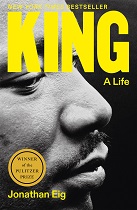
King: A Life – Jonathan Eig

Version 1.0.0

The late Huey P. Newton (1942-1989) once stated that “the first lesson a revolutionary must learn is that he is a doomed man“. These words by Newton have proven to be accurate when examining the lives of those who sought to enact radical change throughout the world. At 6:00 p.m., on the evening of April 4, 1968, Dr. Martin Luther King, Jr. (1929-1968) was standing on the second-floor balcony of the Lorraine Motel in Memphis, Tennessee embracing the fresh air when the sound of a gunshot was heard. The members of his entourage looked up to the balcony to see him lying on his back and mortally wounded. He was rushed to St. Joseph’s Hospital where he was declared dead at 7:05 p.m. An icon of the Civil Rights Movement had been silenced but his impact and words were not. Dr. King did not live to see the fruits of his labor, and he had come to accept that reality before his tragic death. His story has been told numerous times over the years, but when I saw this Pulitzer Prize winning book by Jonathan Eig, I decided to add it to my reading list. And what I found is a well-written, well-researched and balanced account of Dr. King’s short but extraordinary life.

As I began to read the book, I noticed that the footnotes are placed at the end of the book as opposed to the end of each chapter. This approach made the narrative flow much smoother, and I hardly noticed the page count while reading. The book does move chronologically as one would expect from a biography, but it feels more like a discussion than a timeline of King’s life. Further, the author pulls no punches when it comes to King’s faults but also gives credit to his successes, and this gives the book a well-rounded feeling to it. I do caution readers that it is necessary to approach the biography as unbiased as possible because there are parts of the story that do not show King is the most favorable light. But he was a human being and had his flaws like everyone else and there is more to the story than you will find in history textbooks.

The crucial historical moments in America’s past are discussed as they should be, but the private side of his life is where the book excels. His personal emotional struggles with fame and purpose, and infidelity are intense sections of the book but also revealing. Personally, I was aware of his romances outside of his marriage but the scale of it was larger than I had previously known. In fact, Eig’s book shows that the real number of women may be higher than anyone suspected. King was aware of his weakness but his statements regarding his father Martin Luther King, Sr. (1899-1984) are revealing. Women had always been a soft spot for the Kings, and Martin Jr., would find one of his most challenging experiences in his romance with a white woman named Amelia “Betty” Moitz. This is a part of Dr. King’s life I never learned about through any school textbook. In hindsight we know that the relationship did not last but the story is interesting and will have you asking yourself questions about the couple and how their lives would be in the year 2025. Of course, this was during the reign of Jim Crow and interracial dating and marriages were extremely taboo and, in some states, illegal. This section of the book alone should be a reminder of the many freedoms we sometimes take for granted.

Following his courtship of Coretta Scott (1927-2006), the couple elopes and begins to expand their family. However, we soon begin to see that Martin’s calling to the growing movement meant extensive time away from home. Although he did have strong bonds with his children, his rigorous travel schedule, and the amount of territory he covers in the book are surreal. Coretta authored her own book titled ‘My Life, My Love, My Legacy‘ which is a valuable resource regarding the couple’s home life.  Thankfully, help in the movement comes in the form of other activists whose own lives would be deeply affected by their determination for equality. King’s friend and close colleague Rev. Ralph D. Abernathy (1926-1990), and mentors Bayard Rustin (1912-1987) and Stanley Levison (1912-1979) prove to be anchors to keep him grounded as the intensity of the movement increased. The relationship between King and Levison is a focal point in the story due to the latter’s affiliation with communist parties and the interest taken towards both men by the Federal Bureau of Investigation (“FBI”) led by J. Edgar Hoover (1924-1972), whose obsession with King was nothing short of paranoia. The FBI weighs heavily on the story not only due to its surveillance of King, but also due to the bureau’s actions towards other figures in the story such as Malcolm X (1925-1965) who is part of the story on a handful of occasions but represented a far more frightening alternative to Dr. King.

Throughout the book, King fights battles on every front, and his relationship with President Lyndon B. Johnson (1908-1973) produced some of the highest achievements in the lives of both men. However, it also marked the initial descent of their influence and popularity due to circumstances each struggled to control. The buildup and fallout are riveting and tragic but a critical part in the final four years of Martin’s life. Readers who lived through the events discussed in the book may feel a surge of memories coming flooding back to a time in America my father has described as the “scariest years of his life” due to the civil unrest, assassinations, and the war in Vietnam. While Martin was traveling, speaking, and laying his life on the line, Coretta was at home, but that does not mean she was immobile or insignificant. In fact, she was a source of strength and sanity for Martin when he arrived home. And had he retired from the movement as friends had suggested, this book would have a different ending. However, King had found his purpose and the last speech he gave in the days leading up to his assassination continues to give me chills.

Slowly but surely, the moment we know is coming arrives and the darkness surrounding it is no less pronounced today than it surely was then. An epilogue follows the narrative and provides a short follow-up to the post-assassination events. After finishing the book, I found a deeper appreciation for Dr. King’s work and legacy while at the same time accepting his flaws. J. Edgar Hoover was convinced that Dr. King was a “fraud”, but the truth is far more complex. While he may not have measured up to Hoover’s standards, he did place his life on the line for what he believed in, and in doing so he became an icon around the world.  We can disagree on his approach and character, but his impact and achievements stand on their own merits. If you like this book, I also recommend Ralph Abernathy’s ‘And the Walls Came Tumbling Down‘ in which he discusses his friendship with Martin and the mission to break down Jim Crow.

ASIN ‏ : ‎ B0BBD5GXTF
Publisher ‏ : ‎ Farrar, Straus and Giroux (May 16, 2023)

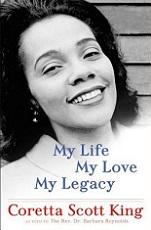
My Life, My Love, My Legacy – Coretta Scott King

corettaI find that as I age, I am more focused on historical events that changed the course of America, in particular from Black Americans.   It has been said that in order to know where you are going, you have to know where you come from.   For millions of Black Americans, the question of identity has been a difficult one to answer.  Some prefer the term African-American while others prefer Black-American.  And there are some who prefer Afro-American or just simply Black.  Regardless of the label, there is a shared history of pain, struggle and the never ending goal for full integration American society.  Over the past fifty years, tremendous progress has been made in the United States but there is still much work to be done.  But one of the greatest things about America is our ability to correct and learn from mistakes that have lingered for too long.  The young generation of today lives in a world far removed from only twenty years ago.  Their world is one in which technology is ingrained and life moves at an even faster pace.  My father often thinks back to the period of integration and the times where it seemed as if America was going to tear itself apart.   Even to him, as a kid it seemed as if the accomplishments by Black Americans over the years were just a pipe dream.

The Civil Rights Movement was a platform not just for Black-Americans but for all people that had been denied basic civil rights to which everyone is entitled, whether here in the United States or around the world.  Dr. Martin Luther King, Jr., has always been seen as the “leader” of the American movement.  The reality is that he was one of endless figures who displayed unparalleled bravery and dedication.  But he is easily the most recognizable.  But behind him, was his wife Coretta Scott King (1927-2006), who in later years became even more vocal in her commitment to Dr. King’s legacy and the movement they both believed in.  This book is her autobiography so that the world can learn more not about Mrs. King but about Coretta.

Her story begins in 1927, in the small town of Heiberger, Alabama during the Jim-Crow Era.  Readers sensitive to the subject matter might find this part of the book a little unnerving.   Although there are some low points, there are equally many high points as well and the pride and dignity with which the Scott family carried itself offsets the darker memories that she recalls.  From an early age, she is independent, tough and open to change.  Those traits would prove to be invaluable later in life when a young bachelor named Martin Luther King, Jr., walked into her life.  It is at this point in the book that the story picks up speed at an extraordinary pace.

Martin’s story is well-known and he remains one of the most iconic figures in world history so I do not think it is necessary to go into detail about his life in this post.  Plus, Coretta does that for us but not in the position of a biographer, but simply as his wife and the mother of their four children.   This is the behind the scenes look into their very private life which might surprise some.  In contrast to the public version of Dr. King which was cool, controlled and always prophetic, the version shown by Coretta is humble, playful, a homemaker, a prankster and a father.   The movement is never far away and Coretta explains early on that they both believed that the movement was a higher calling than anything else.  And each would maintain that belief until the end of their lives.

As the story moves into the 1960s, the movement gains momentum and Coretta revisits all of the critical moments that changed America.  The bus boycotts, Rosa Parks (1913-2005), Bull Connor (1897-1973) and Jim Sharp (1922-2007) are just some of the events and figures that she discusses.  She also discusses the much darker moments that occurred such as a the murders of John F. Kennedy, Malcolm X, Robert F. Kennedy and her beloved Martin, whose death rattled the globe and changed her life permanently.  Following his assassination, she became the heir apparent to the King legacy and she has never wavered in that task.

The book changes gears after Martin’s death and the focus shifts primarily back on Coretta. Her children also come into sharper focus and she discusses how each responded to their father’s death and what he meant to them.  Although Martin was gone, Coretta was still in high demand and the movement never stopped.  Her circle of friends and acquaintances changes slightly but the core group of support remains intact.  Later in her years, she finds herself in what some would call the widow’s club but to her, it was far from that.  She was a survivor of the movement who understood that death was a constant threat to anyone who dared to challenge the system.

There is one part of the book that did strike me and that was her discussion of rumors of Martin’s infidelity.   Accounts of philandering, allegedly picked up through FBI wiretaps has circulated for years.   It is true that tapes were mailed to their house and Coretta elaborates on what they contained.   She also has choice words for J. Edgar Hoover and his bureau.   King’s friend Ralph Abernathy (1926-1990) comes under fire here for his statements in his autobiography And The Walls Came Tumbling Down wherein he discusses Martin’s transgressions.  Coretta remains firm in her beliefs about Martin’s actions outside the home and Abernathy never changed his position.  All are now deceased, leaving us without the opportunity to clear up the issue.  What I can say is that I have never seen any photo evidence of such activity and the main source for the information came from the very agency whose job it was to discredit him.  I will leave the issue up to the reader to research.

Dick Gregory once said that Black History is American History.   One month in February does not come close to telling the full story.  But that is easily circumvented through books such as this, written by those who were present during the defining moments in the American experience.   Coretta is no longer with us, but her words of wisdom and guidance remain as a light to lead us through our darkest times, some of which have yet to come.  Highly recommended.

ISBN-10: 1627795987
ISBN-13: 978-1627795982

Orders To Kill: The Truth Behind The Murder of Martin Luther King-William F. Pepper

peppers order to killApril 4, 1968-Dr. Martin Luther King, Jr. is assassinated as he stands on the balcony in front of room 306 at the Lorraine Hotel in Memphis, Tennessee.  That same night, Senator Robert F. Kennedy (D-New York) gives what is considered by many to be the best speech of his career on the back of a pickup truck to a crowd of stunned and angry supporters.  A drifter and ex-convict by the name of James Earl Ray is arrested at Heathrow Airport in London after a manhunt and extradited back to the United States.  Following his indictment, he pleads guilty to the crime, but many questions about his motive and actions continue to go unanswered.   The murder of Dr. King and of President Kennedy would be the subject to investigation by the House Select Committee on Assassinations.  And although the investigations revealed new evidence in both murders, new suspects and evidence of a probable conspiracy in President Kennedy’s murder, the complete truth about both murders continues to elude the American public.

Decades have passed since Dr. King’s murder and the official story still stands.  But this book by William F. Pepper will challenge everything you thought you knew about the murder and his alleged assassin James Earl Ray.  The Freedom of Information Act completely changed the face of investigative reporting and gave citizens of all professions and walks of life a powerful tool in their efforts to learn the truth about historical events in which disturbing questions still linger.  The FBI, under the tutelage and direction of J. Edgar Hoover, conducted illegal domestic wiretapping and surveillance on American citizens, political organizations and figures.  The infamous COINTEL program cast a dark cloud over the agency and re-enforced the suspicions and concerns of an agency out of control.

1968 was a tumultuous year with the Vietnam war raging  and American involvement increasingly escalating.  Social tensions brimming under the surface resulted in race riots across the country and the murders of John F. Kennedy and Medgar Evars were still fresh in the minds of civil rights activists and citizens deeply concerned about the direction in which their country was headed.   Destined to break with the Johnson administration, King’s opposition to the Vietnam war, his rhetoric and social standing sent chills down the spines of the politicians in Washington and the military industrial complex.  Unwilling to tolerate civil unrest at home, the government began to increase domestic surveillance using MIGs (Military Intelligence Groups), the CIA, FBI, ONI and NSA.  Their trail of King would lead them to Memphis where fate would take over resulting in the tragic events on April 4.  Ray’s conviction seemed simple enough, he pleaded guilty as recommended by then attorney Percy Foreman and sits in jail to this day.   However, as Pepper’s reveals, the guilty plea and evidence presented, both crumble under intense scrutiny and there were events that transpired that day unrelated to James Earl Ray.  Over the years, Ray has given many accounts of his actions that day and none are in tune with those of a lone nut. Portrayed as a stone cold killer and rabid racist, he was convicted in the court of public opinion even before he set foot in a courtroom.  Pepper’s investigation unearths a mountain of evidence and cast strong doubt on Ray’s guilt and forces the reader to re-examine everything he/she thought they knew about one of the most infamous murders in American history.

There’s an entire cast of characters in the book, including President Johnson, J. Edgar Hoover,  H.L. Hunt and Carlos Marcello.  The web of intrigue between these once powerful figures is nothing short of spell-binding and disturbing.   A common question Americans ask one another is who really controls this country?  I believe that investigations into the murders of President Kennedy, Senator Robert F. Kennedy and Dr. Martin Luther King, Jr., will provide insight into the machinations of the U.S. Government and show what true power really is.  Had Dr. King lived to this day, he’d be 86 years of age and we can only guess as to what he would think of the current state of our country.  Next month is the national holiday for his birthday, but this year, the celebration will have a different meaning for myself and I’m sure others that have read this book.  I no longer question why he was murdered but question what if he had not been.

ISBN-10: 0786702532
ISBN-13: 978-0786702534