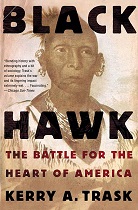
Black Hawk: The Battle for the Heart of America – Kerry A. Trask

While reviewing recommendations from Bookbub, I came across this book from author Kerry A. Trask about Black Hawk (1767-1838), a war chief in the Sauk tribe in North America. Today their descendants can be found in the States of Iowa, Kansas, Nebraska, and Oklahoma. The title grabbed my attention, and I began to ask myself how much I knew of Black Hawk and the Sauk people. I soon realized that I knew extraordinarily little and decided to make the purchase and rediscover a piece of American history. And what I found is a haunting yet important book about our nation’s past.

Prior knowledge of the Sauk tribe or the Black Hawk War of 1832 is not necessary to appreciate this book. The author provides a thorough explanation of Sauk history. The only trouble I initially had was keeping a mental picture of locations in the story. A map nearby may be a useful tool and keeping track of their movements, particularly after the treaty signed between Sauk representatives and the U.S. Government in 1804. This agreement would prove to be the pivotal moment in the story and set the Sauk on a collision course with the United States military. However, America was also going through growing pains, and the author discusses the horrid shape of the army in the early 1800s as confrontations with the native tribes increased with deadly consequences.

It should be noted that the book is not an easy or lighthearted read. In fact, there are parts of the story which will be uncomfortable. There are no glorious moments or riding off into the sunset. This story is vivid, raw and touches on a dark time in American history which should be known, understood, and never forgotten. That does not mean that the book is a story of American aggression against native tribes. While there are moments in which foresight would have helped, actions by the native tribes are equally as haunting and focus on the life and death situations which occurred frequently outside of the borders of the United States. I was mindful that in 1804, there were only seventeen states in the union and territory further west was “unorganized”. I say that loosely due to the fact that British and French fur traders continued to operate outside of America’s borders and further north in Canada.

After learning about the Sauk way of life, the story changes gears when Indiana Territory Governor and future President William Henry Harrison (1773-1841) signs the Treaty of St. Louis with Sauk representatives in November 1804. Each side had their view of the treaty, and the author explains the series of events for the reader to decide. Strangely, the Sauk returned years later and agreed once again on the conditions offered. However, Black Hawk and the older leaders decided that they would not surrender their land and the arrival of white settlers in Sauk territory set the stage for dark acts of retribution which Washington could not ignore. Readers familiar with America’s wars with the “Indians” will not be surprised at the descriptions of violence towards settlers. The text is grim, and emphasizes the risk taken by those venturing into unknown territory. While I read, I was reminded of the Fort Parker Massacre in 1836, discussed extensively in S.C. Gwynne’s ‘Empire of the Summer Moon: Quanah Parker and the Rise and Fall of the Comanches, the Most Powerful Indian Tribe in American History‘, a book which left me speechless. It may be tempting to view the natives as “savages”, but it is imperative to remember that they lived in a world far different from Europeans and had their own customs in regard to conflict resolution and protection of their territory.

The Sauk had been forced to move west in 1831 by military intervention but decided to re-claim their land in 1832. And here is where things escalate. Our ringside seat allows us to see the suspense build as Black Hawk and the association of Fox and Kickapoos, form their war council in response to increasing pressure from the United States. And once the military campaigns begin, the heat is turned up and the months between April and August of 1832 would be remembered for the bloodshed and heartache as the Black Hawk War claimed its victims. Early in the campaign, the native tribes maintain an advantage over American troops, but the military might of the United States and a Iowa County militia Colonel Henry Dodge (1782-1867) would prove to be too much. Interesting, two highly important figures in American history make an appearance in the story: future President Abraham Lincoln (1809-1865) and future Confederacy President Jefferson Davis (1808-1889). This caught me completely off guard and added more intrigue to the story. The climatic Battle of Bad Axe would be the final nail in the coffin of the Sauk but Black Hawk’s story was far from over. However, he could not run forever and eventually accepts defeat, but the story takes a few unexpected turns. Following his death in 1838, the story becomes even more bizarre and disturbing as post-mortem events play out.

This book is a gem, and I did not anticipate the impactful story contained within. It is well-researched, well-written and a frank but enlightening discussion of America’s past. A friend once told me that history should never be erased but always understood. The indigenous tribes of North America endured heartache, separation, betrayal, and death as the United States expanded its borders. However, the tribes also battled each other and committed acts of unspeakable violence against settlers looking for greener pastures. History can be uplifting but it can also be sobering and haunting. As I stated before, there is no glory to be found in this raw look at the past. But we can find value in understanding the story of the Sauk and all that they lost.

ASIN ‏ : ‎ B00GET19F6
Publisher ‏ : ‎ Henry Holt and Co.; First edition (December 24, 2013)

The President and the Freedom Fighter : Abraham Lincoln, Frederick Douglass, and Their Battle to Save America’s Soul- Brian Kilmeade

On December 6, 1865, Congress ratified the Thirteenth Amendment to the United States Constitution, which marked the end to slavery and indentured servitude in the United States. President Abraham Lincoln (1809-1865) had approved the version presented before in January of that year but did not live to see it ratified, having been assassinated at Ford’s Theater on April 14, 1865. The ratification of the amendment was a bittersweet vindication of Lincoln and a former slave who became one of America’s strongest voices for abolition. Frederick Douglass (1818-1895) outlived Lincoln by thirty years but remained committed to the goal of equality and an America representative of all its inhabitants. This book is the story of their lives, friendship and the issue of slavery, over which America pulled itself apart.

This book is a not a standard biography of either Lincoln or Douglass, but author Brian Kilmeade does provide enough background information to give readers a solid understanding of their beginnings which stand in stark contrast. Lincoln, who was born free as a White American, was the extreme opposite of Douglass who was born enslaved in Maryland. But as they both matured, America began to go through a metamorphosis and each man would find his calling in pushing the nation forward. However, to appreciate the crossing of their paths in life, Kilmeade moves back and forth between he key events which shaped their views of America and their purposes in life.

Although the book is not a standard biography of either figure, I did find a wealth of information in the book. And for readers who are well read on both, Kilmeade’s narrative can still be of value. While reading the book I could see the importance in the contrast between Douglass and Lincoln setting the stage for future events. And this is a strong aspect of the book. Each man came to detest slavery but through extremely different paths. Lincoln would use the courts and politics, but Douglass’s journey was far more difficult and dangerous and would take him through abolitionist circles which results in the appearance of notable historical figures in the story which heightens the suspense.

Any story regarding Federick Douglass is incomplete without mention of William Lloyd Garrison (1805-1879), a staunch abolitionist and strong influence in Douglass’s life, and the abolitionist John Brown (1800-1859). Each man plays a significant role in the book, and Brown’s story is fascinating on its own. He remains both famous and infamous depending on who you ask. However, we cannot deny the impact of his raid on the Harper’s Ferry federal arsenal in 1859. That event sent shockwaves across the United States and might have been far more deadly if other noted abolitionists had stood behind Brown’s actions. The relationship between Brown and Douglass is a moving part of the story and highlights the difference between conviction and recklessness.

While the abolitionists are fighting the battle against slavery in public, Lincoln comes into his own as a politician with a bright future. His rise to fame in what became the Republican Party is part of the story as well, and what we witness is an odyssey taking place as Lincoln’s views on slavery are challenged and changed. And part of that progression was his relationship with Douglass, which is the crux of the book. As a history lover, I thoroughly enjoyed this part of the story. Of course, we cannot ignore the “elephant in the room” which is the looming American Civil War. The buildup is part of the account, particularly the growing resentment in South Carolina when it becomes clear that Lincoln is the favorite to win the 1860 presidential election. His victory that November was seen as proof by the newly formed Confederate States of America in January 1861 that secession was the only option. And on April 21, 1861, the first shots of the war were fired, sending America into darkness for the next four years. For Douglass and Lincoln, the conflict brought them closer together and saw the end of their friendship.

As the war heats up, both men are watching with uneasiness as Confederate forces prove to be tougher than expected. The Union needed an advantage and here is another crucial part of the story when the subject of black fighting units takes center stage. Ironically, the idea of colored troops caused division as deeply as the war itself. In hindsight we know that the Union eventually formed units of black soldiers who performed equally as courageous as white troops. The saga of the Union’s colored soldiers is captured with grace and respect by the author who has given us a valuable book regarding a dark time in American history. In April 1865, the war comes to a bloody end, but Douglass’s story is not yet finished. And the South was determined to rise again.

Following the war, the story continues with Douglass’s life and the changes he endured as America was altered for better and worse. Reconstruction, Jim Crow, and southern resentment would affect the lives of Black Americans for decades to come. Douglass remained steadfast in the movement for civil rights, but he could not escape father time and makes his departure from the story in 1895. Both men were gone but their legacies were cemented in history. And through books like this we can step back in time to revisit an era when America was at a crossroads with morality, technology, and the very constitution our nation is founded on. There are tragic moments in the book, but it is a story which provides enlightenment, humility and an appreciation for the things we take for granted. Highly recommended.

ASIN ‏ : ‎ B08Z7RC9N6
Publisher ‏ : ‎ Sentinel (November 2, 2021)

Perón – Joseph A. Page

peronAn old friend once said to me that in Argentina “it is rare for a non-Peronist president to finish a full term”. The remarked surprised me at first but then I thought of the late Juan Domingo Perón (1895-1974) who served as Argentina’s president three times. His final term was short-lived due to his death on July 1, 1974, in Buenos Aires. Today the country is under the leadership of Javier Milei who famously raised a chainsaw on the campaign trail as he promised to slash government spending. Time will tell if Milei’s approach is the right course, but no leader can move Argentina forward without acknowledging the influence of Perón. This biography was on the list of recommendations I regularly receive and immediately caught my attention. And what I found is a well-researched, well-written and engaging account of Perón’s life and the turbulent political history of Argentina. 

During one of my visits to Argentina, I had the opportunity to witness a discussion regarding Perón’s legacy. The participants were people I met through a mutual friend and had come over for dinner. The conversation quickly grew tense with both sides digging into their respective positions. As the only American in the group, I realized that it was imperative for me to listen and refrain from speaking. I was in their country and needed to hear their history as they knew it. And I saw firsthand how Perón had shaped the lives and minds of Argentines decades after his passing. Of course, the discussion was far from the final analysis on the legacy of Juan Perón. But it did provide me with crucial insight, and I relied on those memories as I began to read this definitive biography. 

Although I strongly recommend some research into Perón’s presidency beforehand, it is not required to enjoy this book. The author provides a discussion of Argentine history which readers will find fascinating. Included in the discussion is the election of Hipólito Yrigoyen (1852-1933), who famously became known as “the father of the poor” and the first democratically elected president. As the story moves forward, we are introduced to the Perón family and patriarch Mario Tomás Perón. The story is typical of South America at that time but when Juan decides on a military career over medicine or law, his life and that of Argentines was destined for change. There is nothing about military career which stands out in the book, but he did find time for love and walks down the aisle with Aurelia Tizón (1908-1938) in 1929. Their union is happy but short-lived, and her death serves as an eerie premonition for what would later come in 1952. 

Perón moves through the ranks steadily but before he reaches the pinnacle, the world is forced to confront the growing Nazi threat from the Third Reich in Berlin. The outbreak of World War II set the world ablaze, but it also placed Argentina in a difficult position. The information contained here is crucial for it explains the long and difficult path Argentina and America have traveled together. Neutrality, escaping Nazi leaders and the looming Cold War stirred tensions between the two nations. Page provides a wealth of information to provide the reader with a thorough picture of what happened and why. Further, the impact of former U.S. Ambassador to Argentina Spruille Braden (1894-1978) cannot be overlooked. His battles with Perón are a significant aspect of the relationship between Washington, D.C. and Buenos Aires. 

In 1945, both Germany and Japan surrendered ending World War II. On the domestic front, Perón’s had ascended to the leadership position of the nation and his changes once again when Maria Eva Duarte de Perón (1919-1952) enters the story and becomes the most popular First Lady in Argentina’s history. On her own, Eva Perón is a fascinating figure, and there are books, a play, and a movie about her life. However, the focus here is on Juan and his rise to power. We do learn about their private life, and the dedication Eva had for him. Although it is not clear when she developed the condition that claimed her life, there are clues in the story. But what is definite is that both Juan and Eva both knew that something was terribly wrong with her health. The author explains the developing tragedy with the right amount of tact, making sure to keep Juan as the focus of the book but giving enough attention to Eva’s struggles with her own mortality. Readers who want to know more about her life will find ‘Evita: The Real Life of Eva Perón ‘ by Nicholas Fraser and Marysa Navarro to be a fair starting point. We can see that the end is coming and the final scene in her life plays out as one would expect, devastating Juan and the nation. But there is more to her death and the movement of her casket post-mortem between multiple countries is a surreal and nightmarish story on its own as readers will learn. 

Though in mourning, Juan’s problems were only beginning, and domestic tensions continue to brew. The buildup of the opposition forces to Perón’s reign is captivating, and the stage is soon set for his exile which lasted an overwhelming seventeen years. His defiance and exodus play out like a major motion picture with suspense, tragedy and emotions running rampant. But what Argentines could not have known was that Perón would come back and take control of the country. His time in exile is equally fascinating, and we follow him through South America, the Caribbean, and Spain where he established long-term residency. In each country, Perón is a guest but also witness to history as coups and political violent take place time after time necessitating a quick exit by the former Argentine president. Students of Latin American history will find this section of the book to be intriguing and Venezuela stands out due to current day events. 

Perón’s time in Spain is uneventful, however he soon finds third wife Isabel Martínez de Perón, who is still alive today. Their marriage provided Juan with a boost in image which had been severely damaged through the scandal involving teenager Nelly Rivas (1939-2012). Perón denied any improper behavior regarding their relationship but as shown in the book, there was more to the story. You can be the judge. Isabel’s entry in the picture sealed any hope of Rivas finding her way to Juan and the “Conductor” as Perón was informally known, set his sights on his native land and the throne he once claimed. And thus, the stage is soon set for his triumphant return to Argentina. But before I go further, it is necessary to mention a figure in the story whose name is still obscure. When I read of José López Rega (1916-1989) I could not recall any information I had previously come across to explain his role. However, Page solves that issue and Rega’s involvement in the life of Juan and Isabel is both mystifying and absurd. He was a character out of central casting, but his influence could not be denied. His rise and fall are covered here and provide an interesting and unbelievable sub-story to the main narrative. 

The return of Perón to Argentina plays out as readers will expect, with flair and drama. But what is more important are the incidents which took place preceding his return and allowed for his next presidency. Anyone who knows Argentine politics will understand the short-lived tenures of numerous presidents and military rule to stabilize the country. Page does not go into the “disappeared” which is a dark and unsettling time in Argentina’s history. But as someone who has visited the country, those who were taken in the 1970s never to be seen again have not been forgotten, and the era continues to haunt the nation. The downfall of presidents, military actions and vitriol used by political candidates provides a roller coaster ride that the author takes us through. The story is surreal at times but also a reminder of the fragility of democracy. Argentines who lived through these times have stories they can tell you, and the emotion with which they speak will say more than their words. 

After making his return to Argentina and the presidency, Perón’s life moves toward its conclusion as his health issues become more frequent and serious in nature. Curiously, the Central Intelligence Agency had been keeping reports on the matter and their findings are included in the story. It will be clear to readers that the end is coming and that Perón is slipping away. And on July 1, 1974, the finale plays out bringing the conductor’s life to an end. However, stepping in to fill the void is wife Isabel who becomes the next president. Her time in office is short-lived and a coup forces her into exile as well marking the end of the Perón presidency. And like a house of cards, those close to him fall out of favor and make their exit from the stage. Perón was gone but Argentina was nowhere close to a strong democracy and would go through political and social unrest more than once which threatened to turn the country on its head. Today Argentina is once again at a crossroads but hopefully this is the right turn to move forward and put the errors of the past to rest. If you want to know about Juan Perón, the charismatic yet unorthodox former leader of Argentina, this is must-read. 

ASIN ‏ : ‎ B0BWRJ1Z69
Publisher ‏ : ‎ Open Road Media (April 4, 2023)

John Quincy Adams – Harlow Giles Unger

quincy

Every time I visit New England, I am amazed at the amount of history one can discover. My trips to Vermont, New Hampshire, Rhode Island, Maine, and Massachusetts have all left a mark as I learned more about the country in which I was born. However, there is still American history I have to learn, and when I saw this biography of former President John Quincy Adams (1767-1848), my curiosity piqued and I knew I had to read it. And what I found is a story every American should know, and we have author Harlow Giles Unger to thank for this remarkable biography of a president who is underrated.

Before starting the book, I was aware of Quincy’s time in office but my knowledge of his personal life and contributions to America’s development was in insufficient. I felt as if I was reading about him for the first time, which deepened my interest and enhanced my shock as I learned of his incredible life. The story begins in Braintree, Massachusetts in July 1767, when Quincy as he is known, is born to John Adams (1735-1826) and wife Abigail (1744-1818). His father served as the nation’s second president and was instrumental in his son’s personal life and political career. I noticed early in the story that Quincy had a strong bond with his parents which proved to be the foundation he needed throughout his journey. But the family was fiercely committed to education and self-improvement, themes which remained with Quincy for life.

Unger’s writing style kept me glued to the pages from beginning to end, and the narrative has an exceptionally smooth flow which maintains a steady pace as Quincy’s life moves forward. Within the first ten years of life, resistance against Britain intensified and culminated with the American Revolution for independence. The conflict, discussed in the book and witnessed by Quincy, had a profound impact on him. Although he was too young to fight the British, he witnessed the importance of independence and sacrifices by patriots resisting British rule. As he ages, the story shifts gears when he attempts to gain admission to Harvard. The saga surrounding his admission is interesting and resembles modern-day anxiety and struggles by students seeking entry into ivy-league institutions. In hindsight, we know he eventually did gain admission, and went on to complete law school. However, the legal field was not all it was thought to be but everything in the book changes when he is selected for government service by President George Washington (1732-1799).

Washington’s offer to Quincy to become America’s Minister to Holland, comes as a surprise but with the urging of his father, he accepts and embarks on a European journey that changes his life permanently. And while America had gained its independence, Europe was still embroiled in revolution and chaos. The unrest across the continent takes center stage, in particular France during the reign of King Louis XVI (1754-1793), who was overthrown and beheaded in 1793. Several years later, another ruler ascends to the throne and forces the world to recognize the name of Napoleon Bonaparte (1769-1821). He also appears later in the story as the United States expands to the south and west across North America. But there is another component to France’s story in the form of its raging war against England. I could not stop reading as the crisis plays out and challenges America’s foreign policy. What transpires is an eerie premonition of future events in which France requested United States involvement. There is also the issue of the British who have not forgotten the loss if England’s thirteen colonies. Their acts of aggression and the American response show how close we came to war with Britain for a second time.

During the period of 1974 to 1817, Adams traveled around Europe through government positions, and the details of each are too extensive to discuss here. The details are in the book and the stories are fascinating. He developed a lifetime of experience at a very young age but also found time for love which resulted in his marriage to Louisa Catherine Johnson (1775-1852) on July 26, 1797.  Their story is wholesome but the personal tragedies within the Adams family are heartbreaking. It seems for every success there was an equal tragedy which Quincy and Louisa are forced to confront. There are also issues within her family as well, emanating from her father Joshua who causes grief and chaos through his own financial failures. But destiny was waiting for Quincy and his return home in 1817 proved to be the change he needed.

In 1817, President James Monroe (1758-1831) chose Quincy to be his Secretary of State. This decision had monumental ramifications for Adams personally and the political landscape of America. His effectiveness  did not go unnoticed, and history buffs will instantly think of the Monroe Doctrine, which is discussed by the author. Quincy’s star continues to rise and rumors about a presidential campaign soon begin. Curiously, Louisa is not at all thrilled by Washington, and the description of the city by Unger leaves much to be desired. The physical state of Washington seems unthinkable today, but in the 1800s, it was the reality. In 1825, fate intervened, placing Adams in the White House for a single term. And instantly, opponents and opportunists move behind the scenes to secure their own political ambitions. It becomes clear that politics was never for the faint of the heart. The actions of Henry Clay (1777-1852) and John C. Calhoun (1782-1850) are questionable to say the least.

dams’ tenure in the White House is uneventful but opposing forces soon begin to form, throwing their weight behind Andrew Jackson (1767-1845). And it is here that we see the groundwork for the two political parties which dominate American politics today. Jackson is a controversial figure, and Adams was no fan. In fact, his comments about Jackson are similar to others who could not envision the “rascal” or “illiterate” in the White House. But that is exactly what happened. Quincy took his loss in stride but was far from finished with politics. And as a member of the House of Representatives he made his voice loud and clear as he argued for causes which lacked popular support.  I found this part of his story incredibly interesting and as it continues, Adams becomes more outspoken about his convictions which provoke censorship. His anti-slavery stance drew the wrath of pro-slavery congressmen and highlights the hotly contested matter of human bondage.

The outspoken congressman was forcing America to examine its moral fabric, and this won him more support than opposition. And as a gift from above, he finds himself involved in a legal case involving the Portuguese vessel Amistad, manned by slave hunters who had kidnapped Africans from Sierra Leone for transport to Cuba. Mutiny occurred and when it was over, the captain and crew lay dead. The slaves were arrested and sent ashore to the United States where they were tried in court. Adams takes up their defense and his legal training kicks into a high gear as he puts on a master class in what is known as oral argument in the legal field. Today it may absurd that a legal argument over kidnapped human beings was needed, but in 1839, slavery was both legal and encourage in parts of the world. The case and its conclusion cemented his legacy as a champion of human rights.

Behind the scenes, Quincy and Louisa go through their trials and tribulations with brief periods of distance. But she knew she could not keep him down. By January 1848, his health had significantly declined, but staying home was not an option. On February 23, he made his way to the Capitol as usual, but this day would not end like the others. In fact, what happened during the afternoon session left me speechless. But after reading the book, I could not see Adams departing any other way. He lived and died for the success and progression of the United States of America. Today he would be called “liberal” and “progressive” but in his time he was an advocate for the things we still debate today.  The amount of research required for this book could only have been staggering. The author’s beautifully compiled narrative is seductive from start to finish, and at no point in the book did I lose interest. I could not put it down and found myself eager to read more regardless of the time or location. If you are in search of a delightful book about an outstanding leader in America’s past, this is strongly recommended.

“It is of no use to discover our own faults and infirmities unless the discovery prompts up to amendment.”-  John Quincy Adams

ASIN ‏ : ‎ B008EMEH5A
Publisher ‏ : ‎ Da Capo Press (September 4, 2012)

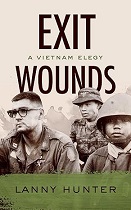
Exit Wounds: A Vietnam Elegy – Lanny Hunter

HunterOn October 19, 1965, North Vietnamese soldiers fortified their positions surrounding the Plei Me camp located twenty-five miles south of Pleiku City. Before nightfall, the soldiers launched the first major offensive of the Vietnam War, a conflict that lasted ten years and deeply divided two countries. One of the soldiers who fought and survived the battle is Lanny Hunter, a former medical officer in the United States Army Special Forces. This is the story of his military service, the offensive at Plei Me, and his return to Vietnam in 1997 to locate Y-Kre Mlo, a Montagnard interpreter who remained in Vietnam following America’s withdrawal.  

Hunter’s book does not follow the traditional autobiography format. Instead, we shift gears between current-day return to Vietnam and his memories of from the war. This approach gives the book an enhanced feeling of authenticity as we follow his journey back to Vietnam in two different time periods full of memories that will last a lifetime. Other veterans have returned to Vietnam in search of closing, internal peace, and other personal reasons. One book I recommend is ‘Goodbye Vietnam‘ by William Broyles in which the author examines his service in the war and where America went wrong. Hunter had no desire to return but a message helps to change his mind, and he soon boards a Boeing 747 bound for Ho Chi Minh City (formerly Saigon). By his own admission, he had a range of emotions returning to Indochina and as we see in the story, the combatreflexes were dormant but still present. However, he soon begins to adjust to a new Vietnam free of NVA soliders, landmines and other horrors of war. And when he reunites with Y-Kre, the story takes on a sentimental tone that remains until the end.  

The siege at Plei Me takes center stage, and Hunter revisits the battle through his role as a medic.  His descriptions of battlefield wounds and deaths are not to be taken lightly and emphasize the severity of warfare. As he treats the injured soldiers, his medical training kicks into high gear but there are  also occasions in the story where his combat training was needed. While doing his best to survive the siege, Hunter is seriously injured but mends his wounds and ensured that he remained in country to continue his role as a medic. His service in Vietnam was not solely centered around Plei Me, and there are other stories in the book of his actions as a doctor, including treatment of sexually transmitted diseases and wounds inflicted during drunken fights between “allies”. The anecdotes are interesting and provide more context for the ugliness of war. 

During his return visit, he eventually finds Y-Kre, and their reunion is heartwarming. And it was in this book that I learned more about the Montagnard people and their role in the Vietnam War. Y-Kre’s story of how Vietnam changed after the war is dark, and the way in which he and other Montagnard’s were abandoned by the United States Government is heartbreaking. He survived the war and its camps, but it took many years for him to recover both physically and mentally. Hunter also explains the war itself, including America’s escalating involvement into the conflict which originated when the French sought to reclaim its colonial possessions following World War II. But they underestimated the charismatic Ho Chi Minh (Ngyuen Sinh Cung)(1890-1969), North Vietnam’s first leader and the father figure in the war for independence. Hunter provides his perspective as a soldier trapped in a war doomed from the start through this statement which is a sobering truth:  

“Well-versed in Cold War facts and steeped in Cold War rhetoric, I was ignorant of Vietnam’s long, complex history. In this, I was little different from my government, its military leaders, and my commander in chief. The United States had overlooked the first rule of war: “Know your enemy.”

Ho Chi Minh was a complex figure, but he was not anti-American. In fact, he had lived outside of Vietnam for thirty years before returning to the nation of his birth in 1941. And one of his places of residency was my hometown of New York City. Following Japan’s defeat in World War II, Vietnam began to see itself in a different light and Ho recognized that America’s recognition of their government was critical to success. As Hunter explains here again: 

“Between August 1945 and February 1947, Hồ sent the American government eleven diplomatic communiqués pleading for an interest in the plight of the Vietnamese and, in particular, for protection from the French. Neither Truman, nor the State Department, acknowledged a single communication. Instead, America supported France in her effort to retain her colonial empire.” 

The die had been cast and in August 1964, incidents and alleged incidents in the Gulf of Tonkin provided the spark that catapulted America into Vietnam. As Hunter’s tour continued, he came to know the enemy composed of men such as himself. They were husbands, sons, cousins, and fathers determined to defend their country against imperialism by any means necessary. American military leaders struggled to understand this but infantry soldiers and officers who paid attention to the North Vietnamese came to learned their resolve and developed a form of respect for their opponents’ tenacity and dedication. And when he later returns to Vietnam, Hunter encounters former officers who have fought their own personal battles to put the war behind them and find peace in their lives. As I read the story, I could see the author’s challenges in facing men who fought against America on the battlefield thirty years prior. Regardless of which side troops were on, the horrors of war remained and Hunter opens up about his own issues with a condition once deeply misunderstood. 

When my uncle returned from Vietnam, he had to readjust to the world as my father has explained. While aboard the aircraft returning to the United States, senior officers instructed the troops to take off their uniforms before entering the terminal due to anti-war protestors and demonstrations. Taking off one’s uniform is simple but confronting Post-Traumatic Stress Disorder (“PTSD”) is not. Hunter is not immune to it and discusses his acceptance of the condition and the effects of war on those who survive. Sadly, other veterans died before being able to heal and took to their graves, memories that haunted them night after night. As part of the healing process, the author visits the Vietnam War Memorial in Washington, D.C. and finds the names of the men whom he knew during his time in country. Through his words, their memories and sacrifices live on. 

After making his rounds in Vietnam and making peace with the past, Hunter returns to the United States but there is still more to the story. The war will always be with him. To help with this, the veterans have  meetups the veterans have where they re-live their shared experiences and how the war changed each one of them. The snippets of conversation highlight the immense bond formed by men in combat. It is unbreakable and life long. Hunter’s recollections about the friendships between the men is a fitting end to a story about the Vietnam War that is sure to keep you intrigued from beginning to end. Highly recommended.

ASIN ‏ : ‎ B0C1QNBLZ5
Publisher ‏ : ‎ Blackstone Publishing (October 10, 2023)

The Rise and Fall of Jim Crow – Richard Wormser

crowIn 1954 the United States Supreme Court issued a historic ruling in the matter of Brown v. Board of Education which declared that segregation in public schools was unconstitutional. The groundbreaking decision widened the doors for the growing  Civil Rights Movement which was gaining traction across America. However, in the South, the system of Jim Crow was refusing to die, and found support from staunch segregationists determined to resist the Government’s involvement in matters they viewed as being within their state’s authority. In hindsight we can see today that the resistance was futile and compliance with the Supreme Court would be enforced. Jim Crow did fall, but it did not happen overnight. Further, in understanding its demise, we must also focus on its rise, and how, and why it was allowed to happen. Author Richard Wormser provides a recap of the rise and fall of Jim Crow in America, and why these important lessons are still relevant. 

On April 9, 1865, Confederate General Robert E. Lee (1807-1870) and his troops surrendered to Union General and future President Ulysses S. Grant (1822-1885) in Appomattox Court House, Virginia, signaling the final stage of the American Civil War. For Black Americans, the Confederacy’s defeat was welcome news, along with the realization that slavery was gone for good. The former slaves had freedom, but a new challenge emerged for them and lawmakers. How would the former slaves be incorporated into mainstream society? In the South, former slaveowners were left without their source of manual labor as new freed slaves left their former places of bondage for good. In Congress, Republicans wasted no time in reshaping the United States with the goal of healing a nation that tore itself apart. However, the South was far from finished and sought to rise again. As the story here opens, we revisit the time after the war, when Americans treated their wounds, physically, emotionally, and psychologically. 

It would be impossible to discuss the reconstruction period after the war without mentioning U.S. President Andrew Johnson (1808-1875) who gave the South the lifeline it needed to recover and re-enforce its platform of racial segregation. However, the book is not a biography of Johnson and the attempt to impeach him in 1968 is discussed but briefly. What is given focus are his actions to thwart attempts by Republicans to ensure that the states part of the Confederacy paid fully for their war against the North and the facture of the Union. Johnson was so effective that less than fifteen years after the war, the South had removed itself from the destitution that was widespread during the conflict. And as Wormser points out: 

“By 1876, Democrats had regained control of every Southern state except Louisiana and North and South Carolina.”

Once the Democrats regained control of the South, Jim Crow found its footing and would make life unbearable for millions of Black Americans across the region. The system was designed with a focus on brutality and retribution for past events. I warn readers that the descriptions of the violent acts committed against minorities will be difficult to read. Readers sensitive to this subject matter should use discretion. But for those who are willing and able to understand America’s dark past, these sections are crucial because they also helped set the stage for Jim Crow’s downfall. Admittedly, it is hard not to recoil in disgust at what we learn about life under Jim Crow. Today it would be unimaginable for a city in America to operate in such a manner. But prior to the decision in Brown v. Board of Education and legislation by Congress, it was the reality for millions of people viewed as being less than human. 

Jim Crow’s brutality was no secret, but what was happening in Washington as it flourished? The author discusses the White House and the inaction by presidents who sat idling while Jim Crow held the South in its grip. Some were reluctant to act and even supported keeping Blacks contained to the lowest levels of society such as President Woodrow Wilson (1856-1924) whose administration was a Godsend to Jim Crow. That dark period is covered in the book and will leave readers speechless. Local authorities were just as dark and even worse depending on the territory. But in 1914, events in Europe would ignite the spark behind the Civil Rights Movement. On June 28, 1914, Gavrilo Princip, a Bosnian Serb, assassinated Archduke Franz Ferdinand (1863-1914) setting off World War I. For Black Americans, service in the military was seen as a path for recognition that would continue the lengthy line of enlistment by blacks since the American Civil War. But this time, the meaning was more profound as troops returned home with a purpose after serving in Europe where they witnessed society standing stark contrast to America. The genie was out of the bottle and accelerated ‘The Great Migration‘ (1910-1970). 

As blacks continued to gain ground, an organization which had been created in 1909, continued to advocate for Black Americans: the National Association for the Advancement of  Colored People (“NAACP”). This section of the book was interesting and I appreciated the discussion about Walter White (1893-1955) and the risks he took to expose the horrors of Jim Crow and lynching. It is surreal how close he came to death while he investigated the American nightmare. The times were dangerous but there was no turning back, and Black Americans were determined to change America. And in time, another war would see them rise to the occasion. But this time, Jim Crow would not survive. In fact, its demise is due in part to President Harry S. Truman (1884-1972) who was outraged at the treatment returning Black soldiers faced in America where their service meant nothing under Jim Crow. The bold actions by Truman revisited in the story, changed the military, and also pushed him towards reelection in 1948. But more importantly, it was a severe blow to Jim Crow itself which was under attack from all angles. 

Anyone with clear foresight could see that Jim Crow was destined to the trash heap of history. It was only a matter of when. Well, following the 1954 Brown v. Board of Education decision, a new generation of activists rose to the occasion, and they would not rest until minorities in America were afforded equality under the law. We all know their names but those are stories for another time. When I finished the book, I sat for a moment and thought of how much America has changed. There are dark moments in the story, and I found myself enraged while I read certain sections. But it also made me appreciate the United States even more. This book is an incredible discussion of how American split in half, reunited, gave way to a new reign of terror before correcting course. The movement never ends, but the times we live in now are far better than what we read about in books like this. And the most important lesson, we learn from the author’s exhaustive efforts is that Jim Crow should never happen again. 

ASIN:‎ B00IHCNOLK
Publisher : St. Martin’s Press (April 8, 2014)

The New Deal: A Modern History – Michael A. Hiltzik

hiltzigOn March 4, 1933, a new era in American politics was ushered into Washington as Franklin D. Roosevelt (1822-1945) (“FDR”) became the 32nd President of the United States, and succeeded Republican President Herbert Hoover (1874-1964). In doing so, he inherited a nation in financial turmoil and economic uncertainty in the wake of the Great Depression. The new president was determined to fix the country’s financial woes and embarked on a radical plan which became known as the “New Deal”. This collection of legislation, government agencies and fiscal policy became Roosevelt’s signature accomplishment, but he did not live to see its success due to his sudden death on April 12, 1945. We know the results of his policies but what took place behind the scenes as Roosevelt battled congressional opposition, logistical issues, and dysfunction within his administration as he sought to get America back on track? Author Michael Hiltzik answers those questions and others in this book which is crucial in understanding America’s transformation following the economic crash of 1929.

Before proceeding, it should be noted that this story is not about World War II or Roosevelt’s successor Harry S. Truman (1884-1972). In fact, the discussion prior to the war and the book concludes before German’s march into Poland on September 1, 1939. As the story unfolds, Hiltzig focuses on the transition from Hoover’s Republican administration to Roosevelt’s Democrat administration, and the grievous issues waiting for FDR. The transition is far from smooth and the disconnect between the outgoing leader and incoming leader is vividly clear. But once Roosevelt is in office, the story changes gears and picks up in pace as he commences his plan to reshape the United States.

In the weeks leading up to the inauguration, we are introduced to the men and women who played pivotal roles in Roosevelt’s success such as U.S. Secretary of Labor Francis Perkins (1880-1965), U.S. Secretary of the Interior Harold L. Ickes (1874-1952), Presidential Advisor Harry L. Hopkins (1890-1946) and advisor Louis Howe (1871-1936). Roosevelt’s team faced a daunting challenged in changing America’s future, but as we learn in the story, they were instrumental and invaluable in guiding Roosevelt and executing orders when needed. And without them, the New Deal may not have been. What I found interesting is most of his cabinet members remained with him until his death and played crucial roles in assisting FDR on his mission for change. However, Howe’s death was heartbreaking, and he receives a fitting acknowledgment in the story for his influence as a presidential advisor. Although FDR had his supporters, he also had his opponents which included members of the Democratic Party. One unsettling event is the pushback from New York Governor Al Smith (1873-1944) whose fall from grace and exodus from politics is re-told here, and decades later it still comes across as surreal.

The Great Depression had left America reeling financially, and FDR realized that drastic plans were needed to change course. However, that would not be easy with Republican opposition and pushback from the Southern Democrats in the Senate, who were cautious of the new president and staunch defenders of the southern way of life, supported by segregation and Jim Crow. In 1933, he went on the offensive when Congress passed the National Industrial Recovery Act of 1933, which gave way to the creation of the National Recovery Administration (“NRA”) under the leadership of Hugh S. Johnson (1882-1942). The controversial director was a staunch of FDR’s plan, but his own personal demons, explained the book, cast a dark cloud over the administration’s purpose. Johnson’s story is surreal yet tragic, and we can only wonder what his capabilities would have been had it not been for his dark side. However, the bright side of the legislation was the creation of the Public Works Administration, followed in 1934 by the Works Progress Administration, the latter of which had a significant impact on the nation. As the author points out:

“The output of one agency alone, the Works Progress Administration (renamed the Works Projects Administration in 1939), represents a magnificent bequest to later generations. The WPA produced, among many other projects, 1,000 miles of new and rebuilt airport runways, 651,000 miles of highway, 124,000 bridges, 8,000 parks, and 18,000 playgrounds and athletic fields; some 84,000 miles of drainage pipes, 69,000 highway light standards, and 125,000 public buildings built, rebuilt, or expanded. Among the latter were 41,300 schools.”

As he eyed the nation’s recovery, Roosevelt began to envision a financial security system for Americans as they aged. The concept was visionary but faced opposition. Would it be left to the government or the states? It was an important question that is scrutinized in the story by the important figures, including an appearance in the story by Louisiana Senator Huey P. Long (1893-1935) whose statements have become part of legend. The maneuvers behind the scenes are fascinating and allow us to see how life-changing policy is imagined, drafted, and subsequently signed into law. In this situation, that law became the Social Security Act of 1935. Long did not live to see its impact due to his assassination on September 19, 1935, in Baton Rouge, Louisiana. However, millions of Americans can vouch for the foresight by Roosevelt, as Social Security has become a crucial source of income for older, retired Americans.

There are many high moments in the book but dark parts as well, in particular the sobering reality that the New Deal was good policy but for Black Americans, their struggle did not improve as expected. In fact, the gap between White and Black Americans widened in some ways as the government rolled out new policies to push America forward. Jim Crow was alive as well, and the Southern Democrats in the Senate would not entertain any civil rights bills. Roosevelt knew he could not afford to lose their support but faced constant pressure to take a stronger stance on racial injustice in America. Politically it makes sense, but morally it is up for debate. The author tackles the subject head on and pulls back the layers of the New Deal’s real effect on Black Americans. But, regardless of Roosevelt’s decision and actions, race continued to grow as a hotbed issue in America and the coming war with Germany, Italy, and Japan, would force it upon millions of people around the world.

The story begins to wind down as we approach 1938. The NRA had come and gone, and in Europe, tensions were brewing as the German Chancellor Adolf Hitler (1889-1945) set his sights on carving up the continent for the Third Reich’s expansion. In America, the threat becomes increasingly real, and the New Deal would be forced to take a back seat to the war effort. But before the battles and occupation of foreign territory by Axis powers, America was rebuilding itself in monumental ways through Roosevelt’s ideas. And although he did not change the Supreme Court in the ways he intended, he understood how important their decisions are to the lives of every American. The story of his showdown with the Supreme Court is also told here, and it is a tale we have seen play itself out in recent times as the 45th President, Donald J. Trump, made his choices for the highest court in the land. The past is always prologue. If you want to know more about the New Deal and the goals of Franklin Roosevelt’s administration, this is a must read.

ASIN ‏:‎ B004INH9UO
Publisher ‏:‎ Free Press (September 13, 2011)

Samuel Adams: Father of the American Revolution – Mark Pu

adamsOn March 22, 1765, the British Parliament passed the Stamp Act, assessed a tax on  various forms of papers, documents, and playing cards, which was to be paid by the people living within its colonies on North American soil. The legislation provoked outrage and was abolished a year later. However, for the colonists it was a sign that independence from Britain might be the best course of action. One advocate for independence whose voice became dominant was Samuel Adams (1722-1803), a member of the Massachusetts House of Representatives and future Governor. Today he is known was the father of the American Revolution, but his life has become an afterthought. I found this biography by author Mark Puls and decided to learn the life story of a revolutionary who changed history. Having finished the book, I now have a new understanding of American history.

Friends of mine who live abroad have teased about America being a “young” nation in comparison to countries around the world. I cannot argue that point but also note that in its “short” existence, America has accomplished remarkable feats and played crucial roles in world events. And the key to understanding the American spirit lies in its creation in the late 1700s when colonists decided that British rule had to end. However, not all of them were anti-British, and some wanted to remain loyal to the crown. But for Adams, freedom was the only option. His story begins in Boston, where he was born in 1722, a time in which the British Parliament was in full control of its colonies. But that does not prevent the young Adams from coming of age, and we follow him as he matures into a young man blessed with a bright future. Love also enters the story when he meets Elizabeth Checkley (1725-1757). The couple take their vows but later experience unbelievable grief as we see in the story. I found Adam’s ability to continue after so much loss to be a testament to his character which was needed as the movement for independence grew. But not all was lost, and he later weds Elizabeth Wells (1735-1808) who remained with him until his death.

The passing of the Stamp Act is when the story picks up the pace. However, the British Parliament also passed the Declaratory Act which set off alarm bells throughout the colonies. England had started to seal its own fate. For Adams and like-minded individuals, the crown had gone too far and thus, the revolution was born. Before we reach the War of Independence, the movement needed members and this is where the suspense heightens in the book as familiar names enter the story such as future President Thomas Jefferson (1743-1826), and Declaration of Independence signatories John Hancock (1737-1793) and Benjamin Franklin (1706-1790). Britain was not oblivious to the rumblings in the colonies and as explained by the author, it took steps to quash the growing discontent. However, the movement was carefully guarded, with subversion as a useful tactic. In fact, Franklin becomes aware of the colonists’ plans while stationed in London. And his importance cannot be overstated. All were aware that England was watching yet they were determined to see independence. The story becomes a cat and mouse game as the revolutionaries move under the radar while Britain becomes focused on the trouble across the Atlantic. Both sides knew a breaking point was coming. And everyting did come to a head in one event that changed the course of history: the Boston Tea Party.

If you have visited Boston, I am sure you’ve seen the Boston Tea Party Museum. For those who have not, I highly recommend visiting the museum and seeing the preserved ship for yourself. It is step back in time when colonists began to see a country ruled by Americans. On December 16, 1773, Griffin’s Wharf became ground zero as colonists dumped tea chests into the water in protest of the Tea Act. The response from England was expected and severe but did not serve its purpose of deterring future rebellion. The fuse had been lit. And leading the way was Adams whose goal was complete liberation. War eventually comes and forces the colonists to prove their determination. Behind the scenes, Adams, Hancock, and others were hard at work laying the foundation for the United States of America. However, that also proved to be a challenge. In fact, as shown in the story, there were colonists who supported more freedom but also saw value in British rule. But for Adams and Hancock, whose friendship goes through its own roller coaster ride before finding solid footing before the latter’s death, a new nation was worth the bloodshed.

The author provides reports from the war as Adams’ story moves forward, including an appearance by America’s first President George Washington (1732-1799). As a history buff, I could not stop reading as the images of America’s founding were created in my mind. I do caution that the book is not about the war itself. This is Adams’s story and his actions which paved the way for the country I call home. I enjoyed reading about Adams, regrettably turned into a pop culture through a brand of beer. However, there was far more to this man than you might imagine, and to the men who turned a vision into reality. While reading, I could visualize the drafting of the Declaration of Independence and the early version of what became Congress. The founding fathers were brilliant at organization, and this can serve as a case study on how governments were conceptualized. Of course, not all was perfect, and amendments were needed. But the foundation had been laid and it continues to serve us today.

Following the birth of the United States, Adams finds a place in local government, right in his home state of Massachusetts. He came governor following Hancock’s death and remained at the helm until 1797 when he retired from public life for good. On October 2, 1803, he passed away peacefully at home. And when the end was near, I am sure he was able to look back with pride on all that he had one to create the newly independent United States and make his transition from this world to the next.

ASIN: ‎ B00Z65S44I

War on the Border: Villa, Pershing, the Texas Rangers, and an American Invasion – Jeff Guinn

VillaDiscussions of American history during the 1800s may cause one to wonder how the country survived intact. The Civil War, conflicts with Native Americans, and two presidential assassinations highlighted the violent century in which America changed significantly. As the 1900s approached, America was ready for new challenges but in 1914, the world was plunged into war after the assassination of Archduke Franz Ferdinand (1863-1914). As America watched the growing conflict, tensions increased on its southwest border as Mexico found itself in the midst of revolution and armed resistance from rebels such as Doroteo Arango who is famously known as Francisco “Pancho” Villa (1878-1923). This is the story of his role in Mexico’s revolution and its resistance to American foreign policy.

I knew Villa’s name as he has become a pop culture reference in the years following his death. But I did not know his story, and how he became a mythical figure. This book by Jeff Guinn clears up some of the confusion about Villa’s actual role in the revolution and America’s attempt to capture him. The author provides a good primer on Mexican history and United States expansion, in particular the 1847 when the Southwest as we know it began to come into focus. We are also provided with a recap summarizing the impact of former President Benito Juárez (1806-1872). South of the border showed that Mexico had its own political tensions which rose to surface in the last days of President Porfirio Diaz’s (1830-1915) regime. Guinn takes us back in time as the power vacuum begins, and soon enough, Mexico finds itself at a crossroads. What ensues is an intriguing account of unusual coalitions, double cross, political fame, and murder.

Readers should be aware that the multiple men serve as president of Mexico in the book. In fact, at one point, the names change quite rapidly. But this is not the author taking creative freedoms. Mexico was unstable and the thirst for power consumed easily. And it is in the middle of the ongoing political upheaval that we are introduced to Villa, the obscure rebel who had no desire to become president, but still found a place in history. The majority of the conflicts take place in Mexico but on March 9, 1916, Villa staged a raid on Columbus, New Mexico which caught the attention of President Woodrow Wilson (1856-1924), who put his faith in the legendary General John J. “Black Jack” Pershing (1860-1948) to stop Mexican aggression and capture the elusive Villa. And what follows is a cat and mouse game that becomes surreal as Villa seems to escape each time, and even survives an assassination attempt which remained a carefully guarded secret. And while this saga plays out, Mexico continues its cycle of political dysfunction.

Pershing was determined to find Villa; however World War I loomed in the distance and upon America’s entry, the famed general was called into service yet again, leaving Villa free to his own devices. And surprisingly, Mexico had its supporters, including Germany which had its own agenda as the war raged. Villa continues his rebel activities but eventually reaches the end of his usefulness. In 1920, President Venustiano Carranza (1859-1920) was assassinated and succeeded by Adolfo de la Huerta (1881-1955) who negotiated a “early retirement” for Villa which was accepted. Sadly, the revolutionary only had a few more years to live himself and we learn of his fate, and the last days of other figures who could not escape the violence of Mexico. From start to finish the author maintains the right pace of the narrative and the account is a roller coast ride through Mexican history. What we learn is disheartening but also a reminder of the importance of a functioning democracy. Pancho Villa is long gone but he lives on as the iconic bandit who sought to liberate his country.  The reality is far more complicated, less climactic, and darker in some areas. And whether Villa was a saint, or a sinner is up to you to decide. But we have here is a solid discussion of his exploits and role in the Mexican Revolution.

ASIN ‏:‎ B08LDV3VXG

Death of Innocence: The Story of the Hate Crime that Changed America – Christopher Benson and Mamie Till-Mobley

EmmettOn August 28, 1955, Mamie Elizabeth Till-Mobley (1921-2003) received a phone call that permanently changed her life. Her son Emmett (1941-1955) had been abducted and murdered while staying with relatives in Money, Mississippi. The crime was brutal and normally would have been swept under the rug in a small southern town. However,  his mother refused to let her son fade away and become a distant memory. She not only insisted on bringing the remains north, but she also made the fateful decision to have an open-casket funeral. Uncensored images of his body which were published in JET and Ebony magazines, sent shockwaves across America, and even today the pictures are haunting. Sadly, Emmett is known as the teenager who was murdered for the crime of “possibly whistling at white woman”. But is that what really happened that day? The woman behind the register, Carolyn Bryant (1934-2023), allegedly admitted in 2007 that the story was fabricated. But she later told the Federal Bureau of Investigation that she had not recanted. A bureau investigation found no credible evidence that she admitted to making false statements in 1955. The truth about the sequence of events at the store remains shrouded in mystery. Her former husband Roy Bryant and his friend J.W. Milam were acquitted of the crime by an all-white jury but in the court of public opinion, America had reached a turning point.

Till’s death is undoubtedly the darkest point in the book, but it is not the sole focus. In fact, this is his mother’s story of her life, her son Emmett and how she managed to continue living after his untimely and senseless death. As the story begins, Mamie takes us through her childhood which starts in Webb, Mississippi. It is a return to the Deep South, where Jim Crow is in full effect. At the age of eighteen, she meets Louis Till  (1922-1945) whom she marries in 1940. The couple soon finds out that they are expecting a child. The marriage should have been joyful but Mamie reveals the dark side to Louis whose unpredictable and volatile nature cast a dark cloud over their union. After one terrible incident in the book, he is given the choice of jail or the Army. America had entered World War II by this point and Louis soon found himself in Europe. He disappears from the story until 1945, when Mamie receives a notification from the military that Louis had been executed due to willful misconduct. She does not go into the details because she had no idea what took place. However, author John Edgar Wideman did examine what is left of the military file regarding Louis’ execution. He wrote about it in his book ‘Writing to Save a Life: The Lous Till File’. The story is convoluted and not clear in some respects, but the reality is that Louis was gone, and Mamie had become a single parent. So, in the 1950s she made the move to Chicago with Emmett in tow.

Mamie and Emmett’s life in Chicago is fairly routine with her son blossoming into a responsible young man. This is by far the best part of the book, and critical in understanding who Emmett was. His mother provides crucial facts that explain his character and determination in life. However, there is one extremely important aspect of his early struggles with language that provides a clue as to what may have happened later  in Mississippi. I do not want to spoil it for the readers but what Mamie explains will make the alarm bells go off in your head. As I read, I found myself feeling closer to Emmett and enjoying his maturity from a child into a teenager. And had he not been killed; he surely would have grown into a fine adult. From the anecdotes provided by Mamie, Emmett’s high intelligence and sharp wit earned the admiration of his mother, grandmother, and all who knew him.

While raising a son, Mamie also has time for love and goes through her difficulties before finding a rock in the form of Gene whom she marries and remains with until his death later in the story. Gene, along with her mother, are the rocks of the family and help weather the storm through the dark times to come. In the summer of 1955, Emmett wanted to visit his family in the Deep South. Mamie at first is against the idea because she knows that life is Mississippi is not like life in Chicago, and even the mildest interactions between Whites and Blacks could escalate to the point of death. But Emmett and his charm win her over and she agrees to let him go. But the grim feeling about Mississippi never leaves her and even up to the day he leaves, she is still wary of him going to the South. She gives him an extensive pep talk and explains all the fears she had about her only son visiting a part of the country where life for Blacks could be unbearable. At first the trip is routine with constant communication between Mamie, Emmett, and her relatives in Money. But on August 28, 1955, that small town changed and life for everyone did as well.

As I mentioned earlier, there is still mystery surrounding the events at the candy story where Carolyn Bryant worked. What is clear is that Emmett and his cousins purchased candy and were on their way out of the store and had stopped on the front porch to congregate as kids often do. It was alleged that Emmett whistled at Bryant, and other outlandish accounts have claimed that he went as far as to grab her by the waist and make suggestive remarks. Although Emmett was from Chicago, I do not believe he was crazy enough to do such a thing. In fact, the story of the sequence of events changed so many times that it is hard to know what happened. Regardless, none of those things, even if they did occur, justify the brutal execution of a teenage boy. Adults failed Emmett and later on, the American justice system failed him and his family. Mamie is at home when the call comes in, and the heartbreaking news comes through in the book like a sledgehammer. It is a moment we know is coming but the dread surrounding it is no less terrifying. I do not know where she found the strength to keep going, but as the events play out, Mamie is like a rock and never stops in her journey to obtain justice for Emmett.

It is clear from the beginning that the trial would be a farce. The local sheriff and citizens were determined to keep Blacks “in their place” and were not going to convict the defendants. However, their crime attracted national attention and put Mississippi in the spotlight, and rightfully so. The jury’s reason for acquittal is laughable and today we know a decision such as that would not happen. But in 1955, in the Deep South, justice for Blacks and other minorities was almost non-existent. But across the country, Americans were waking up to the injustices across the nation. And Emmett’s death catapulted that movement for Civil Rights. Mamie finds herself in the spotlight, meeting scores of famous people from the Rev. Jessie Jackson to Martin Luther King, Jr. (1929-1968) And later in life, she meets former U.S. President William J. “Bill” Clinton.  Despite the attention, she never loses focus that the movement is bigger than Emmett. But that does not take away from her grief which remains through her for the remainder of the book. One by one, those close to her make their departures as age and poor health claim their victims. She is the last to go in 2003, but before she leaves, she makes sure to explain the reasons behind her actions and everything she learned in her life. Her collaborator Christopher Benson provides a post-script about Mamie and her death which are a fitting ending to the book. If you know the story of Emmett Till’s death, you must also know the story of his life and his family’s trials and tribulations. This is the place to start.

ASIN ‏ : ‎ B003E8AIDO