
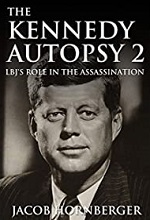
 I recently reviewed Jacob Hornberger’s The Kennedy Autopsy, in which author Jacob Hornberger discusses the anamolies surrounding the forsenic examination conducted on President John F. Kennedy (1917-1963) at Bethesda Naval Hospital following his assassination on November 22, 1963 in Dallas, Texas. In this second part of the series, he examines the role of former President Lyndon B. Johnson (1908-1973) in Kennedy’s murder. To be fair, no “smoking gun” has ever surfaced linking Johnson directly to the crime. However, researchers have long believed that Johnson knew in advance of what was to come in Dealey Plaza and had used the powers of the presidency to conduct a sham investigation that resulted in the much disputed Warren Commission report. Admittedly the evidence is compelling and Johnson has his own trail of indiscretions unrelated to the events in Dallas. In fact, Johnson was complicit in so many things, that his former attorney Barr McClellan felt compelled to write about in his book Blood, Money & Power: How L.B.J. Killed J.F.K. The legacy of Johnson is certainly a topic for another discussion but what Hornberger has to say here just might cause you take another look at the champion of the “Great Society”.
The crux of the book is formed by a series of events that took place within the short span of less than two and a half hours. As a dying Kennedy was rushed to Parkland Hospital, Johnson was also rushed to the facility and remained there until learning of Kennedy’s death at 1:00 p.m. Upon learning of the president’s death and that he was now the new president, he then proceeded to Love Field where Air Force One and Two were sitting idle. However, instead of immediately returning to Washington, he stay in place at love field until Kennedy’s body, which was forcibly removed from Parkland Hospital by fully armed Secret Service personnel, arrived at the air strip. Only then did both aircrafts depart for Maryland and Washington, D.C. Kennedy’s body was transported to Bethesday Naval Medical Center where an even more bizarre series of events took place. However, that is well covered in the first book by Hornberger regarding the topic at hand.
The premise of Hornberger’s argument is this: if Johnson was so afraid that Kennedy’s murder was a Soviet plot to attack America and that his own life could be in danger, then why did he wait at Love Field instead of immediately departing Texas for safer territory? The argument put forth by Hornberger is without question disturbing, but the position taken by the author is thought provoking. And to be honest, no sound explanation for Johnson’s actions has ever been put forth. In fact, his behavior the entire time was more than bizarre and did not reflect the mindset of someone concerned about a large scale attack on the United States.
Some readers may feel that there is no way on earth Johnson could have been complicit in any part of the crime. Unless the person knew him personally, that is purely speculation. But what is clear is that his statements following Kennedy’s death conflicted with his actions that day. In all fairness, the author does not claim that Johnson masterminded Kennedy’s murder anywhere in the book. But he does believe that Johnson knew of the murder in advance, played an enormous role in the cover-up and that there does exist a very real deep state or military industrial complex as described by former President Dwight Eishenhower (1890-1969).
As a bonus, the author also discussed Johnson’s decision to withdraw from the 1968 presidential election. One narrative that has remained in place is that the entry of Robert F. Kennedy (1925-1968) into the race is what ultimately caused Johnson to step out of the race. Another is that the rise of Hubert Humphrey (1911-1978) was proof that the Democratic party was ready for a new direction. Well both may not be entirely accurate and Hornberger has a strong argument for his belief that Kennedy’s murder is the real reason he did not seek reelection. On the surface, it seems far fetched but the author presents a very compelling case that have valid points. And although the Vietnam War had damaged his presidency and civil unrest at home was a pressing issue, Johnson still remained a popular figure. His true reason for stepping down most likely went with him to the grave and we may never know completely. But there is a strong chance that what we have long believed about his decision may be completely wrong. The case is presented here for you to be the judge.
The Kennedy assassination is a riddle with many layers, some of which have been peeled back for us to see the complexity within. Unraveling the entire crime is still a monumental task that requires a focused approached one step at a time. Hornberger has taken that approach in this highly interesting look into the actions of Lyndon Johnson after the infamous volley of gunfire in Dealey Plaza.
ASIN: B07ZKXLXZZ
 The unexpected increase in free time at my disposal has provided me with ample opporunity to increase the amount of reading material at my disposal. I decided to take another look at the murder of President John F. Kennedy (1917-1963), whose death remains one of most puzzling crimes in American history. The official narrative is that on November 22, 1963, lone gunman and former Marine Lee Harvey Oswald (1939-1963) fired three shots at Kennedy’s motorcade from the Texas School Book Depository, fatally wounding Kennedy and severly wounding Texas Governor John Connally (1917-1993). The case seemed open and shut with Oswald forever being labeled as the lone nut or lone gunman. On the surface, the case seems simple but there were many strange things that took place that day after Kennedy died that are not only mind boggling but also deeply disturbing. One of them is the handling of his body and the autopsy that was conducted at Bethesda Naval Hospital.
 Compton, California has earned a reputation over the last fifty years as a place where people are tough, life is dangerous and unless you are from there, you stay away. Gangs such as the Bloods and the Crips have proliferated across the city in the wake of the Civil Rights Movement and the dawn of the crack cocaine epidemic in the United States. In what could rightly be described as a civil war, thousands of black men, women and children have died on the streets of Comptom and in Los Angeles county as gang wars escalated. In 1888, the City of Comptom had formed its own police department to patrol city limits and at the time of the deadly gang wars erupted, it was pushed to its limit. Some officers would leave the department for much quieter neighborhoods with lower crime rates. Others would stay until it was disbanded in 2000. Among the two most well-known as respected officers were Tim Brennan and Robert Ladd. The duo have been interviewed numerous times in recent years, expressing their thoughts on Compton, the murder of Tupac Shakur (1971-1996) and his alleged killer Orlando Anderson (1974-1998). However, there is far more to their story than what we have come to learn on screen and here the two join with Lolita Files, whom some may recognize from the A & E multi-part series
  Drug addiction has steadily become one of the greatest plagues to affict mankind. Nearly all of us know someone who has struggled with addiction or lost their life to it. Recently, I read Sam Quinones’ spellbinding account of the rise in opioid in the United States
  The recent Netflix series
  In August, 2019, a close friend lost her brother, who became yet another statistic in the ongoing crisis regarding opioid and other drug use in America. I had met him previously and his death seemed surreal at the time. In fact, it still does. His parents had never experienced anything like it and did what they could to get him the help that he needed. For them and thousands of other parents who have lost a child to drugs, they often wonder how did this happen? And what could we have done to stop it? There are many answers to both questions but in this eye-opening book, Sam Quinones tackles the first question and tells the story of the development of the opioid epidemic in America.
 In the spring of 1846, a group of settlers left home in Springfield, Illinois en route to either Oregon or California. A popular destination for many was the City of Yerba Buena, known today as San Francisco. By the first week of may, the party had reached Independence Missouri and soon continued on their route. They soon learned of an apparent shortcut through what is known as the Hastings cut-off near Salt Lake City, Utah. The trail was named after Confederate General Lansford Hastings (1819-1870). It was believed that the shortcut would eliminate as much as three hundred miles off of their trip. The group separated and eighty-seven people continued on the trail. Instead of elminating travel time, their journey was extended by another month. Deeply behind schedule, their provisions began to run low and winter soon set in. By the time their ordeal was over, only forty-eight had survived. Some managed to survive by turning to cannibalism and that act has earned them a permanent place in American pop culture. We have come to know this group pf settlers as the Donner Party.
 The past several years have given way to a rise in the number of opioid related deaths in the United States. Cities across America have struggled with a surge in drug overdoses and lack of proper facilities to handle the deceased. I knew several people who battled an addiction to opioids and all but one are now deceased. It is a soul crushing and life depleting addiction that cuts across all ethnic lines. Many of us know someone who is currently battling an addiction or once did in the past, whether it was opioids, alcohol or some other substance. And what we all know is that addicts do not get clean until they have realized there is no where else to go but in the ground. Dan Peres is a former Editor in Chief for Women’s Wear Daily Details and in this revealing memoir, he details his own struggle with a drug addcition that nearly took his life.
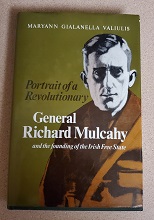 Discussions of the 1916 uprising in Ireland tend to focus on a select group of figures. The names of Patrick Pearse (1897-1916) and James Connolly (1868-1916) are legend in Irish history and their actions part of the narrative of the Republican fight for a united Ireland. In December, 1921, the British Government and Republican forces reached an agreement that officially partitioned Ireland into Unionist north and Republican south. The southern part was established as the Free Irish State, to be led by Michael Collins (1890-1922)who became Chairman of the Provisional Government of the Irish Free State. Collins is well-known in Irish history for his unwavering support of the Republican cause. However, there was another figure who not only worked closely with Collins, but someone whose own story and actions are typically left out of the official narrative. Pictured to the left General Richard Mulcahy (1886-1971), one of the founding members of the Irish Free State and staunch supporter of Irish independence. When I saw this book for sale, I knew immediately that I had to read it and understand who the intriguing character on the cover of the book really was.
 FREETHINKING BIBLIOPHILE
You must be logged in to post a comment.