
 I saw this book in my list of recommendations on Amazon and decided to take a closer look. The cover caught my attention and after reading the full title, my interest peaked. On January 9, 1969 a group of students belonging to the Swarthmore Afro-American Students Society (SASS), took over the admissions office at Swarthmore College. In the months prior, a working paper regarding the recruitment and admission of black students had been released, resulting in immediately backlash from the university’s black students who felt their privacy had been violated and their experiences ignored. The animosity between the students and Dean Hargadon continued to increase and the students felt they had no option but to act. Joyce Frisby Baynes, Harold S. Buchanan, Jannette O. Domingo, Marilyn J. Holifield, Aundrea White Kelly, Marilyn Allman Maye, Myra E. Rose and Bridget Van Gronigen Warren moved into the admissions office and over the next few days, their resistance changed the course of history for Swarthmore College.
The book’s focus is on the takeover as to be expected. But in between chapters focused on the occupation of the admissions office, are the individual stories of those involved. Each story is different but a common bond is that they were only part of a small number of black students who overcame the odds to earn their place at Swarthmore College. Yet, even for all of the intelligence and accomplishments, they still were required to stand up to college officials and voice their concerns over lack of cultural awareness and a dean who became the bane of their existence. Each person takes a turn speaking the book, recounting their story of where they grew up, their lives at home and what made them choose a college in Pennsylvania where hardly any black people had been admitted before. As I read their personal accounts, I could not help but to admire their will and determination to see that the college changed its ways. From the beginning of the takeover, it was clear that they did not see failure as an option.
Nearly all of the stories contain incidents of racial discrimination, some subtle and other incidents quite overt. Readers sensitive to racial incidents might be slightly uneasy and the memories that come to life. The events remembered are disturbing and upsetting but in a testament to the spirits of those who speak, not one resorts to believing they are inferior. In fact, the incidents only strengthen their resolve to keep moving forward. One story in particular struck me and it is this description which gives the reader an idea of what some of them had to endure just to get an education:
“Farther south in Tallahassee, Florida, Marilyn Holifield faced a more aggressively hate-filled environment in her newly integrated high school. White students vilified her daily and called her “n***er.” But the child who loved growing roses with her father was well aware of her family’s legacy of resistance.”
Jim Crow died a slow death in the United States and its remnants remained scattered across parts of the deep south. While federal law prohibits discrimination, it is imperative to remember that less than sixty years ago, people such as the students in this book could not eat the same lunch counters as their white counterparts. Signs for “colored” permeated the south and in the stories at hand, show the reader the capacity for vindictiveness in the human mind. But giving up isn’t an option and their successes in spite of the racism they endured are some of the brightest moments in the book.
All of the group members have gone on to have productive and admirable careers. The takeover is long gone but today, other students, in particular black students can look back on their actions in 1969 as the turning point in the college’s recruiting policies. The battles on college grounds during the Civil Rights Movement is often left out of discussions but the struggle for equality on campus was equally as critical as the battles off campus. This book is a perfect example of the on-campus struggle and how a small group of young men and women challenged the system and succeeded. Good read.
ASIN: B07SR43L6T
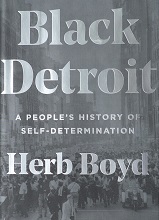 When I think back to my youth, I recall various automobiles that were own by my father, uncles and friends. Their cars were American made and typically products of General Motors. Buick, Pontiac and Cadillac were the cars of choice and hardly anyone then owned a foreign car. If you owned a Cadillac, it meant status and success in the America. Detroit became Motor City and its dominance over the U.S. auto industry remained in place for several decades until automakers from Japan and Germany stormed into the American market. The city has an extensive past, beginning with French explorer Antoine de Lamothe Cadillac (1658-1730) for whom the luxury automobile is named after. In 1701, he established what is now Detroit before eventually returning to France where he lived out the rest of his days. The evolution of Detroit is one of America’s greatest success stories and also one of its greatest tragedies. Throughout all, its black citizens have always remained firm in their dedication to seeing Detroit become a city to be envied. Herb Boyd takes another look at his city and the role of black men and women in the development of a famed city.
 In 2019, streaming giant Netflix premiered “
 FREETHINKING BIBLIOPHILE
You must be logged in to post a comment.