Hitler’s Last Secretary: A Firsthand Account of Life with Hitler -Traudl Junge with Melissa Muller

TraudlOn April 30, 1945, the Soviet Union Red Army, had reached within several blocks of the Reich Chancellory.  Realizing that their fates were sealed, Reich Chancellery Adolf Hitler (1889-1945) and Eva Braun (1912-1945) took their own lives instead of risking capture by Allied forces.  Over the next two days, those who had chosen to remain with them in the underground bunker made their way to surface and attempted to flee Berlin.  Among them was one of Hitler’s personal secretaries, Gertraud “Traudl” Junge (1920-2002).  As a close assistant to the Führer, she found herself in a unique position to observe the daily routine of one of the most powerful men in world history.   This is her memoir of the time she spent with the man who lit the spark for the second world war.

Traudl Junge was one of several people close to Hitler who wrote about their time with him at different points in his life.  Two memoirs that stand out in particular are The Young Hitler I Knew by August Kubizek (1888-1956) and I Was Hitler’s Pilot by Hans Baur (1897-1993).  Both are very good books and show Hitler’s life in different time periods.  Neither discuss the Final Solution in detail and I do not believe that Kubizek was a member of the Nazi Party.  However he was a close friend of the teenage Adolf Hitler and in his book, recalls many memories of their time together during their teen years.  Junge’s account is just as appealing and confirms much of what has been written about the cast of characters that formed the leadership of the Third Reich.

The information she reveals here is not anything groundbreaking nor are there any “smoking guns”.   In fact, there is very little discussion of the war or the Final Solution.  In regards to the war, Junge was assigned to stay close to Hitler and rarely left his side.  Her knowledge and exposure to the war comes largely from dictation that she is asked to type, military figures who arrive to converse with Hitler and the fate of her husband Hans Herman Junge (1914-1944).  The atrocities against Germany’s Jews also receives very little discussion.  But there is a scene in which the wife of a high-ranking official brings up the deportation of Jews.  The matter is not discussed further and Junge does not see her come around again.  As to how much she knew about the extermination camps will always be a mystery.  She did reveal some things here but any other information she may have kept close to the chest went with her to the grave when she died on February 10, 2002.  In 1973, she sat for an interview which was later included in a documentary called World at War, which aired on British television.  It is one of several interviews she gave about her time as Hitler’s secretary.  The program is available on YouTube and can be found here.  And to my surprise she speaks in fluenty English while recalling the memories she had with vivid clarity.  Of course, more than thirty years had passed since war ended and her once brown hair had by then, turned completely white.  But what she says in the interview closely matches what is written in the book.

What is really good about this story is that Junge observes many things about everyone who comes in and out of Hitler’s circle.  What becomes clear throughout the book is that Hitler is without a doubt the pupeteer and those under his command, who are entranced by his aura, go above and beyond to gain his admiration and sabotage competitors.  Rivalries, infidelity, gluttony and even drunkeness are all on the table as Junge gives her descriptions of the many faces she meets in just a few very short years.  And at times, the events that take place make it seem as if Hitler and his suboordinates lived in an alternate reality.

Hitler is by far the star of the show and Junge’s account of his daily activites provides an intimate look at the Führer. And in an almost Wizard of Oz like setting, we go behind the curtains and observe the contradiction between Hitler the leader and Hitler the person who cunningly presents himself as a benevolent father like figure, only concerned with Germany and its people.  Junge easily admits that his charm and personality blinded her to the evil lurking under the surface.  And that side of him is what kept Junge and others arround him largely unaware of major events that were spelling doom for Germany.  Admittedly, the picture she shows of Hitler does give the impression of a harmless older gentleman who many of us would love to have around. However, the cracks in the facade began to appear and she sums the point up perfectly in this quote:

Hitler lived, worked, played with his dog, ranted and raged at his generals, ate meals with his secretaries, and drove Europe towards its fate – and we hardly noticed. Germany was echoing with the wail of sirens and the roar of enemy aircraft engines. Fierce battles were being fought in the East.

This climate of insulation kept Hitler partially blind to his own egomania and the reality on the front lines.  News reports painting a grim picture for Germany’s success do come in and Junge vividly recalls those moments where Hitler literally flew into rages.  And at one point, even as the Russians are steadily advancing on Berlin, he still remains committed to defeating the Red Army.  Perhaps it was delusion or refusal to accept that the destiny he planned for Germany would never come to fruition.  By the time Hitler has decided to take his own life, it is clear to all involved that Germany is doomed. The reality of living in a post-war Germany as a Reich conspirator and the fear of Soviet capture, induced others to follow Hitler’s path including the Reich Minister of Propaganda Joseph Goebbels (1897-1945), his wife Magda Goebbels (1901-1945) and their six children. Today it might seem extreme that they chose death but Junge recalls a comment by Madga that explains the thoughts of those in the bunker:

“Frau Goebbels talked to me about it. There were no differences of class or rank any more, we were all bound together by fate. Frau Goebbels was in greater torment than any of us. She was facing six deaths, while the rest of us had only to face one. ‘I would rather have my children die than live in disgrace, jeered at. Our children have no place in Germany as it will be after the war.” 

Yet even as Hitler was planning his own demise, there were still others were carrying out their duties even if the Führer would not.  The efforts to achieve a negotiated surrender by Heinrich Himmler(1900-1945) and the attempt to seize control of the Reich by Hermann Goering (1893-1946) are both discussed, providing us with a look into the fragmented and substance riddled mind of the Führer, partly due to years of the injections by the Reich “Spritzenmeister”, Dr. Theodor Morrell (1886-1948).  The doctor makes an appearance as well and it is clear that Junge held the same opinion as many others about Hitler’s favorite doctor.

At less than three hundred pages, the book is slightly on the shorter side. But I do feel that Junge and Muller produced a very good memoir that will remain a welcomed addition to my library.  Some readers might expect more from her but what she did leave for us adds another level of authenticity to history’s record of Adolf Hitler’s last days.

ASIN: B005V2EEG8
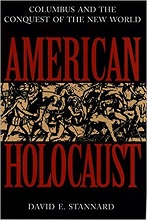
American Holocaust: Columbus and the Conquest of the New World – David E. Stannard

StannardEarlier this week, my boss mentioned during a Zoom office meeting that Columbus Day needed to be re-examined.  He had learned of many dark aspects of Christopher Columbus’ (1451-1506) arrival in the Caribbean.  The movement to end the celebration of Columbus’ life has gained considerable traction over the past several years.  Some states in America have renamed the Columbus Day to  “Indigenous People’s Day”, in honor of the Native Americans who sufferend immensly at the hands of Spanish and other European explorers.  It is a sound recommendation and one that may even happen here in New York City as it becomes harder for people to ignore the disturbing actions by Columbus and his group of marauders.  Many of us learned in school that he was the man who “discovered America”.  But is that what really happened?  An uncontested fact is that Columbus never set foot on North American soil, making the claim of discovering America misleading.  And we know today after many years of neglect by mainstream media, is that indigenous populations were decimated when exposed to the new visitors from abroad.   The true story however, goes far beyond Columbus, who was just one of many bloodthirsty religious fanatics who favored violence over peaceful assimilation.  David E. Stannard revisits the Columbus story in this eye-opening and chilling account that resulted in a stiff drink and a long moment of silence after I had finished reading.
I need to point out from the start that this book is not for the faint at heart.  If you are easily upset by graphic descriptions of barbaric actions, then this book may not be for you.  It is dark, chilling and beyond tragic.  And that is exactly why the way history is taught in the United States is in need of change.  Although the cover of the book gives the impression that the story is solely about Columbus, there is actually far more included in the book regarding the arrival of Spanish and English explorers whose wave of destruction spread across North America, the Caribbean, Central America and South America.

One question that has always typically been asked about the Americas is how long did the native population live there?  It is a good question and Stannard does provide a discussion about the original inhabitants of the Americas.  And what he says might suprise some readers.  I found the topic of Berengia to be highly interesting. The Berengia theory for human migration into the Americas is plausbible and the Bering Land Bridge which no longer exist, gives credence to the author’s point.  However, what is clear is that what we call the Americas had been populated by anicent civilizations thousands of years ago.  Creationists may believe differently but to completely diregard the science at hand would be highly unfortunate as the author provides a thorough discussion of humanity’s existence.

The story picks up pace as the Spanish arrive in the New World.  in August of 1492,  Columbus and his crew wasted no time in implementing their program of terror upon the natives.  The violence is nothing short of gratuitous and disease proved to be just a deadly.  The combination of the two as detailed in the book, had long reaching and long-term effects from which the Americas have never fully recovered.  And in case defenders of Columbus and other explorers point to disease as the major killer, Stannard has this to say:

However, by focusing almost entirely on disease, by displacing responsibility for the mass killing onto an army of invading microbes, contemporary authors increasingly have created the impression that the eradication of those tens of millions of people was inadvertent—a sad, but both inevitable and “unintended consequence” of human migration and progress.

The names of the tribes that suffered so much destruction are voluminous and I learned the name of several that I had no prior knowledge of.  Their names are almost endless and I am sure that only a fraction of the true number of indigenous tribes that called the Americas home are covered here.  In North America alone there were hundreds of tribes, some of which are now extinct including the Canarsie, who have a neighborhood and high school dedicated in their honor right here in my hometown of Brooklyn, New York.  Sadly, most do not know the true story of the Canarise but this book certainly does provide an idea.

Aside from the grim account at hand, Stannard takes yet another approach and explores the reasons behind the Spanish exploration across the ocean.  The true reason for Columbus’ voyage should cause readers to take notice about how much he knew about navigation and the position of the Spain in the European hierarchy.  Putting that aside, there is a much darker aspect to the Spanish missions and this is where religion enters the story.   Many of us know of the Crusades and the horrors of Christianity but in regards to Columbus, there is far more than meets the eye.  The mind-boggling details are included in Stannard’s account revealing yet another side of Columbus that will make many stare in disbelief at the words they are reading.   And if that is not enough, there were yet other reasons for the Spanish conquest and the end result left me shaking my head.

Halfway through the book I felt as if I needed a break but pressed on as I knew there was much more to learn about extermination of Native Americans in what is today called the United States.  Stannard keeps the discussion streamlines but does mention the Trial of Tears and Wounded Knee.  Each of those topics would require a separate book to fully go into the stories behind the tragedies.  The purpose here is to show the different ideologies behind Spanish and British actions in the Americas which both led to the same result for native populations.  The atrocities committed against Native Americans by the United States Government aare beyond upsetting and amount of gore found in recollections of the events might cause some readers to revolt in disgust.  Quite frankly, the European arrival in North America was just as deadly as the Spanish pillaging of Central and South America.  Each empire had its own reasons but for both, religious ideology, finanical motives and beliefs in racial superiority resulted in what Stannard believes to be the worst genocide in world history.   In fact, he states pointedly:  “the destruction of the Indians of the Americas was, far and away, the most massive act of genocide in the history of the world

After I finished the book, I had to sit in silence for a while to digest what I had just taken in.  Columbus’ actions were not a surprise to me as I had already known of his dark legacy.  What I did not know were the names of the numerous forgotten tribes of the Americas who no longer exist today.  The systematic destruction and eradication of their lives and culture is indefensible and nothing short of genocide, sexual exploitation and the plundering of territory inhabited by others whose way of life was completely changed by new faces upon their shores. If this book does only thing, I hope that is to shatter the myth of the new settlers in the Americas arriving with open arms and becoming fast friends with the native peoples.   Revisiting the past is often painful and reveals many disturbing facts that we would rather not know.  But if we are to have a frank and honest discussion about the people we have long called “heroic” and trailblazing” then all of their deeds should be open to examination.  This book is masterfully written, haunting but yet eerily relevant even today.

ASIN: B004TFXREI

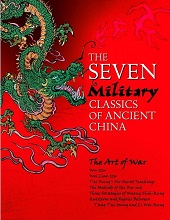
The Seven Military Classics of Ancient China – Sun Tzu, Wu Qi, et al.

Seven ClassicsI decided to change gears and take a look at a book that had been on my to-read list for quite some time.   The Seven Military Classics of Ancient China are  some of the most widely studied writings in regards to conventional and unconventional warfare.  Putting their age aside, the texts provide the reader with an inside look into the strategies behind armed conflict in Ancient China.  And what is contained within the pages of this collection of brilliant military strategy, are dozens of lessons that military commanders can still use even today.

As the book opens, the authors provide us with a brief description which explains how the texts can be interpreted:

Canonized in 1080 ce under the reign of Emperor Shenzong of the Song (r. 1067–1085 ce), this collection of texts is as much a representation of scholarly activity in forming a military tradition as it is a matter of practical concern.

I think the statement is correct but also that there is far more to the texts which will be learned by readers.  But what exactly are the Seven Military Classics?  They are composed of the following works:

  1. Taigong’s Six Secret Teachings, in which King Wen of Zhou has a discussion with Taigong after meeting the strategist who according to Scribe Bian, was sent from heaven to help Zhou run his country.
  2. Methods of Sima which begins by focusing on benevolence and righteousness, two critical components of a peaceful kingdom.
  3. Sun Tzu’s Art of War which is by far the most recognized and referenced manual of all seven classics.  This book is by far what many readers will be anxious to get to if they have not already studied Szu’s words.
  4. Wuzi in which Wu Qi meets with Marquess Wen of Wei to discuss military strategy.
  5. Wei Liazo in which King Hui of Liang meets with Wei Liaozi to understand discipline, virtue, battle formation and the securing of a city.
  6. Three Strategies of Huan Shigong which focus on the upper, middle and lower strategies of warfare.
  7. Questions and Replies between Emperor Taizong of Tang and General Li Jing.

The seven classics do differ slightly in the approach that each take to the issues at hand  but the common theme is warfare.  Public administration is also given high focus and more than one book discusses the importance of ruling with benevolence and the support of the people.  But make no mistakes, these books are military strategy galore, covering fortifications, weapons, troop numbers, battlefield positions and the organization of a disciplined and effective army.   Of course, the weapons and chariots referred to in the texts are beyond outdated however what is discussed about the power of a general and the movement of troops is still relevant.  And in his eternal widsom, Wu Qi had this to say about war:

“There are five causes of war: the pursuit of fame, wealth, revenge, rebellion, and famine. There are also five types of army: strong, violent, determined, righteous, and treacherous.”

With the exception of the Art of War, the texts explore these topics in clear and accurate detail.  Similar to a fly on the wall, we are privy to the discussions between rulers and sages as they discuss the ruling of a nation and the concept of war which is an unavoidable event in the future to come.  When it comes to combat itself, without question, the Art of War is the cream of the crop.  It is the manual for engaging the enemy and waging a successful military campaign.  And out of the seven classics, it holds the biggest place in maintstream culture and is by far the most quoted.  And while it is a gem in its own right, the other classics offer just as much valuable and insightful information for leaders of nations and military commanders.

It is hard not to understate the genius behind these seven classics. And although thousnds of years have passed since they were written, the material is still captivating.  And if I were the leader of a nation, I would certainly refer to this book on occasion.  There are many lessons to be learned if readers are willing to invest their time and attention.  Today, conventional warfare is not seen on the scale that it was in centuries prior.  But there is no telling as to when the next conflagration will erupt.  But if it does, I am sure that the lessons contained in the seven classics will be on the minds of the military figures tasked with achieving victory.

“All warfare is based on deception”. – Sun  Tzu (544 – 496 B.C.)

ASIN: B075S9NKPS

Inconvenient Memories: A Personal Account of the Tiananmen Square Incident and China Before and After – Anna Wang Yuan


WangIn June, 1989, I vividly recall watching the newsroadcasts of the protests in Beijing’s Tiananmen Square. There was much I did know know then about the factors beind the protests but the image of a lone Chinsese man staring down the barrel of a tank was seared into my memory.  He became known as “Tank Man” and his act of defiance is still one of the most moving images in history. The picture truly does speak a thousand words.  The protests began on April 15, 1989 and ended on June 4, 1989.  However, in order to bring the protests to an end, army troops employed a range of tactics including the firing of live ammunition resulting an a still unclear number of deaths.  Estimates ranges from several hundred to several thousand. To those of us in the west, the protests were the result of years of oppression by the Chinese Communist Party (“CCP”) and incompetent officials who had closed China off to most of the world.  However, there was far more to the story than many realized then.   And to understand what was happening and why, we must take a look behind the scenes to see what life in China was really like in the years leading up to the summer of 1989.

At the start of the protests, author Anna Wang Yuan was an employee at Canon Beijing, a sub-division of the Canon Copier Company.  Her boss at that time, Mr. Murata, asks her to take pictures of the demonstrations. And although she is not a protestor herself, she does provide a first-hand account of what was happening on the ground and why the students had refused to leave.  The memories she has compiled, show a China struggling to remove the failures of the past and confront a changing world and younger population with no interest in the constricting ideology of the CCP.   Wang sums up the ideology in this simple statement:

“The official narrative of the Communist Party of China is that Chinese history is divided into two eras by the founding of the People’s Republic in 1949. The two periods are referred to as the new society and the old society, or heaven and hell.” 

It could be said that China continues to sturggle in maintaining the “new society”.   The protests in Hong Kong and tensions with Taiwan have shown that the will to resist Beijing’s rule remains alive and strong.

As I read through the book, I soon realized that the story is not solely about the protests. In fact, it is in large part an autobiography.   It should be noted that the book is not intnended to be a full analysis of the protests from start to finish.  Wang is telling her life story which coincides with one of the most important events in China’s long history.  Westerners might express dismay and confusion at her early family life.  And while I found the events that took place to be quite surprising and also sad,  there are lessons she learns along the way that she never forgets.  The anchor in her early life is undboubtedly her grandmother.  However, their relationship is tempermental and goes through challenges of its own before the book’s conclusion.  What I did notice is that her parents seldom make an appearance and we learn early on that they live in another city called Tianjin with her younger brother Wang Yi.  Yuan relies heavily on friends as she grows up and the most important in the book is Zhi Hua who plays a prominent role in the protests. Their lives would continue to be interconnected years after Tiananmen.

On April 15, 1989, former General Secretary of the Chinse Communist Party Hu Yaobang (1915-1989) died in Beijing.  As explained by Yuan, Yaobang was a supporter of reform and more transparency in government.  He stood in contrast to hardline conservatives within the CCP.  As news of his death spread, students began to organize the protests that would later grip the entire country.   The students eventually drafted what was called the “Seven Demands” based on Yaobang’s ideas.  This manifesto helped lay the groundwork for the reforms sought by students and other activists.   And it is at this point in the book that the story picks up in pace.

Yuan continues to work with Mr. Murata and Ms. Kawashima, a native of Japan. Yuan’s position within the company allowed her to see the complicated relationship between China and foreign countries when it came to economic matters.  In fact, she provides a good explanation of China’s financial policies and international standing at the time of the protests.  Of particular interest was the label of “most favored nation”, a status prized by the CCP but put into serious jeopardy by the events at Tiananmen.  The fallout from the protest had long reaching repercussions that went far beyond satisfying student demands.  And complicating things further, was the decision by party leaders to enforce martial law.  This is by far the darkest part of the book and we can only guess as to how many people were killed as the army cracked down on protestors.  The actions of the military are chilling and it is clear that to remain on the streets is risky and possibly deadly.   As a counter measure, the students engaged in a hunger strike and Yuan serves as the voice on the ground, explaining their condition and how the situation played out.

In the wake of the protests, she eventually leaves her employer while Mr. Murata and Ms. Kawashima return to Japan.  Yuan moves from job to job and eventually makes the  decision to move to Canada.  This is the start of the final phase of the book in which she, her husband Lin Xiao and their two children embark on a long journey to find a final place to call home outside of China.  Her journey takes her down under and finally to North America.  It is a interesting account of the many ways people employ to navigate immigration systems across the globe.  The process from one place to another often seems endless but Yuan never gives up and her will to continue puts the finishing touches on an already incredible story.  And although this is not a memoir or glamorization of the “American Dream”, it does show the ideological and pratical differences between the East and the West.

After finishing the book,  I felt as if I had a far better understanding of Tiananmen and how it looked to some people on the front lines.  Tiananmen will always be one of the most remember events during the 1980s and the tank man cemented his place in the annals of history.   Sadly, China continues to struggle with freedom of speech, expression and the demands of the students in 1989.  Time will tell in the younger generation can change the ways of the old conservative guard.  The CCP is determined to maintain its grip over China but as we have seen throughout history, the will of the people can never be ignored.  If you are looking for a good story about life in China following Mao’s death and a discussion of the Tiananmen Square protests, this is a good read.

ASIN: B07PM9LS25

Ho Chih Minh: A Life – William Duiker

UncleHoOn April 30, 1975, the People’s Army of Vietnam and Viet Cong forces succeeded in the occupation of the city of Saigon in the wake of withdrawal by United States Armed Forces.  America’s departure marked the end of the Vietnam War and provided the Democratic Republic of North Vietnam with the opporunity to unify North and South Vietnam.  The final act of unification would have been welcomed by the first Prime Minister of North Vietnam Nyguen Ai Quoc who was known to the world as Ho Chih Minh (1890-1969).  Older Vietanemse sometimes refer to him as “Uncle Ho”, a benevolent figure who’s life as devoted to completely independence in Indochina from French and Chinese rule.   Ho Chih Minh has always come across as a slightly mysterious figure and some parts of his life are still unknown.  However, author William Duiker provides an informative and thought-provoking biography that explains Ho’s life and the true tragedy of the Vietnam War.

In 1976, Saigon was officially renamed Ho Chih Minh City in honor of Uncle Ho.  It was a fitting tribute to the man who truly believed in one Vietnam and made it his purpose to see it come to pass. But just who was the real Ho Chih Minh?  One adjective is surely not enough to describe this mysterious figures whom we learn about deeply in this biography.  The author has exhaustive researched the book and his recreation of the key events in Ho’s life during his evolution into a world leader provide the picture needed for readers to understand the thoughts behind his decisions and actions.

Familiarity with the Vietnamese language and/or Vietnamese history is not required but possession of either or one of them may result in the book becoming a more enjoyable read.  I found the story easy to follow and from the start, Ho’s intrigue is irresistable.  Some readers might be thrown off by the number of Vietnamese names in particular the name Nguyen which appears frequently in the first half of the book.  There are other names as well, including several used by Ho Chih Minh.  And the name by which he was internationally known has its own back story that the author makes sure to cover.

As I read through the book, I began to see that the key to understanding Ho Chih Minh undoubtedly begins in the 1920s and 1930s when France kept Indochina under strict rule.  The young revolutionary then known as Nyugen Ai Quoc, had determined from a young age that Vietnamese Independence was the only thing that matter.  After surrender in World War II, the Japanese military was forced to significant troops from previously occupied territory across Asia. The power vacuum created by Japanese withdrawal provided the opening needed for the August Revolution which changed history for good and set the stage for many battles to come.

Ho’s actions following the war and Washington’s responses or lack thereof are some of the most sobering moments in the book and instantly caused me to think of my uncle who served in the Vietnam War.  Anyone who has long sought to understand why the United States became involved in Vietnam will find this book enjoyable. At times I was speechless as I read and at one point back to understand how a war could have been prevented nearly 20 years before happening.  This part of the book is simply mind-blowing.   The battles within the U.S. State Department are just surreal and tragically, warnings given by those who foresaw a deadly war coming in the future, were largely ignored.  I do wonder what would have changed had North Vietnam and Washington been able to find common ground in the wake of World War II.  From the very start, Washington never seemed to fully grasp what it meant to be Vietnamese for Ho and other party members determined to resist the French and other nations committed to  colonial rule in Southeast Asia.

There are some parts of Ho’s life that show up on rare occasion in the story. In fact readers will notice the lack of several things typically found in a biography.  However,  Duiker does points out that Ho Chih Minh was a man of many secrets and some records have probably been lost for good. Perhaps that is by design or just unfortunate evens. The lack of romance in Ho’s life, particularlly after the August Revolution is certainly one of the more puzzling aspects of the story.  And even for the women that do enter his life, their time is brief for Ho has his mind set on Vietnamese independence at all costs.

The Vietnam War rightfully enters the story towards the end of the book. However, Duiker does not go off course and devote too much time to it.  I believe that was a good approach because by extensively discussing the war, it would have distracted from Ho’s personal story.  Further, Ho died in 1969, several years before the fighting ended. And in his later years, his duties had been adjusted by party members who were responsible for the American threat and the development of a new Vietnam.   Regardless, I believe that it is safe to say that there can be no discussion of modern day Vietnam with taking a long look at the life of Uncle Ho that stretched across several continents, included several spoken languages, arrests, questions of paternity and a battle against colonialism.  The Vietnamese movement for independence remains one of the most important struggles in world history and in the process, Ho Chih Minh went from radical student to a leader on the world stage.

ISBN-10: 0786863870
ISBN-13: 978-0786863877

The Judas Factor: The Plot to Kill Malcolm X – Karl Evanzz

evanzz1The recent Netflix series Who Killed Malcolm X, shed light on many dark secrets tsurrounding the assassination of Malcolm X (1925-1965) on February 21, 1965 as he began a speech at the Audobon Ballroom in Harlem, New York.   In the wake of the murder, three men were convicted for the crime.  Talmadge Hayer and Norman 3X Butler (now known as Muhammad Abdul Aziz) are still alive but Thomas 15X Johnson died in August, 2009. It is known today that Hayer was one of five assassins who executed Malcolm X. Of the four, high focus was paid on the late Ali Mustafa Shabazz, known then as William X/William Bradley.  In his affidavit provided to attorney William Kunstler (1919-1995), Hayer claimed that “William had the shotgun”.  In spite of the new revelations in 1970, Malcolm’s murder is considered a solved homicide.  The Netflix series revealed a wealth of information as did Manning Marable’s Malcolm X: A Life of ReinventionHowever, the examination of the murder presented here by author Karl Evanzz, is a gem of its own.  

Surprisingly, the book is not solely focused on Malcolm’s murder. In fact, the actual assassination is addressed at the beginning and end of the book.  But in between, Evanzz discusses a range of topics related not only to Malcolm’s murder but other events that took place during the turbulent 1960s.  What can be gleaned from the book is that a crucial part of the plot to kill Malcolm might have been related to political change in the continent of Africa.  As I read through the book, I thought to myself that this part of the discussion is almost always left out. And once readers have digested the full magnitude of what Malcolm had been planning at the time of his death, the assassination will be seen in a much different light.   

In the Netlix series, the tension and eventual falling out between Malcolm and Elijah Muhammad (1897-1975) is discussed extensively.  However, there were somethings that were not included in the final editing process.  Evanzz provides a significant amount of information on the inner workings of the Nation of Islam (“NOI”) and Muhammad’s personal life including the legal issues of at least two of his sons. And for readers interested in the history of the NOI, Evanzz revisits examines the story of the once elusive Wallace Fard Muhammad (1877-1934), the prophet who established the Temple of Islam, the forerunner to the NOI.  Fard was never seen again after 1934 and we can only guess as to what happened to him.   In the wake of his death, Elijah Muhammad established himself as the unquestioned leader of the NOI.  On the surface, he presented himelf as an all-loving leader fully committed to the well-being of black men and women but below the surface as we see in the book, Muhammad was protecting many dark secrets.  

As I read through the book, I felt that the murder of Malcolm X is really a small part of the full story.  The author did an incredible job of taking the reader back into time to understand how the United States and the world was changing at the time.  Malcolm was without a doubt the NOI’s rising star and heir apparent to Muhammad. But over time the friction between the two developed on account of Muhammad’s personal life which became a hot topic in NOI circles.  The fallout that ensued revealed the bitterness between teacher and former student.  And once the rift develops, a dark cloud is cast over the story as the NOI ramps up its attacks on Malcolm, who realizes that death is coming for him.  But what Malcolm says about who wants him dead threw me for a loop and raised my suspicions about a number of things. Readers familiar with the NOI”s inner circle might blanch when they read through this part. 

I truly cannot say enough good things about this book.  Evanzz looked at the murder for many angles and left no stone unturned.  Secrets emerge regarding the Federal Bureau of Investigation’s (“FBI”) COINTEL program, the NYPD’s Bureau of Special Servicess (“BOSSI”) and the actions of the Central Intelligence Agency (“CIA”).  And even within the NOI, disturbing facts come to light about life as a follower of Muhammad.  The Netflix series did feature John Ali, who held several different titles in the NOI. What is learned about him in the book just might make some readers stare in belief at the pages in front of them.  Evanzz’s words are beyond sobering and highlight just how deep the division between Malcolm and the nation was.  However, a statement Malcolm makes about the forces he believed were pulling the strings behind the attempts on his life should cause readers to take notice.  If is almost as if Malcolm knew there was a far more sinister plot in the works. In the weeks leading up to his murder, his actions which are retraced here, show a man who knew the end was coming but continued on his path even with a bullseye on his back. 

Marable’s book on Malcolm’s life is far more extensive than what is found here. However, Evanzz did not write a biography and solely focuses on Malcolm’s demise. As a result, the discussion is shorter but also more streamlined.  Regardless, it is a fascinating look into what really was taking place in the weeks leading up the assassination. The book is riveting, informative and also tragic. But it is a great source of information for the last few years of Malcolm’s life.  Good read. 

ISBN-10: 1560250496
ISBN-13: 978-1560250494