
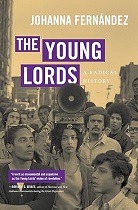
In two weeks, Black History month will commence and highlight the legacy and story of Black Americans. The achievements of America’s black citizens will come into sharp focus, but the story is far from monolithic. In fact, within and around the movements were organizations who modeled themselves after the Black Panther Party of Self-Defense, Student Non-Violent Coordinating Committee (SNCC) and others. Among those groups was the Young Lords, a primarily Hispanic America organization which originated in the windy city of Chicago before spreading to other places including my hometown of New York City. This is their story by author Johanna Fernández and the radical history they created in the struggle by Puerto Ricans for their place in American society.
Although not necessary, I do recommend two other books which could serve as primers for the story of the Young Lords. The first is ‘War Against All Puerto Ricans: Revolution and Terror in America’s Colony‘ by Nelson A. Denis and the second is ‘Fantasy Island: Colonialism, Exploitation, and the Betrayal of Puerto Rico‘ by Ed Morales. Both are invaluable tools in understanding the current-day state of Puerto Rico. I also recommend ‘When I Was Puerto Rican‘ by Esmeralda Santiago. The story here originates in the City of Chicago, where a young Puerto Rican man named Jose “Cha Cha” Jimenez reaches his breaking point after witnessing the discrimination and exploitation of Puerto Ricans who relocated to the mainland United States from their Caribbean island. A native of the island himself, Jimenez understood the experiences of others who had to make a new home in cities they were unfamiliar with. Added to their despair was the social climate of America during the turbulent 1960s when America found itself going through profound change.
I was fascinated learning about Jimenez’s story, and the transformation he undergoes as he becomes aware of the plight facing his neighborhood. The author does an excellent job in allowing the reader to view things as Jimenez would have in the late 1960s. We learn that his mother, who is from an older generation, sees things differently and the two are sometimes at odds over how to move forward when others see them as a threat. His path to the outspoken Lords figure started early. In fact, a Fernandez explains:
“Cha Cha Jiménez had been a Young Lord since the age of eleven. He was among a group of seven youths—six Puerto Ricans and one Mexican—who had organized the gang in 1959. The others included the group’s unofficial leader, Orlando Dávila, as well as Benny Perez, David Rivera, Fermín Perez, Joe Vincente, and the Mexican-descended Sal del Rivero.”
It is surreal that at the age of eleven, Jimenez and others were envisioning their path when other kids would typically be signing up for little league baseball or making plans for summer camp. Further, the author does not shy away from another complicated issue: race within Puerto Rican culture itself. The identity of Afro-Puerto Rican is a major component of the story that actually propels the Young Lords forward. However, it is also taboo, but in the book, the members of the Young Lords are not afraid to confront it and use it as a tool for solidarity. For Jimenez and others like him, they had to confront the issue of being labeled a “minority” while also exploring their heritage. It was a journey in search of two identities.
As the story progresses, the Young Lords grow in size as other young Puerto Ricans are drawn to their message. However, the issue of class comes up, and there is friction between the older middle-upper class Puerto Ricans and the young bearded revolutionaries who were reading the works of Chinese Communist Party leader Mao Zedong (1893-1976), Argentine revolutionary Ernesto “Che” Guevara (1928-1967) and others. The movement could not be contained, and the story picks up the pace when a new chapter for the Lords is formed in New York City. Taking the cue from Chicago, the New York chapter moves full speed ahead in terms of organization and operations that caught the attention of the entire city. The story left me speechless at times and I also felt a tinge of embarrassment for not knowing the Young Lords story and their place in the history of the Five Boroughs. From the seizure of the First Spanish United Methodist Church to the occupation at Lincoln Hospital, the Lords were determined to make their voices heard and did. The unbelievable events are re-told in vivid detail and highlight the organizational skills and commitment by the Lords to their cause. Today both episodes are footnotes in history but in 1970, the New York Police Department took them very seriously.
Following the events of 1970, the story takes a sharp turn when the group shifts its focus from New York to Puerto Rico itself. How and why the decision was made is covered in the book, and as I read, I was confused at the change in course. Of course, Puerto Rico was the heart of the group even with twenty-five percent of the members being Black Americans. However, the island was very different from New York City and Chicago, and that becomes clear in the story. It is not long before the Lords re-focus on New York but by then, the Federal Bureau of Investigation (“FBI”) had them on their radar. And like the Panthers and other left-wing groups, the infamous COINTEL program found its mark. Before the bureau was done, shockwaves traveled through the organization all the way up the chain of command. The story of party official Gloria Fontanez and her marriage are an example of how far the bureau had infiltrated the group. It can be argued that this was the beginning of the end for the Young Lords. However, their impact could not be ignored, and for thousands of Puerto Ricans, they instilled pride and hope, that they too will move forward in life.
Upon finishing the book, I sat back for a minute to digest what I had read. The Young Lords had accomplished what no one imagined, in such a short period of time. Aside from the public actions which caught the attention of City Hall, they had also started a newspaper called ‘Palante’. They understood that knowledge is power, and to learn, reading is a necessary tool. To drive home the point about Palante and its creation, Fernández explains that:
“With little to no experience in newspaper production or training in journalism, the approximately ten young radicals who were on the Palante team at any given time worked doubly hard to produce one of the few bilingual newspapers of the period—no small accomplishment for an organization with few members who were fluent or formally trained in Spanish.”
The success of Palante was no small feat but by 1971, the Young Lords’ offices in New York City were gone. We learn of the split between the New York and Chicago chapters of the organization which is eerily similar to the fallout within the Black Panther Party. Party expulsions, deaths and exodus for other reasons only served to deplete the ranks of the once formidable revolutionary party. But it does not diminished the heights the Young Lords reached in a time when being Puerto Rican was seen as below-human and few understood the pride that came with being Boricua. If you want to know more about the Young Lords and New York City History, this is the place to start.
ASIN : 1469653443


I read your book reviews every week and I share many non-fiction interests. You really hit it with this book. We saw a great documentary on the Young Lords on PBS and I’ve read When I was Puerto Rico, probably at your suggestion. I think the social cohesiveness and unity that these groups like the Young Lords and Black Panthers provided could be important again today. A big brick wall of fear on the part of the officials stopped them.
LikeLiked by 1 person
Hey Rebecca, thank you! ! I have to admit, this book was on my wish list for a while and I wish I had read it sooner. I was blown away by it. I agree that these groups could have a major impact today as they would instill focus and purpose in places that sorely need it. This is the New York City history they never taught us in school. Next time I talk with my parents I want to asky dad about it because he definitely would remember the events in the book.
LikeLiked by 1 person
Look forward to reading it. Happy Rev. Dr. Martin Luther King Jr. Day! Your discussion of the book is a fitting tribute. Thank you.
LikeLiked by 1 person