
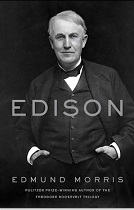
 Each morning, men and women make their way to the NJ Transit rail station located at 12 Read Street in Edison, New Jersey. The township consistently ranks among the best in the Garden State and is a desired suburb of the New York City area. Its Menlo Park section was once home to the brilliant inventor Thomas Alva Edison (1847-1931), whom the area is named after. Of course, the Edison Township we know today is vastly different from the open land the inventor called home in the 1800s. And it was here that some of his greatest successes were had as he helped propel America forward with the aid of innovative technology. This biography by author Edmund Morris, provides a solid glimpse into his unorthodox life.
Readers should be aware that the book does not follow the standard biography format. In fact, it begins near the end of Edison’s life. The author then moves backwards in time, closing the story when reaching his childhood. The change in approach may deter some readers but there remains a relevant story to read. Almost immediately, we learn of Edison’s dietary habits and health issues, due to his erratic lifestyle and maniacal focus on his work. It has been said that there is a fine line between genius and insanity. Edison may have straddled it throughout his entire life. However, there is more to the book which is a trove of information. But I did feel that the technical explanations regarding the earth shatteing inventions may be too detailed for readers without a background in mechanical or electrical engineering, which may result in eager studens of history strugglin in understanding Edison’s inventions and the problems that arose. I was able to follow along in general but admittedly, some of the concepts require a solid understanding of the various components at play. Morris does a masterful job of simplifying the issues as much as possible, but the reality is that there are concepts which cannot be translated into layman’s terms. This is why Edison, and his contemporaries were in a league of their own.
I mentioned before that the book technically reads “backwards”. In fact, the author tells the story of his second marriage to wife Mina Miller Edison (1865-1947) before we learn of the full story behind his first marriage to Mary Stillwell Edison (1855-1874). Edison’s relationships with both were quite strange as he was rarely around. Further, their ages at the time of the weddings would certainly raise eyebrows today. His marriage to Mary would have invited public scrutiny and prosecution in modern times. However, in the 1800s times were different and Edison’s courtship of both paid off. Despite his time away from home as he patented one invention to the next, he also had to contend with his growing children and the blended family which resulted after Mary’s demies. This is undoubtedly the darkest part of the book. Did Edison love his children? Yes, but their bonds were often stormy and his son Thomas Alva Edison, Jr. (1876-1935) stands out as the most tragic of the brood. Frankly, the stories are unreal. Edison could control the inventions, but his family was another story.
There is also the issue of Mary’s death which by all indications remains a mystery. I felt a chill in my body as I read the small passage about her death and the unanswered questions never addressed. I may do further reading to learn what really happened to her. Here, we are left with more questions than answers but the author is as surprised as we are, and there is the chance that the truth is lost to history. Of course, there is a plausible explanation but it is in need of firm evidence for a final conclusion.Although the story is presented in an unusual format, I did enjoy reading it, in particular the section regarding the success of Edison and his team in creating the first power stations to provide light in Europe before turning their attention to lower Manhattan. It was an incredible feat in 1882 when Wall Street came alive with lights, and it helped set the stage for the power grids we have today. I also enjoyed reading about the phonograph and the capture of the human voice which could then be preserved forever. Edison was a marvel for sure, but privately, he still struggled with basic aspects of his life, most notably his constant health problems and endless drive to work without proper rest or nutrition. Both affect him more than once in the book, and I was surprised that he lived as long as he did. And while he dealt with both issues, there was also the business side to inventing which invited intelligent minds, backstabbers and grifters. All three factor into the story, and we see times in which Edison should have been more focused on finances. However, he was an inventor at heart and never stopped creating.
There is a wealth of valuable information about Edison in the book, but it did feel as if his childhood did not get enough coverage. The author does discuss family life but briefly as the book’s conclusion approaches. I feel that the book would have benefited from a more extensive discussion of the young Edison. To be fair, we do learn some things about his childhood but there is much to be desired. And of course, it was America during the 1800s which invites questions about the nation’s struggle with race. Surprisingly, the Civil War barely receives a mention in the book and there are a couple of passing remarks in regard to racial issues that are never fully explained. It is known that Edison benefited from the help of African-American inventor Lewis Latimer (1848-1928) but that working relationship does not receive its due diligence. Further, the famed inventor was a staunch Republican but his views on society’s issues are not explored in the book. I would have liked to have known more about Edison’s views, if any, on the world in which he lived outside of the newest invention. Yet despite these shortcomings, the book is a good place to start if you want to learn more about the man who changed history.
If Thomas Edison were alive today, he would be shocked and pleased to see how far technology has advanced. The electric cars we have today are far more advanced than the vehicle he conceived more than one hundred years ago. And his storage batter has stood the test of time. There is much we owe to Edison’s dreams and the creations which resulted from those visions. He was ahead of his time but also deeply flawed. As an inventor, he was able to bring ideas to life but as a father and husband, his absences left their mark repeatedly. And even those who knew him best often found him mystifying. But he remains one of history’s greatest minds and the next time you flick on a light switch, Thomas Edison is one of the people you can thank.
ASIN : B07NCMDWZD
 FREETHINKING BIBLIOPHILE
there is a urban myth about the relationship between Edison, Ford and JP Morgan; against Nicola Tesla and his inventions , that those were blocked , due the greed of Morgan. Also, the lack of recognition of his apprentices, because they done the hard work.
https://www.thoughtco.com/thomas-edisons-muckers-4071190
The stories inside the History….
LikeLiked by 1 person
These are great points. Also, there was nothing in the story about the “rivalry” between Edison and Tesla. In fact, it’s the other way around, and the two are presented as mutually respectful. Of course, how they felt privately may have been different. Thank you for your input and the link which fills in more to the Edison story. Now I have to search for more material on the ‘muckers’ and learn who these men were that helped Edison rise to fame.
LikeLike