
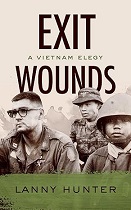
 On October 19, 1965, North Vietnamese soldiers fortified their positions surrounding the Plei Me camp located twenty-five miles south of Pleiku City. Before nightfall, the soldiers launched the first major offensive of the Vietnam War, a conflict that lasted ten years and deeply divided two countries. One of the soldiers who fought and survived the battle is Lanny Hunter, a former medical officer in the United States Army Special Forces. This is the story of his military service, the offensive at Plei Me, and his return to Vietnam in 1997 to locate Y-Kre Mlo, a Montagnard interpreter who remained in Vietnam following America’s withdrawal.
Hunter’s book does not follow the traditional autobiography format. Instead, we shift gears between current-day return to Vietnam and his memories of from the war. This approach gives the book an enhanced feeling of authenticity as we follow his journey back to Vietnam in two different time periods full of memories that will last a lifetime. Other veterans have returned to Vietnam in search of closing, internal peace, and other personal reasons. One book I recommend is ‘Goodbye Vietnam‘ by William Broyles in which the author examines his service in the war and where America went wrong. Hunter had no desire to return but a message helps to change his mind, and he soon boards a Boeing 747 bound for Ho Chi Minh City (formerly Saigon). By his own admission, he had a range of emotions returning to Indochina and as we see in the story, the combatreflexes were dormant but still present. However, he soon begins to adjust to a new Vietnam free of NVA soliders, landmines and other horrors of war. And when he reunites with Y-Kre, the story takes on a sentimental tone that remains until the end.
The siege at Plei Me takes center stage, and Hunter revisits the battle through his role as a medic. His descriptions of battlefield wounds and deaths are not to be taken lightly and emphasize the severity of warfare. As he treats the injured soldiers, his medical training kicks into high gear but there are also occasions in the story where his combat training was needed. While doing his best to survive the siege, Hunter is seriously injured but mends his wounds and ensured that he remained in country to continue his role as a medic. His service in Vietnam was not solely centered around Plei Me, and there are other stories in the book of his actions as a doctor, including treatment of sexually transmitted diseases and wounds inflicted during drunken fights between “allies”. The anecdotes are interesting and provide more context for the ugliness of war.
During his return visit, he eventually finds Y-Kre, and their reunion is heartwarming. And it was in this book that I learned more about the Montagnard people and their role in the Vietnam War. Y-Kre’s story of how Vietnam changed after the war is dark, and the way in which he and other Montagnard’s were abandoned by the United States Government is heartbreaking. He survived the war and its camps, but it took many years for him to recover both physically and mentally. Hunter also explains the war itself, including America’s escalating involvement into the conflict which originated when the French sought to reclaim its colonial possessions following World War II. But they underestimated the charismatic Ho Chi Minh (Ngyuen Sinh Cung)(1890-1969), North Vietnam’s first leader and the father figure in the war for independence. Hunter provides his perspective as a soldier trapped in a war doomed from the start through this statement which is a sobering truth:
“Well-versed in Cold War facts and steeped in Cold War rhetoric, I was ignorant of Vietnam’s long, complex history. In this, I was little different from my government, its military leaders, and my commander in chief. The United States had overlooked the first rule of war: “Know your enemy.”
Ho Chi Minh was a complex figure, but he was not anti-American. In fact, he had lived outside of Vietnam for thirty years before returning to the nation of his birth in 1941. And one of his places of residency was my hometown of New York City. Following Japan’s defeat in World War II, Vietnam began to see itself in a different light and Ho recognized that America’s recognition of their government was critical to success. As Hunter explains here again:
“Between August 1945 and February 1947, Hồ sent the American government eleven diplomatic communiqués pleading for an interest in the plight of the Vietnamese and, in particular, for protection from the French. Neither Truman, nor the State Department, acknowledged a single communication. Instead, America supported France in her effort to retain her colonial empire.”
The die had been cast and in August 1964, incidents and alleged incidents in the Gulf of Tonkin provided the spark that catapulted America into Vietnam. As Hunter’s tour continued, he came to know the enemy composed of men such as himself. They were husbands, sons, cousins, and fathers determined to defend their country against imperialism by any means necessary. American military leaders struggled to understand this but infantry soldiers and officers who paid attention to the North Vietnamese came to learned their resolve and developed a form of respect for their opponents’ tenacity and dedication. And when he later returns to Vietnam, Hunter encounters former officers who have fought their own personal battles to put the war behind them and find peace in their lives. As I read the story, I could see the author’s challenges in facing men who fought against America on the battlefield thirty years prior. Regardless of which side troops were on, the horrors of war remained and Hunter opens up about his own issues with a condition once deeply misunderstood.
When my uncle returned from Vietnam, he had to readjust to the world as my father has explained. While aboard the aircraft returning to the United States, senior officers instructed the troops to take off their uniforms before entering the terminal due to anti-war protestors and demonstrations. Taking off one’s uniform is simple but confronting Post-Traumatic Stress Disorder (“PTSD”) is not. Hunter is not immune to it and discusses his acceptance of the condition and the effects of war on those who survive. Sadly, other veterans died before being able to heal and took to their graves, memories that haunted them night after night. As part of the healing process, the author visits the Vietnam War Memorial in Washington, D.C. and finds the names of the men whom he knew during his time in country. Through his words, their memories and sacrifices live on.
After making his rounds in Vietnam and making peace with the past, Hunter returns to the United States but there is still more to the story. The war will always be with him. To help with this, the veterans have meetups the veterans have where they re-live their shared experiences and how the war changed each one of them. The snippets of conversation highlight the immense bond formed by men in combat. It is unbreakable and life long. Hunter’s recollections about the friendships between the men is a fitting end to a story about the Vietnam War that is sure to keep you intrigued from beginning to end. Highly recommended.
ASIN : B0C1QNBLZ5
Publisher : Blackstone Publishing (October 10, 2023)
 FREETHINKING BIBLIOPHILE