
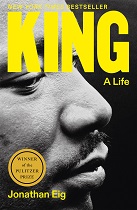
The late Huey P. Newton (1942-1989) once stated that “the first lesson a revolutionary must learn is that he is a doomed man“. These words by Newton have proven to be accurate when examining the lives of those who sought to enact radical change throughout the world. At 6:00 p.m., on the evening of April 4, 1968, Dr. Martin Luther King, Jr. (1929-1968) was standing on the second-floor balcony of the Lorraine Motel in Memphis, Tennessee embracing the fresh air when the sound of a gunshot was heard. The members of his entourage looked up to the balcony to see him lying on his back and mortally wounded. He was rushed to St. Joseph’s Hospital where he was declared dead at 7:05 p.m. An icon of the Civil Rights Movement had been silenced but his impact and words were not. Dr. King did not live to see the fruits of his labor, and he had come to accept that reality before his tragic death. His story has been told numerous times over the years, but when I saw this Pulitzer Prize winning book by Jonathan Eig, I decided to add it to my reading list. And what I found is a well-written, well-researched and balanced account of Dr. King’s short but extraordinary life.
As I began to read the book, I noticed that the footnotes are placed at the end of the book as opposed to the end of each chapter. This approach made the narrative flow much smoother, and I hardly noticed the page count while reading. The book does move chronologically as one would expect from a biography, but it feels more like a discussion than a timeline of King’s life. Further, the author pulls no punches when it comes to King’s faults but also gives credit to his successes, and this gives the book a well-rounded feeling to it. I do caution readers that it is necessary to approach the biography as unbiased as possible because there are parts of the story that do not show King is the most favorable light. But he was a human being and had his flaws like everyone else and there is more to the story than you will find in history textbooks.
The crucial historical moments in America’s past are discussed as they should be, but the private side of his life is where the book excels. His personal emotional struggles with fame and purpose, and infidelity are intense sections of the book but also revealing. Personally, I was aware of his romances outside of his marriage but the scale of it was larger than I had previously known. In fact, Eig’s book shows that the real number of women may be higher than anyone suspected. King was aware of his weakness but his statements regarding his father Martin Luther King, Sr. (1899-1984) are revealing. Women had always been a soft spot for the Kings, and Martin Jr., would find one of his most challenging experiences in his romance with a white woman named Amelia “Betty” Moitz. This is a part of Dr. King’s life I never learned about through any school textbook. In hindsight we know that the relationship did not last but the story is interesting and will have you asking yourself questions about the couple and how their lives would be in the year 2025. Of course, this was during the reign of Jim Crow and interracial dating and marriages were extremely taboo and, in some states, illegal. This section of the book alone should be a reminder of the many freedoms we sometimes take for granted.
Following his courtship of Coretta Scott (1927-2006), the couple elopes and begins to expand their family. However, we soon begin to see that Martin’s calling to the growing movement meant extensive time away from home. Although he did have strong bonds with his children, his rigorous travel schedule, and the amount of territory he covers in the book are surreal. Coretta authored her own book titled ‘My Life, My Love, My Legacy‘ which is a valuable resource regarding the couple’s home life. Thankfully, help in the movement comes in the form of other activists whose own lives would be deeply affected by their determination for equality. King’s friend and close colleague Rev. Ralph D. Abernathy (1926-1990), and mentors Bayard Rustin (1912-1987) and Stanley Levison (1912-1979) prove to be anchors to keep him grounded as the intensity of the movement increased. The relationship between King and Levison is a focal point in the story due to the latter’s affiliation with communist parties and the interest taken towards both men by the Federal Bureau of Investigation (“FBI”) led by J. Edgar Hoover (1924-1972), whose obsession with King was nothing short of paranoia. The FBI weighs heavily on the story not only due to its surveillance of King, but also due to the bureau’s actions towards other figures in the story such as Malcolm X (1925-1965) who is part of the story on a handful of occasions but represented a far more frightening alternative to Dr. King.
Throughout the book, King fights battles on every front, and his relationship with President Lyndon B. Johnson (1908-1973) produced some of the highest achievements in the lives of both men. However, it also marked the initial descent of their influence and popularity due to circumstances each struggled to control. The buildup and fallout are riveting and tragic but a critical part in the final four years of Martin’s life. Readers who lived through the events discussed in the book may feel a surge of memories coming flooding back to a time in America my father has described as the “scariest years of his life” due to the civil unrest, assassinations, and the war in Vietnam. While Martin was traveling, speaking, and laying his life on the line, Coretta was at home, but that does not mean she was immobile or insignificant. In fact, she was a source of strength and sanity for Martin when he arrived home. And had he retired from the movement as friends had suggested, this book would have a different ending. However, King had found his purpose and the last speech he gave in the days leading up to his assassination continues to give me chills.
Slowly but surely, the moment we know is coming arrives and the darkness surrounding it is no less pronounced today than it surely was then. An epilogue follows the narrative and provides a short follow-up to the post-assassination events. After finishing the book, I found a deeper appreciation for Dr. King’s work and legacy while at the same time accepting his flaws. J. Edgar Hoover was convinced that Dr. King was a “fraud”, but the truth is far more complex. While he may not have measured up to Hoover’s standards, he did place his life on the line for what he believed in, and in doing so he became an icon around the world. We can disagree on his approach and character, but his impact and achievements stand on their own merits. If you like this book, I also recommend Ralph Abernathy’s ‘And the Walls Came Tumbling Down‘ in which he discusses his friendship with Martin and the mission to break down Jim Crow.
ASIN : B0BBD5GXTF
Publisher : Farrar, Straus and Giroux (May 16, 2023)
 FREETHINKING BIBLIOPHILE