
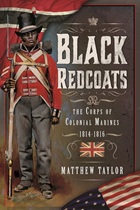
Recently I have found myself focusing more on American history and the 1800s, a century in which the United States underwent profound change. The American Revolution had given birth to a new republic free from British rule and over time it would grow into one of the most powerful nations on earth. However, there was a time when North America was far from united, and a dark reality awaited those brave enough to venture outside of its borders. Across the Atlantic Ocean, Britain had not forgotten about its former possessions and continued to maintain a presence in unchartered territory as it subverted American interests and supported the rights of Native Americans and enslaved Blacks. The growing tension between Britain and America culminated with a declaration of war by the United States against Great Britain on June 18, 1812. The conflict is known formally as the ‘War of 1812‘. Although I was familiar with the conflict, I was not aware of the Colonial Marines and their impact on the war. This book by author Matthew Taylor revisits the war and ‘Black Redcoats’ whose existence threatened America’s darkest institution.
I must admit that I learned extraordinarily little about the War of 1812 in school. And the American Revolution often overshadows it. But this three-year conflict is just as important as others, and in the book, we learn that chance played a significant role in the British choosing to suspend their campaign and agree to a truce. But had Britian decided a different course of action, the United States we know today might look vastly different or not exist. But I was extremely curious about the Colonial Marines. The questions I asked myself were answered quickly and the story told by the author is unbelievable. And in case the reader is not clear about the author’s premise, this quote sums it up precisely:
“The British had deployed a special weapon, a force of warriors with intimate and precise knowledge of the ground, resources, and people of the region that provided a force multiplier to British efforts that ultimately was to lead to the burning of Washington DC and could, had war continued, have led to the destruction of the United States.”
The author sets the stage by explaining the background of the war and how the two nations ended up in a second conflict. His explanation is straightforward and thorough, but by no means is it the final word, and I am sure there are scores of books about the War of 1812. However, regarding the story being told, the narrative fits where it should. It is not long before we learn about the Colonial Marines and how they came to be. In a genius move, Britain had found America’s “Achilles Heel” and as the war raged, these soldiers, inspired by the promise of freedom by Britain, set their sights on the country that was their home and kept them in bondage. As I read, I could easily see why the British recruitment effort was so successful. And once the word is out, the story changes gears as the Colonial Marines are born and their ranks are filled. And when North America became their target, slave owners’ worst nightmare came true and Washington, D.C., was brought to its knees.
Several weeks ago, I reviewed Elizabeth Dowling Taylor’s ‘A Slave in the White House: Paul Jennings and the Madisons‘, and in the book, we learn of the first couple’s escape from the White House as the War of 1812 heated up. The picture painted in Dowling’s book is grim, but the full story is far more chilling. While reading, I found myself at a loss for words as the suspense increased. America was at the brink of destruction and Britain had the option to make it final. In hindsight we know that America survived, and the reasons are explained by the author. But there is another part of the story which I had no knowledge of, and it was through this book that I first learned of Negro Fort in what was then called Spanish Florida.
When I read the words Negro Fort, my brain began scrambling for any details which would give me a clue regarding its existence. I soon realized I was in the dark and in store for a history lesson. This fort established by the British for Native Americans and formerly enslaved Blacks is equally as interesting as the role of the Colonial Marines in the war. And when the British decide to withdraw, they do not forget Negro Fort and do their best to ensure its survival. But a zealous military officer and future president named Andrew Jackson (1767-1845) had other ideas and before he left the White House in 1837, Florida changed significantly and Negro Fort became a distant memory. A full discussion of Jackson’s military career and actions towards Native Americans can easily fill another book and are subjects for a different discussion. However, he is important to the story being told and he did play a crucial role in the conflict. Despite Jackson’s eagerness, the reality was that without British support, Negro Fort was on its own and under threat until it finally fell. But for a time, it existed with Native Americas and former slaves living side by side in a region designated as free territory.
When I finished the book, I was grateful for the story told by Taylor. But I was also angry because I realized that I found yet more American history, I was never taught. And this is one more example of why it is imperative that we read and continue to learn the truth. If you are searching for a good discussion on American history and the War of 1812, this book is what you need. Highly recommended.
ASIN : B0CW1JS854
Publisher : Pen & Sword Military, May 30, 2024

