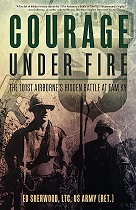
Courage Under Fire: The 101st Airborne’s Hidden Battle at Tam Ky – Ed Sherwood, LTC, U.S. Army (Ret.)

SherwoodIn August 1987, RKO Studio Pictures released ‘Hamburger Hill‘, a Vietnam War era film that recreated “Operation Apache Snow” (May 10, 1969 – June 7, 1969) and focused on the battle on Hill 937 in the A Shau valley known by infantrymen as the “Valley of Death”. The film is gritty, the deaths are gory and by the movie’s conclusion, the concept that war is hell on earth is firmly implanted in the viewer’s mind. However, viewers may not know that there was a second battle being waged at the same time on Hill 367 near Tam Ky. But this mission was called “Operation Lamar Plain” (May 15, 1969 – August 14, 1969) and remained hidden from the public for over fifty years. Lt. Ed Sherwood (Ret.) served in the 101st Airborne Division known as the “Screaming Eagles”, and experienced combat firsthand. And though he was evacuated before the battle’s conclusion due to a significant wound, he made it a goal to set the record straight regarding the battle no one back in America discussed.

As I began the story, I could not help but feel surprised that this battle is absent from books and films on the Vietnam War. In fact, I have watched Ken Burns’ docuseries ‘The Vietnam War‘ and do not recall anything focusing on Operation Lamar Plain or the troops who fought on Hill 367. I found it hard to believe that no one had heard of this battle. I soon learned that was not the case at all, and Sherwood explains towards the end of the book exactly why the public did not learn of the second operation taking place in the Valley of Death. The events on Hamburger Hill are discussed early in the book and Sherwood clears up any confusion that his book is about that battle. But more importantly, he also explains why the A Shau valley was so critical to both sides. It was an essential part of the Ho Chih Minh trail, an extensive network of pathways, routes and tunnels used by the NVA to move supplies. American military commanders know that the trail is critical to NVA operations and any effort to defeat North Vietnam must include destruction or seizure of the supply network. But the Vietnamese were not going away without a fight. And both sides know that a deadly battle lurks in the distance. But before we reach that point, there are other things taking place on the American side, explained by Sherwood as to why the rotation of personnel could be dangerous.

Eventually, Operation Lamar Plain arrives and two men stand out as the soldiers whose actions will help decide the fate of the battle. Captain Leland Roy and Lt. Paul Wharton. Their stories are surreal and a testament to the courage and commitment both men had to their unit and their mission. Sadly, there were significantly casualties suffered the 101st as the battle raged. Sherwood takes us through each day in chronological order with a listing of those killed or missing in action, and those awarded for their actions on the battlefield. I could not help but notice that the average ages of troops were between 19 and 22 years of age. I was disturbed at knowing some of those young men were not old enough to buy a drink in bar but were commander soldiers in life and death situations. And even darker, some of those same men, went to Vietnam and did come back alive. The subject of death and how it is managed is also discussed and there are no words to describe it. Rather, Sherwood sums it up perfectly as a former infantryman. As we learn in the book, the troops did not see themselves as heroes, they simply wanted to do their job and come home alive and in one piece.

Before I continue, I want to pay homage to a woman whose name I did not know before reading this book. She was Lt. Sharon Ann Lane (1943-1969) who was the only female servicewoman killed during combat in the Vietnam War. The circumstances surrounding her death are contained in the book and I also found myself in shock that I had never heard of her death in Vietnam related material.

As the time moves by, Sherwood also includes a list of things taking place back in America or “the world” as troops call it. It is nostalgic and older readers will have vivid memories of that era. But that nostalgia fades quickly as a new day begins and more blood is spilled. But I also noticed the discipline in which troops operated highlighting the necessity for teamwork and precision planning to be an effective combat unit. The men are tired, hungry, and scared but they continue to fight and eventually, the NVA breaks formation on Hill 367. The tide of the battle changes but the physical and mental scars will remain for the troops in the 101st on Hill 367. But if the battle was a success, why was it hidden? Well, Sherwood explains that:

“Once Operation Lamar Plain was successfully kept from the media, war protestors, and political adversaries, there was no benefit to the Military Assistance Command Vietnam, the Joint Chiefs of Staff, or the Nixon administration to disclose that a major battle with high casualties had been hidden from the American people.”

There are countless books, articles, and podcasts on why the American war effort in Vietnam failed in forcing Hanoi’s surrender. That is a discussion is for another time. Here, the focus is on the Hill 367 and the men who gave their lives in service of their country. Sherwood has captured their story for infinity in a book that should be included in all libraries containing material related to the Vietnam War. After finishing this book, I have an even higher level of respect and understanding for what soldiers experienced in Vietnam and why my uncle has rarely discussed that part of his life. Their memories are haunted by death, destruction, Post-Traumatic Stress Disorder (“PTSD”), exposure to Agent Orange and other dark aspects of armed conflict the public pays little attention to.  As Sherwood says, the next time you see a combat veteran, say “remember our fallen”.

“My greatest satisfaction in researching and writing Courage Under Fire was reconnecting over four decades later with veterans from my former 101st unit. Many have become close friends. Also important was finally letting the veterans of Tam Ky (and their families) learn of the battle they valiantly fought so long ago. ” – Lt. Ed Sherwood (Ret.) 

ASIN‏: B0916J8PHV

A Shot in the Moonlight: How a Freed Slave and a Confederate Soldier Fought for Justice in the Jim Crow South – Ben Montgomery

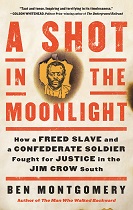
Montgomery_AShotInthe_9780316535540_HC.inddI am consistently amazed at the number of post-Civil War stories I have yet to learn. This book caught my attention, admittedly from the title alone, and it turned out to be an interesting account of an event that could have been lost to history. On the night of January 27, 1897, a mob of men appeared at the home of George Dinning (1857-1930), a former slave in Kentucky, and demanded that he vacate the home and leave the state. Dinning refused and as the two sides stated their positions, a shot was fired from outside the house. While in retreat and fearing for the lives of his wife and children, Dinning returned fire and mortally wounded Jodie Conn (1864-1897). Dinning turned himself in the next day and was later formally charged and charged with a crime. But prison was not the biggest threat. In fact, the local sheriff feared mob retribution at the hands of local whites and makes a quick decision that spares Dinning’s life. And this was the first step on a journey that not only shocked the State of Kentucky but one that changed the American legal system.
Today, the concept of due process is strong, and we have the right to a jury of our peers. But in 1897, for Black Americans, the average jury worked very differently. And if you were a black person accused of murdering a white person, death was almost guaranteed. But for George Dinning, that was not the case. A trial was held, and the author provides selected transcripts of the questioning to show how stories can be influenced and mis-represented. At the end of the proceedings, Dinning is convicted but the Governor of Kentucky, William O’Connell “Bill” Bradley (1847-1914), takes matters into his own hands and sends shockwaves throughout Kentucky.  And incredibly, Dinning’s saga is far from over.

Dinning eventually returns to Simpson County, Kentucky a free man. But his story catches the attention of reporters, politicians, and lawyers. This is where Bennett H. Young (1843-1919) enters the picture. As someone who works in the legal field today, this part of the book was highly relatable. However, I struggled with the fact that Young was a former Confederate soldier who strongly supported and Confederacy and its president Jefferson Davis (1808-1889), but he also believed in the advancement of Black Americans in the wake of the war. It is a contradiction that remains prevalent as the story moves forward to its conclusion.  Young consistently takes bold actions to help blacks that are a permanent part of his complicated legacy. Putting that aside, he does an incredible job of representing Dinning, who is awarded damages in a civil suit against several of the men who surrounded his house on that cold January night in 1897. The judge’s award sends shockwaves across America, changing the concept of legal rights for individuals. For other blacks, Dinning’s victory provided the courage needed to make their own claims for damages against those who had wronged them.  But though George Dinning had won in court, he was far from trouble free.

Following the successful lawsuit, Young eyed the remaining members of the mob and mounts further legal challenges. But before they play out, we reach the book’s darkest moment in which Dinning comes close to losing his life. This part of the story is disheartening yet Dinning again proves that he refused to be intimated or broken. He eventually leaves Kentucky and makes a new home in Indiana where he spent his remaining days. In 2019, Montgomery interviewed Anthony Denning, George’s great-grandson who carries the family named though the spelling is changed slightly. It is likely that Dinning himself made the change after leaving Kentucky. Regardless, the family lineage is intact to this day and George Dinning’s story lives on ninety-seven years after his death. This story has many components but the most important is that it is American history.

“A Winchester rifle should have a place of honor in every black home, and it should be used for that protection which te law refuses to give.” —Ida B. Wells (1862-1931)

ASIN: B0881Y6TGZ

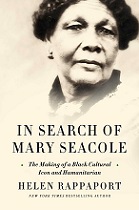
In Search of Mary Seacole: The Making of a Black Cultural Icon and Humanitarian – Helen Rappaport

Seacole

One of the reasons I love to read is because there is always something new to learn. In fact, I would go as far to say there is always a new story waiting to be learned of. I saw this book while browsing for a new read and could not recall seeing the name of Mary Jane Seacole (1805-1881) previously.  The image did look familiar but the story behind the face eluded me. There was only one thing left to do so I bought the book. And what I found is a story that is unique, interesting, and beneficial in discovering history that should be more widely known. Author Helen Rappaport went on a search for the real Mary Seacole, and though there are parts of her life lost to history, this account of her life is a solid foundation. 

I have seen online that debates continue in whether Seacole should be recognized as a nurse, businesswoman or other. The truth is that she was a mix of both and took advantage of the opportunities that came into her life. Her story begins on the island of Jamaica in the early 1800s. The author provides a good discussion of life in that Caribbean nation, then under the control of the British Government. England’s influence can be felt throughout the story, particularly during the Crimea War which Mary sees firsthand. But first, the story of Mary’s life plays out in Kingston, Jamaica. And this includes her marriage to Edwin Seacole (1803-1844). Following his death, Mary’s life took off and we follow her journey to Central America and Great Britain. She rarely sits still in the book and when the war breaks out, she moves again, determined to make her way to the battlefront to assist in any way possible. And it is here that I believe the confusion and controversy over her exact title begins. 

To be clear, Seacole was never designated as “nurse” in the traditional sense. However, she did render aid to wounded soldiers and had prior experience in confronting cholera, still largely misunderstood and without clear remedy. Today, we have an arsenal of tools to fight a cholera outbreak but in Seacole’s time, treatment was non-existent and home remedies were experimental. Further, Seacole was a businesswoman who had success and extensive contacts in the British military. But that success also came with enemies. And readers may be surprised to learn of the animosity between Seacole and the well-known Florence Nightingale (1820-1910). This part of the book did catch me off guard and the dislike and envy from Nightingale is glaringly apparent. Seacole was not a nurse, but she could not be ignored. Rappaport establishes Seacole’s importance with the remark that: 

“There is no doubt that from the late 1850s to her death in 1881, Mary Seacole was the most famous Black woman in the British Empire. Indeed, until she was voted Greatest Black Briton in 2004, only the Trinidadian pianist Winifred Atwell and the Welsh mixed-heritage singer Shirley Bassey had enjoyed an equivalent celebrity; but their popularity had not come until after the Second World War.” 

Seacole’s life was amazing but the biggest mystery in the book is her alleged daughter Sarah, also known as “Sally”. This part of the book leaves room for further research but from all indications, Sally disappeared, and her life remains unknown. However, that did not stop Nightingale from entering the fray and her allegations about Sarah’s parents are startling, but no conclusive evidence was ever produced. We may never know what happened to Sarah, but she did exist and is part of this story. 

Following the war, Mary moves around again, and finds herself in declining health. And on May 14, 1881, died in London at the age of seventy-five. Decades after her death the Jamaican government officially recognized her life and today, she is seen as an iconic figure in both Jamaican and British history but during her time, she endured hardships, heartache, racial prejudice, and sexism but persevered, nonetheless. This is a fascinating read about a figure who made her mark in history at a time when blacks and mixed-race people were still held in bondage. History buffs will also like that the author asks for any contributions to Seacole’s life be made online so if you do know more about her life that is not in the book, you can send the author your suggestions to make the Seacole story as complete as possible. 

ASIN: B09SGP3WJB

Power to the People: The World of the Black Panthers – Stephen Shames and Bobby Seale

ShamesIn his renowned book titled ‘Revolutionary Suicide’, Huey P. Newton (1942-1989) began by saying “the first lesson a revolutionary must learn is that he is a doomed man”. The prophetic words are haunting for many members and affiliates of the Black Panther Party met untimely deaths or were forced to flee the United States and live in exile. However, the Black Panther Party for Self Defense became part of history and when Bobby Seale and Newton created the organization in 1966, the created something that changed the way Black Americans viewed themselves. The image that comes to mind when one speaks of the Panthers are young black men with leather jackets and rifles. But behind the imposing public facade, the Panthers were brilliant community organizers and had a vision for Black Americans that could have changed the United States. Photographer Stephen Shames began to cover Panther rallies and eventually followed their progression. This book, co-authored with Seale, gives former members of the party a platform to explain their actions and decisions, in a time when America was amid social upheaval.

Instead of a standard account of the party’s creation, rise and demise, the authors here present a collection of interviews that touch on all aspects of the party’s existence. And to my surprise, I learned a few things I did not previously know. The beauty in the book is that readers can see the passion and hard work behind the scenes that motivated the Panthers to help the community. Party members were surely a mixed bag of characters, but at its core, the group and its affiliated chapters were committed to uplifting Black Americans and helping them to become self-sufficient so that they too could live the American dream. But what stood out to me nearly immediately was the age of the members. In fact, Ericka Huggins explains that: “one thing that people don’t understand about the Black Panther Party is that the median age of a party member in 1969 was nineteen years old“. Today we would say they were just kids but in 1966, those kids became adults and were determined to make their mark.

Readers familiar with the history of the party will know of the free-breakfast program which incredibly was deemed a threat by former Federal Bureau of Investigation (“FBI”) director J. Edgar Hoover (1924-1972). It is no secret that Hoover feared and loathed civil rights organizations whom he felt had “communist” influence. And the introduction of the infamous COINTEL program succeeded in breaking up the Panthers but at an inflated cost to the FBI and Hoover’s image in later years. But as I read the book, I was curious about other programs that Panthers initiated not just in Oakland, California, but across America. What I learned was impressive and surprising. One event that stands out is that shortly before his death, Fred Hampton (1948-1969) had reached an agreement with Jeff Fort, leader of the Black P. Stones gang in Chicago that would have struck fear in Washington, D.C. But due to Hampton’s assassination on December 4, 1969, the agreement died out. These events were recreated in the 2021 film ‘Judas and the Black Messiah‘, starring Daniel Kaluuyah as Hampton and LaKeith Stanfield as William O’Neal (1949-1990), the FBI informant who played a crucial role in Hampton’s demise. As the book progressed, it became even clearer to me why the Panthers were feared. It was not so much due to the presence of firearms but rather the knowledge and pride being instilled in Black Americans which was sorely needed following the murder of Malcolm X (1925-1965). Seale himself has said that had Malcolm not been murdered, the Black Panther Party would have never been created.

Eventually, the party began to disintegrate under the strain of infiltration by FBI informants which instilled paranoia and distrust among party members. The fallout is discussed by the participants, but the book is not an examination of why the party failed. It is chiefly a collection of memories, both good and bad. Among the more tragic parts is the death of George Jackson (1941-1971) on August 21, 1971, while incarcerated at San Quentin State Prison in San Quentin, California. The book ends before Newtown’s own death in 1989 but there is a discussion of the Panthers’ legacy and the situation in America which should be of concern to everyone regardless of their background. The Panthers no longer exist as the group they were once known as, but their presence and importance cannot be overlooked. And contained within this book are voices from the people that were there, risking their lives to give all power to the people.

ASIN: B01IDGS5EK

Overnight Code: The Life of Raye Montague, the Woman Who Revolutionized Naval Engineering – Paige Bowers and David Montague

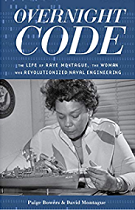
MontagueA friend once asked me why I loved history. I replied that there was always something to learn and that the history we learn in school is a fraction of the information that can be found regarding humanity’s evolution. When I saw the title of this book, I paused instantly and decided to investigate further. A brief synopsis on Amazon told me what I needed to know: there was an important story within that I did not previously know. My intuition was correct, and I felt a sense of shame at not knowing who the late Raye Montague (1935-2018) was and what she accomplished during her time working for the U.S. Government.  This book by Paige Owens and Montague’s son David, sets the record straight and ensures that her story will never be lost to history.

The story begins in Arkansas where Raye is born during the dark Jim Crow era in America. The descriptions of life for blacks in the South are exactly what you would expect to find of that era. And reading what life was like in America is still disturbing. But it is also a testament to the strength to be found in the people who moved forward in life despite their difficult origins. Montague’s story is typical for a Black American at that time, but it changes when she goes to work for Uncle Sam. She found herself in a brand-new environment with a young son she was raising as a single mother. Her trials and tribulations in the dating and marriage markets are discussed throughout the story and what we learn is surreal. But Montague never lets her personal life interfere with her professional life, and even goes to extreme lengths to keep her career going. However, she had to confront two obstacles in the forms of racism and sexism. As a black woman, she stepped into a world dominated by white men. And though she lacked the training they had been afforded, she learned on the job and by chance, is given an opportunity to work on the computers when the main engineers are unavailable. Her supervisor took notice and her life changed permanently.

To say that she accomplished incredible feats would be an understatement. Frankly, she embodies the concept of determination. And her uncanny intelligence is on full display and what she accomplished is amazing. Some of her awards are mentioned as the story progresses but after the book’s conclusion, a full list of her awards is provided, along with photos of Montague and her family. She was nothing short of brilliant. Yet despite her talent, knowledge, and ability to socialize anywhere, opposition to her advancement remained an issue throughout her entire career. She speaks frankly on the issues in the story but never speaks ill of anyone. I am sure she kept many grievances close to the chest as we say, but never lost sight of her goal to be the best engineer in her department. She reached that goal when she generated the first computer designed blueprint for a United States Naval vessel.

There are both antagonists and protagonists in the book. Her guardian angel comes in the form of Wallace “Wally” Dietrich whose guidance helps push her career forward. But there were also detractors, surprised to see a black woman as a peer. But to be fair, there are no acts of violence towards her, and she did form close relationships with co-workers both black and white. And through her hard work and perseverance, she was opening doors for women following her lead. Her personal struggles are the dark side of the book, and I could not believe what she went through in multiple marriages. But her son David was always her priority and she never wavered in making sure he was well taken care of. Today he continues to keep his mother’s legacy alive.

After I finished the book, I took a moment to think about everything I read. And I realized that this book is a perfect example of why history is important. The adage is true; if we want to know where we are going, we must know from where we came.

“I was put here for a reason,” she said. “That reason is to open doors for other people.” – Raye Montague

ASIN:‎ B085175PYS

The War State: The Cold War Origins of the Military Industrial Complex and the Power Elite – Michael Swanson

SwansonOn January 17, 1961, United States President Dwight D. Eisenhower (1890-1969) gave his farewell address to the nation as it prepared to inaugurate the incoming president, John F. Kennedy (1917-1963). During his address, Eisenhower warned of the “military industrial complex” and its influence over foreign policy. Four years later, America was on the path to war in Vietnam. Following World War II, the world felt relieved as the fighting ended and the planet began the lengthy process of rebuilding what had been lost. But what was not seen at the time publicly, were the growing hostilities between Washington and Moscow which began to form the nexus of the Cold War. But an important question is why did the Cold War take place? While it is true that it was not a traditional war in that troops were on the ground fighting, the world came close to the brink of nuclear war and had those weapons been used, I might not be sitting here today writing this blog post. Today, the United States military is both feared and admired, and the national defense budget for the year 2023 stands at eight hundred eight-six billion dollars. The figure is shocking, but it was not always this way. In fact, the national defense budget was far smaller as presidents sought to reduce military spending and focus on other domestic programs. But at some point, that changed and the money going towards America’s defense took on a life of its own. Author Michael Swanson explains the reasons why in this book that explores the Cold War’s origins, the military industrial complex and the powerful figures behind the scenes that influenced Capitol Hill and the White House as America locked it sights on the Soviet Union and exerting the United States’ influence around the world.
The author provides a primer early in the book to set the stage for the coming discussion, focusing on the financial costs of both World War I and World War II. While reading this section, I made note of a fact he provides about the collection of income tax that will surprise readers. As the second world war raged, American officials were eager to bring the war to a conclusion and prevent more casualties. Their wishes were granted in the form of two bombs that mankind had never seen before. But there were also other effects of the bomb that did not relate directly to its ability to cause destruction. In Moscow, all eyes focused on Japan as Hiroshima and Nagasaki were destroyed, and Soviet Premier Joseph Stalin (1878-1953) knew that things between the two nations had changed forever. As Swanson puts it:

“The detonation of the atomic bomb on Japan marked the beginning of the Cold War, because it posed an existential threat to the Soviet Union.”

In America, the Soviet Union was also seen as an existential threat to the nation’s safety. However, the country lacked an effective method of gathering intelligence. That all changed during the administration of Harry S. Truman (1884-1972), informally known as the “accidental president”. Truman held concerns about a Soviet arms buildup and knew that it would increase its weapons arsenal. He had to act and approved two key events that changed American foreign policy permanently. On September 18, 1947, Truman signed into law the National Security Act which paved the way for the creation of the Central Intelligence Agency (“CIA”). But he was not done there and as relayed by the author:

“Harry Truman ordered a reappraisal of national security policy. Completed on April 14, 1950, this report, titled National Security Council Report 68 (NSC-68), became one of the most important documents of the Cold War. It set the stage for a massive arms race and advocated intervention throughout the entire world.”

Frankly, the arms race was on, and every president after Truman would have to fight elements within their own government as fears of a “Red invasion” and “nuclear holocaust” spread across America. Radicals in the American government were convinced that there was a “missile gap” and that more weapons were needed. As Eisenhower enters the story, the pace of the book picks up due to the Cold War becoming a reality. In fact, the conflict forms the bulk of the book which finishes before the debacle in Vietnam. Eisenhower was a famed Allied commander during World War II and seen behind the scenes as an effective leader who preferred to move in silence when possible. But he was not naive to the growing influence of the military and powerful figures in Washington who wanted America to flex its military muscle. Today it seems surreal, but it is important to remember that during this time, there were people who deeply believed a pre-emptive strike against the Soviet Union was warranted and that war would eventually come no matter what. Eerily, they accepted the fact that millions of people in both countries would perish in less than an hour during a nuclear exchange. The unbelievable story is told here again, and readers will shake their heads in disbelief. But the story reaches an even higher level of insanity when America elected its first Irish-Catholic president.

John F. Kennedy remains highly popular to this day although he only served one thousand days in office before his murder in Dallas, Texas on November 22, 1963. But during his time in office, multiple crisis brought the United States and Soviet Union close to all-out war. He had inherited the Cold War and a Russian adversary named Nikita Khrushchev (1894-1971). And the pawn in the chess match between America and the Soviet Union was the small island of Cuba which came close to being the starting point for the next world war. Swanson revisits the two events that placed everyone on high alert:  The Bay of Pigs Invasion and the Cuban Missile Crisis. Readers familiar with both will read this section slightly faster but as someone who had read multiple books on the subject, Swanson version is also good. In fact, I found it to be a very condensed version that is easy to follow without reducing the suspense needed to convey the seriousness surrounding both historical events. As for Kennedy and Khruschev, both men found themselves in a similar position within their governments and shared the same vision for peace. However, both also had to contend with the fact that hardliners in their governments were eager for conflict and might go to any lengths to make it a reality. The author’s discussion of the final weekend in October 1962 will show the concern on both sides about a coup to remove people from positions of power. Thankfully, cooler heads prevailed, and nuclear war did not happen. But in Washington, that was not enough for the military industrial complex, and Southeast Asia was placed on its radar. Kennedy died before finalizing his plans for Indochina but his successor, Lyndon B. Johnson (1908-1973) made it clear that he would not reduce America’s presence and by the time the war ended in 1975, fifty-eight thousand American troops died in Vietnam. But that is a story for another time and another book.

Readers may be tempted to wonder why this story is important today if the Cold War is over. Well, the reason is that defense spending has never been reduced and continues to increase. But we must ask why? Which nation is an existential threat to America today? This section by Swanson towards the end of the book sums up the thinking that almost caused a third world war with nuclear weapons perfectly:

“In the 1950s, air force General Curtis LeMay said he had the ability to order SAC bombers to attack the Soviet Union and destroy all of its war-making capabilities “without losing a man to their defenses.” Americans were completely safe, but they lived in constant fear.”

The past is always prologue, and though the Soviet Union no longer exist, the ideological differences between Russia and America remain. But peace should be the goal and there is enough room on the planet for us all if we place value on our lives which are not guaranteed. This is a good discussion about American history and the dark directions the nation took under misguided fanatical warriors who warmly embraced what could have been Armageddon.

“Cold War? Hell, it was a hot war!” – Robert S. McNamara (1916-2009) (The Fog of War, Sony Pictures 2003)

ASIN:‎ B00EWLGXHW

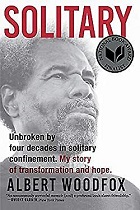
Solitary: Unbroken by Four Decades in Solitary Confinement. My Story of Transformation and Hope – Albert Woodfox

AlbertThe late rapper Tupac Amaru Shakur (1971-1996) soberly noted that prison kills one’s spirit. Each day becomes a repeat of the day before with instructions from guards and strictly observed times for each day’s events. Shakur served eight months in 1995 being bailed out while his conviction was on appeal. Tragically, he died on September 13, 1996, without the appeal having been decided. His story is unique but there are millions of others who are still in prison, serving extensive sentences in some of the country’s most dangerous facilities. Albert Woodfox (1947-2022) was one of those people, having served forty years in prison with most of the time served at Louisiana State Penitentiary in Angola also known as “the Farm”.  Woodfox’s story stands out because he not only served four decades but spent that time in solitary confinement for crimes he did not commit. This is the story of his life and time behind bars as he put his criminal past behind him and transformed himself into a civil rights activist and advocate for prison reform. 

The story begins in Louisiana where Woodfox was born to a mother who could not read and write, and a father who did not stay around to raise his son. But his mother meets another man who becomes his stepfather and fills the void left by his biological father. However, the happy family did not last, and a series of events fractured the once happy household, changing the lives of everyone for good. And it is not long before Woodfox begins his career on the street with drugs and petty crimes which result in early yet short prison sentences. But ironically, the crime that sends him to Angola was not one he was a participant in. Despite his conviction, he should have only served a few years there before being released. But that all changed on April 17, 1972, when corrections officer Brent Miller was stabbed to death. Woodfox did not know it at the time, but the murder of this guard would be the catalyst for keeping him behind bars for forty years. 

Miller’s murder is terrible, and readers should be aware that his last moments were nothing short of horrific. Woodfox becomes an immediate suspect due to his clashes with prison officials over living conditions. Even before Miller’s death, Woodfox was on the warden’s radar and the reasons for this will shock readers and force them to question whether prison is truly for rehabilitation. The conditions he describes are inhumane, but Angola has always had a reputation for being a place you do not want to go to. Despite knowing this, I still found myself aghast at what I was reading. Admittedly, when I read that Miller had been attacked, I did not think Woodfox was responsible. In fact, he was the last person I suspected. For him to murder Miller would have been completely insane due to his high profile and the fact that he had never met the guard. But there is far more to the story that will leave readers shaking their heads and questioning the criminal justice system. 

The saying a “jury of your peers” is supposed to carry significant weight but as can be seen in the book, for Woodfox and others accused of Miller’s murder, the State of Louisiana had other ideas. And we cannot overlook the issue of race which plays heavily in the events that follow. Woodfox had turned to the teachings of the Black Panther Party during his incarceration and had come to understand how his life was affected by the lack of a stable home. But that did not deter him from helping other inmates change their lives. Further, he speaks on a topic that will be upsetting to some readers and that is the dehumanizing experience of sexual assault. If there are any doubts that incarceration destroys what is left of someone, Woodfox removes it here. Frankly, what he describes is out of control but flourished with the knowledge and cooperation of guards whose goal was to break each man down to a shadow of his former self. But as the author explains, he refused to be broken and along with others committed to their cause, remained strong in the face of unrelenting racial hostility and pressure from prison officials. 

Unbelievably, Woodfox was convicted of Miller’s murder with two co-defendants. As someone who works in the legal field, I could not believe my eyes. To say that the investigation into Miller’s death was “sub-par” would be an understatement. In fact, there was hardly any investigation, and the real murderer never paid for the crime. Officials had who they wanted to be convicted and they succeeded. But, over time the story falls apart and attracts the attention of people outside the Angola becoming aware of the horrors the prison system inflicts on inmates. And even those who initially believed in Woodfox’s guilt, change their opinion after learning the truth about Miller’s murder. The efforts of his supporters were not in vain, and he does get a new trial but is convicted again for Miller’s murder. But the way the trial is conducted and the ways in which the prosecutors present their case is absolutely infuriating. Yet Woodfox remains unbroken. But that is not to say he didn’t suffer emotionally as well. He openly discusses his frustrations and the impact on his mental health from the deaths of loved ones he could not be with in their last moments. 

While Woodfox is focused on maintaining his sanity behind bars, outside of Angola interest in his case increases. He and his two co-defendants, Robert King, and Herman Wallace, become known as the Angola 3. King was released 2001 after accepting a plea deal which is explained in the book and Wallace died in 2013. I must warn readers that Wallace’s story is tough to read and the way the State of Louisiana treated this man even at the end of his time in Angola is surreal. Following his release, King becomes the spokesman for Woodfox’s release and the movement to change Angola. The author receives a guardian angel in the form of former U.S. District Court for the Middle District of Louisiana Judge James J. Brady (1944-2017) whose commitment to the law provides hope for Woodfox to keep his faith. This part of the story is interesting because we are witnesses to the legal battles between Brady and the Fifth Circuit Court of Appeals, each wrestling with the questions of Habeas Corpus, cruel and unusual punishment, and Woodfox’s right to fair trial. But in the background is the book’s antagonist, former Louisiana Attorney General James D. Caldwell, also known as Buddy Caldwell. His actions towards Woodfox are disheartening. Woodfox was eventually released but not in the way he would have preferred. However, it brought an end of over forty years of confinement, and he was able to live out his days free from Angola. Sadly, in August 2022, Woodfox became another victim of the Covid-19 virus and passed away at the age of seventy-five. He is now gone but this story will live forever and remind us of the horrors of solitary confinement, prosecutorial misconduct, racial injustice, and the tolls they take on one’s physical and mental health. 

“My fear was not of death itself, but a death without meaning.” —Huey Newton (1942-1989)

ASIN‏:‎ B07MWJ1NPM

The Trafficantes, Godfathers from Tampa, Florida: The Mafia, the CIA and the JFK Assassination – Ron Chepesiuk

trafficante

The official story put forth by the Warren Commission is that President John F. Kennedy (1917-1963) was shot and killed by Lee Harvey Oswald (1939-1963) who fired three shots from the Texas School Book Depository in Dallas, Texas on November 22, 1963. However, Oswald’s guilt has long been in doubt and in 1976, the House Select Committee on Assassinations found a “probable conspiracy” in Kennedy’s murder. Some believe that the conspirators included members of the Italian American Mafia, notably mob bosses Santo Trafficante, Jr. (1914-1987) of Florida and Carlos Marcello (1910-1993) of New Orleans, Louisiana. We know for certain that Oswald was at the Book Depository as the assassination happened. However, events that played out following the shooting in Dealey Plaza indicated a darker and more sinister climate of danger that awaited Kennedy as he stepped off Air Force One at Love Field that morning. It is no secret that mobsters were not fans of Kennedy or his brother, Attorney General Robert F. Kennedy (1929-1968). But did the mob have the power to kill the president? Author Ron Chepesiuk explores this question and more in this short book about the Trafficante family and the role the mob may have played in Kennedy’s death.

Believers of the lone gunman theory will not entertain any theories about the mob, CIA, or others. And for good reason. If we do believe the mob was involved, then a conspiracy exists. However, the mob did have motive, and that aspect is addressed in the book. But before we get to the Kennedy assassination, the author primes us with background information on Trafficante and his father Santo Trafficante, Sr. (1886-1954) who were the undisputed rulers of the Tampa underworld. The book is not an extensive biography of the father or son but provides basic information to understand who they were. But what is of more interest are the connections between them and other underworld figures, and this is where the plot thickens.

Because the book is short, there is a lot of information that is highly condensed. Readers may benefit from other material on the Kennedy assassination, and I always recommend the late Jim Maars’ (1943-2017) ‘Crossfire: The Plot That Killed Kennedy‘ which provides a thorough analysis of the shooting in Dealey Plaza, the death of Dallas Police Officer J.D. Tippit (1924-1963) and numerous other components of the crime that will send chills down your spine.  Chepesiuk’s story is solely on the Mafia, but he does mention other players when necessary.  However, the story here remains centered around the Trafficantes, Marcello and the nexus of underworld crime figures who welded power in America. There are no “smoking guns”, but I did notice that anyone expected to appear before the House Select Committee on Assassinations seemed to meet a sudden death. Appearances are made in the story by Chicago mobster Salvatore “Sam” Giacana (1908-1975) and mobster Johnny Roselli (1905-1976). Their stories are surreal, especially Giancana’s direct link to Kennedy.

It is impossible to discuss the mob’s anger at Kennedy without acknowledging the impact of former Cuban President Fidel Castro (1926-2016). Prior to the Cuban Revolution, the Mafia had turned Cuba into a cash machine and playground for Americans looking for a quick getaway to have fun. Former Cuban President Fulgencio Batista (1901-1973) had allowed the mob open reign but on January 1, 1959, that all changed as Castro marched triumphantly down the streets of Havana. Mobsters who had the means to do so, left as soon as they could. But Trafficante Jr. had an interesting experience in Cuba which I had forgotten about. It is telling of what Castro through of the mob and sets the stage for the future alliance between the CIA, Mafia, and disgruntled Cuban exiles. Castro was serious and the only way the mob could enjoy Cuba was if the bearded leader were gone. This is the beginning of a dark rabbit hole which we cannot go into here. But the author gives us an idea of the sinister partnerships that existed for “mutual benefit”.

There is one more section of the book I want to address, as no discussion of Kennedy’s murder can be held without addressing the dark presence of Jack Ruby (1911-1967), whose actions that weekend following the assassination were strange to say the least. The Warren Commission insisted that Oswald and Ruby did not know each other. But is that the truth? As seen in the book there is compelling evidence that they did know each other, and I recommend readers watch the documentary ‘Rush to Judgment‘ by the late Mark Lane (1924-2016) who published the book of the same name.  Ruby’s mob connections cannot be ignored, and the author weaves them into the story at hand showing that powerful figures were watching Oswald.

The truth about Kennedy’s murder may never be known. And if it is, maybe not in my lifetime as author Anthony Summers says in his book regarding the murder.  Thousands of pages of records are still classified, and as time passes, those with knowledge of what did happen will pass on taking what they know with them to the grave. But I do believe that we have enough information to know that Oswald was only a small piece in a larger puzzle. The mob certainly wanted Kennedy gone and benefited from his death. It had the money and power, but to a certain extent. Removing a president from office is a concerted effort dependent on compartmentalization, a concept the Mafia knew well. The list of Kennedy’s enemies was long, and his death was nothing short of regime change. The mob was only one enemy, and its role is still up for debate. But what Chepesiuk shows is that the mob had a personal stake in seeing Kennedy eliminated. For a good understanding of the powerful crime figures who had turned sour on Kennedy, this is an informative read.

ASIN: B003BIGGQA

Imperfect Union: How Jessie and John Frémont Mapped the West, Invented Celebrity, and Helped Cause the Civil War -Steve Inskeep

fremont

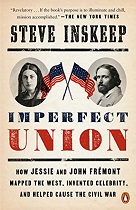
If you live in San Francisco or have visited the “City by the Bay”, I believe you will agree that views of the Golden Gate Bridge are nothing short of breathtaking. It is an iconic structure that is easily recognized as a symbol of the Golden State. But I confess that I never asked myself where the name Golden Gate came from. Two weeks about, this recommendation showed up in my feed. I did not know who John Charles Frémont (1813-1890) nor his wife Jessie Ann Benton Frémont (1824-1902). But the title of the book caught my attention, and I knew I had to make the purchase.  And having finished the book, I can say that not only was it a fulfilling read but also a story I should have learned years ago. In this informative and eye-opening book, author Steve Inskeep takes up back in time when America was still a young nation embracing expansionism into parts unknown and the life story an accomplished yet tragic explorer whose actions and experiences helped to write new chapters in the history of the United States.

Naturally, I wondered why I had never heard of John Frémont and his journeys west. I had a sobering realization that there is a great deal of American history that remains to be told.  John is the pivotal figure in the book and Inskeep provides an early recap of his early life and that of his wife Jessie, whose father, Senator Thomas Hart Benton (1782-1858) plays a significant role in both of their lives as the story progresses. Story picks up in pace as John begins the first of several expeditions that changed his life and the United States. Readers will take notice of the extensive periods of time that pass between the times John and Jessie are together. It may be hard for young readers to envision but in an era before modern forms of communication, letters were the only option. Frankly, there are parts of the story in which Jessie does not know where her husband is. We do as readers but putting myself in her place helped me to understand how rough life was in the early 1800s. Further, the extensive journeys are not for the faint at heart, as Inskeep shows with his descriptions of the harsh condition faced by Fremont and his parties. Adding to the suspense is the fact that Frémont was venturing into territory that did not belong to the United States. The stakes are high, not just for John but for others, including the famous Kit Carson (1809-1868) whose friendship with Frémont is on display as the two venture further west confronting the elements and the unknown.  Their excursions did not go unnoticed and as White American explorers continued to move west, tensions increased with Native Americans and Mexico who claimed a majority of what is today the State of California, igniting a major conflict which the author revisits to examine Frémont’s role. At home was Jessie, but as we learn in the book, she was not the type of woman to sit still and has her journey from start to finish which is also of interest for its moments of grief and reunions with John who she never ceased to love.  It can be argued that Jessie could have become a celebrity “First Lady” had Frémont been elected.

The annexation of territory outside of America’s border was ugly and the author does not hide this fact. The Mexican American War was a turning point in North American history and by its end, California’s fate had been changed permanently. Frémont has a significant role on the side of the United States, yet comically, he finds himself the target of military justice upon the war’s conclusion which saw him appointed as the first Governor of California. But U.S. President James K. Polk (1795-1849) who valued the officer’s successes and talents. Others also took notice, including a group of politicians who had recently formed the Republican Party. Running heavily on the platform against the expansion of slavery and if possible, its elimination, the Republicans struck fear across the South where slavery was a way of life. And it is this part of the book that explains the author’s contention that the Frémonts helped cause the American Civil War.

Of course, Frémont was not the proximate cause of the conflict but the expanding union which began to include more slavery-free states, raised eyebrows in the South. Surprisingly, I was not aware that Frémont was the first Republican candidate for president. The incredible story is contained here, and it is a valuable history lesson. Following Frémont’s rise to fame, his star slowly fades away as a new candidate named Abraham Lincoln (1809-1865) rises in the Republican Party and captures the White House in 1860. The South had already been on edge due to the Republican’s support for the abolition of slavery or the stop of its expansion. But a major trigger for the coming war can be found in how the Republicans won the election. This alone should have been a warning to the South that a conflict with the North would never be quick and easy. Sadly, the war did come and though Frémont was in Europe for a time, upon returning to America he suited up again for the Union Army as America was at war with itself.  The Confederacy eventually suffered defeat but for Frémont, he would never again have the fame he once had. And before Lincoln’s assassination, the two clashed over Frémont’s fiercely independent nature. The details are within and caused me to ponder if Frémont carried bitterness toward Lincoln for becoming president. Inskeep does not explore that idea and it is up to readers to draw their own conclusions. The latter part of his life is uneventful but also heartbreaking for we see a man who is restless and in need of action true to his character. There is no happy conclusion for Frémont nor for Jessie. But unlike her husband, she made the best of her later years, and even published several books during her lifetime. John’s final days are sad, but he did live a life full of incredible experiences that are part of America’s legacy. And any time I visit San Francisco, I will stand at the Golden Gate with an understanding of how and why it all came to be.

ASIN:‎ B07S7M8T4T

The Big Heist: The Real Story of the Lufthansa Heist, the Mafia, and Murder – Anthony M. DeStefano

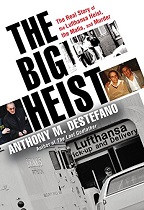
LufthansaDuring a recent discussion with a friend, he confessed to being unaware that the airport robbery referenced in the 1990 Warner Bros. film ‘Goodfellas‘, was about the infamous heist at the Lufthansa cargo terminal at John F. Kennedy International Airport on December 11, 1978. The thieves made off with an estimated $5.875 million dollars in currency and jewelry. To this day, the stolen goods have never been recovered.  The heist and the loot were tightly controlled by Lucchese Family associate James “Jimmy the Gent” Burke (1931-1996), portrayed on screen by Robert DeNiro. The character in the film is cold and calculating but pales in comparison to the real-life mobster whose penchant for murder scared even the most hardened gangsters. Burke died in prison in 1996 while serving time for unrelated crimes and was never convicted for his role in the heist. However, a surviving mobster from the crew at Robert’s Lounge, Vincent Asaro, was tried and acquitted in 2015 for his alleged role in the crime.  In 2017 he was tried and convicted in a separate case which involved a vehicle being set on fire. However, he is currently a free man, having been released due to the Coronavirus Pandemic and deteriorating health. The other major participants in the crime are all deceased leaving Asaro as the last man standing. But, if he did take part in the crime, why is he never mentioned in the film? And what exactly happened that night at JFK when Burke’s crew pulled off the infamous heist?

Anthony DeStefano takes another look at the Lufthansa Heist and the failed attempt to convict Asaro, to break down the series of events that led up to the heist, and the real-life stories of the people in the mafia underworld.  I did see some reviews on Amazon which pointed out that the book is average. And while I can say that there are no “smoking guns”, where the book does excel is helping the reader and fans of the film to understand the gangsters who were part of Burke’s crew and the world, they operated in.  This book fills in some gaps in the story known because of the film. Most significant is the murder of Paul Katz on December 6, 1969. This crime is not mentioned in the film, and I previously was not aware of the full story. Further, the criminal histories of both Burke and Lucchese Family mobster Paul Vario (1914-1988), who is known as Paul Cicero in the film. The late Paul Sorvino (1939-2022) was excellent as Vario, but the real-life gangster could be far deadlier than the on-screen version. His story, as told here, might shock readers. And even Hill benefited from the charisma of Ray Liotta (1954-2022) who presents a deeply flawed character that is also likeable in the film. The real-life Hill was nowhere near as smooth as the man we see on screen. But the movie was right in showing that Hill did not take part in the robbery. However, he was entrenched in the planning and execution. And for reasons that may be lost to history, he survived a killing spree in which Burke removed connections that could landed him behind bars for the Lufthansa Heist.

While watching the film, it is easy to like some of the characters. But make no mistake, the real mobsters at Robert’s Lounge, who also spent time at Hill’s bar, The Suite, were hard core criminals with drug habits, gambling addictions, violent streaks, and limited formal education. The streets are where they plied their trade, and Kennedy Airport was their playground. In fact, the film only captures a small part of the hijacking aspect. And for the first time here, I learned more of Thomas DeSimone’s (1950-1979) criminal history.  He is named Thomas DeVito in the film and played by the iconic Joe Pesci. Hill said that the portrayal was about 95% accurate, but again, the real-life Tommy was far more ruthless than what is shown in the film. But what is constant both here and, in the film, is that Tommy was a loose cannon. And the section in the book regarding his demise reveals yet another fact left out of the film. There is far more to Tommy’s story than is covered here, and there are dozens of videos online that address the real story behind Goodfellas. However, DeStefano provides intriguing information.

Admittedly, the story does move around a little between Asaro, Burke and Robert’s Lounge’s crew. But towards the end, DeStefano ties it all together as the trial comes into focus and a forty-year-old crime comes back to life. I cannot say I was surprised by the acquittal, but I do think the trial revealed crucial facts about the Lucchese Family’s inner workings that will cause moviegoers to re-think how they see the film. To be fair, Martin Scorsese made an incredible film, and it is extremely accurate. However, there are noticeable changes with the script that omit key events that would have explained some of the scenes in the film. Nevertheless, the movie is considered a masterpiece, and rightfully so.  It remains a favorite in my collection. But when we take a closer look at the ‘Goodfellas’ story, the glamour comes off, revealing a murky world full of deceit, greed, and violence.  If you liked the movie and are interested in the back story of Henry Hill and his co-conspirators, this is an informative read.

““When I met Jimmy Burke in 1964, he practically owned New York’s Kennedy Airport. If you ask me, they named the place after the wrong Irishman.” – Henry Hill (1943-2012)

ASIN:‎ B07TT3PYSM