
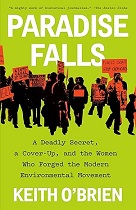
 In the 1890s, William T. Love set his sights on the Niagara River near Niagara Falls, New York. He envisioned a lively city full of promise but in 1893, a financial panic disrupted his plans, and by 1897, Love had abandoned his dream. However, the land was deemed valuable by others, and in the 1940s, the Chemical Hooker Company (“Hooker”) purchased the area that had become known as “Love Canal”. In 1953, the company sold the land to the Niagara Falls City School District at the low price of one dollar. To the board it seemed like a dream come true, but lurking underneath the surface were secrets that should have been cause for alarm. For the residents of Love Canal, the neighborhood they had grown to love, became the biggest threat to their lives. When I saw this book for purchase, I stopped for a moment to consider what I knew about Love Canal. I was aware that it was known for being contaminated, but there is far more to the story told by author, Keith O’Brien, who takes a deep dive into the tragic history that will leave you speechless.
The book commences by revisiting the experience of Debbie Gallo, who suffers burns while visiting a local playground. Her mother rushes her to the hospital, and the young girl makes a full recovery. However, their experience was mild in comparison to what was to come. After a brief explanation of the canal’s history and Love himself, the story picks up pace as the main characters enter the story. We soon learn about the families of Lois Gibbs and Luella Kenny, two mothers whose voices became irreplaceable in the struggle to hold Hooker responsible for the contaminants lurking in Love Canal. On the government side, the response from New York States comes through the words and actions of former Governor Hugh Carey (1919-2011) and former Health Commissioner David Axelrod (1935-1994). Carey weaves his in and out of the story, leaving Axlerod to manage the bulk of the tasks as health commissioner. But interestingly, even the health department had its own internal divisions over the Love Canal scandal, with the fiercest advocate for change being Beverly Paigen (1938-2020), whose story highlights the politics at play within the agency. The story is certainly a mix of pivotal figures, including then President James Earl “Jimmy” Carter, who inherits the Love Canal problem which becomes a hotbed political issue as his campaign for re-election is threaten by the popularity of Republican candidate Ronald Reagan (1911-2004). But none of this should take the attention away from the real victims in the story, the people of Love Canal. What they experienced was nothing short of horrific.
As I read the story, I found myself aghast at the staggering number of toxic chemicals investigators found at Love Canal. And regardless of the name revealed, it is understood that none were safe for human exposure. While the State of New York was going through the motions in responding to the crisis, families were falling apart. The story of Luella Kenny and her son Jon Allen is heartbreaking. The signs were there but it seemed as if no one was paying attention except Luella, who knew something was wrong with her son. Then there is the story of Elene Thorton, a resident of public housing who becomes a vocal critic on behalf of the black residents of Love Canal also struggling to have their stories told. Sadly, even in the time of a major crisis, the issue of race comes into play. And the monsters known as envy and greed also enter the story and threaten to undermine the effort to hold Hooker accountable. Frankly, no one comes out of the experience unscathed. Even Gibbs who becomes the spokeswoman for Love Canal saw her personal life suffer. Her two lives are revisited as the author peels the layers back on the tragedy, revealing the incredible sacrifices by those determined to find resolution.
Probing by investigators underscores the disturbing reality that Hooker had not been fully transparent. But the find that breaks the camel’s back is the discovery of a dreaded and well-known pollutant called Dioxin. You may have heard the name before as it is a known cancer-causing toxin used in the herbicide labeled “Agent Orange” during the Vietnam War. At this point in the story, the floodgates are opened, and Washington can no longer ignore the Love Canal issue. To be fair, President Carter does take action, and the Super Fund legislation is passed by Congress. And the offer by Governor Carey to buy the property of homeowners in Love Canal was a good will gesture. But the efforts were sometimes too little too late. Those who survived Love Canal did so at the cost of personal hardship and in some cases, with lingering health issues.
Today there are new residents living near Love Canal which officials insist are safe. However, I doubt that we will fully know how deep the pollution was in the area. Yes, investigators cleaned up what was possible and demolished unsafe structures. But contamination is never a quick fix and for several decades, Hooker Chemical had free reign to dump its toxins. The story of Love Canal is the proof we need of how lack of oversight can have deadly consequences. This story is unbelievable and includes everything you would expect about a tragedy in a small American town. There are tears, death, fame, jubilation and even a hostage situation as the people of Love Canal fight for their lives when a paradise fell. Highly recommended.
ASIN : B096DLTZF5
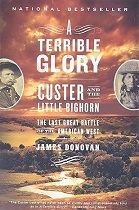 On June 25, 1876, the United States Army’s Seventh Calvary Unit engaged a combined force of Lakota Sioux, Northern Cheyenne, and Arapaho tribe warriors in a battle which resulted in a stunning defeat for the military and became known as “Custer’s Last Stand” due to the death of
  Provisional data from the National Center for Health Statistics at the end of December 2022, showed that overdose deaths in America remained at over one hundred thousand. Although a decrease from the previous year, the statistics are sobering and a reminder that the war against opioid addiction continues as fentanyl claim victims, and a new drug “
 On September 19, 1881, Vice-President
 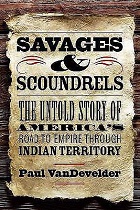 I am constantly amazed by the amount of history regarding the creation of the United States that I have yet to learn. The story of North America’s indigenous population is a heartbreaking account that receives scant attention today. America’s expansion from thirteen British Colonies to world superpower is unparallel in world history but the dark reality behind that metamorphosis is that Native American tribes once widespread across the continent were systematically uprooted, and, in some cases pushed into extinction. On the natives’ side, battles for territory and supremacy raged and the blood spilled as tribes waged war with each other cannot be overlooked. The events that took place in North America upon the birth of a nation are a far cry from the happy portrait that that is portrayed at “Thanksgiving”. Author Paul Van Develder explores the past during the era when “Manifest Destiny” drove westward expansion and turned open territory into deadly battlefields.
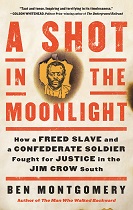 I am consistently amazed at the number of post-Civil War stories I have yet to learn. This book caught my attention, admittedly from the title alone, and it turned out to be an interesting account of an event that could have been lost to history. On the night of January 27, 1897, a mob of men appeared at the home of
  In his renowned book titled ‘
 On January 17, 1961, United States President
 FREETHINKING BIBLIOPHILE
You must be logged in to post a comment.