

Earlier this year I posted a review of Gregory David Roberts’ masterpiece ‘Shantaram’, a fictional novel based loosely on his life story and events that transpired in Bombay, India, known today as Mumbai. The story is unbelievable yet intriguing from the start with a cast of characters that are sure to be remembered. I recently finished this sequel to Shantaram in which Roberts continues his story two years after the finale in part one. And like the first book, the story at hand here is unforgettable and filled with plot twists that will satisfy fans. At over eight hundred pages, the book is not a quick read and due to Roberts’ writing style, the pace of the story moves quickly. In contrast to the first part, it was easier keeping track of the characters in this story. There are familiar names from part one such as Lisa, Didier, Kavita, and Karla, who emerged in part one as the object of Lin’s affection. Their exploits are far from over and by the time this book is over, they have run amok all over Bombay on missions not for the faint at heart.
The book opens with Lin engaged in his routine criminal activity. He is still living with Lisa who Karla rescued from the infamous Madame Zhou in part one. Lisa has turned her life around and has set her sights on bigger things. Lin, however, is still running around with underworld figures. He visits a local drug spot to rescue a friend named Vikram who has a serious addiction. There he meets the Irishman Concannon and Dennis who both play crucial roles later in the story. But before we reach that point, the Company and Lin have their own issues as they face a threat from rival gang the Scorpions and Lin realizes that he wants out of the criminal life. Company boss Sanjay, who is not popular, is willing to let him leave but not before one last mission in Sri Lanka which Lin accomplishes. But while he is gone, a series of events in Bombay involving Lisa transpire that turn his world upside down and signal that the story is about to take a sharp turn. Upon returning to Bombay aided by suspicions implanted by the Blue Hijab’s words, Lin becomes a man destined to find the truth. And to help him find that truth, Karla fills the void and their complicated past from part one comes back to life as they each wrestle with the lives they have created. Madame Zhou also returns filled with rage and thirsting for revenge. Lin is also seeking revenge but is burdened with the reality of being a Company outsider and a target of the Scorpions. His protector and brother in arms Abdullah stands by his side in this part as well as the fearless warrior who stares death in the face and is the main threat to Sanjay’s reign in a metaphorical clash of the titans.
Lin finds himself in a strange place realizing that he has done too much to turn back and done too much to move forward without pushback. Added to his issues are the plights of Divya, Rannvieg and Ranjit, Karla’s husband. Lin is the person they all seek out for help and like a juggler, he confronts and diffuses situations but not always without violence. And lurking in the background is Concannon who is by far the book’s biggest antagonist. But Lin is far from alone, and standing behind him is the Frenchman Didier, who is not only the comic relief in the book, but the type of muscle needed when the streets are hot. His sexual orientation is the source of controversy more than once in the book, but he never fails to show his strength when needed. He is, without question, my favorite character in the book.
As the story picks up in pace upon Lin’s return to Bombay, the chips begin to fall, and the fallout is nothing short of astounding. Frankly, there are a lot of departures and few arrivals. While reading the latter part of the story, I could tell that things were coming to a head and the final part of the story would leave no stone unturned. There is heartache at the end but also justice even if it is unconventional. Lin is alive to tell the story but not without his demons and the realization that the dark side of Bombay is darker than one may think. But there are ways out and throughout the story, that is a common theme. The problem, however, is that everyone is in too deep. From Vikram to the corrupt police official Lightning Dilip and even Diyva’s father, all are up to their necks in some scheme or racket in Bombay. That is not to say there are no morals in the story. In fact, the characters are fully aware of their shortcomings and the choices they have made in life. And that is a part of the story that can be lost. In both books, each person is confronted repeatedly with moral challenges that test human nature and our willingness to corrupt ourselves to survive or to indulge. Idriss is the guru on the mountain they seek enlightenment from and the discussion they have provides something to consider. But even Idriss cannot stop the deadly actions in Bombay from reaching the mountain. Abdullah never fails his mission and the last time they visit the mountain in the story, all debts are paid.
Readers in search of a short story will not find it here but those who enjoy long books and intricate storytelling will love this. And if you have read Shantaram, you must read this. I have yet to watch the television show based on it, but my hope is that it does the book the justice it deserves.
ISBN-10: 0802125557
ISBN-13: 978-0802125552
 February 9, 1979 marked 40 years since Paramount pictures released the cult-classic film
  This weekend, I took advantage of some free time to revisit this classic book by the late author George Orwell (1903-1950). I had been thinking about it for some time as I watched news to remain aware of the continuing Covid-19 pandemic and developments in China, in particular Beijing’s efforts to place Hong Kong firmly in its grip. North Korea increased tensions with South Korea by termination diplomatic relations and destroying the joint liaison office used for meetings between world powers and Pyongyang. The world seems to be at the brink of anarchy as right-wing figures rise to power and in the process take their nations in a different course away from progressivism. In some nations, the state becomes the face of nation and party rules over the individual. Essentially, in the years since this book was written, we have seen the rise of what Orwell called Big Brother.
When he wrote this book in 1949, I do not believe that Orwell had any idea that this book would become the blueprint for the totalitarian police states we see in existence today. This book became so popular that not only is it assigned reading for many students but it was also adapted for the silver screen in 1984 by Michael Radford. The film of the same name was released on March 22, 1985 and starred John Hurt and the late Richard Burton. Since that time, it has remained a masterpiece about the watchful eyes of the government and is often cited during discussions about invasion of privacy and overreach by the government.
The main character is Winston Smith, a party worker in the Records Department within the Ministry of Truth, whose job it is to re-write the past according to Big Brother’s doctrine. He is married but separated from his wife Katherine who appears briefly in the story and always in the past. He suffers from an ulcer that will not heal and spends his days revisioning history using the new language Newspeak. He has no life outside of the party and his existence is a repetition of the prior day. Winston does his job with no emotion but has his doubts about Big Brother. His co-workers Syme and Parsons tow the party line and make every effort to show allegiance to the state.
By chance, Winston meets a young lady in the department named Julia. At first she is elusive but the two eventually become close, too close for comfort according to Big Brother. They seek refuge at the residence of Mr. Charrington under the impression that their meetings are discreet. They are committed in their belief that Big Brother is a fraud and that their way of life cannot continue to exist in that form. Winston and Julia are soon introduced to a crucial character named O’Brien and in his presence they confess their true feelings. O’Brien invites them to the Brotherhood and they leave with strict instructions as to how to move forward. The main requirement is that they read the book by Emmanuel Goldstein, the radical figure who remains the target of the “Two Minutes of Hate” program aimed at discrediting his reputation. Winston eventually gets his hands on the book and during a tryst with Julia, begins to read to to her. But unbeknownst to them, things were about to take a dark turn for the worst and Big Brother was about to make his presence felt.
The final part of the book is without question the best. As O’Brien’s true role emerges, the reality of Big Brother’s endgame becomes hauntingly clear. The party’s slogan that War is Peace, Freedom is Slavery and Ignorance is Strength, are reinforced sadistically by O’Brien. His goal is get Winston to see the truth in Big Brother’s existence and is committed to breaking him down so that Winston can be rebuilt. Today we would call it “re-education” as it is known in state-controlled nations. The full party doctrine comes flowing out of O’Brien’s mouth and there is one line in particular that sums up the party’s stance:
This weekend, I took advantage of some free time to revisit this classic book by the late author George Orwell (1903-1950). I had been thinking about it for some time as I watched news to remain aware of the continuing Covid-19 pandemic and developments in China, in particular Beijing’s efforts to place Hong Kong firmly in its grip. North Korea increased tensions with South Korea by termination diplomatic relations and destroying the joint liaison office used for meetings between world powers and Pyongyang. The world seems to be at the brink of anarchy as right-wing figures rise to power and in the process take their nations in a different course away from progressivism. In some nations, the state becomes the face of nation and party rules over the individual. Essentially, in the years since this book was written, we have seen the rise of what Orwell called Big Brother.
When he wrote this book in 1949, I do not believe that Orwell had any idea that this book would become the blueprint for the totalitarian police states we see in existence today. This book became so popular that not only is it assigned reading for many students but it was also adapted for the silver screen in 1984 by Michael Radford. The film of the same name was released on March 22, 1985 and starred John Hurt and the late Richard Burton. Since that time, it has remained a masterpiece about the watchful eyes of the government and is often cited during discussions about invasion of privacy and overreach by the government.
The main character is Winston Smith, a party worker in the Records Department within the Ministry of Truth, whose job it is to re-write the past according to Big Brother’s doctrine. He is married but separated from his wife Katherine who appears briefly in the story and always in the past. He suffers from an ulcer that will not heal and spends his days revisioning history using the new language Newspeak. He has no life outside of the party and his existence is a repetition of the prior day. Winston does his job with no emotion but has his doubts about Big Brother. His co-workers Syme and Parsons tow the party line and make every effort to show allegiance to the state.
By chance, Winston meets a young lady in the department named Julia. At first she is elusive but the two eventually become close, too close for comfort according to Big Brother. They seek refuge at the residence of Mr. Charrington under the impression that their meetings are discreet. They are committed in their belief that Big Brother is a fraud and that their way of life cannot continue to exist in that form. Winston and Julia are soon introduced to a crucial character named O’Brien and in his presence they confess their true feelings. O’Brien invites them to the Brotherhood and they leave with strict instructions as to how to move forward. The main requirement is that they read the book by Emmanuel Goldstein, the radical figure who remains the target of the “Two Minutes of Hate” program aimed at discrediting his reputation. Winston eventually gets his hands on the book and during a tryst with Julia, begins to read to to her. But unbeknownst to them, things were about to take a dark turn for the worst and Big Brother was about to make his presence felt.
The final part of the book is without question the best. As O’Brien’s true role emerges, the reality of Big Brother’s endgame becomes hauntingly clear. The party’s slogan that War is Peace, Freedom is Slavery and Ignorance is Strength, are reinforced sadistically by O’Brien. His goal is get Winston to see the truth in Big Brother’s existence and is committed to breaking him down so that Winston can be rebuilt. Today we would call it “re-education” as it is known in state-controlled nations. The full party doctrine comes flowing out of O’Brien’s mouth and there is one line in particular that sums up the party’s stance:
 My father recommended this book at the end of a conversation during one of my typical weekend visits. He commented that he had read the book during his late teen years and always remembered it for standing out as unforgettable. When I arrived back home, I went online to begin my search and quickly found it on Amazon. The book is fiction, which I rarely read, but my father generally has great recommendations on all types of media. And I am happy to report that once again, he did not let me down. I have already called him twice to discuss this short but powerful book by the late Samuel Eldred Greenlee, Jr. (1930-2014). The title alone is enough to raise eyebrows and at first glance, seems politically incorrect. But behind the cover page is a story that takes the ingredients of Washington, the Central Intelligence Agency (CIA), Civil Rights Movement and Black militancy and combines them into tale that is sure to be remembered for years to come by all who have opened the pages of this book.
 Many of us believe that it could never happen here and that the United States is too stable and developed for the military to even attempt a coup. The suggestion would be dismissed instantly by those who believe such things happen in Third World nations. But what if it did happen in the United States? And how would the plot develop? Fletcher Knebel (1911-1993) and Charles W. Bailey, II (1929-2012) put their minds together as they pondered these questions and others resulting in this masterpiece, Seven Days in May. According to legend, President John F. Kennedy (1917-1963) liked the book so much that he allowed director John Frankenheimer (1930-2002) to use the White House grounds while creating the film of the same name that was released in 1964 starring Burt Lancaster (1913-1994) and Kirk Douglas (1916-). Kennedy did not live to see the film and his assassination was more than the writers could have imagined as they created this book.
 In volume two of this three-part series, Bureau 13 saved mankind for a second time as they battled a crafty villain on the USS Intrepid and New York City’s West Side Highway. At the conclusion of the book, we were able to breathe a sigh of relief as Special Agent Ed Alvarez and his team prevailed. However, for Bureau 13, there is no such thing as the end and they are back again as a new enemy threatens to obliterate the City of Chicago and turn the United States in a land of werewolves. At first, the mere mention of werewolves sounds implausible. But we must remember that this is Bureau 13 where the impossible becomes possible on a daily basis.
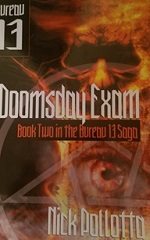 Author Nick Pollotta returns with this second installment in the trilogy of the story of Bureau 13, the secret agency within the U.S. Department of Justice responsible for the tracking and apprehension of all supernatural creatures that pose a treat to the safety of the nation. In
 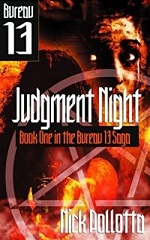 Nearly all of the reviews I have written have been of books that are classified as non-fiction. This review will be different as I have a taken a short break from the normal material to let my mind have some fun with this book that was recommended to me by a co-worker. It is book one in a trilogy and the review for the second book will follow shortly. The cover of the book gives the reader the indication that it is a novel of horror of the most unspeakable kind. However, I can assure that is not the case but the book is a non-stop ride from beginning to end. If I had to give it a definite classification, I would reply that it is a place where the Men In Black meets The Suicide Squad, Harry Potter with a touch of Fallout added. But what exactly is the book about? And what on earth is Bureau 13?
 The story begins in Harlem, New York as we are introduced to a musician named Rufus Scott. He has just met a recent transplant to New York City from Georgia named Leona. Sparks fly between the two and Rufus invites her to an after party at the apartment of a friend. It is there that they come intimate and that encounter sets into motion a chain of events that affects nearly every single character in the book. Rufus’ best friend in Vivaldo, a young Italian from Brooklyn. He is involved with an older woman named Jane, who has a drinking problem but somehow manages to function and continue painting. At first, Rufus and Leona are on the path to love but reality quickly sets in. You see, Rufus is a Black American and Leona, a white woman from the South. And this is before laws against interracial marriage were ruled unconstitutional by the Supreme Court. Their trials and tribulations are heartbreaking and Rufus struggles with Leona and himself all the way to the end. Incredibly, the two of them only take up a third of book, the rest is devoted to Rufus’ friends and former flame, who all converge to add unexpected twist and turns to each other’s lives.
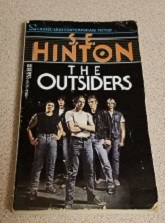 This past weekend I had the fortune of becoming re-acquainted with two of my teachers from the eighth grade. One of them has now turned eighty and looks as sharp as she did when I was a thirteen year-old kid. During the conversation, I mentioned that I still had my copy of The Outsiders, the book we read as a class that has remained with me to this day and occupies a space on my bookshelf. I find it incredible that after nearly twenty-five years, I still love the book and remember passages from the book in their entirety. It is a classic story given to us as a gift that keeps on giving by famed author S.E. Hinton (1948-). The book is popular among many of my peers and my former teacher has recently given a copy to her grandsons so that they may find joy in the book. I had the pleasure to meet both of them and believe that they will turn out to be fine young men. Many years from now, they took will look back on The Outsiders as one of the greatest books they have ever read.
 FREETHINKING BIBLIOPHILE
You must be logged in to post a comment.