
 I recently reviewed Volume I in this exceptional review of the murder of President John F. Kennedy (1917-1963). Author John M. Newman returns in Volume II to the incredible story of the events leading up to Kennedy’s time in office and his untimely demise. Here we change gears and take a deeper look at the alleged defection of Lee Harvey Oswald (1939-1963) to the Soviet Union, the mob ties of Joseph P. Kennedy, Sr. (1888-1969), the role of Italian-American mobster Sam Giancana (1908-1975) and the foreign policy decisions in Cuba, the Congo and Southeast Asia.
The story of Lee Harvey Oswald is an open and shut case if you believe the government’s official story. What we do know is that he did in fact travel to the Soviet Union and attempted to renounce his U.S. Citizenship. But what is often left out of the discussion is did he actually renounce it? To some the question might seem strange but if we take a closer look along with the author, we see that many of Oswald’s actions in Russia did not make sense. In fact, things were so confusing that his mother Marguerite Oswald (1907-1981) wrote to the State Department to verify if her son had given up his U.S. Citizenship. If you eyebrows are now raised, you are on the right track and what follows in this book will change your perception of Oswald’s possible intentions in the Soviet Union. Admittedly, Oswald is still a mysterious figure. The amount of information known about him still pales slightly to the unknown information surrounding his career in the military and his actions in Dallas leading up to Kennedy’s murder. The Central Intelligence Agency (CIA) has generally been quite vague about what it knew about Oswald’s attempted defection and his return to the United States. The opening of the infmamous 201 file on Oswald has always been a topic of discussion in assassination researcher circles and for good reason. Newman explores the issue in detail and clears up some of the mysteries that have lingered for years. But what may really rattle readers is his hypothesis as to why Oswald traveled to the Soviet Union in the first place. Newman does not declare that his belief is what happened but his suggestion has plenty of traction and if it is ever proven to be correct, it would completely change what we knew about Lee Harvey Oswald.
As John F. Kennedy settled into office in January, 1961, his administration faced its first crisis as news of the murder of Patrice Lumuba (1925-1961) spread across the globe. Kennedy publicly had believed in a free Africa policy and Lumumba’s murder dealt a heavy blow for his vision of Africa’s future. Today we have the benefit of hindsight to look back on Lumumba’s death. And what we can see is a story that is much darker than most could have ever imagined. I should point out that there is no direct relationship between Lumumba’s death and Kennedy’s murder. But what is revealed is the role of the CIA which was also discussed in Volume I. The agency as it is known informally, became a foreign policy division of its own and by the time Kennedy took office, no one in Washington dared to challenge it. In fact, the agency was so powerful, that several presidents were unaware of what the agency’s true mission actually was. Author David Talbot discusses the agency in detail in his phenomenal book “The Devil’s Chessboard: Allen Dulles, the CIA and the Rise of America’s Secret Government”, which is a thoroughly researched account of the rise of the CIA under its controversial director Allen Dulles (1893-1969). Newman puts Dulles and the agency back in the spotlight, revealing a sinister web of deceit determined to engineer Lumumba’s downfall. The story is critical to understanding what would follow from the agency in Cuba and eventually Southeast Asia.
Cuba once again comes into focus as Fidel Castro breaks ties with Washington and officials are left seeting with disdain towards the beared revolutionary. This part of the book is perhaps the most chilling as it provides an inside look into the battle being waged behind the scenes to coach Kennedy into an all out war with Cuba. Truths, half-truths and outright lies served to cause confusion and errant decisions that resulted in the distrastrous Bay of Pigs invasion in April, 1961. The mission was a total failure and publicly, Kennedy excepted blame. But behind the scenes, a war was looming between the White House, the Joint Chiefs of Staff and America’s intelligence community. The stakes had been raised and Kennedy came to realize that the CIA was now an obstacle that had to be removed. But what he did not know at the time was that the agency plays for keeps and waits patiently for the right moment to execute.
To say that these books are mesmerizing would be an understatement. This is the history we are never taught in school. The information revealed in these books should serve as the basis for history lessons given about the events during the Cold War and the CIA’s rise to power. The author concludes the book with a snippet from the story of former CIA agent David Atlee Phillips (1922-1988), whose words are an indication of what is come in Volume III of the series titled Into the Storm: The Assassination of President Kennedy. A storm was definitely brewing and by the time it ended, America was never be the same again.
ASIN: B01N16W6E4
 The lone gunman theory remains the official position taken the United States Government with regards to the assassination of President John F. Kennedy (1917-1963). The alleged assassin, Lee Harvey Oswald (1939-1963) was convicted in the court of public opinion before standing trial in a Dallas courtroom. His assailant, Jack Ruby (1911-1967) permanently silenced Oswald forever and prevented Americans from knowing more about the former Marine that had once lived in the Soviet Union. The big question surrounding Kennedy’s death is who did it? The crime is similar to a black hole, puzzling even the most hardened researchers. The late Jim Marrs (1943-2017) once said that we know who killed Kennedy, we just have to look at the evidence. Author John M. Newman has joined the group of assassination researchers and has produced this first volume in what will be a multi-volume set about the deadly events in Dallas, Texas on November 22, 1963.
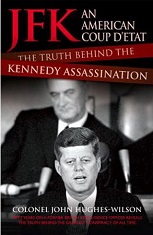 Last week I was debating what book to read next and realized that I had not covered anything on the assassination of President John F. Kennedy (1917-1963) in quite some time. To many Americans, his death is in America’s past, and a crime never to be solved. With that being said, his murder is a reminder of how easy it once was to remove a sitting president from the highest office in the land. Kennedy’s death endures as one of America’s darkest moments and the unanswered questions surrounding the events in Dealey Plaza still send chills down the spines of even the most seasoned researchers. Colonel John Hughes-Wilson has taken another look at the crime and lays out his case for what he believes was a coup d’état on November 22, 1963. In the fifty-years since JFK’s death, researchers have been able to compile a staggering amount of revealing evidence throughout independent research and the release of government files under the Freedom of Information Act and the President John F. Kennedy Assassination Records Collection Act of 1992. Incredibly, Hughes-Wilson has managed to compress thousands of pages of information into a book that is less than 400 pages. But contained within the pages of this book is an excellent summary of what happened before, during and after Kennedy’s murder.
 The murder of John F. Kennedy (1917-1963) continues to maintain its place among the greatest crimes in American history. The official story as published by the Warren Commission is that former Marine Lee Harvey Oswald (1939-1963) fired three shots in six seconds from the sixty floor of the Texas School Book Depository, fatally wounding Kennedy and severely wounding Texas Governor John Connally (1917-1993). To many, including the author of this book, David Lifton, the government version seemed to be the best and final explanation. But over time Lifton came to doubt the official story and after obtaining a set of the twenty-six volumes that composed the Commission’s investigation, his doubt turned into disbelief and lead him down the path that culminated with this national bestseller.
 America is often referred to as the land of opportunity for anyone wishing to start a new life far away from home. Since the days of Amerigo Vespucci, the territory we now call the United States has been a primary destination for world travelers. In recent years, legislation regarding immigration has been an important topic which provokes fierce debate. Every country has its issues with immigration and none has a perfect regarding the same. However America has been the place where millions of immigrants have made a new home. The late John F. Kennedy, formerly the Thirty-Fifth President of the United States, left us with many writings, interviews and speeches before his untimely death in Dallas, Texas. His sharp wit, uncanny foresight and fierce independence catapulted him to the top of the list of Americans whose names live on forever. As the descendants of Irish settlers from Ireland escaping the potato famine, his family came to America in search of a new life. Their journey was long and their assimilation into a new society rough, with prejudice and xenophobia forming substantial obstacles to peace and happiness. Their plight was never forgotten and is told again in this short but engaging book that clarifies his position that America truly is a nation of immigrants.
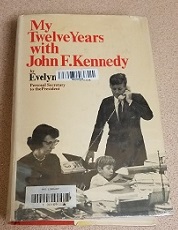 November 22, 1963 remains a day seared into the minds of millions of people around the world. Known informally in the United States as the day Kennedy died, each year it reminds of the tragic events of that day in Dallas, Texas. The spirit of John F. Kennedy has remained with America and today, decades after his death, his legacy continues to gain in strength. The debate regarding his accomplishments while in office has raged continuously. But what cannot be denied is his impact of the conscience of the United States and his status as a symbol of hope for an entire generation. When he died, he left behind not only a widow and two children, but millions of fans, friends and his personal secretary of twelve years, Evelyn Lincoln.
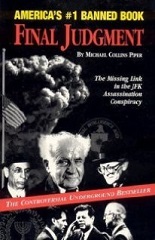 The murder of John F. Kennedy remains one of America’s darkest moments. His assassination in Dealey Plaza and the murder of his alleged assassin two days later shocked the world and marked a turning point in American history. The Warren Commission’s report is still the government’s official position on the murder. It concluded that there was no conspiracy to murder John F. Kennedy and that Lee Harvey Oswald acted alone. In 1966, Mark Lane’s Rush to Judgment was released and became the first major book to challenge the Commission’s conclusions. Lane became a pioneer in the process with his book being followed by more than 200 hundred others regarding the events of that day. Each has its strengths and weaknesses but all provide a window into what some have called the crime of the century. There are literally dozens of theories as to how and why Kennedy was killed. It is up to the reader to cross-reference the facts and reach a conclusion. However, in the majority of the books regarding the murder, all tend to focus on the complicity of the U.S. Government and organized crime. The Italian-American mafia has long been suspected in the assassination. But like everything else regarding the murder, things are not always as they may seem.
 For twelve years Evelyn Lincoln served as John F. Kennedy’s devoted secretary. Following Kennedy’s murder she penned a memoir of her time as his assistant under the title “My Twelve Years with John F. Kennedy”. As his secretary she was a first hand witness to his daily routine and the decision making process behind some of the biggest moments in American history. The relationship between Kennedy and Vice-President Lyndon Johnson has been documented in scores of books. But Lincoln’s account is a welcomed look into the unusual relationship between two polar opposite individuals.
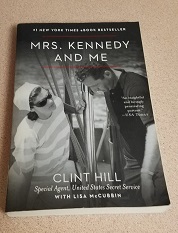 The workplace in a sense becomes a second home to the majority of us, and for some of us, they become even closer to us than those with whom we have a biological link. But what happens when you’re an agent in the Secret Service? There is no set eight-hour workday for agents assigned to the first family. Instead, their hours are often unpredictable, long and extremely fatiguing. Nevertheless, the agents do their jobs to the best of their abilities and in the process create bonds with the members of the first family that sometimes remain in place many years after their service has ended. Clint Hill, long retired from the Secret Service, is best remembered by many people from the Zapruder film, in which he is the sole agent that attempts to come to the aid of the president as jumps on the back of the motorcade as the Secret Service transports a mortally wounded John F. Kennedy to Parkland Memorial Hospital. He has written several books on his time as a Secret Service agent with several presidents and the events that took place during that fateful trip to Dallas, Texas. This is his memoir of his time with the former first lady and the relationship that developed.
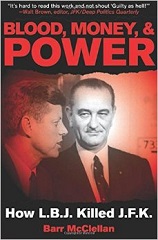 Prior to his death from cancer, Jack Ruby, the convicted murdered of Lee Harvey Oswald who executed his prey live on national television, once remarked that to get answers in the murder of John F. Kennedy, it would wise to ask the man currently in office. That man as we all know was Lyndon B. Johnson. In most history classes, Lyndon Johnson or LBJ for short, is seen as a pioneering president, responsible for the passage of the monumental Civil Rights Act of 1964. However, what is often looked over is his role in the escalation of the U.S. military in southeast Asia resulting in the Vietnam War. As the body count of American soldiers climbed, his approval rate dropped to absurdly low levels, possibly the worst in recent history. And the announcement of Robert Kennedy for candidacy for president served as a final nail in the coffin forcing Johnson to withdraw his name in the 1968 presidential race. Many years after his death, the true story of the life of Lyndon Johnson has come to light in dozens of books. And what we learn through each of these books is that there was a very dark side to the 36th President of the United States.
 FREETHINKING BIBLIOPHILE
You must be logged in to post a comment.