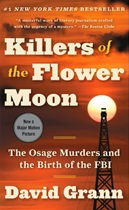
Killers of the Flower Moon: The Osage Murders and the Birth of the FBI – David Grann

I was in the search for a new book and saw this title by David Grann which caught my attention because I knew that I had seen the name before. Then I realized that a Hollywood film of the same name had been released starring Leonardo DiCaprio, Lily Gladstone and Robert De Niro. I have yet to see the film and in hindsight, having read the book first may be a bonus. The movie is on my watchlist and if it is close to the story told within, I can expect a powerful film from director Martin Scorsese. Prior to reading the book, I was not familiar with the Osage murders in Oklahoma during the early 1900s. As a result, I learned the story for the first time, and after finishing the book, I felt anger and sadness. But despite the range of emotions triggered by the story, the book is excellent and the suspense kept me glued to the book as I learned the story of a dark time in Oklahoma’s history.

The book begins with the disappearance of Anna Brown (1885-1921) on May 21, 1921. We soon learn about Anna’s family history and the Osage tribe to which they belong. Her sister Molly Burkhart (1886-1937) and husband Ernest Burkhart (1892-1986) quickly emerge as the central figures in the story, and begin a desperate search for Anna. However, there is more than meets the eye, and to understand Anna’s fate, the author explains the Osage tribe and their relocation from Kansas to Oklahoma by the United States Government. The move proved to be a blessing and a curse but the statistics regarding the Osage’s financial status left me speechless. I was not prepared for the jaw dropping numbers presented by the author. But it was easy to see how they became targets for the violence which arrived at their doorsteps. The situation is made more complex with the mixed marriages between Osage women and white men. Today the couples would not earn a second glance but in the 1920s, Native Americans were still sadly viewed as “savages”. Statements by Ernest’s aunt in the book reflect this mindset. At first, the mixed marriages provided me with a sense of hope but as the layers are pulled back on murders, the plot thickens in ways I did not expect. And this resulted in me wanting to read even more of the book as the saga continued to unfold.

Every story regarding the dark side of human nature has an antagonist, and this book is no different. Here, that person is William K. Hale (1874-1962). It did not take long to realize that Hale was a strange character, and he cast a dark cloud over the story. I could feel the shift in the mood through the author’s words as I learned of Hale’s background and his actions regarding the Osage. The feeling I had about Hale was right on the mark. In Washington, D.C., the Osage murders did not go unnoticed and the Bureau of Investigation, later renamed the Federal Bureau of Investigation (“FBI”), found itself involved with the case after its director J. Edgar Hoover (1895-1792) dispatched special agents under Tom White (1881-1971) to solve the case and bring the murderers to justice. White had his hands full but soon learns that there are dark secrets in the Osage case, and his investigation also highlights the mistakes made by local police. But he gets a break when the home of local resident Bill Smith implodes. The fallout from the collapse of the Smith house soon leads White on another path that goes into the heart of the Osage murders, and what he learns will leave readers reeling. If the story had you on the edge of your seat up until this point,  you had better hold on tight because it soon takes another turn into the dark.

At first, I was not sure how the Smith case would help break the murder investigation, but like a series of dominoes, people begin to fall, and the truth begins to come out, and I could not believe what I read. The tragedy of the Osage tribe is heartbreaking, and the way in which they were targeted is repulsive. Actions of those cursed with greed highlight the power money has over people and the lengths to which people are willing to go to obtain wealth. However, justice prevails and there are prison sentences handed out. And while they may seem light to some readers, I was both surprised and grateful that justice was done in a time when being Native American still provoked disgust and discrimination. But just when you think the story is over, the author takes us another ride in the epilogue where he discusses a disturbing aspect of the Osage murders that the police and FBI have not fully addressed. And the question emerges; how many murders have occurred which were never solved? And how long did the crimes occur? And did the perpetrators have the protection of local officials? The full truth will never be known, but the author presents a chilling case for a far more disturbing trend which had developed in Osage territory.

After I finished the book, I had a moment of silence for Anna Brown and the Osage tribe members whose lives were taken due to greed and vindictiveness. Their story is a tragic tale of Native Americans whose lives were upended, improved and then imperiled. We are unable to go back in time and correct the wrongs done to them, but we can honor their legacy by never forgetting their story. I did not know what to expect when I began this book but it has become a story I will not forget.  This book is well-written and well-researched, and the story is told in a narrative which maintains the right mix of elements to convey the author’s words. And when I do watch the film about the Osage murders, I can reflect back on Grann’s work which I am grateful to have discovered. Highly recommended.

ASIN ‏ : ‎ 0385534248
Publisher ‏ : ‎ Doubleday, April 18, 2017

All Blood Runs Red: The Legendary Life of Eugene Bullard: Boxer, Pilot, Soldier, Spy – Phil Keith with Tom Clavin

People have asked me how I decide on the next book I want to read. Well, the truth is I do not always know and sometimes find hidden gems purely by accident. Such is the case with this book. It was not on my radar at all, but I am deeply grateful that I did discover it. And to be brutally honest, I admit feeling a sense of guilt that I did not know of Eugene Jacques Bullard (1895-1961), whose life story is preserved in this biography by Phil Keith with Tom Clavin which left me grateful and humbled. 

Before continuing, I must point out that there are aspects of Bullard’s life lost to history. However, there is a wealth of information about him in public records, and Bullard both wrote and spoke about his life. You might be wondering how this Black American ended up in France becoming an infantry soldier, pilot, business owner, and celebrity in his own right. The proof is in the pudding as they say, and once I began the book, I found myself glued to it, stealing any spare time to open my Kindle and pick up where I left off. There are sections of the book which are not pleasant to read, and readers sensitive to descriptions of warfare and racial discrimination may want to use discretion. Despite the dark moments in the story, the book is an incredible story of a man who made history in his own way.

Bullard’s story begins in the Deep South, in Georgia where he is born in 1895. It is understood that this time in America was exceedingly difficult for Black people, particularly in rural Georgia. And the difficulties one would expect are in the story, highlighting the sacrifices parents made for their children. As for Eugene, it soon becomes clear that life under Jim Crow is not what he wants, and by the age of sixteen, he is on his way to a life abroad which took him to places he could have never imagined. The unorthodox and surprising chain of events detailed by the authors is a testament to the luck and help from others which shape our lives.

Although he had departed from America, the story is far from over. Arrival in the United Kingdom provides the starting point for his European journey which takes him to France and in the trenches during World War I. The story feels like a depiction out of Hollywood, and as I read about the injuries he sustained and the loss of life, I could not imagine the fear and anxiety which must have gripped him and his fellow soldiers. War is brutal and its savagery is on full display here. However, Bullard had an unusual ability to keep pressing forward, first as a boxer and then as a soldier. And when battlefield wounds and a chance opportunity present a rare opportunity, he takes to the skies in the seat of a cockpit. It is here when the story changes gears as the legend is born.

The book has its twists and turns including his brief love affair with a “lady of the night” and the arrival of American forces in World War I (1914-1918) which brings the nightmare of Jim Crow to France where Bullard and his contemporaries make it clear to the Americans that Europe was not the South. Nonetheless, there were those who tried their best to make his life miserable, and Dr. Edmund Gros (1869-1942) proves to be his arch nemesis. Despite the roadblocks, Bullard continues to earn his fame and builds a life in France. Although the country was not void of racial prejudice, Bullard does well for himself and his club became so popular that he entertained people from all walks of life including authors Ernest Hemingway (1899-1961) and F. Scott Fitzgerald (1896-1940).  He also found love and marriage which produced two daughters and an ill-fated son. The marriage did not last, and it is not clear what happened. We have a general idea based on the book, but Bullard remained silent on some details. Regardless, it is a sad moment in his story and the arrival of World War II (1939-1945) would split the family apart. But there is a happy conclusion to their story which will make you smile. The war brought the reality of the Nazi menace to France’s doorstep, and an underground resistance network develops. Bullard finds a friend and partner in Cleopatre “Kitty” Terrier who becomes a lifelong friend and plays an instrumental role in saving Bullard’s family. Resistance to Nazi Germany’s Third Reich was dangerous and Bullard comes close to meeting his maker in one disturbing incident as explained by the authors. The surreal and uplifting story is a  shining moment in the book.

In July 1940, Bullard returned to the United States and Harlem became his home for the rest of his life. But he was not one to sit still and attempts to revisit the past with a trip to his native Georgia. This part of the book will stir emotions for readers who have spent an extensive amount of time away from home. Today we have email, instant messaging, and social media, but in Bullard’s time, letters and telephone were the methods of communication. Reading his plight reminded me of the conveniences of modern technology and the saying that “there is no place like home”. Bullard returned to New York and found employment at Rockefeller Center operating an elevator while attending official functions in Manhattan related to the French government. And that is the iron of his story. In America his skills and war record were unknown but to the French, he was one of their greatest heroes.But a chance encounter with a studio executive gives Bullard his “fifteen minutes” of fame on national television. Alas, the “Black Swallow of Death” had earned recognition on home soil. 

Time catches up with us all and Bullard was no exception. His physical decline is hard to accept but I also thought of the physical and emotional trauma throughout the story and how each took its toll on him. But throughout the book, Bullard kept pressing forward and beamed with pride at the medals and recognition he earned in Europe. And in time, his own country would honor his life in ways he could not have predicted as a young boy living under Jim Crow. His life story is full of highs, lows, heartbreak, and moments of unimaginable glory. This book has quickly become a favorite of mine and I have already recommended it to a close friend. I now recommended it to anyone interested in an incredible story about world history and Eugene Bullard who proved throughout his life that all blood runs red. 

ASIN ‏ : ‎ B07N7G776W
Publisher ‏ : ‎ Hanover Square Press, January 18, 2023

Greg Scarpa, Legendary Evil: The Many Faces of a Mafia Killer – Jonathan Dyer

The Italian American mafia or “La Cosa Nostra”, became firmly entrenched in American society as immigrants from Italy to their newfound home. On the streets of New York City, a young mobster named Charles “Lucky” Luciano (1897-1962) realized that the constant violence among gangsters was no good for business and envisioned a “commission” to rule mob affairs. Luciano’s vision became a reality and the “Five Families” are now a permanent part of the city’s history. One of these families, the Colombos led by the mob boss Joseph Colombo (1923-1978), is noted for its civil wars, and members who have turned state’s evidence. One of them was not only a ruthless killer, but a bigamist and Federal Bureau of Information (“FBI”) informant. In Brooklyn, Gregory Scarpa, Sr. (1928-1994) became known as the “Grim Reaper” and throughout his career, he would prove more than once that the name had been earned. Author Jonathan Dyer explores the life of the mobster who terrorized adversaries and sent shockwaves through mafia circles.

I previously reviewed Peter Lance’s ‘Deal With The Devil: The FBI’s Secret Thirty-Year Relationship With A Mafia Killer‘ which chronicles Scarpa’s role as an informant. The book is particularly good, and Dyer uses it here as a source for what is a more complete picture of Scarpa’s life. Aside from Lance’s book, I had viewed documentaries on Scarpa and I have also read the book ‘The Mafia Hitman’s Daughter‘ by Linda Scarpa and Linda Rosencranci. His daughter’s book is eye opening and shows the effects life in the mafia has on family members. This book is a mix of both with additional exhaustive research. And the result is a book which will stand the test of time. Dyer provides a raw and unfiltered look at Scarpa’s violent and tragic life. 

Following the early discussion of Scarpa’s early life, the story changes when he meets his first wife Concetta “Connie” Farace (1931-2012). The story is routine, with Scarpa earning his stripes on the street and Connie bearing the couple’s children. However, the story takes a sharp left turn when the FBI institutes the Top Echelon Criminal Informant (TECI) program. This new pilot program by the bureau would find a willing participant in Greg Scarpa who soon joins and begins a thirty-year relationship with the “Hoover” boys. And if that is not shocking enough, the book takes another turn when he meets a teenage girl whom he would remain with for twenty-five years while taking on yet another wife, resulting in a love story completely off the rails. Added to the mix is his protege Larry Mazza, whose role in the couple’s lives is surreal. You must read it to believe it.

In what becomes a strange paradox, Scarpa feeds the FBI crucial information on mafia activity while at the same time engaging in criminal enterprises. In one instance, what should have been an air-tight case against Scarpa and his co-conspirators for a counterfeit money scheme was dismissed under mysterious circumstances. The dismissal raises the unanswered question, was the FBI protecting its asset? As for Scarpa, he continued to enjoy his relationship with the bureau while wreaking havoc in the streets. However, he is credited with assisting the FBI on high profile cases. The only issue is that only one out of the three presented by Dyer seems to be the most plausible. Dyer breaks down each alleged assist by Scarpa and uses the process of elimination to assess which account has the most credibility. But it is not long before the story takes on more bizarre twists and turns.

Scarpa’s relationship with his children is interesting and highlights the contradiction which exists in his story. While he was easily killing fathers and husbands, he went to extreme lengths to protect his own. Each child carries their own scars and trauma in the book. Linda has spoken for herself, but Gregory, Jr., and Joey (1971-1995) are not as fortunate. Gregory Jr. was released from prison in November 2020 and has remained out of the public light. Joey met a horrific death, and the story as told by Dyer is heartbreaking and disturbing. Gregory Jr. was closest to their father and that devotion would earn him a staggering prison sentence and demons to haunt him for the rest of his life.

As the story progresses, Scarpa continues his pattern of manipulation and exploitation but receives a life diagnosis when he goes into the hospital to treat a bleeding ulcer. A tainted blood transfusion leaves Scarpa infected with a disease that changed life as we knew it during the 1980s. And this is where the downfall ofthe mobster begins. His physical decline and power struggle within the Colombo family between supporters of Carmine “The Snake” Persico (1933-2019) and Victor “Vic” Orena, intensifies the suspense as mob hits, criminal indictments and mortality take their toll on all involved. And throughout all, Scarpa remains a gangster to the core. The story is insane and will leave readers shaking their heads at Scarpa’s escapades and violence which ensued. But as the saying goes, every gravy train reaches its destination, and Scarpa finds his meal ticket with the FBI set to expire. And when the government came for justice, Scarpa found himself persona non grata in law enforcement circles. A shocking admission in open court would forever change the way his contemporaries viewed him and cement his legacy in the annals of mafia history. 

Dyer’s account of Scarpa’s life is well-written and well-researched. It is full of information and cross-referenced. It is still a new release, and I am sure readers with a soft spot for mafia history will be interested in what the author has to say. After finishing the book, I did not have any strong emotions towards Scarpa but could see that his life and the lives of those around him became dysfunctional due the mafia’s grip on them. Another former Colombo member Michael Franzese who has gained a new following online once said that the mob destroyed lives. He is absolute correct. If you are a mafia aficionado or in search of an informative book about the streets of New York City and its Five Families, you will enjoy this. 

He was neither God nor devil. He was, like the rest of us, mortal, distinguished from most of his fellow human beings by his unlimited capacity for evil. His existence was terrifying during his life, and the story of his life is a frightening reminder of the human capacity for betrayal and deceit, for duplicity and greed, for violence and death.” – Jonathan Dyer 

ASIN ‏ : ‎ B0FDSNQPCZ
Publisher ‏ : ‎ WildBlue Press (22 July 2025)

Hellhound on his Trail: The Electrifying Account of the Largest Manhunt in American History – Hampton Sides

At 6:05 p.m., on April 4, 1968, Dr. Martin Luther King, Jr. (1929-1968) was standing on a second-floor balcony of the Lorraine Hotel in Memphis, Tennessee when witnesses say they heard a sound like a car backfire. To the members of his entourage, the reality was far more terrifying and instantly grim. The civil rights icon had been shot by a high-powered rifle and was clinging to life as he was rushed to a local hospital. He later succumbed to his wounds, leaving behind his grieving widow Coretta Scott King (1927-2006) and four children. In Washington, D.C., President Lyndon B. Johnson (1908-1973) was briefed on the situation and at the Justice Department, Attorney General Ramsey Clark (1927-2021) made it clear to Federal Bureau of Investigation (“FBI”) director J. Edgar Hoover (1896-1972) that the bureau must take control over the investigation into the murder. Fears of nationwide unrest gripped officials, and law enforcement realized that the killer must be apprehended as soon as possible. The roads leading to that fateful evening in Memphis, and the worldwide manhunt for James Earl Ray (1928-1998) form the crux of this national bestseller that will have you at the edge of your seat.

The first half of the book is composed of two timelines. We are introduced to Eric S. Galt, Ray’s persona as he crosses from Mexico back into the United States. Instantly we can see that Galt is an unlikeable figure who drifts from one place to the next. The author does a masterful job at retracing his steps and presenting them in the smooth narrative format found in the book. As I read, I could see that Galt is strange and nothing good follows him. The second timeline revisits the final months in Dr. King’s life. The tremendous strain his work had on his personal life and health is evident. Further, scrutiny by the FBI was persistent, and J. Edgar Hoover was determined to expose the man he called a “fraud”. The reasons for Hoover’s animosity towards King are examined in the book and left up to the reader to decide. I can say that Dr. King had his flaws like everyone else. But he did not know that a drifter using the stolen identity of Eric Galt was also making his way to Memphis, Tennessee and that they both had a date with destiny.

As Sides moves between the two timelines, you can see that they are bound to intersect. And like dominoes falling, one event after another sets the stage for April 4. I must warn readers that the shooting and aftermath are graphic and will be unsettling. In fact, what Sides explains will send chills down your spine. The murder of Dr. King was nothing short of brutal and cold-blooded. However, that is far from the end of the story. In the wake of the gunfire, Dr. King’s aides scramble to make sense of what happened, and emergency personnel do their best to aid the fallen leader. But his wounds proved to be too severe and after reading the book, death was likely the better option for him. The author’s description of the bullet’s impact will clarify the severity of the wounds. As Dr. King lay dying in the emergency room, the FBI was gearing up for the largest manhunt in American history. And the author takes us on the journey from Memphis to the United Kingdom.

In the middle of all that is happening, there is still the story of America at that time. Sides revisits our nation’s history during a turbulent time when change was both needed and scary. Sides discusses the political climate including Johnson’s decision in March 1968 not to seek or accept his party’s nomination for president of the United States as the Vietnam War becomes an anchor around his neck. The entry of Senator Robert F. Kennedy (1925-1968) into the presidential race became Johnson’s worst nightmare and gave millions of Americans a new found hope for the future. But the push for civil rights and an end to the war in Vietnam had America on edge, and what becomes clear is that the 1960s was a dangerous time in the United States. Eric Galt, whom authorities would learn was James Earl Ray, nearly sent an entire country over the edge with one rifle shot. Within hours, the FBI was on the case.

After the FBI assumes the lead role in the investigation, the book shifts gears as the bureau engages in an all-out effort to find the killer. It is one of the FBI’s shining moments. I was speechless at the savvy skills of special agents and the speed at which they accumulated evidence and added information in an era before modern-day technology. Readers who love crime investigations will find this section of the book irresistible. I was rooting for the agents as they turned over new leads and pieced together the life of James Earl Ray. The information they uncover regarding his family history is crucial and should not be overlooked. I previously was unaware of these details and learning the new facts provided a better sense of how and why James Earl Ray grew into the person that he was. That in no way excuses his actions, and Ray was his own worst enemy. And though he had a head start on the bureau, he engineered his own downfall across the Atlantic Ocean.

In America, mourners focused on paying their respects to Dr. King, whose funeral was a monumental event in the nation’s history. But it was not without its detractors, and no story about Dr. King or the movement would be complete without a word on former Alabama Governor George C. Wallace (1919-1998). He appears in the story, but this is not a biography of him, but rather a discussion of how Wallace’s rhetoric helped create people like James Earl Ray. In later years, Wallace changed his tune and disavowed his former segregationist stance. But others did not, and some of them appear in the story but only briefly. The focus remains on capturing Ray who first fled to Canada before landing in Portugal. But it was the United Kingdom where his train to freedom was derailed.

I could only shake my head as I read of Ray’s time in the United Kingdom under a fake name and passport. Lack of money and a concrete exit plan take their toll, and a series of actions by him on the streets of London are insane. I honestly could not believe anyone could be either that bold or careless, but such is the case here. His sloppiness and eagle-eyed British investigators help bring the international saga to an end but even while in custody, Ray proves to be more moronic. In fact, investigators are surprised at his off-the-cuff statements and cannot believe the cognitive dissonance. The book concludes as he returns to America after losing the fight against extradition. His trial and conviction are not discussed here, the author’s focus was on the events leading up to the crime, the crime itself and the manhunt. But as an added bonus, the epilogue contains a story from 1977 where Ray is serving time in prison and finds a way to escape from the facility. The unbelievable story will have readers shaking their heads. Thankfully, he was found and returned to prison to serve out the life sentence he received. On April 23, 1998, James Earl Ray died at Nashville Memorial Hospital in Madison, Tennessee at the age of seventy from complications due to Hepatitis C.

If you need an enjoyable book about the murder of Martin Luther King and the manhunt for James Earl Ray, you will love this.

ASIN ‏ : ‎ B0036S4BX0
Publisher ‏ : ‎ Vintage, April 20, 2010

Overland Railroad: The Green Book and the Roots of Black Travel in America – Candacy A. Taylor

In March of this year, my family and I embarked on a road trip to Maryland for a cousin’s baby shower. On Interstate 95, we made a couple of expected stops for hungry stomachs and full bladders. The rest stops were filled with people from all backgrounds, stopping briefly before continuing to destinations across America. Sadly, there was a time when rest stops looked completely different, and for non-white travelers, the interstate highway system was frightening and dangerous. Jim Crow was alive and strong, and across the nation, change was coming but at a slow pace. However, that did not stop millions of people from driving across America, and to aid black Americans, a useful tool called the “Green Book” provided information which could save one’s life. Author Candacy Taylor looks at the Green Book and how it aided black people brave enough to set out on a classic American road trip. 

I was familiar with the Green Book but admittedly, there was much I did not know. So, I made the purchase and started reading instantly. Before I continue, I should point out that this book may cause you to feel angry and feel a sense of outrage. I say this because today it is unconceivable to think that a person of Indian or Chinese descent cannot use a rest stop on an interstate highway because of how they look. But, several decades ago they would have been forced to suffer indignity and humiliation due to restrictive laws which enforce segregation, and the threat of violence from people determined to maintain a social order they saw as being right for everyone. However, the United States was changing, and the movement for civil rights continued to grow. But until legislation guaranteed equal rights, creative tools were needed to navigate society. 

The Green Book was the creation of Victor Hugo Green (1892-1960), a gentleman I knew little about before reading the book. Taylor focuses on his life which begins in New York City. Green had realized that the automobile was going to change America, and black motorists needed both help and protection on the road. In 1936, the first Green Book was born but that was only the beginning. In fact, the author takes us a long journey which focuses not only on the book for travelers, but America’s past and how discrimination affected its citizens. And what she discusses enhances the importance of the book.

Undoubtedly, there are dark moments in the story, but there are bright spots as well. In fact, both white and black Americans played a role in affecting change, and the importance of Esso (ExxonMobil) gas stations and the foresight of the Chrysler Motor Company should not be overlooked. The Green Book is paramount in the account, and the information it provided was invaluable. Imagine wanting to take a road trip but having no idea whether an area is safe because of your ethnicity or needing a restroom and having to use the woods or drive an extra one hundred miles miles because every sign you see says, “no colored allowed”. It seems surreal today, but it should be a reminder of the freedoms we take for granted.

The automobile changed life for millions of Americans, but it also introduced new challenges and dangers which took time to resolve and answer. However, as the author tells the story of the lifesaving book, there is another element to the picture that should not be overlooked. Black Americans began to purchase automobiles, and it was a step up in class. But it did not go unnoticed and the reaction to upward mobility of blacks is a crucial aspect of the Green Book story and shows that America was not only confronting the issue of race but also the issue of class. Further, World War II had opened a door for blacks which they were determined to walk through. It should be noted that there were black people who did not want integration, but not for reasons one may suspect. 

Today, most of the locations in the Green Book are gone, and the book itself has been long out of publication. Its demise is due to several factors, and one adds a twist of irony to the initial need for it. Although the book is now gone, its role and importance in the lives of black people traveling America’s roads will never be forgotten. And if we continue to move forward, we will never need the Green Book again. But to do that, we must always remember where we came from and how far we have progressed. This book fills in the gaps that may be missing for some. 

ASIN ‏ : ‎ B07QDK1MFD
Publisher ‏ : ‎ Holiday House, January 28, 2020

The Last Founding Father: James Monroe and a Nation’s Call to Greatness – Harlow Giles Unger

On September 3, 1783, representatives of United States, Great Britain, Spain, and France signed the Treaty of Paris which officially concluded the American Revolutionary War and recognized the newly formed nation of former British colonies. The founding fathers of the United States soon realized that a monumental task lay before them, and they wasted no time in creating the country they had envisioned as the movement for independence gained momentum. Among the men whose vision shaped the America we know today was James Monroe (1758-1831) who served as America’s fifth president. Having outlived his contemporaries, he is accurately referred to as the last founding father by author Harlow Giles Unger who returns with another engaging biography of an American leader. 

I previously reviewed Unger’s biography of President John Quincy Adams (1767-1848), a book which I could not put down as I read the life story of an American figure who helped change the course of history. Adams makes an appearance in this book as well, when President Monroe entrusts him with tasks crucial to America’s development. However, the focus of this story is on Monroe and his incredible life. I approached the book with limited information on Monroe. In school, his name was remembered for the policy which bears his name, the Monroe Doctrine. The story behind Monroe’s 1823 congressional address in which he laid forth the doctrine’s goals is told within, providing readers with an inside look into the thought process behind the actions of the Monroe Administration. 

Monroe’s story begins in Westmoreland County, Virginia in 1758 as American patriots are beginning to question British rule. The growing young man bears witness to British encroachment, and when the war for independence begins, Monroe joins the Continental Army under the leadership of America’s first President George Washington (1732-1799). The two would go on to have a lasting friendship which is discussed by the author. Monroe also found company in mentor and fellow President Thomas Jefferson (1743-1826) who remains a close confidant of Monroe through the rest of the book following their initial acquaintance. Sadly, the same cannot be said of former President James Madison (1751-1836) whose friendship with Monroe took an unexpected turn. The details are contained within, and it is interesting to see the bonds between the men who were responsible for shaping the nation known globally as the United States of America. 

While Monroe was making a name for himself in politics, he also believed in family. He and wife Elizabeth (1768-1830) were deeply in love and she was equally effective at foreign policy as her husband. Her actions regarding the pending fate of Adrienne de La Fayette (1759-1807) in France will surprise readers. She is also remembered as an elegant first lady, and the reasons why are explained in the story. As for James Monroe, building America was paramount, and in 1803, he played a prominent role in the Louisiana Purchase which tripled the size the of the United States overnight. Readers interested in the deal will appreciate this section of the book as the back door dealings spearheaded by Monroe result in a land grab that is still shocking to this day. But while America was growing, England had not forgotten its former colonies, nor its conflict with France, and all hell breaks loose during the War of 1812. The buildup to the conflict is important and Unger explains the events thoroughly and at the right pace. The suspense is gripping, and readers will see the conflict looming in the distance as Europe becomes more unsettled. It would not be the last time that a war in Europe brought America into the conflict. 

Following the war, Monroe returned to the State Department, and in 1816 he makes a decision that changes his life forever when he decides to run for president. With hindsight we know he was successful, and the focus here is on his presidency and his accomplishments as commander-in-chief. However, there is the elephant in the room in every story of America’s early days and that is the issue of slavery. Surprisingly, there is not much about it in the book and early administrations sought to avoid the issue altogether. However, Monroe would be forced to confront the matter during the Missouri Compromise of 1820. Monroe’s position on the matter was unsurprising because he was a slave owner himself just as several founding fathers were. Monroe did see slavery as a threat to the future of the nation and realized that freedom could not exist with enslaved people, but he also reaped the benefits from being a slave owner and believed in the rights of pro-slavery states. He did endorse one plan to rectify wrongs done to African slaves, and it explains the existence of Monrovia, Liberia. The issue of slavery would be decided forty-five years later when the first Republican president did what no leader before him had dared to do.

After departing the White House, Monroe’s life returned to a sense of normalcy, but he faded away from public light and found himself to be a symbol of a bygone era in American history. His legacy had been cemented but the United States was on a new course, chartered by President Andrew Jackson (1767-1845) who remains one of the most controversial leaders in American history. His story is a roller coaster ride on its own and I strongly recommend Jon Meachem’s ‘American Lion: Andrew Jackson in the White House‘ which is a good source of information about Jackson’s command of the United States. As time passes, Monroe’s life changes and on July 4, 1831, he takes his final breath in New York at the age of seventy-three, leaving behind a legacy which shaped American foreign policy for years to come. If you are searching for an enjoyable book regarding America’s founding fathers, this biography of James Monroe will be a fitting addition to your library.

The most beloved president after Washington, Monroe was the only president other than Washington to win reelection unopposed.

ASIN ‏ : ‎ B002RBWF26
Publisher ‏ : ‎ Grand Central Publishing, April 8, 2025 

Area 51: An Uncensored History of America’s Top Secret Military Base – Annie Jacobsen

Of all the military installations, few are as mysterious as Area 51 which is located at Groom Lake in southern Nevada. The secretive military base has been the subject of rumors that the United States Government is holding the remains of an unidentified flying object (“UFO”) and extraterrestrial lifeforms. The theories are entertaining but remain unproven. This raises the question of what is Area 51? Annie Jacobsen, author of the best-selling book ‘Operation Paperclip: The Secret Intelligence Program that Brought Nazi Scientists to America‘, takes us on a deep dive into the history of Area 51 to reveal as much as possible about America’s most controversial and mysterious military base.

Prior to reading this book, I did not have any pre-conceived ideas about Area 51. Of course, I have heard and read of rumors that the United States Government is concealing alien lifeform and protecting dark secrets. The allegations are unfounded, but what we do know is that the area is heavily guarded and trespassing is forbidden. As a primer to the story to be told, Jacobsen discusses the controversial Robert “Bob” Lazar, a noted conspiracy theorist whose claims regarding secretive government operations have earned him an audience of likeminded individuals. To some he is a tin foil loyalist but was he completely off the mark? Well, the truth is complex but not as sensational as we might hope.

Looking back at the book, the crux of the story is the finale of World War II. We go back in time to 1945 when Allied commanders are on the brink of a Nazi defeat and a battered Japanese military. The development of the Manhattan Project was pivotal to the use of Little Boy and Fat Man against Japan in August 1945, and they were no secret to Soviet Premier Joseph Stalin (1878-1953). His counterpart in America, President Harry S. Truman (1884-1972), had been thrust into the role of commander-in-chief following the death of his predecessor Franklin D. Roosevelt (1882-1945), and quickly learned of America’s secret weapon. Stalin’s infiltration of America’s military secrets set the stage for the next four decades and paved the way for the growth of Area 51, where research and development reached new heights.

The success of the atomic bombs Little Boy and Fat Man had convinced even the most pessimistic generals that air combat was equally as important as ground troops. But before the story kicks into high gear with the Cold War, Jacobsen discusses an incident in Roswell, New Mexico in July 1947 that provided the spark to the rumors of a hidden UFO. The incident reappears later in the story with a plausible explanation for its origins and a surprising revelation about the aviation parts discovered. However, some mystery remains as to what really happened in Roswell. Whatever took place was serious enough to warrant the attention of the United States military and America’s intelligence apparatus. Both would play crucial roles in the development of Area 51.

The book is engaging from start to finish, but Area 51’s story takes on a new dimension when Central Intelligence Agency (“CIA”) operative Richard M. Bissell, Jr. (1909-1994) is assigned control over the base, to the objection of Air Force Gen. Curtis E. Lemay (1906-1990), former commander of the Strategic Air Command and legendary veteran of World War II. Their feud would eventually come to a head in April 1961, when a new President John F. Kennedy (1917-1963) agreed to a CIA mission doomed from the start. But while America was focused on Cuba, the Soviets continued their space program and surveillance on adversaries. The cat and mouse game between America and Russia heats up with U-2 spy flights, espionage, and the belief on both sides of a nuclear confrontation. In hindsight we know that nuclear war did not take place, but that did not stop research and development at Area 51. In fact, the bag of tricks only grew as innovative technology emerged to transform America’s military.

The U-2 spy flights, and the capture of Francis Gary Powers (1929-1977) are also discussed, and both are well-known historical events, but I found the section regarding the development of the aircraft interesting. The engineering behind the new stealth aircraft is surreal, but also not without tragedy through trial and error. Powers’ capture and ordeal made headlines around the world, but they did not stop operations at Area 51. Bissell was removed in 1961 following the Bay of Pigs disaster, but that did not stop Area 51. In fact, defense contractors found a new market as Soviet aggression increased, and a war loomed in Southeast Asia. And in the years to come, a modern technology known as a drone aircraft would take to the skies and change warfare forever. The development of the drone is another interesting section in the book, and we turned the corner with its introduction and use.

While I read, I realized that the book was more important than just Area 51. In fact, it is full of historical information, and Jacobsen’s writing style keeps the narrative going at the right pace. I was aware of some events discussed in the book, but I also learned added information about the height of the Cold War, and classified information which had remained hidden for decades. The more I read, the less I was focused on the existence of aliens or spaceships. It was clear that Area 51 was more than a dumping ground for UFOs. It is a core part of America’s defense and a hub of top-secret activity only those with a certain clearance level are allowed to see. I believe that some secrets of Area 51 will remain hidden for assorted reasons. However, I do not think it is because of sensational claims by conspiracy theorists but instead feel that its importance to the nation’s defense is far too critical to allow compromise. Area 51 will remain off-limits. But Jacobsen has revealed a wealth of information about the mysterious location in southern Nevada.

Readers looking for gossip about hidden aliens, UFOs and other strange items may be disappointed here, but readers interested in facts about the base, and its role in the Cold War and America’s defense network, will appreciate Jacobsen’s work. She admits that she could not learn everything about Area 51, and to be fair there are no public tours of the facility. However, this book is a thorough account of its existence, development, and importance to national security. I would have liked to learn more about engineer and scientist Vannevar Bush (1890-1974), a co-founder of Raytheon and will have to add a biography of him to my reading list. But in regard to Area 51, this book is exactly what I needed. Highly recommended.

ASIN ‏ : ‎ B004THU68Q
Publisher ‏ : ‎ Little, Brown and Company
Accessibility ‏ : ‎ Learn more
Publication date ‏ : ‎ May 17, 2011

The Fighting Bunch: The Battle of Athens and How World War II Veterans Won the Only Successful Armed Rebellion Since the Revolution – Chris DeRose

When I saw the name Athens on the cover of this book I was surprised at first. Of course, I knew of Athens, Greece, but knew nothing about the city of the same name in Tennessee, a state I visited in October of last year. But such is the beauty and benefits of books. The story told within this book by Chris DeRose is of the “Battle of Athens” which took place between August 1 – 2, 1946. But what makes the story even more interesting is that the insurrection which took place was executed by American veterans of World War II who had become disillusioned and aghast at the corruption and voting suppression in Athens. This is a book of many stories which all culminated in that hot August night when Americans reclaimed the democracy they fought and died for across Europe and the Pacific.

At first, I could not believe that the insurrection occurred. The idea seemed surreal, and I had never heard of this event in school, nor had I seen anything about it online. However, not only did it occur, but it remains one of the rare times when Americans openly rebelled against a local government. In Athens, a political machine existed with a strong alliance between the powerful E.H. Crump (1854-1974) of Memphis, Senator Paul Cantrell (1895-1962), and local Sheriff Pat Mansfield. All the tricks known for voter suppression and grifting are on full display, and I found myself speechless at the brazen corruption. Political violence, intimidation, extortion, and outright fraud are rife early in the story. But what they did not know at the time was that their days were numbered. However, before we reach the climactic battle in August 1946, the author introduces the major players who lead the charge to retake Athens. And to do that, we go back in time to World War II. 

The back stories of the men who returned to Athens are equally as important as the fallout to come. I was glued to the pages as I read of their experiences in combat, as the Allied forces took on the Axis powers. The past comes alive as we learn of the deadly battles they survived, and the mental and physical scars they carried with them as they returned home to America. Putting the events in Athens aside, their stories could be a book of their own. They each return home changed men who had seen the horrors of war. We follow them as they adjust to society after the military, but it soon becomes apparent that in Athens, there is something very rotten taking place. The GIs have a plan of their own and form a non-partisan party to take on the machine. At the forefront is a veteran named Bill White who becomes the driving force to elect the veterans’ candidate and fellow veteran Knox Henry (d.1952). The powers in control pay little attention to the veterans at first but it soon becomes clear that a rigged election is not on the table. And when the machine pushes back against the GIs, the veterans realize that they may be home, but another war must be fought. The story picks up pace as the GIs turn the City of Athens upside down. 

White and his fellow veterans go to work dismantling the corrupt machine piece by piece. The collapse of Cantrell’s fiefdom is swift and ugly and leaves the corrupt politician with no choice but to exit quickly. However, White and the other veterans were far from done and left no stone unturned as they unseated and removed every politician and law enforcement official who had made their lives a living hell. As I read, it felt as if I were watching a feature film due to the author’s brilliant re-telling of the events. The narrative flows at the right pace with the right amount of suspense added in. Yet, I still could not wrap my head around the fact that this event happened in 1946. It is a story that should be told in classrooms across America. And the story should remove any doubt as to how precious and sacred democracy is. Following the downfall of the machine, the author provides a recap of events and an epilogue which should satisfy readers. I thoroughly enjoyed this book and found inspiration in the veterans’ call to action to push back against a corrupt system which was nothing short of tyranny. If you are looking for a delightful book about Americans standing up for their rights and our democratic processes, this book is highly recommended. 

ASIN ‏ : ‎ B084M1Y65B
Publisher ‏ : ‎ St. Martin’s Press, 2020


Just as I Am – Cicely Tyson with Michelle Burford

At the age of ninety-six, actress Cicely Tyson (1924-2021) was able to look back on a journey which no one could have predicted. And when she passed on January 28, 2021, it was another reminder of the mortality which confronts us all. However, there is much to celebrate about her life which she recalls in this autobiography presented to us with the help of author Michelle Burford. The cover caught my attention and once I began, I could not put it down. 

Following a recap of the family’s origins in the small Caribbean nation of Nevis, the story moves to New York City where her parents William (1897-1961) and Fredricka Theodosia Tyson (1897-1974) raise three children in a section of Manhattan Island known as Harlem. Their story is an immigrant tale, and young Cicely soon learns the cruelty of racial discrimination and witnesses the turmoil brewing between her parents. Unbeknownst to her at the time, the actions of her father would come back to play a role in her own life many years later. Cicely, sister Emily (1926-1999), and brother Melrose (1922-1991) each find ways to cope with the strains of family life. The maturing Cicely proves to be the one with the most to learn, and meeting with a pastor’s son named Kenneth throws a curve ball into the story that I did not see coming. And it forces Cicely to evolve from a teenage schoolgirl to an adult very quickly. 

Life becomes complicated for Cicely but eventually stabilizes for her and daughter Joan whom she adores. There are the typical worries about finances, security, and long-term goals. But an unexpected opportunity arises when she decides to answer a call for potential models. One thing leads to the next, and she catches the eye of someone who has connections in the film industry. However, Cicely is skeptical and does not see herself as a Hollywood talent. But she soon comes to terms with it and this quote from her stayed with me long after finishing the book: 

“My mother understood what I didn’t yet at the time, that there’s a path in this life with your name on it. What God means for you to have, no one can take away from you. It’s already yours. Our mission, as God’s children, is to surrender to what he has ordained—and to freely let all else just pass us by.”

As her Hollywood career takes off and the accolades come in, the story changes gears again with the entry of jazz musician Miles Dewey Davis, III (1926-1991). Readers familiar with Davis’s story will know it was beyond wild, but Tyson provides an interesting firsthand account of his battles with substance abuse which Miles himself discussed in his autobiography written with Quincy Troupe. Their story is an unusual account, and their romance did not develop instantly. In fact, Davis was with someone else when they first met. But fate had its own plans, and they would reconnect, find true love with each other, and walk down the aisle to exchange wedding vows. But behind the public image of the sharply dressed power couple, there were dark times due to Davis’s destructive lifestyle. The incidents which occur are surreal but highlight the seriousness of Davis’s condition. Their marriage was a roller coaster ride, and even after separating they remained closed. Tyson comments on an attempt by Miles to reconcile later in life as he continued to deteriorate caught my attention because his proposal instantly puts her on guard and signals that he was dealing with something just as dangerous as drug addiction. 

While Davis comes in and out of the story, Tyson continues to rise as a Hollywood star, and she explains the stories behind her iconic roles and friendships with stars of the past who are no longer with us. It is a fascinating look at the motion picture industry and the challenges faced by black women who find themselves in tinsel town. She waged a constant battle against the stereotypical portrayals of black women and that is part of her enduring legacy. Despite the sexual predators, offensive scripts, and rigors of the entertainment industry, she kept rising as a star and mastering her craft. And in her advanced years, she continued to appear in front of the camera to keep moving forward in life. This is one of the best autobiographies I have read. I only wish it were longer. I thoroughly enjoyed reading about Tyson’s life and the people who were part of it. Recently, I was eager for another biography to read, and this book was just what I needed. 

“To examine, to question, to discover and evolve—that is what it means to be alive. The day we cease to explore is the day we begin to wilt. I share my testimony in these pages not because I have reached any lasting conclusions, but because I have so much to understand. I am as inquisitive about life now as I was as a child. My story will never be finished, nor should it be. For as long as God grants me breath, I will be living—and writing—my next chapter.” – Cicely Tyson 

ASIN ‏ : ‎ B08425MPGS
Publisher ‏ : ‎ HarperCollins Publishers, 2021 

Handsome Johnny: The Life and Death of Johnny Rosselli: Gentleman Gangster, Hollywood Producer, CIA Assassin – Lee Server

On August 7, 1976, a fifty-five-gallon drum was found floating in Dumfoundling Bay near Miami, Florida. Upon closer inspection, authorities were shocked to discover human remains which had been packed inside of the drum with the victim’s legs completely severed. The body was later identified as Johnny “Handsome” Roselli (1905-1976), a well-known Italian American crime figure who had made a fortune in Hollywood and worked with factions within the United States Government to assassinate Cuban leader Fidel Castro (1926-2016).  Roselli’s death was as mysterious as his life as a powerful figure in the criminal underworld. Author Lee Server explores his life in this interesting biography which gave me chills.

I knew of Johnny Roselli before reading the book due to his name appearing in books regarding the assassination of President John F. Kennedy (1917-1963). The Kennedy family makes their appearance in this book as well, when young Jack finds friends in Las Vegas through his connection to singer Frank Sinatra (1915-1998). But before we reach Roselli’s time on the West Coast, we first learn of his early life in Esperia, Italy, and the family’s migration to Boston, Massachusetts. At first it is a standard immigrant tale of the times but when Roselli’s father passes away, life for young Filippo Sacco as he was known then, is never the same. A stepfather enters the picture, but another curveball is thrown at the reader when we learn of the insanity surrounding his mother’s new love. I was speechless as I read this section, but I was not surprised that young Filippo soon found himself on the wrong side of the law which required an exit stage left.

Chicago is what you would expect, full of gangsters, corrupt politicians, and violence galore. And Johnny steps right into, engaging with some of the most dangerous figures in the annals of organized crime, including Alphonse “Al” Capone (1899-1947) and Frank Nitti (1886-1943). Eventually Chicago loses its luster, and an invitation to come out to California arrives. Seizing the moment, Roselli agrees and the biography changes gears as we revisit the golden age of Hollywood, Las Vegas, and their dark secrets. There is a lot to unpack but the author’s writing style is smooth and engaging, and I found myself soaking up the information as the pages went by. He provides the right amount of attention to each subject without affecting the pace of the book. Roselli was firmly entrenched in the film scene and found himself surrounded by the biggest names in the industry. Yet, no one knew anything about his past. He remained a mystery even to those who knew him well. But that anonymity and steady cash flow were derailed when Castro and his revolutionaries took over Cuba. Roselli may not have known it at the time, but his role in the efforts to silence Castro would seal his own fate in ways he could not have predicted.

When the decision is made to covertly approach the mafia to help oust Castro, the story morphs into a surreal tale of strange alliances, double crosses, and secret agreements. This part of the book is wild, and only the beginning. Roselli’s role and the fallout from the failed attempts to topple Castro are discussed in numerous books regarding Kennedy’s murder but Server provides a good summary of what happened to keep the focus on Roselli’s life story. However, what he does discuss is enough to leave readers with enough information to piece together the picture of the intelligence community’s desire to eliminate Castro. The White House was aware of the plans in store for Castro’s domain, and Roselli found himself in a usual position along with mobster Salvatore “Sam” Giacana (1908-1975), who plays a significant role in Roselli’s story and the Castro plots. There is also a discussion of the 1960 election which remains controversial due to claims that it was “fixed” for Kennedy’s win. When the covert plans between the mafia and government agencies are discovered, both Giacana and Roselli soon realize their lives will never be the same after the Government turned its attention to both.

Roselli finds himself on the radar of the Federal Bureau of Investigation (“FBI”) which begins to investigate his background, and what they find regarding his emigration to America comes back to haunt Roselli’s every move. I was not aware of this part of his story and could not help but think it is something we are currently seeing today as background checks take on a more serious nature. Criminal charges and a conviction for an unrelated issue arise, and following several years of incarceration, Roselli is freed in 1973. The author traces his steps as he relocates from California to Florida where his sister and husband reside. His life calms down as he keeps a low profile, but the past was not done with him. He had become a key witness for committees investigating the intelligence community and its bags of tricks. On July 28, 1976, Roselli took his sister’s car and left the house, never to be seen alive again. The author rightfully explains the gruesome death and the discovery of his remains, but the book does not go into motive or suspects. Instead, it concludes right after his body is given to his relatives. I think a discussion about the crime and who wanted him dead would have been beneficial, but the book is still a great read.

Johnny Roselli’s death remains unsolved, but there are theories as to who killed him. Personally, my first guess would be the mafia itself who saw him as a liability. The manner of his death and sudden disappearance have the markings of a mob hit. Whether that is what happened is unknown, but readers can come to their own conclusions. His death was tragic, but his life was anything but ordinary. He lived fast, spent lavishly, enjoyed access to powerful people, and died violently as powerful people covered their tracks and tied up loose ends. However, Roselli did leave his mark on Hollywood and in American history for better and worse. This is his story and a look at the Italian American mafia whose influence in the United States continues to fascinate readers and moviegoers alike.

ASIN‏ : B00AAYF9MK
Publisher ‏ : ‎ St. Martin’s Press, November 13, 2018