Brotherhood Dharma, Destiny and the American Dream – Deepak Chopra and Sanjiv Chopra

Chopra1The unexpected increase in spare time that that I now have, has allowed me to catch up on books that I had planned to read over the next several weeks. Among them is this inspiring memoir by brothers Deepak and Sanjiv Chopra. I was familiar with Deepak, having seen him in interviews and on social media.  Sanjiv was a bit more obscure but also just as accomplished as we learn in the book.  But there is far more to the story than their known accomplishments. In fact, what I found is a story of the challenges a person faces when deciding to leave one home and make another in a place thousands of miles away.  It is the story of immigration and two brothers finding the Amerian Dream, a concept which many today do not always believe in or in other cases, have come to misunderstand.

The story as to be expected, begins in India where Dr. Krishan Chopra and wife Puspha, welcome their first child Deepak. Several years later he is joined by brother Sanjiv.  As each brother recalls his life as a child and experiences with his sibling, we are able to learn about India culture which includes a significant amount of diversity that still remains unknown to many.  Each discusses the traditions in their culture from the appendix “chahca” onto the name of the father’s youngest brother to fascinating aspects of Hinduism.  Those who are accustom to a monotheistic faith may possibly find Hinduism completely at odds with their belief system. However, I found many intriguing lessons to be found in the book that can be applied regardless of religious convictions.

Family plays an important role throughout the story and what remains strong are the bonds they have with their parents, uncle Rattan Chacha and their own children.  As an American, I could relate to their story but I also do see where family relations are different in the United States.  Does that mean one system is better than the other? Not all and it truly does depend on where we find ourselves.  For Deepak and Sanjiv, a new place known as America would be their calling and New Jersey became the first stop.

As they get older and advanced through medical school, the Unied States becomes the focus so that they can advance their education.  What is interesting, is that neither expected to stay their permanently but rather get the right education and return to India where they could put it to use.  And that is the true irony of the book: two doctors who had no intention on staying in America, became citizens and have led incredible lives living out the American Dream.  I think  Sanjiv said it best when he remarks ” When you start on your path there is no way of knowing where it will take you or even where it will end. It’s just the natural way to go.”  Boston eventually called both brothers where each makes a name for himself.  Sanjiv’s wife Amita also established herself in the medical field and Sanjiv never fails to praise her accomplishments.  Deepak also gives his wife Rita her rightful place in the story and each brother shows their devotions to the women they fell in love with.

The Chopra brothers find success in America, through trials and tribulations.  Similar to many new immigrants, they learn about supermarkets, credit, American holidays and even the element of crime which confronts Deepak in his own home.  Thankfully no one was injured and he survived to later co-author this book.  The issue of race does appear in the story as Indian doctors are forced to prove themselves in a new culture which knows very little about India.   Their actions, in particular those of Deepak, shed light on a dirty secret with the medical professional community but one that is not unique to it.  But while they adapt to life in America, India is never lost on them and and I felt that the decision by Sanjiv and Amita to celebrate the holidays Diwali and Holi is one of the most moving moments in the book.   And as their children grow up, along with Deepak and Rita’s, both families make it a point to never forget India and their roots.   As a black American, my roots are mostly to be found here in the United States so the concept of the “old country” does not always fit into my existence.  As a result, this part of the book caused a stir of emotions and if I did have the “old country” to return to, I would also want my own children to maintain that ancestral connection.

Anyone familiar with Deepak will be aware of his association and promotion of transcendental meditation.  He discusses how and why he came to practice it and the interest taken by Amita and finally Sanjiv.  The holisitic system of Ayuverda is also discussed by Deepak, who maintains his commitment to western medicine while at the same time embracing the thought that altnerative medicine also has a place in treatment regimens.  It is a good discussion but also one that needs several books to be covered fully.  However, Deepak presents his own compelling reasons for becoming a proponent of transcendental meditation and it has prompted me to take a deeper look at it myself.

Sanjiv is not as much of an explorer as Deepak and he gives his own reasons. He remains committed to western medicine but fully supports his brother’s exploratory nature.  Their relationship reminds me of my brother and I,  who are very different in ways but always committed to each other.  Brotherhood is a truly beautiful thing when all of the right pieces are in place.  I think in our situation, I would be Deepak and my brother certainly is more like Sanjiv.  But we have our common ground and genuine love for each other.

If you are looking for a great story about brotherhood, love and success in America, this is an excellent read that will surely improve your mood after you have finished it.  I thoroughly enjoyed the book and being able to fully understand the importance of Dharma in our lives.  Great read.

ASIN: B00GPI01D2

JFK’s War with the National Security Establishment: Why Kennedy Was Assassinated – Dougas Horne

horne1One of the most important questions surrounding the assassination of President John F. Kennedy (1917-1963) has always been why was he murdered?  We do have the official explanation that Lee Harvey Oswald (1939-1963), a former Marine and attempted defector to the Soviet Union, murdered Kennedy due to his own deranged thoughts which no one has been able to accurately explain.  And although he was murdered before he could stand trial in a Texas courtroom, Oswald remains labeled as Kennedy’s assassin.  But to understand the murder of any politician, it is necessary to examine the political and social climate in existance at the time. There are many clues to why Kennedy was murdered if we are willing to look.  Douglas Horne served on the Assassination Records Review Board, the organization that was developed to examine the voluminous recorsds produced in response to the President John F. Kennedy Assassination Records Collection Act of 1992.  The act was created as a result of Oliver Stone’s groundbreaking film JFK, starring Kevin Costner as former New Orleans District Attorney Jim Garrison (1921-1992). His unique position on the board, has allowed him to view documents that many had never seen before and some of what he found is covered here with regards to the internal battle between Kennedy and factions within his own administration.
To some readers it may sound unbelievable that a sitting United States President was at odds with his own cabinet but that is exactly what was taking place prior to Kennedy’s death.   But what were the roots of the tensions and widely differing views?  Horne clues us in as we re-examine the Bay of Pigs invasion, Cuban Missile Crisis, Laos and ultimately the Vietnam War.  Kennedy did not live to see the escalating U.S. involvement and had set into motions plans for a far different course of action.  A full discussion of his true plan for Vietnam is discussed by John Newman in his phenomenal book JFK & Vietnam: Deception, Intrigue, and the Struggle for Power, which I highly recommend to any reader interested in how the United States might have avoided war in Southeast Asia.   The book is spellbinding and will leave readers in shock.  But Newman’s work does not detract from the work of Horne, whose discussion of the very critical events during Kennedy’s administration present some very disturbing revelations.  Also, Horne references Newman’s work on occassion even including information unvailable to Newman at the time.

The first event that Horne addresses is the failed Bay of Pigs invasion in April, 1961.  Fidel Castro’s (1926-2016) removal and the installation of a government favorable to Washington had become of the utmost urgency during the transition of power from Dwight D. Eisenhower (1890-1969) to John F. Kennedy.  Before leaving office, Eisenhower had approved several covert plans and Horne explains Cuba quite pointedly:

On January 3, 1961, Eisenhower terminated diplomatic relations between the United States and Cuba, setting the stage for the paramilitary invasion. President-elect Kennedy had learned of the proposed invasion (by about 1400 Cuban exiles training in Guatemala) on November 17, 1960, after his election. Eisenhower left the invasion to his successor to implement.

The invasion was a failure and Kennedy soon came to distrust the intelligence community and the Joint Chiefs of Staff.  The seeds of division had been planted and grew exponentially over the next two years.  Cold-War warriors had mistakenly believed the young president could be bullied into taking action but they would soon learn that Kennedy had a whole different idea for United States foreign policy.

Horne’s narrative is chilling to the core and at some points in the book I had to take a step back and digest what I had just read.  In what could only be described as mind-boggling, the failed Cuban invasion did not deter the military from setting its sights on Southeast Asia, in particular Laos and later Vietnam.  Kennedy’s refusal to invade Laos is the earliest indication of how he viewed the “Domino Theory” and the futility of a ground war in Indochina.

Behind the scenes in Washington,  Kennedy was under enormous pressure to launch a first strike not only against Cuba but also against the Soviet Union on more than one occassion with China being collateral damage.  It was estimated that in a nuclear exchange, well over three hundred million Americans and hundreds of millions of people in Russia, China and Eastern Europe would have died within a matter of hours or even minutes.  Today, it seems unthinkable that those in power were actually considering intiating a nuclear confrontation but at the time, World War II was still fresh in the minds of Americans, in particular those who served in the war.  Horne focuses highly on one person in particular who very well could have started World War III.  Gen. Curtis E. LeMay (1906-1990) was chosen by Kennedy himself in the wake of his first summit with former Soviet Premier Nikita Khrushchev (1894-1971).   The summary Horne provides about LeMay sets the tone of the book going forward and at that point, it will be clear to readers that tensions are about to increase. But who was LeMay?  Horne explains:

By the time President Kennedy attended the public swearing-in of General Curtis LeMay as the new Air Force Chief of Staff on June 30, 1961, LeMay was already a revered American icon to many. He had courageously led large elements of the 8th Air Force in Europe during World War II, and had personally designed, and commanded, the horrific firebombing campaign against Japan’s cities that had virtually razed that nation to the ground during 1945 (and in this role, his bombers had dropped the first two strategic nuclear weapons ever used in combat on Hiroshima and Nagasaki).

It is clear from the start that Kennedy had aligned himself with someone who saw combat as the only means to an end.  And by the end of the book, the dysfunctional and bitter relationship between the two helps to explain the forces Kennedy was contending with unbeknownst to the American people. LeMay is just one of multiple figures in the book, whose actions and statements are nothing short of scary.  A post-apocalyptic future akin to the film The Book of Eli, could have very well happened had some individuals been successful in their efforts to goad Kennedy into nuclear conflict.  And if you have any doubts that this could have happened, considered this quote by Horne:

LeMay’s concept of nuclear war was total: he believed in what he called the “Sunday punch,” or throwing everything you had at the enemy at the very beginning of hostilities — an attack from all directions, with the majority of your own weapons — that would go on without stop, for several days. His concept of nuclear war was orgiastic, and Wagnerian.

When it became clear that Kennedy would not approve an invasion of Cuba nor attack the Soviet Union, the topic of Vietnam takes center stage, becoming the hotbed issue that researchers believe was the last straw, resulting in the “green light” to remove Kennedy from office.  Horne’s essays are informative and should be read by those who study the Vietnam War, those who served and anyone in search of the truth about Dallas.  It is a case study of when U.S. foreign policy does disastrously wrong.  And for the young president, Vietnam became a moment of extreme clarity and proof that he could no longer trust his own administration.

The book is filled with dozens of important events, National Security Action Memos and transcripts of critical meetings.  One committee meeting in particular stands out not for what was said in the meeting but what was captured by the secret recording system after Kennedy had departed the room.  The discussion by the military generals who remained in the room is provided here showing that none supported Kennedy and wanted nothing short of a show of force.  Nearly all of the former officials are deceased but their names will remain ingrained in American history.  Kennedy had enormous foresight but had his hands full with powerful and intimdating figures including J. Edgar Hoover (1895-1972), Allen Dulles (1893-1969) and Gen. Lyman Lemnitzer (1899-1988), the former head of the Joint Chiefs of Staff whom Kennedy replaced with Gen. Maxwell D. Taylor (1901-1987).  The military industrial complex, described by Presiden Eisenhower in his farewell address was alive and well, forcing Kennedy to make decisions that bucked the establishment and resulted in him being engulfed in a hornet’s nest of enemies.  It is simply an American tragedy and the fictional book Seven Days in May, provided a blueprint for regime change which many never thought could be possible in the United States.

Research into Kennedy’s murder continues to reveal information that has been carefully hidden to elude investigators and curious citizens who intend on learning the truth about the events in Dallas on November 22, 1963.  Some will always believe that Lee Harvey Oswald did in fact pull the trigger.  But others who have long ago learned to see past the shots in Dealey Plaza, will find this book by Horne to be eye-opening and hair-raising.  And as author John Newman has made clear in his own works on the assassination, a storm was definitely brewing before Kennedy’s murder.

ASIN: B00NHVBIF0

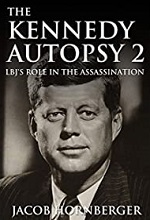
The Kennedy Autopsy 2: LBJ’s Role in the Assassination – Jacob G. Hornberger

Hornberger2 I recently reviewed Jacob Hornberger’s The Kennedy Autopsy, in which author Jacob Hornberger discusses the anamolies surrounding the forsenic examination conducted on President John F. Kennedy (1917-1963) at Bethesda Naval Hospital following his assassination on November 22, 1963 in Dallas, Texas. In this second part of the series, he examines the role of former President Lyndon B. Johnson (1908-1973) in Kennedy’s murder.  To be fair, no “smoking gun” has ever surfaced linking Johnson directly to the crime. However, researchers have long believed that Johnson knew in advance of what was to come in Dealey Plaza and had used the powers of the presidency to conduct a sham investigation that resulted in the much disputed Warren Commission report.  Admittedly the evidence is compelling and Johnson has his own trail of indiscretions unrelated to the events in Dallas.  In fact, Johnson was complicit in so many things, that his former attorney Barr McClellan felt compelled to write about in his book Blood, Money & Power: How L.B.J. Killed J.F.K. The legacy of Johnson is certainly a topic for another discussion but what Hornberger has to say here just might cause you take another look at the champion of the “Great Society”.

The crux of the book is formed by a series of events that took place within the short span of less than two and a half hours. As a dying Kennedy was rushed to Parkland Hospital, Johnson was also rushed to the facility and remained there until learning of Kennedy’s death at 1:00 p.m.  Upon learning of the president’s death and that he was now the new president, he then proceeded to Love Field where Air Force One and Two were sitting idle. However, instead of immediately returning to Washington, he stay in place at love field until Kennedy’s body, which was forcibly removed from Parkland Hospital by fully armed Secret Service personnel, arrived at the air strip.  Only then did both aircrafts depart for Maryland and Washington, D.C.  Kennedy’s body was transported to Bethesday Naval Medical Center where an even more bizarre series of events took place.  However, that is well covered in the first book by Hornberger regarding the topic at hand.

The premise of Hornberger’s argument is this:  if Johnson was so afraid that Kennedy’s murder was a Soviet plot to attack America and that his own life could be in danger, then why did he wait at Love Field instead of immediately departing Texas for safer territory?   The argument put forth by Hornberger is without question disturbing, but the position taken by the author is thought provoking.  And to be honest, no sound explanation for Johnson’s actions has ever been put forth. In fact, his behavior the entire time was more than bizarre and did not reflect the mindset of someone concerned about a large scale attack on the United States.

Some readers may feel that there is no way on earth Johnson could have been complicit in any part of the crime. Unless the person knew him personally, that is purely speculation. But what is clear is that his statements following Kennedy’s death conflicted with his actions that day.   In all fairness, the author does not claim that Johnson masterminded Kennedy’s murder anywhere in the book.  But he does believe that Johnson knew of the murder in advance, played an enormous role in the cover-up and that there does exist a very real deep state or military industrial complex as described by former President Dwight Eishenhower (1890-1969).

As a bonus, the author also discussed Johnson’s decision to withdraw from the 1968 presidential election.  One narrative that has remained in place is that the entry of Robert F. Kennedy (1925-1968) into the race is what ultimately caused Johnson to step out of the race.  Another is that the rise of Hubert Humphrey (1911-1978) was proof that the Democratic party was ready for a new direction.  Well both may not be entirely accurate and Hornberger has a strong argument for his belief that Kennedy’s murder is the real reason he did not seek reelection.  On the surface, it seems far fetched but the author presents a very compelling case that have valid points.  And although the Vietnam War had damaged his presidency and civil unrest at home was a pressing issue, Johnson still remained a popular figure. His true reason for stepping down most likely went with him to the grave and we may never know completely.  But there is a strong chance that what we have long believed about his decision may be completely wrong.  The case is presented here for you to be the judge.

The Kennedy assassination is a riddle with many layers, some of which have been peeled back for us to see the complexity within.  Unraveling the entire crime is still a monumental task that requires a focused approached one step at a time.  Hornberger has taken that approach in this highly interesting look into the actions of Lyndon Johnson after the infamous volley of gunfire in Dealey Plaza.

ASIN: B07ZKXLXZZ

The Kennedy Autopsy – Jacob G. Hornberger

Hornberger1The unexpected increase in free time at my disposal has provided me with ample opporunity to increase the amount of reading material at my disposal. I decided to take another look at the murder of President John F. Kennedy (1917-1963), whose death remains one of most puzzling crimes in American history.  The official narrative is that on November 22, 1963, lone gunman and former Marine Lee Harvey Oswald (1939-1963) fired three shots at Kennedy’s motorcade from the Texas School Book Depository, fatally wounding Kennedy and severly wounding Texas Governor John Connally (1917-1993).   The case seemed open and shut with Oswald forever being labeled as the lone nut or lone gunman.  On the surface, the case seems simple but there were many strange things that took place that day after Kennedy died that are not only mind boggling but also deeply disturbing. One of them is the handling of his body and the autopsy that was conducted at Bethesda Naval Hospital.

Jacob Hornberger is the president of the Future of Freedom Foundation , an organization whose goal is the “aim of establishing an educational foundation that would advance an uncompromising case for libertarianism in the context of both foreign and domestic policy“.  His mission in finding the truth has led him on the trail taken by other researchers into Kennedy’s death.  His focus here is on the autopsy itself and many bizarre and troubling anomolies that have surfaced over the past several decades.  Some readers might wonder how the autopsy could be a source of controversy but there is ample evidence that there was a flurry of unusual activity as the president’s body arrived in Maryland. And what Hornberger discusses here may blow the minds of many.

I strongly recommend anyone interested in the full story of JFK’s autopsy to read David Lifton’s Best Evidence: Disguise and Deception in the Assassination of John F. Kennedy , a chilling examination of the handling of Kennedy’s body following the assassination.  However, there is much that can be learned here which is based partly on Lifton’s work.  The book reads like a long essay and in fact, Hornberger describes his writings as exactly that.  The format makes the narrative flow smoothly without becoming drawn out or extremely repetitive.  And although the author repeatedly drives home his point, at no point does the book feel like a rehash of what we have already learned.  It is a dark and sinister tale which few are willing to discuss, mainly out of fear that they will be labeled as a “conspiracy theorist”.  However, if one does not believe the offiical story about Kennedy’s death and believes that more parties were involved, then by definition he/she would be considered a conspiracy theorist. But I digress.  Hornberger backs up all of his claims with solid evidence, based on interviews of the personnel on staff that day at Bethesda and the timelime set by the Warren Commission itself.

Kennedy’s autopsy was performed by Lt. Col. Pierre Finck, Dr. James Hughes and Dr. J.  Thorton Boswell (1922-2010).  All three were noted military physicians but inexperienced with gunshot victims.  However, they were given the task of what was then the most important autopsy in American history.  The official story is that the autopsy began roughly around 8:00 p.m. on November 22.  However, several individuals would later give statements to investigators and the Assassination Records Review Board that opened a can of worms and threw the whole story into uncertainty.  Snippets of their statements are included here and what they have to say may cause the hair on your neck to stand up.  Further, we are tempted to ask the question, when exactly did Kennedy’s body arrive at Bethesda?  And how many autopsies were performed that night?  Further, what are we to make of the report filed by FBI Agents James Sibert and Francis O’ Neill, who both reaffirmed the words in their report thirty years after the assassination?

The autopsy is one of the most overlooked parts of Kennedy’s murder.  Oswald, the rifle and the murder of Dallas Police Officer J.D. Tippit (1924-1963) have taken center stage in the assassination story but events outside of Dallas that day often remain secluded in the shadows.   Diligent research has brought them to light for those who wish to see.  Undoubtedly there is more to the story than many of us could ever imagine.  The doctors who performed the autopsy stated under oath that higher ups in the military command gave orders that night as well as other individuals who remain unidentified. A military controlled autopsy on a civilian is almost unheard of. Yet on that day, Kennedy’s body was illegally removed from Parkland Hospital under circumstances which are nothing short of troubling and a tightly controlled forensic examination occurred. Further, those who did attend and assist were sworn to secrety by military brass.  The story is simply unbelievable but actually happened as described and is well-documented.

The murder of John F. Kennedy continues to intrigue researchers intent on learning the truth about Dallas that day.  They may one day find out what actually did happen in its entirety.  And through books such as this, the real truth will continue to emerge.  Some may write off Hornberger as another conspiracy nut but I caution them that the book is not simply a rant by a deranged nut.  There are many dark details here which should be paid close attention to if we are to learn the truth about Kennedy’s murder.

ASIN: B00NHVT820

Once Upon a Time in Compton – Tim Brennan, Robert Ladd and Lolita Files

compton1Compton, California has earned a reputation over the last fifty years as a place where people are tough, life is dangerous and unless you are from there, you stay away.  Gangs such as the Bloods and the Crips have proliferated across the city in the wake of the Civil Rights Movement and the dawn of the crack cocaine epidemic in the United States.  In what could rightly be described as a civil war, thousands of black men, women and children have died on the streets of Comptom and in Los Angeles county as gang wars escalated.  In 1888, the City of Comptom had formed its own police department to patrol city limits and at the time of the deadly gang wars erupted, it was pushed to its limit.  Some officers would leave the department for much quieter neighborhoods with lower crime rates.  Others would stay until it was disbanded in 2000.  Among the two most well-known as respected officers were Tim Brennan and Robert Ladd.   The duo have been interviewed numerous times in recent years, expressing their thoughts on Compton, the murder of Tupac Shakur (1971-1996) and his alleged killer Orlando Anderson (1974-1998).  However, there is far more to their story than what we have come to learn on screen and here the two join with Lolita Files, whom some may recognize from the A & E multi-part series Who Killed TupacIn the show she is assisting famed attorney Benjamin Crump who takes another look at the murder of the slain rapper.  This is their story about their lives and time in Comptom as part of a police department located in the middle of a war zone.

Those of us who live outside California may find the gang culture to be both mistifying and tragic.  The Crips, who feature prominently throughout the book, have a long past of their own.  The gang’s formation is rightfully captured by Zach Fortier and Derard Barton in I am Raymond Washington: The Authorized Biography About the Original Founder of the Crips, which I highly recommend to readers interested in the development of the Crips.  Brennan and Ladd became intimately familiar with them and other outfits that compose the fifty-five known gangs of Compton. The two were so well known on the streets that Brennan earned the nickname “Blondie” as a result of a song by DJ Quik.  But just how did the two end up in Compton and become partners for fifteen years? Lolita Files narrates their story in this book that is a both a biography and an investigative look into one of America’s most violent cities.

Files provides a short history on Compton which I found to be very interesting and informative.  The city’s later history is similar to other cities across America where white flight helped give way to the ghettos that developed. Compton is no different and its descent into madness in the wake of the 1965 Watts Riots, is an American tragedy that unfornately is not unique.  However, nothing could have prepared Compton for what would come next and when the gangs arrived, the city was transformed into hell on earth.  It is not long into the book before Brennan appears and we learn about his migration to California where he makes a home in the Compton Police Department.  He is schooled as a rookie and moves up through the ranks.  However, it is not until he meets California native Robert Ladd that the dynamic duo is formed and through their work, become nationally recognized experts on gang culture.

The book is not solely about the two officers but Files also discusses the city’s most notorious gangsters whom Brennan and Ladd became very familiar with.  Nightly gang shootings, drug transactions and even domestic disputes, kept the Compton Police Department busy and Files takes us back in time when Brennan and Ladd found themselves in the middle of open gang warfare.  They are joined by Reggie Wright, Sr., whom some may recall as the father of Reggie Wright, Jr., a former Compton Police Officer himself who later provided protection to Death Row Records through his company Wright Way Security.  The stories are crazy and some unreal but Compton was akin to the wild wild west except the gang members were not using six shooters but heavy artillery designed to cause mass casualties.

Politics play a part in the story as one would expect and some of the events that take place are both head scratching and amusing.  And the takeover by the Los Angeles Sheriff’s Department was the final nail in the coffin and officialy marked an end to the Compton Police Department.  However, before that took place, the gang unit had been making waves and putting a dent in gang activity.  But there were a couple of events that were even too large for Brennan and Ladd.

No book about Compton would be complete without the Los Angeles riots in the wake of the acquittal of several officers who took part in the beating of motorist Rodney King (1965-2012).  The verdict set off riots across the county of Los Angeles and I remember watching the events on television with disbelief and fear of what would happen next.  Files revisits the tragedy and the response to the mayhem by the Compton Police Department. It is a dark time in American history, but one that can never be forgotten, especially by the people of Los Angeles.   By this point in the story, we come to know Brennan, Ladd and other officers in the Compton Police Departmentve very well.  However, the story picks up its pace after a deadly shooting takes place in Las Vegas, Nevada on September 7, 1996.  That night, Tupac Shakur was shot and mortally wounded after an altercation at the MGM Grand Hotel with South Side Crip Orlando Anderson.  Shakur’s death on September 13, 1996, unleashed a wave of violence across Compton between Bloods and Crips that placed Brennan and Ladd on the front lines in the investigation.  Files takes on the role of our reporter and delivers the full inside scoop on the deadly retaliation that took place.  Anderson is also a point of focus and his story is revisited including his own death in May, 1998.

Readers who have followed Brennan and Ladd will undoubtedly find this part of the book to be of high interest. Further, Files has proven herself to be highly knowledgeable  about the crime as evident by her appearance alongside Crump.  The scuffle at the MGM, the events leading up to it and its aftermath are covered completely.  Further, the efforts of former detectives Russell Poole (1956-2015) and Gred Kading are examined in detail.  Viewers of the USA show Unsolved, will be familiar with Kading’s name as well as those who have studied the Shakur case.  The death of rap star Christopher”The Notorious B.I.G.” Wallace (1972-1997) on March 9, 1997, also enters the story and Files discusses it in depth.  The writing is good and I even learned an intersting fact about Duane “Keefe D” Davis which I had not previously known and possible connections between Wallace and the South Side Crips.  I also learned more about Brennan’s interactions with Kading’s task force which had been assembled to learn the truth about Wallace’s death.  Motives for both murders are presented and some viewers may feel that perhaps the simplest explanation is the most likely.  Sadly, both Shakur and Wallace’s murders remain unsolved.

What I have described so far does not come close to acknowledging everything that will be found in the pages of this book.  It is simply a great read about the Compton, and a must-read for anyone who wants to learn more about the city that gangs and rappers put on the map.  There is a cast of characters to be found in the story ranging from former Death Row Records CEO Marion “Suge” Knight to the deplorable racist gang known as the “spook hunters”.  Compton is full of history  and it is still being written.  And only time will tell if its residents can make peace with the past and move away from the violence that has claimed far too many lives.  Great book.

ASIN: B079RKDS4M

Smacked: A Story of White Collar Ambition, Addiction and Tragedy – Eilene Zimmerman

SmackedDrug addiction has steadily become one of the greatest plagues to affict mankind.  Nearly all of us know someone who has struggled with addiction or lost their life to it.  Recently, I read Sam Quinones’ spellbinding account of the rise in opioid in the United States Dreamland: The True Tale of America’s Opioid Epidemic , in which Quinones explains how and why opioids have become so ingrained and deadly in American culture. My boss had recently ordered this book about drug addiction to understand the matter which had come up in one of our cases.  He mentioned that he did not have the time to read it at the moment but let us know that the book was for the taking to anyone who had interest in it. I decided to take it along with a few other books also on the opioid epidemic.  Similar to Dan Peres As Needed for Pain: A Memoir of Addictionthe story at hand involves the drug addiciton of a successful individual whom many would not suspect of being an addict.  Eilene Zimmerman tells the story of her late husband Peter, whose battle with addiction claimed his life and led her on a mission to understand how drugs have infiltrated the lives of even the most successful.

As the book opens, Eilene arrives at Peter’s house after learning he had a bizarrer outburst at his son Evan and daughter Anna.  No one has heard from him and she decides to check on him and confront him over his behavior.  Upon arrival at his house, she notices several odd things before finding him face up and deceased.  A called is placed to 911 and she desperately tries reviving him but it is soon clear that Peter is gone.  At this point in the book, we are not sure why he has died but only that something terrible has happended and many questions now exist that are answered as the book progresses.

The story of his life and their time together is equally as important as his death and Eilene takes us all the way back to the time when she was twenty-three and in search of a job after recently being laid off.  She meets Peter after he interviews her at a job placement center. Over the next two years they became friends and eventually found themselves in a committed relationship.  Zimmerman’s memories provide examples of how true love flourishes under the most unexpected of cirumstances.  Marriage, children and an eventual move to San Diego, California follow where they settle in with their children Evan and Anna.  Peter is a successful partner in a law firm whileEilene exercises her talents in journalism.  However, their marriage soon desolves and not long after, Peter starts to exhibit some very strange behavior. 

Peter, who was once a doting father and husband, begins to unravel, missing appointments or in some cases not showing for events. Although the couple divorced, they remained close because of their children.  Eilene notices some very disturbing aspects of his appearance which Peter quickly explains as Hasimoto’s disease.  Wanting to believe him at face value, she accepts his expanation until discovering one day that some parts of the story do not add up.  But Peter has an answer for everything, a commonly known trademark of drug users.  As she relays the memories of his behavior, readers will be tempted to think “why didn’t she see that he was using drugs?”.  One answer is that prior to Peter, she had no direct exposure to it.  Her story is similar to thousands of grieving relatives who have never seen up close, the effects of drugs that are mentioned on television and the internet.  Peter’s children are equally disturbed and distressed by their dad’s behavior but no one can come up with a logical answer for his erratic actions.

The author looks back with hindsight and provides insightful comments as she tells the story.  It is clear that she is now well immersed in the underpinnings of drug addiction in America and also part of the growing number of those who have lost someone close to narcotics.  She is candidly honest about her failure to see what was slowly becoming obvious and why she held on to her belief that he needed to see another doctor about the Hashimoto diagnosis.   But through her words, readers will be able to piece together a picture of a man who is in the grip of a serious addiction that is literally changing him mentally, physically and emotionally. The meltdown kicks into high gear and for Zimmerman and her children, events soon take a dark turn.

After learning about their lives and the road leading up to Peter’s death, Zimmerman has a lot more to discuss in the book and devotes a signficant portion to the use of drugs in corporate America, in particular among lawyers.  This section hit home because I work in the legal field and bear witness to the amount of pressure and stress that attorneys carry daily.   Some handle it better than others and yes, from my own knowledge as well, some turn to drugs to ease the stress.  But wht I learned here was more than I had bargained for. And to make matters even more surprising, what Zimmerman relays is just a small sample of what is possibly very large scale.  Further, what she relays is that drug use is more prevalent among professionals than most of us think.  It also reinforces the notion that not all drug users look like they use.

Towards the end of the book, she also devotes a section to Generation Z and the modern day professional.  The invention of social media and concept of being “plugged in” all day long has not only increased workloads but stress.  The use of drugs culd very well increase among the younger generation who are coming of age in an era where social and workplace pressures are higher than ever.  In Japan,  it is well documented that some people have succumbed from working themselves to death.  While the United States does not appear to be as extreme in the idea of overwork, there are many professionals who do work eighty or more hours each week.  For some of them, the keep going, they will turn to illegal drugs that give them the assist they need to keep going. But how do we then give them the help they need before it is too late?

I found myself glued to the pages of this book.  Once the story begins, it continues to pick up speed as Peter begins his descent from which he will never return.  Zimmerman’s honesty about her own actions and beliefs will provide solace to other wives and mothers who have been in the same situation.  And in spite of all that happens in the book, she never stops loving him even after he is gone, showing the long lasting effects of losing someone to drugs.  This is a great read from a very strong person who tells you her story so that your family does not live through what she did.  Highly recommended.

ISBN-10: 0525511008
ISBN-13: 978-0525511007

Message to the Blackman in America – Elijah Muhammad

muhammad1The recent Netflix series Who Killed Malcolm Xrenewed my interest in the death of Malcolm X (1925-1965) and the Nation of Islam (“NOI”) under the guidance of Elijah Muhammad (1897-1975).  Malcolm’s death is still revisited as one of the darkest moments in the Civil Rights Movement.  Muhammad and his star pupil had long fallen out of favor after Malcolm’s death, rumors swirled that the leader of the NOI had ordered the assassination.  No proof ever surfaced of it and whatever Muhammad did know, he took with him to his grave.  He left behind a trove of writings, speeches and statements from public appearances that shed light on his thoughts regarding Islam, race and the future of America.  In 1965, this book was published as Muhammad’s message to the black men of the United States.

Although I am not Muslim, I was curious to see what Muhammad had to say and if it would be relevant to me being a black American.  I am familiar with some of the rhetoric from the NOI which Malcolm later sought to distance himself from.   But the fact remains that Malcolm did receive from Muhammad many of the teachings that guided him as his responsibilties in the NOI continued to increase and hecame its brightest star.  If there was one thing I was sure before starting the book, it was that Muhammad would not mince words.  In fact, no one in the NOI minced words and their belief in full freedom and equality for black people is well-known and documented.  But this is Muhammad’s show and he waste no time in getting his points across.

From the start, Muhammad directs his attention to Christianity and its role during slavery in America. Those who are devout Christians may find this argument to be difficult to read but it is imperative to remember these are his thoughts only and it is up to you to decide which religion is right for you.  Further, he is speaking from the point of view of a member of the Islamic faith and there is no doubt that he believes in Allah as the savior for black people.   He does make compelling arguments and in fact, uses scriptures from both the bible and Quran to make his case.  However, the rhetoric is strong and the use of the term “devils” for white Americans and Europeans will undoubtedly be unsettling.   I had to remind myself that today we would not see anything like this but in Muhammad’s era, the United States was a very different and violatile place.  And perhaps if I had been born at the same time as Muhammad, I myself may have felt the same way.  In end, some who read the book might decide to convert to Islam while others accept his argument and continue on with their lives as things are.

By far, the part of the book which seemed the most outlandish is the section about  a scientist named Yakub, who apparently “created” the white race.  I have never seen any documented evidence of such a person or evidence of notes, test, etc.  I am inclined to believe that the story of Yakub is nothing more than a myth that continues to endure. Followers of the NOI may feel differently and I say to each his own.  However, this theory of Yakub, forms the base of Muhammad’s arguments about the nature of the “white devils”.   Some readers will surely roll their eyes at this part of the book.

Muhammad was a very sharp thinker but it is apparent in the book, that his voice is also laced with fierce emotion.   It is almost as if you can feel him raising his voice as the book progresses.  At one point, he does bring up the issue of the black woman which I found to be interesting and mystifying considering Muhammad’s well-known philandering.  Much of it has flown under the public radar but I recommend Manning Marable’s Malcolm X: A Life of Reinvention for a thorough discussion of what exactly did happen between Muhammad and the multiple secretaries he procreated with that helped cause the eventuall split with Malcolm.  I could not help but feel that it was quite hypocritical for Muhammad to preach about taking care of the black woman while stepping out on his own wife Clara Muhammad (1899-1972).

In spite of the heavy rhetoric that relies on shock value, Muhammad does make a very good argument in his belief of black people not waiting for help from anyone but instead, going out and doing.  Of all of the topics in the book, I firmly agree with him on this one in particular.   His message about self-sustainability and actual progress is spot on and can be used by anyone regardless of race. His words about changing the future of black people are still relevant today and many more people should hear this argument.  It is clear that he truly wanted the best for all black people.   However, I do not agree with his views on integration.  But again, I did not live in America in 1965 and did not experience the racism that black people faced on a daily basis.  If I had, perhaps I would agree with Muhammad.

Today we can see in hindsight that Elijah Muhammad was right about some things but wrong on others. His prediction of America meeting its doom did not come to pass.   And his argument against interracial marriage is still believed by some but interracial marriage continues to increase as more people turn to online dating and long-distance romance.  The world that he knew is far different today and will be even more different by the time I reach my senior years.  But Muhammad has his view and explains his position. It is up to the reader to accept or deny the argument.

Overall, the book is a mixed bag.  Within its pages is truth, rhetoric, religious arguments and even outlandish theories.  But Muhammad was not just an ordinary person.  The NOI remains today but its public presence is scaled down considerably.  But at one time, it was the focus of many Americans, seen as a group of black Muslims who were no longer accepting any excuses for the advancement of black people and other minorities.  These are the words of its most famous leader for audiences of all types.

ASIN: B0054R9C1M

Dreamland: The True Tale of America’s Opioid Epidemic – Sam Quinones

DreamlandIn August, 2019, a close friend lost her brother, who became yet another statistic in the ongoing crisis regarding opioid and other drug use in America.  I had met him previously and his death seemed surreal at the time. In fact, it still does.   His parents had never experienced anything like it and did what they could to get him the help that he needed.   For them and thousands of other parents who have lost a child to drugs, they often wonder how did this happen?  And what could we have done to stop it?  There are many answers to both questions but in this eye-opening book, Sam Quinones tackles the first question and tells the story of the development of the opioid epidemic in America.
Purdue Pharma, the company that reaped billions of dollars in the manufacture and sale of OxyContin, filed for bankruptcy in September, 2019, as it settled scores of claims former opioid addicts and family members of those who perished while addicted to the drug.  As part of its bankruptcy filing, it will pay out billions of dollars to those who fell victim to the company’s false adveritsing.   However, it is not the first time Purdue Pharma paid out money in litigation. Quinones revisits the year 2007, in which former U.S. Attorney for the Western District of Virginia John Brownlee launched an investigation into the company’s advertising practices. Purdue later entered into a plea deal with the government in which it agreed to pay a $634.5 million dollar fine. Several of its top executives later served time in prison.

When we think of the opioid epidemic, many ideas come to mind of the drugs that people take the alleviate pain and in other cases, feed an addiction that has become a raging monster.   Some users rely on prescription drugs while others have turned to street drugs, the most popular of which is heroin.   I personally knew someone who succumbed to heroin and each time I think of how short his life was, I shake my head in disbelief.   But I also realize that he was not himself and was caught in the grip of a drug that changes the way the mind and body functions.  We know these drugs exist, but the question is why?

Quinones presents a premise for the book which answers why we have opioids to begin with. Doctors have long sought a way to relieve pain for patients without casuing  addiction.  In short, they were searching for what Quinones calls the “holy grail”, a nonaddictive pain killer.   But to understand the current crisis, we first must learn how opioids were developed and the author provides a back story to their development.  The origins of heroin, methadone, diacetylmorphine and morhpine are discussed.  As I read the book, I thought to myself that the doctors who discovered these drugs most likely had no idea what they would become in years after their deaths.  If they had, perhaps one of more of them would have tried to halt its production.  We shall never know.

The story at hand is really two separate account of opioids, both legal and illegal.  Quinones weaves both into one story but alternates between the two as the book progresses. One part of the story begins with prescription pain killers in the medical field, whose development was quite low until phyiscians Dr. Russell Portenoy and Dr. Kathleen Foley published a paper in 1981 which did not find a direct link to opioid use and later addiction.  The pharmaceutical industry took notice and the town of Portsmouth, Ohio began to feel the effects from a wave of drugs that later changed an entire country.  Portsmouth had once been a thriving city in small town America and Quinones provides a well-written and informative section devoted to its rise and decline, with particular focus on its once mega-sized pool called dreamland.  The small town’s story forms part of the rust-belt narrative featured prominently throughout the rest of the book.

The other part of the story begins in Mexico where we visit the town of Xalisco in the State of Nayarit.   Some readers may be unfamiliar with the town and I personally did not know of its importance to the drug epidemic.  Quinones explains life in this small town, based largely in part of his time living in Mexico.  As the story of the Xalisco becomes more important,  I began to ask myself the same questions as law enforcement personnel: how did this small Mexican town flood the United States with heroin?  The story is actually quite simple and Quinones re-assembles the pieces of the puzzle so readers can see how the infiltration in America’s suburbs began, targeting a generation of young white suburban kids. It is a part of the war on drugs that many still do not fully understand but this book certainly removes all doubt.  The ghost of trafficker David Tejada and others continues to haunt the lives of kids addicted to black tar heroin which has caused the deaths of thousands of young men and women.

The pharmaceutical industry has become a behemoth in the manufacture and distribution of pain killers.  Purdue Pharma, which has been embroiled in controversy, traces its origins back to the legacy of Arthur Sackler (1913-1987), whose family was also named as a defendant in the lawsuit that resulted in its recent bankruptcy filing.  It is imperative to understand Sackler’s influence and Quinones delivers the goods.  In addition to Sackler, there are many others who played a crucial role in the development of prescription pain killers with varying degrees of influence including Dr. Hershel Jick and his then assistant Jane Porter Boston Collaborative Drug Surveillance Program,  Dr. Nathaniel Katz and quack phsyician Dr. David Procter, who could be described as the father of the pill mill.

On the other side of the battle there were many who realized early that something was brewing and that America was in trouble.  Law enforcment officers began to notice a new trend in drug use across small town America but sadly, many of these departments had never been exposed to narcotics of that caliber. And it is an issue which the author explains quite well.  Heroin and other dangerous drugs were never thought of something suburban kids did, it was only what the “city people” did.  However, its introduction into the American heartland changed all perceptions and people soon realized that the drug spares no one. It does not care about wealth, gender, ethnicity or anything else. Its sole purpose is to addict the user.  Drs. Jennifer Sable, Ed Socie and Gary Franklin had begun to sound the alarm bells with the help of pharmacologist Jaymie Mai but many years would pass before those in power too notice.  And years before Purdue came crumbling down, another lawyer named Joe Hale had attempted to bring the company to justice.  The stories of these men and women whose efforts did not go in vain are covered here and Quinones has done a great service to them in showing readers that there were those fighting the battle many years ago.

To say that this book is incredible would be an understatement. It is at times surreal and at others, infuriating.  Greed and negligence combined to spread a wave of deadly addiction across an entire country.  And the failed war on drugs was equally responsible.  Quinones has presented an irrefutable account of the opioid epidemic and its stranglehold on the nation.  For the families of victims such as Matt Schoonover, the pain never ends.  And I think of Francisco Baez, whom I knew very well until his death at the young age of twenty-four.  Their stories are just a sample of the thousands of opoid related deaths every year in America.  And parts of the country which never knew hard drugs are being forced to reckon with a new demon that destroys everything in its path.  This story is an American tragedy but it allows us to see how and why America turned into dreamland.  Excellent read.

ISBN-10: 1620402505
ISBN-13: 978-1620402504

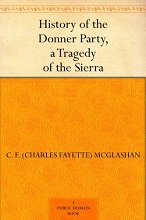
History of the Donner Party, A Tragedy of the Sierra – Charles Fayette McGlashan

DonnerIn the spring of 1846, a group of settlers left home in Springfield, Illinois en route to either Oregon or California.  A popular destination for many was the City of Yerba Buena, known today as San Francisco.  By the first week of may, the party had reached Independence Missouri and soon continued on their route.  They soon learned of an apparent shortcut through what is known as the Hastings cut-off near Salt Lake City, Utah. The trail was named after Confederate General Lansford Hastings (1819-1870).  It was believed that the shortcut would eliminate as much as three hundred miles off of their trip. The group separated and eighty-seven people continued on the trail.  Instead of elminating travel time, their journey was extended by another month.   Deeply behind schedule, their provisions began to run low and winter soon set in.  By the time their ordeal was over, only forty-eight had survived.  Some managed to survive by turning to cannibalism and that act has earned them a permanent place in American pop culture.  We have come to know this group pf settlers as the Donner Party.
The book was originally published in 1880 and this Kindle version is a digital transformation to permanent preserve a book that remains invaluable. When we think of the Donner party, cannibalism typically comes to mind. However, there was far more to the story and the true tragedy of their journey is often lost during discussions of the events that took place.  So just what exactly did happen and why?  McGlashan has the full story, having done the research needed and he even conducted interviews with survivors of the tragedy.  What emerges is a full picture of what really did happen although I am sure some minute parts of the story are lost to history.

The journey west by the Donner and Reed families was typical of the era as settlers sought a new life “out west”. California was destination number even years before the gold rush of 1849.  For the Donners and Reeds, it was a chance at new opportunity far removed from the daily life in Springfield, Illinois.  As their plan picked up, the number of travelers increased until reaching a staggering ninety people.  A number of those who had joined, were not related to either family but had heard about the expedition and expressed interest.  When they set out in early 1846, none of them could have imagined the disaster that lay ahead.

The author details the tragedy as food becomes scare and a brutal winter ravages the party.  Their deaths are sobering and also tragic.  But interstingly, cannibalism plays a minor role in the tragedy in contrast to what has been portrayed in the media and in pop culture.  Nature and lack of food combined to prove the biggest obstacle to survival instead of the treat of being murdered for food.  The cannibalism comes about as a necessity similar to the experience of Nando Parrado, Roberta Canessa and the surivors of Uruguayan Air Force Flight 571 as detailed in his book Miracle in the Andes: 72 Days on the Mountain and My Long Trek Home.  External factors as opposed to some internal predatory nature, are the factors behind those in each story making the decision to do the unthinkable.

Those in search of an uplifting read will be quite disappointed. However, if you choose to read about the Donner party, then I have to assume you already know something about their story.  And if so, you know every well that the traditional “happy ending” does not apply here.  Some members did survive but remained scarred by what they saw and experienced.  American history is filled with tales of finding a new life and exploring new terrority, but this book reminds us that for some, that curiousity also led them down a path from which very few have returned.  If you are interested in the Donner party and the truth about the events in 1846-1847 as a group of settlers sought refuge in a new part of the United States, this is a good read.

ASIN: B081YYH16Z

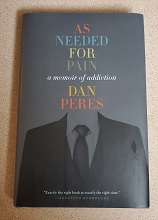
As Needed for Pain: A Memoir of Addiction – Dan Peres

20200319_191037The past several years have given way to a rise in the number of opioid related deaths in the United States.  Cities across America have struggled with a surge in drug overdoses and lack of proper facilities to handle the deceased.  I knew several people who battled an addiction to opioids and all but one are now deceased.  It is a soul crushing and life depleting addiction that cuts across all ethnic lines.  Many of us know someone who is currently battling an addiction or once did in the past, whether it was opioids, alcohol or some other substance. And what we all know is that addicts do not get clean until they have realized there is no where else to go but in the ground.  Dan Peres is a former Editor in Chief for Women’s Wear Daily Details and in this revealing memoir, he details his own struggle with a drug addcition that nearly took his life.

His story begins in Pikesville, Maryland in a run of the mill Jewish family.  He recounts his early life growing up in the suburbs before his life changes course and he finds himself at New York University.  It is there that the story picks up pace and Dan continues his ascent in the social scene in the city that never sleeps.  Journalism soon becomes his calling and he makes his entry into the fashion wold where he exceeds as a journalist and even gets to meet his childhood icon David Copperfield.  His job took him to Europe where he makes a home in Paris.  His recollections of his time there are some of the best parts of the story.  Upon returning to New York, he decides to pull a physical stunt that goes terribly wrong.  Two back surgeries and a bottle of Vicodin later, the addict was in the making.  And what starts out as simply medication to recover from back surgery,  soon turns into a habit which took him to hell and back.

Peres is blessed with sharp wit and his observations of the situations he found himself in and his own behaviour, add a touch of lightheartedness to a story that is quite serious.  Professionally, he was able to get by while personally, his life became a mix of drugs, escorts, lies and more drugs.  All the while, his maintained a public facade misled most until the demons caught up with him and his life began to unravel.  Two pills a day escalated into nearly a two dozen and then even more as the monster of addiction took hold of every facet of his life.  Throughout the book, Peres is frank about just how crazy things had become and his state of mind.  The story is simply mind-boggling and it truly is a miracle that he did not die.

Before meeting the woman who would become his wife, several women enter and exit the story under assumed names including one known as “Chickpea”.   The relationships or what could be better described as unspoken arrangements,  highlight the dysfunction in his mind as a result of an addiction that refused to release him from its grip.  His addiction pushed him to the brink and the episodes in Tijuana, Mexico and Skid Row in Los Angeles are the moments in the book where we realize he truly went off the deep end.  But Peres knows this and in the book, he literally takes himself to task for what could only be described as lunacy.  But such is the mind of an addict and Peres succeeds in showing us how addicts function under the influence of the drugs they consume.

After becoming a husband and expectant father, the addiction refused to let him go.  The actions of his family and in particular his Aunt Lou, are part of the what saved his life.  Their efforts are a prime example of the battles being waged across America today as families struggle to get loved ones the help they need. Peres provides a textbook example of the importance of intervention.  This story is a roller coaster ride and I am sure that readers whill find it enjoyable yet sad at the same time.  Peres is still alive to tell his tale but others were not so lucky.   But just maybe, this heartbreaking story of addiction will be enough to deter the next person from going down the same path. Good read.

ISBN-10: 0062693468
ISBN-13: 978-0062693464