
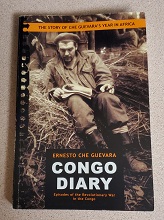
 I have been taking advantage of the free time that I now have at my disposal and was reorganizing the book shelves when I came across this book which I had purchased quite some time ago. It is the translated diary of Dr. Ernesto “Che” Guevara (1928-1967), from the failed revoultion in the Democratic Republic of the Congo im 1965. The book was published in 2011 and through the joint efforts of the Che Guevara Studies Center and his widow Aleida March. In the years following the repatriation of Che’s remains to Cuba in 1997, there was a resurgance of interest in his work and this diary is just one of several regarding the revolutions in Cuba, the Congo and Bolivia where he met his untimely death.
Che has become a pop culture figure but the reality is that he had no use for captialism and saw American imperialism as a system that needed to be stopped. After great succes in the Cuban revolution, he sought to spread those ideas across Latin America and any nation threatened by imperialism. On June 30, 1960, the Congo achieved independence from Belgium and Patrice Lumumba (1925-1961) became its first prime minister. Less than a year later, he was removed from office, detained and executed in a coup that resulted in the installation of Joseph Kasa Vubu (1915-1969) and Moise Tshombe (1919-1969) to positions of power which they maintained with an iron fist. Guevara had traveled to several African nations as an emissiary of the Cuban Government. And he soon became convinced that a revolution was needed in the Congo to remove the dictators in office and establish true independence.
It is clear early in the journal that Che’s decision to leave Cuba did not come easily and he comments on it right away in this short but revealing passage:
“I was leaving behind nearly 11 years of work alongside Fidel for the Cuban revolution, and a happy home, if that is the right word for the abode of a revolutionary dedicated to his task and a bunch of kids who scarcely knew how much I loved them. The cycle was beginning again.”
I personally could not imagine leaving a wife and five children to take part in a revolutionary struggle thousands of miles away from home. And this part of Che’s life has alwasy left me conflicted. While I always admired his abilty to commit to his beliefs unfailingly, I also questioned whether a father should leave his family for those same beliefs. His widow Aleida has continued to maintain his legacy which is open for debate, depending on the participants in the discussion. She does provide a discussion of her thoughts and feelings regarding their life together in Remembering Che: My Life with Che Guevara.
The tone of the diary is set from the beginning through Che’s words that “this is the story of a failure“. Upon his arrival in the Congo, it becomes clear that there is much work to do if the revolution is to succeed. However, the Congolese and groups of Rwandans who have also joined the resistance movement, are not guerilla fighters and lack the basic tools needed for armed struggle. The Argentine revolutionary kicks into gear and attempts to apply the lessons learned in Cuba to the Congolese struggle but learns over time that the feat is nearly impossible. The discipline and ideological commitment found in Cuba does not exist in the same capacity in the Congo. And the effort is cursed by power hungry and extravagant characters whose only concern is self-endorsement. His anecdotes show the disorganization and monumental challenged he faced in creating a revolutionary army.
Africa is far more diverse than some people realize. Within the borders of the many countries that compose the continent, are hundreds if not thousands of various different langauges and customs. Traditional medicine and superstition are combined in daily life and carried over into the independence movement. The concept of dawa weighs heavily in the story and Che explains its power over the men and the challenge it presented. Throughout the diary, he explains other important aspects of the Congolese culture, in particular food staples that the men are forced to rely on. For Che, the meager and simplistic diet is not a challenge but for the men, it proves to be beyond grueling.
As a trained physican, he notes the medical issues that arise including self-inflcited alcohol poisoning and other ailments including veneral disease. And although he does not take part in much of the fighting himself, he does treat fighters who return from the front lines after having been wounded. He provided descriptions of their conditions and characters in his observations about the reality of their degrading campaign. Hope and optimism had led Che to the Congo but it is not long before see in the diary, a change in his level of confidence in the struggle. In letters between himself, other figures and Fidel Castro (1926-2016) the serious issues developing within the group become critically important and an indicator that doom awaits.
Halfway through the book, it is clear that the Congo revolution is struggling to stay alive. Booze, women and popularity have infected the mindset of a number of fighters. Further, division between the Congolose, Rwandans and Cubans proved to be too much to overcome. Che quickly sums up the issue that had developed:
The Rwandans and the different Congolese tribes regard each other as enemies, and the borders between ethnic groups are clearly defined. This makes it very difficult to carry out political work that aims toward regional union – a phenomenon common throughout the length and breadth of the Congo.
This small passage summarizes the challenges Che faced which he document, in addition to what he believes were his own failures as a leader. Whether he could have truly succeeded is left up to the reader to decide. But what is clear to me is that the mission was doomed from the start and the Congo was not yet ready to be a truly independent nation. Dejected, the Cubans eventually return home to Cuba as well as Che, where he remained until 1967 when he set off for the ill-fated Bolivian campaign from which he would not return alive.
The power that comes with being a dictator has proved to be too seductive for many to resist and Africa has continued to be plauged by megalomaniacs who have failed to bring economic wealth and true democracy. Poverty, sham elections and crackdowns against resistance to government policy continues to this day. Perhaps the polticial and social climate in many parts of Africa will one day change and they do, it will have to be through diplomacy and not armed struggle. And if we need a reminder of why violence will not succeed, Che’s words here are perfect reference guide.
ISBN-10: 0980429293
ISBN-13: 978-0980429299
 I have always wondered what happened to the family of former Lucchese family assoaciate Henry Hill (1943-2012) following their entry into the Witness Protection Program. Hill had been expelled from the program due to multiple arrests, including one in 1987 for narcotics trafficking. In the years that followed, he became somewhat of a celebrity, appearing on shows and giving interviews about his life in the mafia. His ex-wife Karen, has remained out of the public light, living her days peacefully under the cloak of anonymity. Their children Gregg and Gina have families of their own but do their best to also remain out the public light. Their father’s life was portrayed on screen by Martin Scorcese, whose film
 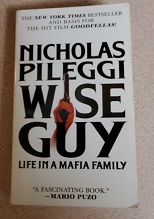 Recently, I was browsing Netflix and saw that Martin Scorcese’s classic film
 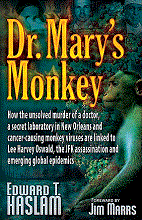 On July 21, 1964, New Orleans police officers responded to a call about a mysterious fire in an apartment complex. When officers arrived and entered the apartment, they found the body of Dr. Mary Sherman (1913-1964), a noted orthopedic surgeon and cancer researcher. The details surrouning her grisly demise are hair raising, chilling and also mystifying. The murderer was never caught. Edward T. Haslem is a New Orleans native whose father was a close acquaintance of Sherman. In fact, his father was asked to identify her remains and the incident left him visibily shaken as Haslam captures the below passage:
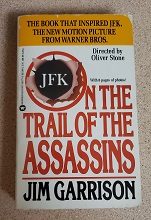 I decided to use the spare time at hand to reorganize my book case and other shelves upon which sit the other literature that I have come to love and appreciate. While perusing the books, I found this book by former New Orleans District Attorney James “Jim” Garrison (1921-1992) who is remembered for bringing the only public trial in the murder of President John F. Kennedy (1917-1963). In 1992, Warner Brothers released Oliver Stone’s
 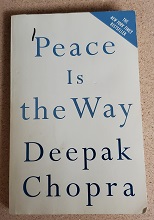 We hear the word peace often, typically while watching news broadcasts regarding ongoing conficts around the world. The search for peace remains the ultimate goal of mediators intent on resolving long standing feuds that have claimed lives and destroyed cities. Cease-fires and treaties are signed by which all parties agree to end hostilities. However, conflict resolution and geunine peace are two very different concepts. Many of us seek peace in our lives, away from those who have wronged us or others who remain a source of irritation. The American pacifist A.J. Muste (1885-1967) believe that there is no way to peace, but instead that peace is the way. That is the central theme of this book by Deepak Chopra, M.D., who along with brothe Sanjiv, wrote the beautiful memoir
  The unexpected increase in spare time that that I now have, has allowed me to catch up on books that I had planned to read over the next several weeks. Among them is this inspiring memoir by brothers Deepak and Sanjiv Chopra. I was familiar with Deepak, having seen him in interviews and on social media. Sanjiv was a bit more obscure but also just as accomplished as we learn in the book. But there is far more to the story than their known accomplishments. In fact, what I found is a story of the challenges a person faces when deciding to leave one home and make another in a place thousands of miles away. It is the story of immigration and two brothers finding the Amerian Dream, a concept which many today do not always believe in or in other cases, have come to misunderstand.
 One of the most important questions surrounding the assassination of President John F. Kennedy (1917-1963) has always been why was he murdered? We do have the official explanation that Lee Harvey Oswald (1939-1963), a former Marine and attempted defector to the Soviet Union, murdered Kennedy due to his own deranged thoughts which no one has been able to accurately explain. And although he was murdered before he could stand trial in a Texas courtroom, Oswald remains labeled as Kennedy’s assassin. But to understand the murder of any politician, it is necessary to examine the political and social climate in existance at the time. There are many clues to why Kennedy was murdered if we are willing to look. Douglas Horne served on the Assassination Records Review Board, the organization that was developed to examine the voluminous recorsds produced in response to the President John F. Kennedy Assassination Records Collection Act of 1992. The act was created as a result of Oliver Stone’s groundbreaking film
 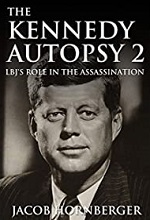 I recently reviewed Jacob Hornberger’s
  The unexpected increase in free time at my disposal has provided me with ample opporunity to increase the amount of reading material at my disposal. I decided to take another look at the murder of President John F. Kennedy (1917-1963), whose death remains one of most puzzling crimes in American history. The official narrative is that on November 22, 1963, lone gunman and former Marine Lee Harvey Oswald (1939-1963) fired three shots at Kennedy’s motorcade from the Texas School Book Depository, fatally wounding Kennedy and severly wounding Texas Governor John Connally (1917-1993). The case seemed open and shut with Oswald forever being labeled as the lone nut or lone gunman. On the surface, the case seems simple but there were many strange things that took place that day after Kennedy died that are not only mind boggling but also deeply disturbing. One of them is the handling of his body and the autopsy that was conducted at Bethesda Naval Hospital.

You must be logged in to post a comment.