
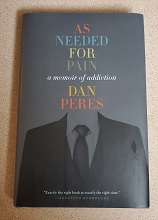
 The past several years have given way to a rise in the number of opioid related deaths in the United States. Cities across America have struggled with a surge in drug overdoses and lack of proper facilities to handle the deceased. I knew several people who battled an addiction to opioids and all but one are now deceased. It is a soul crushing and life depleting addiction that cuts across all ethnic lines. Many of us know someone who is currently battling an addiction or once did in the past, whether it was opioids, alcohol or some other substance. And what we all know is that addicts do not get clean until they have realized there is no where else to go but in the ground. Dan Peres is a former Editor in Chief for Women’s Wear Daily Details and in this revealing memoir, he details his own struggle with a drug addcition that nearly took his life.
His story begins in Pikesville, Maryland in a run of the mill Jewish family. He recounts his early life growing up in the suburbs before his life changes course and he finds himself at New York University. It is there that the story picks up pace and Dan continues his ascent in the social scene in the city that never sleeps. Journalism soon becomes his calling and he makes his entry into the fashion wold where he exceeds as a journalist and even gets to meet his childhood icon David Copperfield. His job took him to Europe where he makes a home in Paris. His recollections of his time there are some of the best parts of the story. Upon returning to New York, he decides to pull a physical stunt that goes terribly wrong. Two back surgeries and a bottle of Vicodin later, the addict was in the making. And what starts out as simply medication to recover from back surgery, soon turns into a habit which took him to hell and back.
Peres is blessed with sharp wit and his observations of the situations he found himself in and his own behaviour, add a touch of lightheartedness to a story that is quite serious. Professionally, he was able to get by while personally, his life became a mix of drugs, escorts, lies and more drugs. All the while, his maintained a public facade misled most until the demons caught up with him and his life began to unravel. Two pills a day escalated into nearly a two dozen and then even more as the monster of addiction took hold of every facet of his life. Throughout the book, Peres is frank about just how crazy things had become and his state of mind. The story is simply mind-boggling and it truly is a miracle that he did not die.
Before meeting the woman who would become his wife, several women enter and exit the story under assumed names including one known as “Chickpea”. The relationships or what could be better described as unspoken arrangements, highlight the dysfunction in his mind as a result of an addiction that refused to release him from its grip. His addiction pushed him to the brink and the episodes in Tijuana, Mexico and Skid Row in Los Angeles are the moments in the book where we realize he truly went off the deep end. But Peres knows this and in the book, he literally takes himself to task for what could only be described as lunacy. But such is the mind of an addict and Peres succeeds in showing us how addicts function under the influence of the drugs they consume.
After becoming a husband and expectant father, the addiction refused to let him go. The actions of his family and in particular his Aunt Lou, are part of the what saved his life. Their efforts are a prime example of the battles being waged across America today as families struggle to get loved ones the help they need. Peres provides a textbook example of the importance of intervention. This story is a roller coaster ride and I am sure that readers whill find it enjoyable yet sad at the same time. Peres is still alive to tell his tale but others were not so lucky. But just maybe, this heartbreaking story of addiction will be enough to deter the next person from going down the same path. Good read.
ISBN-10: 0062693468
ISBN-13: 978-0062693464
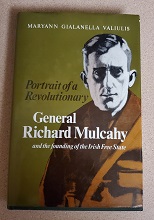 Discussions of the 1916 uprising in Ireland tend to focus on a select group of figures. The names of Patrick Pearse (1897-1916) and James Connolly (1868-1916) are legend in Irish history and their actions part of the narrative of the Republican fight for a united Ireland. In December, 1921, the British Government and Republican forces reached an agreement that officially partitioned Ireland into Unionist north and Republican south. The southern part was established as the Free Irish State, to be led by Michael Collins (1890-1922)who became Chairman of the Provisional Government of the Irish Free State. Collins is well-known in Irish history for his unwavering support of the Republican cause. However, there was another figure who not only worked closely with Collins, but someone whose own story and actions are typically left out of the official narrative. Pictured to the left General Richard Mulcahy (1886-1971), one of the founding members of the Irish Free State and staunch supporter of Irish independence. When I saw this book for sale, I knew immediately that I had to read it and understand who the intriguing character on the cover of the book really was.
 I saw this book in my list of recommendations on Amazon and decided to take a closer look. The cover caught my attention and after reading the full title, my interest peaked. On January 9, 1969 a group of students belonging to the Swarthmore Afro-American Students Society (SASS), took over the admissions office at Swarthmore College. In the months prior, a working paper regarding the recruitment and admission of black students had been released, resulting in immediately backlash from the university’s black students who felt their privacy had been violated and their experiences ignored. The animosity between the students and Dean Hargadon continued to increase and the students felt they had no option but to act. Joyce Frisby Baynes, Harold S. Buchanan, Jannette O. Domingo, Marilyn J. Holifield, Aundrea White Kelly, Marilyn Allman Maye, Myra E. Rose and Bridget Van Gronigen Warren moved into the admissions office and over the next few days, their resistance changed the course of history for Swarthmore College.
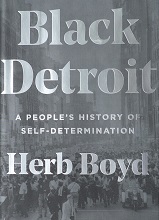 When I think back to my youth, I recall various automobiles that were own by my father, uncles and friends. Their cars were American made and typically products of General Motors. Buick, Pontiac and Cadillac were the cars of choice and hardly anyone then owned a foreign car. If you owned a Cadillac, it meant status and success in the America. Detroit became Motor City and its dominance over the U.S. auto industry remained in place for several decades until automakers from Japan and Germany stormed into the American market. The city has an extensive past, beginning with French explorer Antoine de Lamothe Cadillac (1658-1730) for whom the luxury automobile is named after. In 1701, he established what is now Detroit before eventually returning to France where he lived out the rest of his days. The evolution of Detroit is one of America’s greatest success stories and also one of its greatest tragedies. Throughout all, its black citizens have always remained firm in their dedication to seeing Detroit become a city to be envied. Herb Boyd takes another look at his city and the role of black men and women in the development of a famed city.
 In 2019, streaming giant Netflix premiered “
 History has many dark secrets that some have wished remained hidden from the official record so that the history that has been portrayed remains sanitized and above reproach. But it is also said that what you do in the dark always comes to light. In the wake of the coup that saw the overthrow of Chilean President Salvador Allende (1908-1973) on September 11, 1973, the country was placed in a vice grip by his successor, Augusto Pinochet (1915-2006), who commenced a program of retribution against enemies, activist and those “suspected” of being part of the opposition to the new government. His regime was marred by human rights violations for which he was arrested by British Police in England on October 17, 1998. Pinochet was extradited back to his native Chile but never stood trial for his actions. He died on December 10, 2006 of congestive heart failure and pulmonary edema. His death marked the end of legal action to bring him to justice but it did not stop the prosecution of others who were complicit in the horrific actions that took place in the aftermath of the coup. Researchers continued to investigate Pinochet’s actions and those of fellow dictators in Argentina, Brazil, Paraguay and Uruguay. During one such expedition in Paraguay, a trove of documents were uncovered that shed light on a joint program created by several neighboring countries to track down those deemed enemies of the state with the purpose of execution. The program is known as Operation Condor and here Charles River Editors provides a concise summary of how and why the program came into existence.
 On June 6, 1944, American, British and Canadian troops stormed the beaches at Normandy, France and commenced an ground war against Nazi Germany. The European Theatre was marked by brutal fighting that saw high numbers of casualties on all sides of the conflict. In the end, Nazi Germany fell to allied forces and accepted an unconditional surrender on May 8, 1945, commonly known as VE Day. The Japanese military continued to fight and remained defiant until two atomic bombs forced it too into surrending to Allied forces. VJ Day marked the end to World War II and the world breathed a sign of relief. For the United States Army, the European Theatre was a hard fought campaign that no one ever wanted to see again. Author Stephen Ambrose has composed a breathtaking account of the Army’s mission from the beaches at Normandy until the Allies seized Berlin in May, 1945.
 Those of you who follow my blog probably know by now that I have covered quite a number of books regarding Northern Ireland the conflict known as “The Troubles”. My curiousity with the conflict in Northern Ireland stems partly from my love of history and partly from my visit to Ireland in 2016. I sought to fully understand the battle being waged by Republicans to unify the country and the opposition mounted by Loyalist who remain in support of British rule. Author Tim Pat Coogan has written of the 1916 Easter
 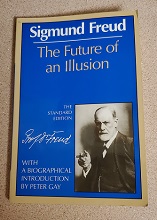 It is simply amazing that eighty-one years after his death, Sigmund Freud (1856-1939) continues to be part of American pop culture. The term “Freudian slip” is still used by professionals of all walks. It has been many years since I have read his work, in fact my memories of studying Freud come mainly from my time in college. A neighbor in my building needed to off-load some books and among the prized possessions was a group of Freud’s works. I picked them out rathern than see them head off to recycling, believing that even in the digital age, good books in print still have a place in every library.
 FREETHINKING BIBLIOPHILE
You must be logged in to post a comment.