
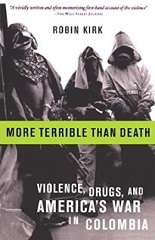
 Earlier this year, Netflix released the second season to the hit show ‘Narcos’ starring Wagner Moura as the infamous Pablo Escobar. While not exactly a dead ringer for Escobar, Moura pulls off a stunning performance bringing the late drug czar back to life. The series is violent and gritty but a look into a time in Colombia’s past when life was more terrible than death. Robin Kirk is currently the Faculty Co-Chair of the Executive Committee of the Duke Human Rights Center at Duke University. She is an experience human rights worker and penned this phenomenal account of the effects of the drug trade on the nation of Colombia.
To most Americans, Colombia is known for coffee, violence and cocaine. While it is true that the country produces the largest amount of cocaine in the western hemisphere, there is far more to Colombia than meets the eye. The country is also known for its beautiful landscape, hospitable people and some of the finest cuisine in Latin America. Intervention by the United States into Colombian affairs, the constantly growing market for illegal drugs and political instability helped turned Colombia into the most dangerous country of earth with a murder rate nearly triple of the worst American cities. Escobar stands out as the most popular narco to have come out of Colombia. But what most forget is that the drug trade went far beyond Escobar and involved many players, some of whom held high positions in Colombian society. Through Kirk’s memoirs of her time there, we come to know the courageous Colombian citizens who risked their lives in service of their beloved homeland. The extreme acts of violence are well-known and documented. Escobar literally held the country in a grip of fear as he waged war against the establishment determined to see him in prison or dead. As the acts of terror grew, Los Pepes and other cartels unleashed a deadly campaign to rid Colombia of the Rionegro menace. The ensuing war resulted in one of Latin America’s bloodiest drug wars with hundreds of men and women dying at a staggering rate. But as we make our way through Kirk’s book, we are able to see there were more players involved and more ideology in effect than is often shown.
In the wake of U.S. aggression, many Latin American nations struggled with class war between conservative and liberal, Colombian in particular. The civil war in 1948-1958 known as la violencia was an eerie premonition of the future to come. The FARC and right-wing Peasant Self-Defense Forces of Córdoba and Urabá, led by the late Carlos Castano, rose to prominence as the two largest extremists groups determined to bring a change to Colombian society by any means necessary. The drug cartels, M-19 Marxist group and the National Liberation Army (ELN) added another dynamic to already precarious situation and the battles between the parties resulted in a torrent of violence that shocked and appalled the citizens of Colombia and the world at large.
To the average American it is easy to write off Colombia as another hodgepodge of violence. But the stark reality is that the carnivorous American appetite for cocaine helped fuel the highly profitable drug trade and war. The war on drugs, spearheaded by President Ronald Reagan and continued by future presidents, did little to deter the monster that had been unleashed. Chemical sprays and millions of dollars invested in anti-drug campaigns had little or no effect on the supply of cocaine and in some cases had adverse effects health wise upon the people with the misfortune to live in areas in close proximity to narco operations. Suspicion, fear and paranoia gripped the minds of drug traffickers and left and right-wing leaders. Doctors, politicians and even judges were no longer safe and many have been forced to leave Colombia in fear of their lives never to return. Today, the drug trade continues and the government of Colombia continue to negotiate with the FARC to reach a peace agreement. A truce would be a monumental historical moment giving the people hope and restoring their faith in the country they call home.
The story of Latin America is one of which many Americans remain ignorant. Assumptions and pre-conceived notions have caused many to disregard Colombia as nothing more than a country of outlaws plagued by greed and cocaine. But in reality the truth is far different. The people there wish to live in peace and happiness like other countries but have been plagued by an environment encompassed by terror and fear from various angles by various groups all with separate agendas. And while it appears that its worst days are behind, there is still much work to be done as can be seen from the rejection of the proposed peace deal with the FARC. But all is not lost and a new future for Colombia is apparent as it finds itself on the brink of overdue social reform. With this incredible account of the turmoil that engulfed Colombia and the tragic fates of those who dared to speak up in defense of the place they called home, Kirk has done a great service to everyone that calls their self Colombian.
ASIN: B004WOH0D0
 James Baldwin once remarked that the story of Black America was America’s story and believe that it was impossible to separate the two. Nearly all of this nation’s major events are in some way related to the plight of America’s minorities. The country that is the land of immigrants becomes more of a melting pot with each passing week. The recent documentary “13th” highlighted the system of mass incarceration that has resulted in America having the largest prison population of anywhere in the world and millions of young Black and Hispanic men and women being placed behind bars for extended sentences based on convictions for trivial crimes. At the heart of the African-American experience is the precarious state of the immediate family structure and the constant discord that exist.
 On July 10, 2013, the Hon. Nicholas G. Garaufis of the Eastern District of New York ruled that former Bonnano Crime Family boss Joseph Massino was to be
  The reputation of Christopher Columbus and his actions continue to be re-examined as more cities throughout the United States pay homage to the nation’s Native American population. His arrival in the Caribbean in 1492 set off a chain of events critical to development of the area as we know it today. It is common knowledge that many atrocities were committed during Columbus’ voyages to what was called the New World. As the Spanish colonized the Caribbean, the native Indian population began to decline and was nearly non-existent by 1524. We know them by the name Taino but their history and significance is still widely understated. But just who were the Tainos and how did they come to inhabit what is today the Spanish, British, Dutch and French West-Indies?
 July 19, 1979- Nicaraguan dictator Anastasio Somoza Debayle is overthrown in a coup headed by the Sandinista National Liberation Front. His removal brings an end to a thirty year reign of tyranny and oppression from the Somoza family, supported by the United States. Somoza joins a long list of puppet dictators enabled and sustained by U.S. foreign policy guided by financial interests. Today, Nicaragua is the second poorest nation in the Americas behind Haiti. In some areas, residents are forced to live on as little as
  The late James Baldwin (1924-1987), remains one of America’s most gifted authors. He is also remembered as an icon of the civil rights movement who was fiercely outspoken against the injustices committed against African-Americans. Similar to Bayard Rustin, his homosexuality resulted in a life long inner turmoil in a quest to find true love and happiness. When he died in France in December, 1987, he left this world as a bachelor and without children. It could be argued that his children are the writings he left behind that examined society, human nature and emotions. One of these stories is Giovanni’s Room, Baldwin’s masterpiece about the complexities of the human heart and the burden of living with repressed sexuality.
 On August 16, 2003, Idi Amin Dada, the third President of Uganda from 1971-1979,
 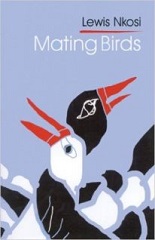 This gem for which I have written a review came as a recommendation by a close intimate in Argentina. And although short in its duration, the book contains powerful messages about our concepts of love, sex, race, class and justice. The story is of Ndi Sibiya, a young man from a town called Mzimba in the continent of Africa, who is condemned to death after being convicted of the rape of an English woman in the “whites only” section at the local beach. At the beginning, Sibiya informs that he is to die but at first we do not know the exact crime he has been charged with. As the pieces of the puzzle come together, we learn that each day for the past several weeks, he has had a wordless encounter with an English woman who sun bathes naked on the beach. She initially caught him watching her but did not report him and according to Sibiya, continues to show him her body. One day the tension proves to be too much and the two engage each other intimately. Sibiya is arrested and charged with violation of the Immorality Act and rape, both of which carry the death penalty.
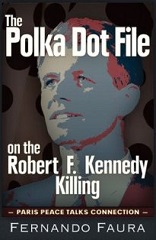 Each time I drive across the Robert F. Kennedy memorial bridge as I pass from Queens to the Bronx and sometimes Manhattan, I think about his importance to the State of New York and the United States. The former attorney general, senator and presidential candidate was one of the most polarizing figures of his time. His murder on June 5, 1968, shocked the world leaving millions of people speechless about what they had just learned. A young Jordanian immigrant named Sirhan Sirhan was later tried and convicted for the murder and the case is considered solved in Los Angeles County. Similar to the murder of John F. Kennedy 5 years earlier in Dallas, Texas, upon closer examination, many disturbing facts emerge that cast a chilling doubt over the official story.
 FREETHINKING BIBLIOPHILE
You must be logged in to post a comment.