All The Shah’s Men: An American Coup and the Roots of Middle East Terror-Stephen Kinzer

all_the_shahs_men_book_coverAugust 19, 1953-Iranian Prime Minister Mohammad Mossadegh (1882-1967) is removed from power in a coup engineered by British MI6 and the United States’ Central Intelligence Agency under the control of Kermit Roosevelt. Mohammad Reza Shah (1919-1980) returns from exile in Rome to reestablish himself as the nation’s highest authority. The Shah proceeds to place the country in an iron grip, enforcing dictatorial rule for the next twenty-five years before his abdication in 1979 resulting in the seizure of power by the Ayatollah Khomeini setting Iran on a path of radical Islamic rule highlighted by the administration of Mahmoud Ahmadinejad.  The coup in 1953 and the actions of U.S. President Jimmy Carter in 1979, permanently changed the relationship between the United States and the once promising Islamic Republic.

A little more than one year ago, the United States in conjunction with several other allies, reached a formal agreement to limit Iran’s ability to manufacture and stockpile nuclear weapons.  The agreement has been both lionized and criticized by the far right and far left. It is assumed by many that Iran is a sworn enemy of the United States and seeks to destroy all that America stands for.  Islamophobia and ignorance have allowed the belief that Iran is a threat to peace in the western hemisphere to proliferate exponentially.  Christianity still holds the record for the largest number of followers.  But that might change sooner than we might believe.  The Pew Research Center has projected that Islam will hold the title of the world’s largest religion by 2070.  The overwhelming majority of people who believe in Islam are very peaceful and sincere individuals. Fanatical believers unafraid of committing extremist acts have cast a dark cloud over the faith, breeding fear and suspicion that have resulted in a surge in hate crimes against those of the Muslim faith.  But was Islamophobia the sole reason for the actions of August, 1953?

Stephen Kinzer revisits Iran in 1953 in this investigative account of the origins of the coup, its implementation and consequences which continue to haunt Iran and the world to this day.  The life of Mohammad Mossadegh, the charismatic voice of democracy and liberty who gained a following as he chartered his course with the purpose of transforming Iranian society, is examined in detail.   Free speech, open elections and personal freedom became staples of his rule giving hope and optimism to thousands of believers.  But as we learn in from Kinzer’s investigative efforts, foreign influences, economic restrictions and domestic threats embarked on a collision course that dealt Iran a blow from which it has never fully recovered.

But just how did the coup happen and why was it initiated?  The answers to those questions, found in this book, are key to understanding the tragic results of U.S. and British involvement in the nation’s domestic affairs.  Greed, oil, British embarrassment and the fear of communism, were just a few ingredients in a stew that served as the catalyst for Mossadegh’s removal. The lack of appreciation for Iranian history and the complicated relationship between the Shiites and Sunni Muslims, allowed intelligence operatives from abroad to engage in a deadly plot resulting in one of the darkest moments in Middle Eastern history.  Today it is difficult to believe that the coup affects present day events.  But as we learn through Kinzer,  destabilization and political turmoil that ensued giving rise to fierce anti-western ideology, is directly tied to the coup.  The attack on the U.S. Embassy in 1979 and subsequent events further complicated matters.  War with Iraq and the emergence of international terrorism pioneered by radicals such as Osama Bin Laden continued to amplify aggression on both sides. The nuclear arms restriction deal came as a result of long hours of discussion, assurances and acts of faith by all involved.  Agreements reached with the deal,  have given way to the first steps on the road to reconciliation.

We have much ground to cover as we continue to reconcile with Iran. Many wounds have yet to fully heal and will require more patience and understanding on both sides.  The first step, which has already been taken, is to admit wrongdoing.  Governments can apologize but its citizens can and do sometimes remain defiant and unconvinced of any form of complicity.  In order for us to understand Iran and remove our fear of Islamophobia and our destruction, we must first learn why their feelings exist. Only then can we begin to untangle our complicated coexistence and move forward in a harmonious and promising direction.

“Those who are at war with others are not at peace with themselves.”- William Hazlitt

ISBN-10: 047018549X
ISBN-13: 978-0470185490

Lies My Teacher Told Me: Everything Your American History Textbook Got Wrong-James W. Loewen

lies-my-teacher-told-me-web

“There is nothing new in the world except the history you do not know ” – President Harry S. Truman

In comparison to many countries around the world, America is still a young nation.  Our history dates back several centuries which is far shorter than the thousands of years of history claimed by countries such as Greece and China. However, in the short time the United States has been in existence,  the world has witnessed its development and transformation into a world superpower. The image that is projected is of the land of the free and the home of the brave.  The battle for independence against Great Britain and the Declaration of Independence are considered to be hallmark moments that defined the future course of the United States.  But if we take time to examine our history here, we will find that much of what we have learned is not only wrong but has also caused many of us to live in ignorance, unaware of how our country became what it is today.

In two days, Columbus Day is upon us yet again.  In New York City, the Columbus Day Parade will march down 5th Avenue.  On October 4, the city of Denver, Colorado did something no other state has ever done before when the city council voted 12-0 to remove Columbus Day as an official holiday. The city has renamed the day Indigenous People’s Day.  Denver joins several other cities that have taken similar measures to pay homage to the plight of America’s Native American ancestors.  As a kid, I was taught that Christopher Columbus “discovered” America and without him, America would not exist.  I continued to believe that as I  grew up until several years ago when I came across an article that revealed the truth surrounding the arrival of Columbus, his brother Diego and their entourage in the Caribbean.  As the truth became clearer and the veil of deceit was lifted, I was forced to think not only about the myth of Columbus but about hundreds of other things I learned in history classes throughout the years.  My brother, aware of my love of history, picked up this book for me by James W. Loewen.  The cover alone is enough to provoke interest and suspicion but what’s inside the book is truly invaluable.

The idea that a teacher has lied about a historical event sounds preposterous to some. But as I made my way through this book, I began to see that the failure of teachers to teach the truth about America’s past is a small part of a larger problem, a system wide defect that has plagued classrooms for decades.  The poor vetting of information contained within history books and the desire to show our history in the best light possible has resulted in generation after generation being misinformed.  In fact, there are times at which our knowledge of our own history is so inferior that foreigners have a deeper wealth of knowledge as to how America was founded.  Our patriotism and sensitivity to criticism has caused many of us to automatically reject any notion that what we have been taught in school could possibly be completely wrong.  But if we are to learn the truth, then the first step is admit that we have been wrong. And with this book, James W. Loewen leads the way.

I cannot imagine that a book of this nature was easy to write for a number of reasons.  But I have always felt that true patriots love their country but never excuse its wrongdoings. Just as we take to task our siblings and friends for their transgressions, we bear the responsibility to ourselves and our fellow citizens to acknowledge  that our past has not always been glamorous and has a very dark side.  The demographics of America continue to change and we truly are a nation of immigrants.  However  class division, racial discrimination, genocide and domineering foreign policy became staples of the foundation of the United States.  Acknowledging this does not make any of us less patriotic but it helps us to understand how are we have come and how far we still have to go.  All Americans should read this book and I belive it would be highly beneficial to make this book mandatory reading in all schools.  And even for those who are not American, it might confirm what you already knew or enlighten you to other things you do not yet know

ISBN-10: 0743296281
ISBN-13: 978-0743296281

Kill The Dutchman!-Paul Sann

DutchmanOctober 23, 1935- Arthur Flegenheimer, better known as Dutch Schultz, is gunned down with two of his associates at the Palace Chop House in Newark, New Jersey. Schultz was mortally wounded as he stood in front of a urinal in the men’s restroom.  He survived for another day before dying on October 24, 1935 at the age of thirty-three.  Today, the Palace Chop House is gone, having been demolished to make way for additional parking spots.  Already a legend in the making, Schultz’s murder catapulted him to the top of the list of legendary crime figures during the era of prohibition.In the thirty-three years that he spent on earth, he gained fame, infamy and a legacy that remains in place to this day.  But who was the real Dutch Schultz and why was it necessary to have him murdered?
Paul Sann (1914-1986), a former editor for the New York Post,  examines the Dutchman’s life in this investigative report that is the definitive account of the death of Arthur Flegenheimer.  Schultz never wrote an autobiography or kept a personal journal like the majority of crime figures from his era.  His story is put together by court records, testimony of those who either knew Schultz or dealt with him [personally and various other sources of information.   And the image that we come to see is of a life nothing short of complex and tragic.  Known on the streets and in the media as the Beer Baron of the Bronx, he gained infamy as a suspect in the murder of several people, most notably Vincent “Mad Dog” Coll, a former partner turned mortal enemy.  The two waged an intense turf battle that ended with Coll being shot at least fifteen times inside a phone booth in front of 312 West 23rd Street on February 8, 1932.  Although Coll was retired effective immediately, Schultz had another enemy, one that would bring his downfall and unknowingly play a part in his murder, former Governor of New York, Thomas E. Dewey. Dewey, then former U.S. Attorney for the Southern District, gained notoriety for his efforts at fighting organized crime and the conviction of Charles “Lucky” Luciano in 1936.  The no-nonsense attorney became the Dutchman’s biggest obstacle and threatened to end his career permanently.  The events that unfolded as these two titans clashed is stuff of underworld lore and critical to understanding Schultz’s tragic end in Newark.

In the aftermath of his murder, law enforcement had no positive identification of his murderer and it would be many years before the identity of his killer became known as Sann shows us.  As we learn the true story of his murder, we also see the many enemies that surrounded Schultz with a vested interest in his elimination.  The Dutchman was close friends with Lucky Luciano, Meyer Lansky and other top members of what was called “The Syndicate”.  And like many of those mobsters and other outlaws of the era such as John Dillinger and George “Babyface” Nelson, he found himself on J. Edgar Hoover’s most wanted list.  When he muscled in on the Harlem number rackets he earned a lifelong nemesis in Stephanie St. Clair, the top female and African-American crime boss in New York City at the time.  Never known to be afraid of violence, stories of the Dutchman’s short temper and eagerness to use a firearm helped to cement his legacy as one of the toughest Jewish gangsters in New York City history.

Today it’s hard to picture the lawlessness that once existed on the streets of New York City.  But at a time not more than 100 years ago, the streets of New York ran red with blood as gangsters traded lead cutting each other down and waged gun battles with cops. Organized crime ran hundreds of rackets and corruption was rampant throughout the city. Mobsters, police and elected officials worked in tandem as everyone received their share of the proceeds.  Crusaders such as Thomas E. Dewey, Fiorello La Guardia and Lewis J. Valentine, the former Police Commissioner, are a few of the colorful figures who joined in the effort to restore prestige to the City of New York and in the process bringing and end to the careers of those such as the Schultz.  If you’re a fan of the old stories of the prohibition era gangsters, follow Sann as he steps back in time into the underworld full of characters such as Al Capone, Frankie Yale, Johnny Torrio, Salvatore Maranzano and the late Schultz.  The book is an engaging account of a pivotal moment in the criminal underworld of New York City.

ISBN-10: 098843010X
ISBN-13: 978-0988430105

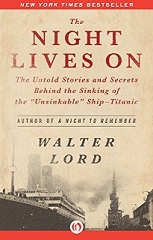
The Night Lives On: The Untold Stories and Secrets Behind the Sinking of the “Unsinkable” Ship – Titanic-Walter Lord

51irw4kxthl

The sinking of the RMS Titanic remains the deadliest maritime incident in history with over 1,500 casualties on the night of April 15, 1912, as the vessel embarked on its maiden voyage from Southampton, England to New York City.  Today, more than 100 years after the disaster, many questions about that night continue to linger with the answers to those questions lost to time and the remaining survivors of the wreck are now deceased. The never ending questions that remain are how and why did the tragedy occur?  Researchers and investigative panels have attempted to answer this question and while we know a great deal of critical information regarding the tragedy, there are still many beliefs held as to how the tragedy  unfolded. Some of the theories go as far to suggest that is was actually the Titanic’s sister ship The Olympic which actually sank at the bottom on the sea. Conspiracy theories, misinformation and unfounded claims have caused confusion and masked the truth regarding the events of the night of April 15, 1912.

Walter Lord revisits that cold April night in the middle of the Atlantic to  relive the events as they unfolded in an attempt to form a complete picture of what transpired and how.  Drawing on the testimony taken of the remaining crew members following the tragedy,  passenger accounts and documents, the image we see from Lord’s research is one in which many individuals were complicit and that the sinking was a disaster in the making even before the ship left Southampton for its maiden voyage.  He also puts to rest several ridiculous stories that were told after the sinking without any factual basis, persisting for several decades and serving only to add more confusion to an already horrific account.  Stories such as a passenger dressing in woman’s clothing and shootings aboard the ship became staples of tales told of the ship’s last moments.

J. Bruce Ismay, chairman and managing director of the White Star Line, the company that owned both the Olympic and Titanic, never recovered following the disaster and was savaged by the media for having left the ship and the company’s failure to protect the lives of its passengers.  But as we see as we make our way through this exceptional account of the night, a series of events outside of Ismay’s control, unfolded and in the process doomed the ship almost from the start.  Staffed with a well-trained crew and in close proximity to other ships that night, mainly the The RMS Carpathia and the SS Californian, the Titanic’s voyage should have been a relatively smooth and safe passage.  But as we now know, fate took over that night resulting in unspeakable horror that continues to stir discussion and spark controversy to this day.

The sinking of the Titanic, for all of its tragic aspects, did serve as a lesson for vessel safety for future generations.  White Star Line merged with Cunard in 1934 and is now owned by the Carnival corporation.  The Titanic remains on the floor of the ocean, its final resting place from which it will never be lifted.  On May 31, 2009, Millvina Dean, the last survivor of the disaster, died at her home in Southampton, England.  And in 2014, The Indegraph Times uploaded a documentary to YouTube narrated by Peter Willis that presents the event in a completely different light suggesting that the tragedy was a  carefully staged deception by the vessel’s owners that went horribly wrong.   Everyone that was on the vessel is now deceased and are unable to give any further testimony about the events of that night.  Many questions will probably remain unanswered for an eternity.  But from the investigations that took place, the documentation that has survived and books such as this excellent investigative report by Lord, we do have an almost complete picture of what really happened that night separating fact from fiction in the story of the great and tragic RMS Titanic.

ISBN-10: 0140279008
ISBN-13: 978-0140279009

Brainwashed: Challenging the Myth of Black Inferiority-Tom Burrell

brainwashedAs recent events have shown, America continues to struggle with freedom and equality for all of its citizens.  And while great progress has been made over the past 50 years, there is still much ground to cover and many thins to understand.  A friend once told me that Black Americans are unique in the world for a variety of reasons but mainly because there is no other group of people similar. At first I didn’t quite understand where she was going with the conversation, but the more I listened and the more I began to digest her words, I came to understand the meaning behind her words and why they sparked such deep thought within me.   Her words however, only covered a fraction of the entire story and as author Tom Burrell points out, the story of the Black American is a long and tragic one that is still not fully understood.  In this exceptional testament to the current day status of Black Americans, Burrell forces the reader to open the eyes and mind as we explore the enduring myth of Black Inferiority (BI).

Some may be tempted to say that no such thing exist and that Black Americans are more successful now than ever before.  While that’s party true, the underlying story is that the successes and achievements of Black Americans across many fields are sometimes a cover and in many cases the exceptions and not the norm.  The election of Barack Obama misleading caused many to believe that America had moved past its ugly past and that for Black Americans, life would be dramatically different.  Not only was it unrealistic to believe one man could change an entire country himself, it was also unfair to place such a huge burden upon him.  However, he is without a doubt, the most recognized and respected role model for millions of young African-American men and women.  Another point that might be made is that slavery ended over 100 years ago and no one in America is a slave today.  True, emancipation did occur in 1865 under President Lincoln, but it is wise to remember, mental slavery is just as dangerous and disheartening as physical slavery. And for many Black Americans, that slavery still exists and in most cases unbeknownst to its victims.

Burrell, who has had a long career in the field of advertising, examines the root causes of the black inferiority complex seeking to understand how and why it exist.  He revisits the system of slavery and the disastrous effects of it on the self-image of those enslaved.  The physical pain and economic depravity continued for decades before Black Americans finally began to advance. But even today, poverty remains a significant issue across the country for Black Americans and as we very well know, Americans of other backgrounds as well.  Financially, Black Americans have made great strides individually, but as a whole, our communities still suffer from decades long conditions and mindsets that do nothing to enhance the well-being of its residents. Burrell shows us the origin of both and why they continue to persist.

The book may give off the impression that the blame for the belief in inferiority lay solely with White America. However, that is not the case for Burrell shows that Black Americans also share some the blame for the current conditions of the Black community.  Degrading images in the music industry, aversion to books and learning, poor spending habits and horrific dietary habits have resulted in a very slow road to destruction of what Burrell calls a form of suicide.  High mortality rates combined with neglect of health and sub par health care have shortened the life span of thousands of Black Americans.  Street violence and domestic violence have caused even more destruction and remain very sensitive issues with the community sometimes seeming to be beyond reproach. The hold of religion over the Black community is also examined to shed light on the complicated relationship between Christianity, slavery and modern day America.  Each of the chapters in the book explores a different avenue that is set to take us to the final destination.  But as Burrell points out, the destination isn’t yet determined but if things don’t change, the future is grim.

James Baldwin once said that the African-American story is America’s story. For if there are no African-Americans, there is no America.   The media reminds us daily of the injustices and crimes committed by Americans against each other and in particular people of color.  Until we understand why our nation’s history affects us today, we will continue to make the same mistakes over and over again.  Burrell’s focus is on Black America but the lessons in the book can be applied to any group of people deemed to be inferiority for whichever reasons.  As a child, I grew up in East New York, Brooklyn during the 1980s and 1990s, when the area was one of the worst in the City of New York. Burrell’s book struck a chord and many of his points resonated with me and are things I’ve seen and experienced first hand.  This book is a must for all Americans of all backgrounds and even if you don’t live in America, you too might find the information in this book to be eye-opening and highly sobering.  But as we are reminded throughout the book, the inferiority we perceive to see and feel is nothing more than a myth.

ISBN-10: 1401925928
ISBN-13: 978-1401925925

The Last Testament of Lucky Luciano- Martin A. Gosch & Richard Hammer

16057485-_uy200_January 26, 1962, Naples, Italy – Salvatore Lucania, also known as Charlie Luciano and Lucky Luciano, dies of a massive heart attack at Naples Airport at the age of 64.  The aging mobster had suffered several recent heart attacks and had arrived at the airport to meet film producer Martin Gosch, who was to adapt a screenplay of the legendary mobster’s life.  Luciano had resided in Italy since February, 1946 when he left New York Harbor for the last time.  The terms of his parole, granted after lending his help to the allied effort in World War II, required that he leave the United States and never return. Tragically, it wasn’t until death that he was allowed to come home when he was interned at St. John’s Cemetery in Middle Village, Queens, New York.
Luciano never wrote an autobiography and it is for this reason I’d like to point out that this is not his autobiography.  This book is based on notes from the conversations that Gosch (1911-1973) had with Luciano before his death during the years 1961-1962.  Gosch has long been deceased.  Richard Hammer is still alive and has commented on the criticism that the book received. He admits that the originals of the notes are no longer in existence and much of what Luciano said is hard to verify.  With that in mind, I think it is wise to remember that the book is a look at this life but not a word for word autobiography.   And since Luciano is also deceased, he is unable to verify its contents.  But I think on the whole, the book is a good look into the New York underworld of that era and the major players.  The major events in the book are true and have been well documented. The smaller day-to-day events, transactions are thoughts alleged to have come from Luciano himself are sometimes questionable.  Do I believe that all of the statements attributed to Luciano are true? No, but I do believe a large number are probably accurate.

It would have been great if Luciano could have either written this himself or given his approval but since neither is possible, this is the closest we have to any type of statement by Luciano about his life aside from the postcards, letters and other miscellaneous documents in his writing that are currently in existence. Mafia bosses have rarely written or verbally told their life story with the exception of Joseph Bonanno who broke from the norm publishing a book of his life in the mafia. But what we do know is that Luciano was in negotiations to have a movie based on his life produced.  His untimely death canceled any possible deal and the project has been lost to history.

His role in the reorganization of the American mafia can never be understated but it can be overstated.  To many he is the man who built the modern-day mafia but to others, just a smaller part of a big effort to change the  direction of organized crime in the United States.  Here is and his story is left up to the reader to cast judgment.  Frank Costello, Meyer Lansky, Bugsy Siegel, Thomas Dewey and all of the big names from the era make an appearance in the book resulting in an engaging tale that pulls the reader in from start to finish.  But it is important to remember that sometimes the line between fiction and non-fiction can become slightly blurred. Nonetheless, it’s a good look at the legendary figure.

ISBN-10: 1936274574
ISBN-13: 978-1936274574

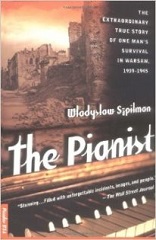
The Pianist: The Extraordinary True Story of One Man’s Survival in Warsaw, 1939-1945-Wladysaw Spzilman

pianistRecently, I watched the 2002 film ‘The Pianist’ starring Adrien Brody as Wladyslaw Szpilman (1911-2000), the pianist for Polish Radio who miraculously survived in Warsaw, Poland during the Nazi occupation.  The film was recommended to me by someone very  close to me in Buenos Aires and to say the film left me speechless would be an understatement.  After viewing the film, I decided to locate the book that inspired it and found Spzilman’s book on Amazon.  The book left me just as speechless as the film and even more in awe of Szpilman, as I know in order to have written the book, it would have required an extraordinary amount of courage on his part.  The film follows closely to the book with very minor liberties taken by the filmmakers.  Their finished product, is one of the best film adaptations that I’ve seen.
Spzilman’s book is slightly different in that it’s one told from life inside Poland and not Germany. The book begins on August 31, 1939, the day before the Germany Army launched the planned invasion of its Polish neighbor. The invasion had been planned well in advanced and a covert operation, named “canned goods” was used to describe the false flag mission that gave provocation for the Nazi assault.  The Nazi threat had been looming over Poland for some time but as we see in the book, the savagery that resulted post-invasion was never envisioned by the people of Poland. Spzilman, a musician, and his family remain in Warsaw as the Germany army approaches, refusing to leave the only place they’ve called home. Their lives would never be the same after the war and for Spzilman, he would never again see any of his family members.

The Nazis began to construct the Warsaw ghetto as they continuously redesigned territorial borders expanding the reach of the Third Reich.  As Szpilman relates, the ghetto was in a way worse than a jail cell for in a jail cell there’s a concrete definition of the nature of the relationship that exists.  With the ghetto, no such definitions existed giving the Jews the false sense of well-being which lead many of them to believe that they would return home after serving in the labor camps during the war.  The Germans’ macabre and perverse motto  of arbeit macht frei, posted at the entrance of camps, reveals the level of vindictiveness displayed by unwavering believers of Aryan-supremacy and Jewish inferiority.  Painful as it may be, Szpilman recounts the daily humiliation endured by Jews and the careless acts of murder committed by the Nazi regime.  The crimes committed and disregard for human life are beyond shocking but reveal the truly revolting nature of the Third Reich’s plan for the removal of Jews from Europe that culminated with the deadly “Final Solution”.

By chance, Szpilman is separated from his family and is forced to survive on the streets of Warsaw, literally hiding in plain sight.  Air raids, evacuation of residents and mounting German losses in the field, resulted in the neglect of many parts of Warsaw which would serve as a refuge for Szpilman during his quest to stay alive.  Death, hunger, disease and mental instability are all threats to him on a daily basis but fate was on his side and he survives through sheer determination and help in some of the most unlikeliest of places.

Following the war he returned to Polish Radio but never forgot the events of those years. His story is among many of the horrors of the Holocaust which serve to remind us of the dangers of blind patriotism and fanatical beliefs.  And as we continue to move forward in life and find ourselves at a crossroads in which decency and criminality cross paths, we can turn to the story of ‘The Pianist’ to remind us of the importance of helping others which in turn, allows us to learn about ourselves and the human race.

ISBN-10: 0312263767
ISBN-13: 978-0312263768

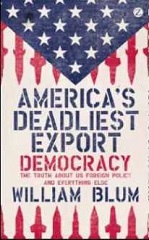
America’s Deadliest Export-Democracy: The Truth About US Foreign Policy and Everything Else-William Blum

hqdefault

The recent terror attack in Manhattan’s Chelsea neighborhood highlighted the concern many Americans have about fellow citizens of the Islamic faith that have originated in or spent considerable time in the Middle East.   The oft-asked question is usually “why do they hate us?”. Iraq, Afghanistan and Syria, are only a few out of many nations in which the United States has involved itself in the nation’s politics.  To many Americans, the dislike and/or intense hatred of America displayed from the region boggles the mind and is utterly incomprehensible. But if we take a closer look at things from another point of view, we come to see there is more than meets the eye as author William Blum points out in this book that is guaranteed to make you question everything you thought you knew about American foreign policy.

From the start, this book will be hard for many Americans to accept.   Blum pulls no punches but instead goes full steam ahead, methodically showing how U.S. foreign policy has destabilized nations resulting in the removal of dozens of foreign leaders and political turmoil which continues to haunt many of those nations to this day.  David Talbot, author of ‘The Devil’s Chessboard‘, revealed the dark rise of the CIA and its actions which influenced American foreign policy following World War II.  Similar to Talbot, Blum brings to light many dark secrets that the average American would rather not know.  Almost all of us born in America were raised to believe that the United States is the leader when it comes to democracy, justice, liberty and freedom for all.  Throughout the years, we have enforced our system of government around the world, or as Blum puts it, exporting democracy.  But a critical question arises.  In the nations to which  we exported democracy, was it needed or asked for?  As Blum shows us, U.S. foreign policy dictated that it was. But in many countries nations, it wasn’t needed  and as a result, millions of people around the world have suffered at the hands of U.S. foreign policy.  Air raids, propaganda and economic penalties are just some of the methods used against those nations which do not comply with the agenda of the U.S.  From Mossadegh in Iran in 1954 to the current war on terror, many important facts have been hidden from the American public, allowing us to believe that all actions carried out in the name of freedom have been in the best interests of the people of the United States.  On a regular basis, the media shows us a purported new “threat” from a number of foreign nations.  But as Blum asks us, “who is really going to attack the US?”.

Some will read this book and believe that Blum is unpatriotic, cynical and even treasonous. But I believe that thoughts of that nature are severely misguided.  Contrary to what many may think, it is possible to be patriotic but still question and even expose the wrongdoings by our own government.  And as Jesse “The Body’ Ventura recently said in a video regarding Colin Kaepernick, the government has to earn patriotism.  In the eyes of many around the world, we are seen as the big brother that exerts his influence wherever he goes. But our most tragic mistake is to believe that everyone desires to live as we do.   No government is perfect and every country has its regrettable moments.  But is the duty of every American to acknowledge when our country is wrong and/or misguided and see things from the eyes of those who we persecute either intentionally or inadvertently.  I’ve always felt that people who are the most critical of this nation are also some of the most patriotic.  It is their belief in the good of the nation that forces them to confront its shortcomings.  People such as William Blum are doing their part to show other Americans what has been occurring right under our noses.  You don’t have to agree with everything he says, but if you open your mind and digest what he’s written, you may find that you have a new understanding of the pitfalls of a misguided foreign policy and why it brings shame on the United States of America.

ISBN-10: 1783601671
ISBN-13: 978-1783601677

Stokely: A Life-Peniel E. Joseph

14894638

Each year as we revisit the civil rights movement and the contributions of African-Americans,  those of us old enough to remember the movement and the violent and turbulent decade of the 1960s, will recall vivid memories of Martin Luther King, Jr., Malcolm X and the Black Panther Party, among others.  The movement contained dozens of highly gifted and intellectual activists whose rhetoric and charisma often galvanized an entire audience. Among these gifted orators was Stokely Carmichael, later known as Kwame Ture. Although he died on November 15, 1998 after  a battle with prostate cancer, his legacy continues and he is remembered by many as one of the most passionate and controversial voices at the time.

The native of Port of Spain, Trinidad and Tobago, left a mark on America, even after relocating to Guinea under the government of Ahmed Sékou Touré.  As we look back on his life in this phenomenal biography by Peniel E. Joseph, we are able to revisit a life that was nothing short of extraordinary and spanned across three continents.  Present at nearly every major event of the movement and associate of many of its pioneers, his actions and movements resulted in both praise and consternation from his peers.  His fiery and passionate speeches, encouraging armed struggle, earned him the wrath of several presidents and a spot on the FBI’s list of racial radicals.  He was so despised, that the U.S. government even attempted to prevent him from leaving the country.  And throughout all of this and much more, Carmichael remained committed to the struggle with the full intent of overturning what he saw as an unjust and morally corrupt government and society.

Reading about icons is never easy for that they have as many negative traits as they do positive.  We sometimes make them out to be larger than life but in the process often forget that they are also human.  Failed romances, a troubled marriage, adultery and accusations of misogyny, plagued Carmichael throughout his life.  And for some of his peers, his words were far more extreme than they were willing to accept. Thoroughly researched and presented in an engaging style that keeps the reading stuck to the pages, the book is a gem and a pleasure to read.  In publishing this masterful work, Joseph as done a service to Carmichael’s legacy.   We also revisit the friendships and enemies that were mainstays of his life which including Eldridge Cleaver, Huey P. Newton, Martin Luther King, Jr., Idi Amin and Harry Belafonte to name a few.  And is through these relationships and the public battles he waged, that Kwame Ture was eventually born.

His tragic death at the age of 57, prevented him from seeing the results from the monumental efforts put forth by activists and Carmichael himself.  If he were alive today, perhaps he would still be calling for Pan-Africanism and armed struggled. But I do believe he would feel vindicated by his prior radical beliefs.   Jim Crow has long been demolished and America has made great strides in living up to the reputation as the land of freedom and democracy. Far from perfect, the nation continues to reexamine itself in the effort to move forward progressively.  And as we do move forward, Stokely’s words will be there to remind us of the pitfalls of oppression and ignorance.  He will always been controversial to many but we can all agree that he remains one of the most colorful and dynamic figures in the history of the civil rights movement.

ISBN-10: 0465013635
ISBN-13: 978-0465013630

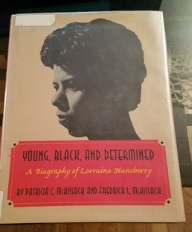
Young, Black and Determined: A Biography of Lorraine Hansberry-Patricia C. McKissack and Fredrick L. McKissack

20180602_215808January 12, 2017 will mark fifty-two years since Lorraine Vivian Hansberry (1930-1965) died at the age of thirty-four after a long battle with intestinal cancer. Her masterpiece A Raisin In The Sun and the Broadway play of the same name, broke new ground in America for African-American playwrights. In fact, her play was the first by an African-American woman to have a run on Broadway.  The story of the Younger family has been played out in cities all over the country as people have desired to leave their own communities in search of a better quality of life. The book remains her most popular work but just who was the real Lorraine Hansberry?  In this biography, Patricia and Fredrick McKissack tell the story of the playwright’s life from start to finish. And what we see is the formation of the one of the most gifted Americans to have ever lived.

Tupac Shakur had always mentioned Hansberry as one of his idols. The same applies for the myself.  Her tragic death at such a young age, is one literature’s and society’s greatest losses.   She was born into a family of descendants of slaves on both sides but grew up in a very affluent household.  Educated in schools of high prestige and was surrounded by family members committed to excellence who instilled in her from a young age, a commitment to excellence and other traits that remained with her through life as she becomes a playwright and spokeswoman for the growing movement to eradicate Jim Crow and obtain civil rights for all people in the United States.

The Lorraine we come to know as we read through the book, is one who is not afraid to break new ground, challenge social norms and express her thoughts.  She remains disturbed by racial prejudice, war and poverty.   Writing becomes her outlet and as a result, she produced classic works that have stood the test of time.  Her personal life in many ways, made as much of a statement as her works of fiction.  She was present at the now famous meeting with then Attorney General Robert F. Kennedy, in which she and several other activists made their case for civil rights heard.  Kennedy came away from the meeting browbeaten but in just a few short years, he would become a candidate for President of the United States and a leading icon of the movement to reshape America through a liberal lens.   Her marriage to Robert Nemiroff was a social taboo at the time and illegal in some states.  She smoked cigarettes, supported the gay cause, wore long pants and even challenged Malcolm X on his views against interracial marriage during his tenure under the Nation of Islam.  Reportedly, the two became friends later on.  Never one to be controlled, she lived her life on her own terms and at her own pace. And even as she was dying from terminal cancer, she continued with her work while focusing on the many issues that continued to plague Black Americans.  Her vivacious personality, sharp mind and literary skill, earned her the respect, admiration and friendship of an endless list of writers, actors, government officials and activists.

Today I often wonder what would she think if she were alive today, about the current state of America. I think she would ask us if we have learned anything from A Raisin In The Sun.  More than fifty-seven years later,  America still struggles with acceptance of those of us that come from different countries, speak different languages, eat different foods and worship different gods.  We have come a long way since Hansberry’s time and  are decades past the inhumane system of Jim Crow.  However, we still have a long path in front of us where much work is needed.  If she were here with us, she would encourage us to continue to make our voices heard in opposition to injustices afflicted upon anyone of any background.  As A Raisin in the Sun continues to be re-made for film, television and Broadway, Hansberry lives on in immortality with her words continuing to remind us of the importance of self-reflection and the struggles we all face.

I highly recommend that anyone who is a fan of Lorraine Hansberry read this biography of her life.  She and her family were quite unique in many ways but Lorraine by far was the standout.  As a person who loves literature, it would have been a pleasure to just sit and talk with her about a range of topics.  Reading through her material, I have become acquainted with a voice that touches deep inside human emotion forcing us to confront the very things we wish did not exist.  Had she lived, I believe her career would have reached new heights and Broadway would have been in her debt. This is the life of Lorraine Vivian Hansberry.

“Never be afraid to sit awhile and think”. -Lorraine V.  Hansberry

ISBN-10: 0823413004
ISBN-13: 978-0823413003