
 January 26, 1962, Naples, Italy – Salvatore Lucania, also known as Charlie Luciano and Lucky Luciano, dies of a massive heart attack at Naples Airport at the age of 64. The aging mobster had suffered several recent heart attacks and had arrived at the airport to meet film producer Martin Gosch, who was to adapt a screenplay of the legendary mobster’s life. Luciano had resided in Italy since February, 1946 when he left New York Harbor for the last time. The terms of his parole, granted after lending his help to the allied effort in World War II, required that he leave the United States and never return. Tragically, it wasn’t until death that he was allowed to come home when he was interned at St. John’s Cemetery in Middle Village, Queens, New York.
Luciano never wrote an autobiography and it is for this reason I’d like to point out that this is not his autobiography. This book is based on notes from the conversations that Gosch (1911-1973) had with Luciano before his death during the years 1961-1962. Gosch has long been deceased. Richard Hammer is still alive and has commented on the criticism that the book received. He admits that the originals of the notes are no longer in existence and much of what Luciano said is hard to verify. With that in mind, I think it is wise to remember that the book is a look at this life but not a word for word autobiography. And since Luciano is also deceased, he is unable to verify its contents. But I think on the whole, the book is a good look into the New York underworld of that era and the major players. The major events in the book are true and have been well documented. The smaller day-to-day events, transactions are thoughts alleged to have come from Luciano himself are sometimes questionable. Do I believe that all of the statements attributed to Luciano are true? No, but I do believe a large number are probably accurate.
It would have been great if Luciano could have either written this himself or given his approval but since neither is possible, this is the closest we have to any type of statement by Luciano about his life aside from the postcards, letters and other miscellaneous documents in his writing that are currently in existence. Mafia bosses have rarely written or verbally told their life story with the exception of Joseph Bonanno who broke from the norm publishing a book of his life in the mafia. But what we do know is that Luciano was in negotiations to have a movie based on his life produced. His untimely death canceled any possible deal and the project has been lost to history.
His role in the reorganization of the American mafia can never be understated but it can be overstated. To many he is the man who built the modern-day mafia but to others, just a smaller part of a big effort to change the direction of organized crime in the United States. Here is and his story is left up to the reader to cast judgment. Frank Costello, Meyer Lansky, Bugsy Siegel, Thomas Dewey and all of the big names from the era make an appearance in the book resulting in an engaging tale that pulls the reader in from start to finish. But it is important to remember that sometimes the line between fiction and non-fiction can become slightly blurred. Nonetheless, it’s a good look at the legendary figure.
ISBN-10: 1936274574
ISBN-13: 978-1936274574
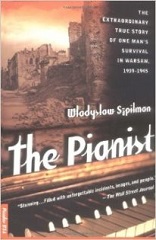 Recently, I watched the 2002 film ‘The Pianist’ starring Adrien Brody as Wladyslaw Szpilman (1911-2000), the pianist for Polish Radio who miraculously survived in Warsaw, Poland during the Nazi occupation. The film was recommended to me by someone very close to me in Buenos Aires and to say the film left me speechless would be an understatement. After viewing the film, I decided to locate the book that inspired it and found Spzilman’s book on Amazon. The book left me just as speechless as the film and even more in awe of Szpilman, as I know in order to have written the book, it would have required an extraordinary amount of courage on his part. The film follows closely to the book with very minor liberties taken by the filmmakers. Their finished product, is one of the best film adaptations that I’ve seen.

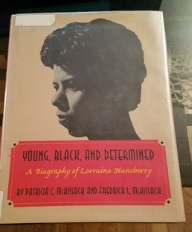 January 12, 2017 will mark fifty-two years since Lorraine Vivian Hansberry (1930-1965) died at the age of thirty-four after a long battle with intestinal cancer. Her masterpiece A Raisin In The Sun and the Broadway play of the same name, broke new ground in America for African-American playwrights. In fact, her play was the first by an African-American woman to have a run on Broadway. The story of the Younger family has been played out in cities all over the country as people have desired to leave their own communities in search of a better quality of life. The book remains her most popular work but just who was the real Lorraine Hansberry? In this biography, Patricia and Fredrick McKissack tell the story of the playwright’s life from start to finish. And what we see is the formation of the one of the most gifted Americans to have ever lived.
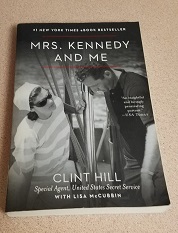 The workplace in a sense becomes a second home to the majority of us, and for some of us, they become even closer to us than those with whom we have a biological link. But what happens when you’re an agent in the Secret Service? There is no set eight-hour workday for agents assigned to the first family. Instead, their hours are often unpredictable, long and extremely fatiguing. Nevertheless, the agents do their jobs to the best of their abilities and in the process create bonds with the members of the first family that sometimes remain in place many years after their service has ended. Clint Hill, long retired from the Secret Service, is best remembered by many people from the Zapruder film, in which he is the sole agent that attempts to come to the aid of the president as jumps on the back of the motorcade as the Secret Service transports a mortally wounded John F. Kennedy to Parkland Memorial Hospital. He has written several books on his time as a Secret Service agent with several presidents and the events that took place during that fateful trip to Dallas, Texas. This is his memoir of his time with the former first lady and the relationship that developed.
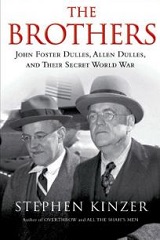 On July 26, 1947, President Harry S. Truman signs the National Security Act, establish a new intelligence agency to gather information deemed critical to the protection of the United States from foreign threats. The new agency is known as the Central Intelligence Agency and its initial members are former members of the Office of Strategic Services which had been discontinued following the allied Victory in World War II. As the Cold War heated up with the Soviet Union and new leaders came to light in several continents, the members of the new agency felt a surging sense to act preemptively to what was perceived to be direct threats to the safety and stability of the western hemisphere. Among the large number of those afraid of Communist infiltration and the end of U.S. business interest were two brothers who controlled an overwhelming majority of power over U.S. foreign policy whose names today are largely unknown to the younger generation. John Foster and Allen Welsh Dulles, the former Secretary of State and Director of the C.I.A., remain controversial and pivotal figures in 20th century American history. In this expose about their time in high posts within the U.S. government, author Stephen Kinzer reveals the dark side of the U.S. government as two brothers used the White House, military and Central Intelligence Agency to advance their financial agenda across several continents resulting in the overthrow of governments, assassination of foreign leaders and financial exploitation of smaller nations caught in the grip of U.S. occupation.
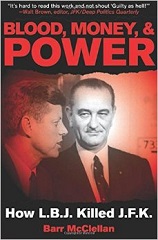 Prior to his death from cancer, Jack Ruby, the convicted murdered of Lee Harvey Oswald who executed his prey live on national television, once remarked that to get answers in the murder of John F. Kennedy, it would wise to ask the man currently in office. That man as we all know was Lyndon B. Johnson. In most history classes, Lyndon Johnson or LBJ for short, is seen as a pioneering president, responsible for the passage of the monumental Civil Rights Act of 1964. However, what is often looked over is his role in the escalation of the U.S. military in southeast Asia resulting in the Vietnam War. As the body count of American soldiers climbed, his approval rate dropped to absurdly low levels, possibly the worst in recent history. And the announcement of Robert Kennedy for candidacy for president served as a final nail in the coffin forcing Johnson to withdraw his name in the 1968 presidential race. Many years after his death, the true story of the life of Lyndon Johnson has come to light in dozens of books. And what we learn through each of these books is that there was a very dark side to the 36th President of the United States.
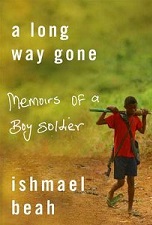 The story of the continent of Africa is one of the most beautiful and tragic we have ever seen. The mass of land that has been described as the cradle of civilization and home to some of the most beautiful places on earth, has also been subjected to severe colonization resulting in continuing poverty, tribal and cultural division and civil wars that nearly destroyed several countries as millions of people lost their lives before the genocidal campaigns were brought to a halt. The story of Rwanda is largely well-known, from books and even a feature film, ‘Hotel Rwanda’ starring Don Cheadle. Rwanda, however, is not the only country to experience a crisis of that nature and as we learn in this memoir by Ishmael Beah, Sierra Leone also has a dark history of internal conflict which caused the nation to be considered one of the most dangerous places in the world. And even to this day, their dark past continues to remain relevant.

You must be logged in to post a comment.