
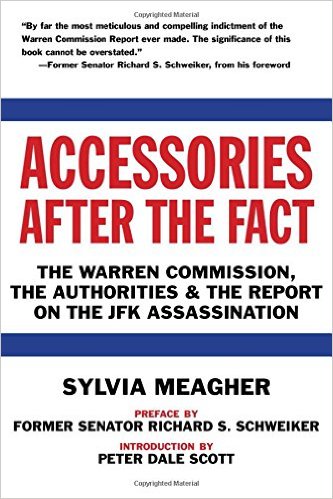
Sixty years have passed since the assassination of President John F. Kennedy (1917-1963) in Dallas, Texas on November 22, 1963. Public opinion in regard to the Warren Commission’s report has continued to shift, with a majority of Americans disapproving of its conclusions. Over time, the National Archives has released more documents relating to Kennedy’s murder, but there are still important materials that remain classified. When taken at face value, the Commission’s report seems to provide an open and shut case; three bullets fired by a lone deranged gunman from his sniper’s position on the sixth floor at the former Texas School Book Depository building. But upon closer examination, it becomes clear that there are unanswered questions and troubling aspects of the official investigation which have never been explained.
The biggest issue with the Warren Commission’s report is the lack of a usable index. This inadequacy combined with contradictions and other unnerving aspects, convinced the late Sylvia Meagher (1921-1989), that action was needed. As she read the report and its supporting volumes, she could not ignore the growing belief inside of her that the official story was not true. This book is her dissection of the Commission’s report, paying close focus on the case against Oswald and the story put forth by the Dallas Police Department. To be clear, there is no smoking gun and Meagher does suggest who might have pulled the trigger. She does, however, stick to the evidence which results in hair-raising questions about what really happened that day.
Officially, the U.S. Government has maintained that Lee Harvey Oswald (1939-1963) fired three shots from a bolt-action Mannlicher Carcano rifle in six seconds, fatally wounding Kennedy and seriously wounding Texas Governor John Connally (1917-1993). Incredibly, it is claimed that one bullet struck both, inflicting multiple non-fatal wounds. This “single bullet” theory has been the foundation of the Commission’s conclusion that Oswald was the lone gunman. But the question remains, if no one saw Oswald pull the trigger or on the sixth floor at the time of the assassination, then who did? Skeptics of Meagher will say that Oswald purchased the rifle, brought it to work, assembled it before killing Kennedy and decided to leave the evidence behind as he “escaped” from the building and boarded a bus then taxi to arrive home in the Oak Cliff section of Dallas. A selling point of his guilt has been that he “fled” from Dealey Plaza and had previously attempted to assassinate ultra right-wing General Edwin Walker (1909-1993). But is that really true? Meagher points out remarkably interesting evidence that does not support that thesis. Further, Oswald’s widow Marina admitted to initially lying to investigators out of her “distrust” of them. Oswald may have been telling the truth when he said he was a patsy.
The murder of Dallas Police Officer J.D. Tippit (1924-1963) has been used to convince the public that Oswald was cold-blooded murderer who not only killed an officer in the line of duty but also eliminated the head of the U.S. Government. However, like everything else, Tippit’s story is far from open and shut. The author discusses his situation and points out things that raise more questions. The analysis is thorough and I strongly recommend Joseph McBride’s ‘Into the Nightmare: My Search for the Killers of President John F. Kennedy and Officer J.D. Tippit‘ which provides even more crucial information about Tippit’s life. To date, there is no evidence that proves Tippit was part of a conspiracy to murder Kennedy. However, his movements in the forty-five-minute window prior to his death are highly unusual and have never been fully explained. In fact, his communications with the police dispatcher only add to the mystery.
A major topic of debate has been whether Oswald was on an intelligence mission at the time of the Kennedy’s death. His mother Marguerite Oswald (1907-1981) claimed several years before the assassination that her son was working for U.S. intelligence. At times she has been written off as a crackpot, but when Oswald’s movement’s to and from the Soviet Union are explored, one cannot ignore that his ability to escape the U.S. criminal justice system is nothing short of mind blowing. Meagher revisits his move to the Soviet Union, attempt to “defect” and provide military secrets to the Russians, and return to the United States with a Soviet wife, and without any criminal prosecution during the infamous Cold War. The story is surreal but was written off by the Commission as ordinary.
Following Kennedy and Tippit’s murders, Oswald was apprehended at the Texas Theater. While he sat in the Dallas County jail, many strange things and people were moving behind the scenes unbeknownst to him. One of these people was Jack Ruby (1911-1967) whose murder of Oswald on November 25, 1963 on live television, sent shockwaves across the globe. Ruby insisted that he was emotional and snapped when murdering Oswald. But his actions that weekend around Dallas and the jail are highly questionable, and Meagher makes sure to take a deep dive into the two days when the world was on edge. One thing that stood out is Ruby’s appearances near the homicide office on the third floor of the jail complex. Further, his access to the basement of the jail preceding Oswald’s murder has always been a murky tale. While it is known that Ruby had scores of officers as friends, none were ever charged with letting him into the jail. But was he “let in” or “allowed in”? The testimony excerpts from Dallas policemen only add to the confusion.
On a final note, Meagher mentions the investigation by former New Orleans District Attorney James “Jim” Garrison (1921-1992). His case, which was both groundbreaking and problematic, is a topic for a whole other discussion. However, Meagher does point out something in regard to the Warren Commission report’s role in Garrison’s case which I had not noticed previously. And as I read her words, I had to scratch my head in disbelief. On January 14, 1989, Meagher died at the age of 67 at St. Vincent’s Hospital in New York City from complications of the flu. Had she lived, I believe she would have been thrilled to see Oliver Stone’s ‘JFK’, the film which renewed public interest, resulted in the JFK Assassination Records Collection Act of 1992 and supported Garrison’s belief that rogue elements of the intelligence community played a role in Kennedy’s death. Stone’s film is solid, but Garrison and his investigation were far more complicated. The case against Clay L. Shaw (1913-1974) was weak but Garrison did succeed in opening the door for more analysis of the crime. The investigation into the events in Dealey Plaza is far from over and the search for truth as to who killed John F. Kennedy continues. And this tool can help guide the way.
ASIN : B00E25IM6S
 Periodically my father will reminisce about his childhood in East New York, Brooklyn. and sometimes I’ll pass through my old neighborhood on my way to visit my grandparents. Today, much has changed and a large majority of the people I remember from that time are gone, but he violent and shocking memories will always remain. By the time I grew up in East New York, the demographics had far changed. Rarely did I see any faces in the area that weren’t Puerto Rico, Dominican or African-American. The Caucasian faces were mostly Police Officers, Firemen, EMTs and missionaries from the Church of Latter Day Saints. As kids, we often heard stories about the gangs that roamed East New York waging turf battles with each other using, knives, zip guns, car antennas and anything else that could be used to inflict pain. The stories seemed unbelievable at the time but after reading this book, I have a whole new understanding of the place I once called home.

 On May 30, 1961, Rafael Leonidas Trujillo, the dictator of the Dominican Republic was assassinated in the capital city of Santo Domingo. His death concluded a 30 year reign of oppression inflicted upon the Dominican people and the neighboring country of Haiti. Widely considered to be the worst dictator Latin American history, he is responsible for the Parsley Massacre in 1937, the deaths of the Mirabal sisters and an unknown number of murders. True to the form of an egomaniac, he went as far as to have statues of himself constructed throughout the country while at the same time renaming the capital Trujillo City. His initiation of the system of ethnic cleansing that attempted to “whiten” the republic created a climate of racial dysfunction that affects the island to this day. A thirst for blood and supreme dominance encouraged him to plot the assassinations of several Latin American leaders and threatened to destabilize the Caribbean and curtail American business interests. Fifty-five years later, the question of how Trujillo assumed power is often asked. The relationship between the U.S. and the Dominican Republic is a long fractured story and a prime example of the effects of imperialistic foreign policy. Eric Paul Roorda has studied the complex relationship between the two nations and the rise of a tyrant.
 The film “Black Mass” featuring Johnny Depp as the notorious Boston criminal James “Whitey” Bulger, took us inside the old Boston underworld and the power struggle between the Irish and Italian organized crime organizations that turned the city into a battle zone. Bulger’s story, due in part to documentaries, media coverage and books, is well-known. But what isn’t widely known, is the story of the Winter Hill gang’s most efficient and feared killer, Johnny Martorano. In the film, Martorano is played by actor W. Earl Brown. Howie Carr presents us with this chilling account of Martorano’s early life, his descent into the crime world, affiliation with Bulger, arrest and decision to become a testifying witness against the Winter Hill gang and numerous individuals targeted in law enforcement investigations. And what he reveals is a gritty underworld full of corruption, drugs, sex, money and murder. All of the infamous Boston gangsters make an appearance including, Donald Killeen, Indian Al, Wimpy Bennett, Gennaro “Jerry” Angiulo and Tommy King.
 October 11, 1991-Comedian Redd Foxx dies of a massive heart attack in Los Angeles, California while on the set of the sitcom ‘The Royal Family’. His death stuns the entertainment industry and households across America. The hard scrabble, gravely voiced comic from St. Louis had made a name for himself with a profane but utterly realistic stand up routine and the hit sitcom ‘Sanford and Son’. When Foxx passed, I hadn’t yet started high school, but had watched routinely, the re-runs of Sanford and Son on television. His catchphrase “ya big dummy” was one that my friends and I would toss around from time to time. However, none of us could understand at the time how far-reaching his legacy would be and why his life and death were so important to thousands of young aspiring entertainers.
 July 26, 1947- President Harry S. Truman signs into law the National Security Act, establishing the formation of an intelligence agency dedicated to serving the president. The end result is the formation of the Central Intelligence Agency. Later in life, Truman came to regret the law as the CIA grew beyond his original intentions into an unaccountable, dangerous and highly suspicious agency seemingly under the control of no one. Stories of operatives such as Allen Dulles, Bill Harvey, Richard Helms, David Atlee Phillips, Cord Meyer, Jr. and James Jesus Angleton are both endless and legendary. But what was really going on within the CIA and what was the true nature of its relationship with the White House? David Talbot presents to us his investigative report into the dark side of the CIA and the secret government within the United States.
 May 14, 2013-Billie Sol Estes
  On April 15, 2008, Nujood Ali stood in a Yemeni courtroom and pleaded her case for a divorce from a physically, sexually and emotionally abusive husband. At the age of 10, her case caused shock and outrage around the globe. The marriage and subsequent divorce shed light on the old customs in the outskirts of Yemen. Born in the remote Yemeni village of Khardji, Nujood’s story is one of many that go untold each year not only in Yemen, but in countries across the Middle East. Married in exchange for the sum of US $750, her new life quickly becomes a nightmare as she is forced to leave her family and reside with her much older husband whom she does not know.
 FREETHINKING BIBLIOPHILE
You must be logged in to post a comment.