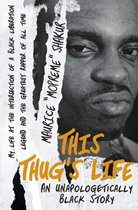
This Thug’s Life: An Unapologetically Black Story – Mopreme Shakur

At 4:03 p.m. (PST), on September 13, 1996, medical personnel at the University Medical Center of Southern Nevada announced the death of rap star and actor Tupac Shakur (1971-1996). His mother Afeni (1947-2016) was forced to confront the death of her first-born son at the youthful age of twenty-five. Standing by her side was stepson Maurice “Mopreme” Shakur, the son of Mutulu Shakur (1950-2023) and Sharon Harding. In the wake of Shakur’s death, attention was focused heavily on Afeni, but Mopreme has a story of his own which I had the pleasure of reading. I recently reviewed Jeff Pearlman’s Only God Can Judge Me: The Many Lives of Tupac Shakur‘ and Staci Robinson’s ‘Tupac Shakur: The Authorized Biography‘. Both books are well-written and explore Tupac’s thoroughly. However, Mopreme was in a unique position to tell what he knew both as a sibling and rapper. This is his story in which he revisits his own past, and the short and tragic life of his famous younger brother.

I first became aware of this book shortly after its publication due to a contact submission on this site and made a mental note to purchase the title when I had the time to read it. That moment arrived a few weeks back and I am more than satisfied with my decision. This book is good in so many ways, and I enjoyed learning Mopreme’s story which goes far beyond the rap music industry. In fact, the Shakur name is firmly entrenched in American history in both negative and positive lights, depending on who you ask. To clear up any confusion, Mopreme entered Afeni and Tupac’s lives several years following famous rapper’s birth. Mopreme recounts his family’s roots in Queens, New York, and the early childhood years spent with his Aunt Joanna in Fayetteville, North Carolina, before making his return to the city that never sleeps. And this is where the story begins to take unexpected twists and turns.

Mopreme’s mother is a source of stability in the book, sorely needed in contrast to the lifestyle of Mutulu, who goes “underground” to avoid authorities, particularly the eyes of the Federal Bureau of Investigation. Mopreme discusses their relationship which is filled with love but also complicated due to his father’s fugitive status. However, there are bright moments in the book, but Mutulu would eventually face the court system and lose his freedom for four decades. While behind bars, the multiple families Mutulu created would struggle with his incarceration and the pressure of carrying the Shakur name. As for Mopreme, his time with Tupac is still in the future, and his life takes a different path that I was not aware of previously, but what he explains provides the background information on residency in California, and reunion with Afeni, Tupac and sister Sekyiwa (“Set”) after a several years apart. And once the siblings are reunited, the story intensifies as the music industry becomes their focus.

While reading the book, I reminded myself not to lose focus on Mopreme’s story. Of course, Tupac’s role in the story is significant, but it is imperative to remember that Mopreme was also a rapper. His anecdotes from his time in the business as the Shakur brothers are “coming up” is gold. It is an incredible journey and Mopreme was there to witness it all. But the story takes a dark turn when Tupac is shot several times during a robbery at Quad Studios in Midtown Manhattan on November 30, 1994. And it set the stage for the last two years of Tupac’s short life. Mopreme was not present during the shooting but discusses what he knew and how the family responded to it. Further, he touches on Tupac’s conviction in December 1994 on sexual abuse charges. The following year, Tupac walked out of the Clinton Correctional Facility in Dannemora, New York to the waiting arms of Death Row Records CEO Marion “Suge” Knight. Tupac was out of jail pending his appeal, but as Mopreme explains, things went from good to disturbing, and he began to see changes in his brother due to his association with the record label. Although Mopreme was never signed to Death Row, he did interact with its roster, and he provides insight into what he witnessed and how it changed his perception of where their lives were headed. And it forced him to reevaluate his own life which included marriage and fatherhood. But readers will see that a dark cloud is forming on the horizon.

The events of September 7, 1996, have been told countless times, and the night ended with Tupac Shakur critically wounded and Suge Knight with non-life-threatening injuries. Mopreme does not go into extensive detail about the shooting, but he does provide a glimpse into Tupac’s hospital room and his physical condition. His account is first-hand and should clear up any debate as to whether Tupac was aware of his surroundings at any time, he was admitted to the hospital. Initially, doctors had given Tupac a fair chance of survival, but in the days leading up to September 13, the trauma from the gunshot wounds took its toll on his body and his death on Friday, September 13, sent shockwaves across the globe. The impact on his family was monumental, and Mopreme details how it affected him personally. Anyone who has watched interviews with him in recent years knows that it still affects him to this day. Currently, Duane “Keefe D” Davis awaits trial in Las Vegas for Tupac’s murder. Time will tell in a jury will return a verdict of guilty but until then, the case against him continues to proceed. If David is found guilty, it will bring a sense of closure to the Shakur family and help Mopreme find peace with his brother’s death. I strongly recommend this book for Tupac fans or anyone looking for an enjoyable book about a family whose name and lives are part of American history.

ASIN‏ ‎ B0FBHY2KD3
Publisher : Dafina, February 24, 2026

Tupac Shakur: The Authorized Biography – Staci Robinson

In October 1994, the late rap star and actor Tupac Amaru Shakur (1971-1996) appeared for an interview with journalist Ed Gordon of Black Entertainment Television (“BET”). During their conversation, Gordon asked Shakur where he saw himself in ten years. The response was “I just want to be alive”. Two years later he was gone at the age of twenty-five. Twenty-nine years have passed since his death, yet we continue to speak of him, ask about him, and shake our heads at his premature death. A young Black male lost to gun violence is a recurring nightmare which has replayed itself in trouble neighborhoods across America. However, in his short life, Shakur also touched millions of people through his music and his roles in feature films. But there is always more to the story than the flashy jewelry and perfect smiles before the cameras. Author Staci Robinson examines Shakur’s life in a biography which is both thorough and haunting.

Shakur’s story begins long before his birth, and his story cannot be told without discussing his mother Afeni Shakur (1947-2016). As a member of the Black Panther Party, Afeni became well-known by law enforcement and found herself fighting for her freedom during a criminal trial in New York State Supreme Court. Her arrest, incarceration and quest for freedom set the stage for the way she would raise her future son who arrives in June 1971. There are feature films, documentaries, and books about Shakur’s death, but I still found interesting tidbits of information in Robinson’s account. Further, the narrative provides a very intimate look into their lives. And while I read, I could feel the frustration and despair which engulfed him with each relocation and humiliating experience due to their mother’s lack of a steady income. And the absence of a father only added to the anger and grief.

Despite their dire situations, there are bright moments in the book. From an early age, Shakur was talented and had an uncanny ability to connect with people. In 1984, he embarks on his journey to fame with a performance at the Apollo Theater. This part of his life is often overlooked but as Robinson explains how he landed the role of Travis an adaptation of Lorraine Hansberry’s (1930-1965) ‘A Raisin in the Sun‘, I was able to see that the roots for his future success in the entertainment industry were being planted. And though several years would pass before his breakthrough as part of the rap group Digital Underground, a star was born. But I also noticed something else in the book which I had not previously focused on. As we follow Shakur through his pre-teen and teen years, we are also able to see his capacity for absorbing knowledge and deep appreciation for the arts. His mind was a sponge that soaked up anything and everything. His time at the Baltimore School of Performing Arts where he meets lifelong friend Jada Pinkett Smith is one the brightest moments in the story. But the softer side of Shakur stands in stark contrast to the rap star later murdered in Las Vegas, Nevada.

The family’s move to Marin City, California opened new doors for Shakur and paved the way for his life in the music industry. But it was not without its hiccups and the long journey he makes to finding his footing is interesting and highlights the role luck plays in our lives. Of course, Shakur was incredibly talented, but meeting the right people at the right time always pays dividends. And when he meets Leila Steinberg, Atron Gregory and the late Shock G (1963-2021), the story shifts gears as the Tupac we came to know begins to take shape. The story is a roller coaster ride in which Tupac befriends other artists, dates celebrities, breaks into Hollywood and finds himself on the wrong side of the law. And throughout the story, I felt chills each time he told someone he would not live past twenty-five. This dark premonition hangs over the story, and when he is shot and wounded at Quad Studio in Manhattan on November 30, 1994, his premonition is no longer brushed aside.

The Shakur family did not have money, but they did have an endless supply of love for each other, and that is on full display in the book. And despite Afeni’s addiction to crack cocaine which is a dark section in the book, Tupac always loves his mother, and family is there for each other until his last moments. In December 1994, Shakur was convicted in New York State Supreme Court of sexual abuse in a case with many unanswered questions. Shakur always maintained his innocence and was acquitted of far more serious charges, but the experience and his incarceration weighed heavily on him and played crucial roles in the artist who found a new home at Death Row Records. Family is there to lean on throughout it all, but we can also see that he is on a collision course with a dark fate. Eventually he is released on appeal, and the author clarifies exactly how he was bailed out. Marion “Suge” Knight, the CEO of Death Row Records at the time, did play an instrumental role in helping Shakur obtain his freedom, but the full story is a bit more complex and sometimes misunderstood.

Once free and in California, Tupac does not waste time and hits the studio with a vengeance and creates one of the most successful rap albums in history, ‘All Eyez on Me’. Following a trip to New York City in late August 1996, Knight asks Shakur to go to Las Vegas for the Mike Tyson & Bruce Seldon boxing match. The trip should have been routine, but it would be the last time anyone would see Shakur alive. Robinson goes through the series of events culminating with the gunfire from a white Cadillac which pulled alongside Knight and Shakur as they waited at a traffic light on the Las Vegas strip on September 7. The aftermath and scene at the hospital is discussed and the story concludes with his death on September 13. Readers interested in the shooting and pending trial of Duane “Keefe D” Davis, will need to look elsewhere. Robinson does not discuss conspiracy theories or the murder investigations. Nor does she discuss the East and West Coast rivalry in the rap music industry in detail. And she made the right call as that would have resulted in the story veering far off course. I also felt this way after thinking about the other aspects of his life which are not discussed at full length here. There are things I wish had been discussed but I also realized that had she done so, the text would have been extensive and required a multi-volume biography. The author included just enough information to keep the story moving at the right pace. And the most important moments are captured in the narrative. When I reflected on the book after I was finished reading it, I realized that some parts of his life could be a book of their own. Robinson’s book is balanced, with the right mix of Shakur’s gifts, his flaws, the highs, and lows of his life, and all that came with his ascension to stardom. This is a good look at the life of the immortal and infinitely controversial Tupac Shakur. 

 “I‘m not saying I’ll change the world, but I guarantee I’ll spark the brain that will change the world. So keep your head up. Do what you gotta do. And then inside of you, I’ll be reborn.” – Tupac Shakur 

ASIN ‏ : ‎ B0BTLC8NTX
Publisher ‏ : ‎ Crown, October 24, 2023