
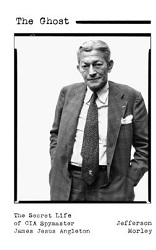
He was arguably the most feared and secretive intelligence officer to have worked for the Central Intelligence Agency. And although he left the agency in 1974, his name still conjures up images of the cold warrior with nerves of steel, engulfed in the world of counterintelligence and determined to protect the United States at all costs. Formally he was known as James Jesus Angleton (1917-1987), but to author Jefferson Morley, he is referred to as the ghost. The title fits appropriately for the secret life of the late CIA spymaster was one which Hollywood could never replicate on screen. By all accounts, his personality was outwardly unassuming, but behind the horn rimmed glasses, was an operative that ate, slept and breathed counterintelligence.
This project began in 1994 and the amount of research Morley has invested is impressive. Angleton did not leave behind diaries or personal writings, he was far too cloak and dagger for that He did however, testify before Congress as the CIA’s domestic mail spying program came under fire after being revealed by the press. The spymaster escaped without prosecution but his career at the agency was effectively finished. He would remain hidden in the shadows but still involved in the field until his death on May 11, 1987. The mystery surrounding Angleton helps to keep him in the public light, but what is it about him that is so fascinating?
Morley has composed a solid biography of Angleton, but there is still much about his life that has probably been lost to history. Angleton himself said that he would take things to his grave and I have no doubt that many secrets were buried with him. And next to Allen Dulles, Dick Helms, Bill Harvey, Cord Meyer and the many legendary officers once part of the OSS, Angleton stood as a gatekeeper to the trove of the Agency’s dark secrets. And throughout his life he was involved with a cast of characters who made their names famous as operatives of the agency that John F. Kennedy once threatened to scatter into a thousand pieces. As he moves up the ladder and increases his power, his secretiveness and paranoia grows at an exponential rate. His hunt for Soviet moles would prove to be one of the final nails in the coffin of his career and nearly crippled the CIA. But was he too paranoid or did he know more than he let on?
There is so much about Angleton’s life that remains a mystery. He was a family man, but his wife and children barely factor into the story. Instead, the book is filled with CIA intrigue, informants, double agents and political gambles in Washington. And sadly, it seemed that when no enemies existed, they were manufactured to suit personal agendas. And for Angleton, this might have been an underlying cause of his later obsession of moles within the government. But such was Angleton’s mind, the maze with false exits, traps and more riddles than answers. The man whom Morley calls “the ghost”, led a life which did not give away secrets and prevented even the most prying eyes from gaining too much insight. It may have been by design or just an extension of the counterintelligence legend’s way of operating.
To say that Angleton’s life was incredible would be a severe understatement. In fact, throughout every major event that takes place, the CIA seems to be close by and his actions regarding some are bizarre and even disturbing. Although detested by many, scared of by others and mind boggling to subordinates, he endeared himself to more than one president and those relationships gave rise to many questions surrounding his actions following JFK’s murder, RFK’s murder and the murder of Mary Pinchot Meyer.
By the time he died, his CIA life was far behind him but the saying goes that you never really leave the agency. For James J. Angleton, the agency was his life and in a taped interview with Thames TV in 1975, he stated pointedly that he regretted nothing. I have no reason to doubt him and after reading this book I believe that you will also feel the same way. But as I read the book, I could see that in more than one way his life was quite tragic. As Morley explains, secret intelligence work was his life, but what suffered in the process was his personal life and in some cases his health. In a tragic fate, the love he would give to the CIA would not come to him from his family. Even to them he remained the elusive ghost.
Readers who are familiar with the stories from the cold-war CIA era will know many of the facts revealed in the book. We have heard the names before and their actions are now well-known. But I do think that the section on Lee Harvey Oswald is telling and adds yet another question to the mystery of Kennedy’s murder. When asked about the assassination, Angleton reportedly said ” a mansion has many rooms, I was not privy to who struck John”. Exactly what he meant we will probably never know. But what is clear is that Angleton possessed knowledge of many things that most Americans would prefer not to know.
I cannot imagine that writing a book on a secret CIA operative is an easy task. But Morley’s account of Angleton’s life is a solid work and will be appreciated by historians. Love him or hate him, there is no denying Angleton’s legacy, fame and infamy in the annals of the history of the Central Intelligence Agency.
“Deception is a state of mind–and the mind of the state.”– James J. Angleton
ISBN-10: 1250080614
ISBN-13: 978-1250080615
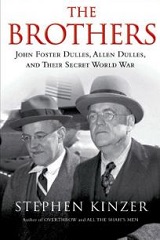 On July 26, 1947, President Harry S. Truman signs the National Security Act, establish a new intelligence agency to gather information deemed critical to the protection of the United States from foreign threats. The new agency is known as the Central Intelligence Agency and its initial members are former members of the Office of Strategic Services which had been discontinued following the allied Victory in World War II. As the Cold War heated up with the Soviet Union and new leaders came to light in several continents, the members of the new agency felt a surging sense to act preemptively to what was perceived to be direct threats to the safety and stability of the western hemisphere. Among the large number of those afraid of Communist infiltration and the end of U.S. business interest were two brothers who controlled an overwhelming majority of power over U.S. foreign policy whose names today are largely unknown to the younger generation. John Foster and Allen Welsh Dulles, the former Secretary of State and Director of the C.I.A., remain controversial and pivotal figures in 20th century American history. In this expose about their time in high posts within the U.S. government, author Stephen Kinzer reveals the dark side of the U.S. government as two brothers used the White House, military and Central Intelligence Agency to advance their financial agenda across several continents resulting in the overthrow of governments, assassination of foreign leaders and financial exploitation of smaller nations caught in the grip of U.S. occupation.
 July 26, 1947- President Harry S. Truman signs into law the National Security Act, establishing the formation of an intelligence agency dedicated to serving the president. The end result is the formation of the Central Intelligence Agency. Later in life, Truman came to regret the law as the CIA grew beyond his original intentions into an unaccountable, dangerous and highly suspicious agency seemingly under the control of no one. Stories of operatives such as Allen Dulles, Bill Harvey, Richard Helms, David Atlee Phillips, Cord Meyer, Jr. and James Jesus Angleton are both endless and legendary. But what was really going on within the CIA and what was the true nature of its relationship with the White House? David Talbot presents to us his investigative report into the dark side of the CIA and the secret government within the United States.
 FREETHINKING BIBLIOPHILE
You must be logged in to post a comment.