
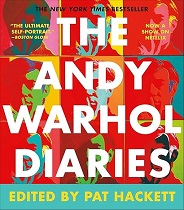
This statement may be bold, but there will never be another Andrew Warhola (1928-1987), known to the world as Andy Warhol. The undisputed king of pop art remains an iconic figure, vividly remembered for his bright colored wigs, thin frame, and soft-spoken nature. He seemed to be everywhere and knew everyone and was firmly entrenched in popular social circles. But behind the fame, there was a different Andy, misunderstood and overlooked. Several years before his death, Warhol asked his close friend Pat Hackett to help in transcribing his personal diaries. The pages totaled over twenty thousand but were condensed by Hackett into a final product suitable for publishing. This Kindle version is condensed slightly further but it is still an impressive eight-hundred forty-two pages which cover the years 1976 to 1987. Warhol died on February 22, 1987, following surgery to have his gallbladder removed, which explains the abrupt ending of the diaries. However, there is more than enough material in the book to satisfy Warhol fans.
The book is not a biography at all. Warhol does mention family members but only regarding the day’s diary entry. This is a collection of daily observations about work, friends, the New York City nightlife, and his inner struggles. If you watched the Netflix series ‘The Andy Warhol Diaries’, then this book will feel like closure. I watched the docuseries and thought it was one of the best Netflix has released. Of course, the producers could have added more material because Andy’s life was a non-stop show which reached a heartbreaking conclusion. But surprisingly, in the diaries, Andy himself is not the over-the-top eccentric character you might expect. In fact, those around him steal the show and what Andy recorded is nothing short of wild. His diaries also confirm that the lifestyles of the rich and famous are sometimes out of control.
As the diaries progress, we become familiar with Andy’s social circle which consist of fashion designer Halston (1932-1990) and boyfriend Victor Hugo (1948-1994), author Truman Capote (1924-1984), rockstar Mick and wife Bianca Jagger, fashion columnist Diane Vreeland (1903-1989), Interview editor Bob Colacello, and fashion designer Diane von Furstenberg. I did notice that Jed Johnson (1948-1996) is rarely mentioned. Johnson’s role as an employee at Warhol’s Union Square office and love interest following the 1968 shooting of Andy by Valerie Solanis (1936-1988) that nearly killed him, naturally gave me the expectation to read more about his life with Warhol. However, that is not the case here. Jed is mentioned but in passing, and the most significant entry is when he moves out of their place in December 1980. Understandably, the end of their relationship was difficult for Warhol and whether he omitted Johnson intentionally or whether Hackett left those pages out at his request I do not know. Jed is discussed extensively in the Netflix docuseries.
Readers will notice that early in the day, the diary entries are mundane but as night falls, and New York City comes to life, the entries heat up as the gang meets up for nights of mayhem with the famed Studio 54 being their home base. The entries are unreal, and yes, there are copious amounts of drugs, alcohol, and debauchery. Frankly, if you know anything about Warhol and his crew, then the diaries are everything you expect. Some are more extreme than others, but each has his or her own set of problems making the narrative more intriguing. Andy’s observations are revealing and humorous. They were stars but as we see, their personal lives were all over the place. Andy’s diaries reveal the human side of people known to the public through a carefully crafted image. The veil is lifted here to reveal their fears, anger, concerns, and moments of reflection. But of all the people he discussed, Victor Hugo stands out as the most outrageous rascal of the bunch. He was an exciting, daring, obscene yet tragic figure whose own story is a discussion for another time.
After Jed moves out, Andy finds himself in a sunken place, but he finds a new crush in Paramount movie executive Jon Gould (1953-1986). There is not much of a story here except for random entries by Andy discussing their phone calls, infrequent times together and where their relationship was going. However, Andy does say that Gould had asked him to be kept out of the diaries, and that may be the explanation for the lack of material. But this results in more confusion about the nature of their relationship which seems to have been asexual. And when Gould becomes the latest victim to a deadly new virus spreading among gay men, the wedge between them began to grow.
As Andy details his daily routine, travels abroad and escapades at night, we also see that he fears the virus originally termed the “gay cancer”. Warhol did not contract the virus himself due to his lack of sexual activity. In fact, in one diary entry, he flatly states that he “does not do anything”. He was idle but the virus was all around him and after Gould’s admission to New York Hospital in 1984 for pneumonia, Andy gave instructions to his housekeeper which are explained in the diary, which highlights his fear of the mysterious virus. While I read of the demise of close friends and famous stars who had contracted HIV, I found myself transported back in time to re-live the shock I had when the news broke of those stories. It was a dark time, and no one who lived through the 1980s will ever forget the shock of HIV and AIDS. Andy was spared HIV, but he had his own health battles which rise to the surface in the book. His notorious gallbladder, which resulted in that fateful surgery in February 1987, was not a sudden illness. There are multiple diary entries in which he discusses the problem and his diet, which was not very friendly towards it. And his alcohol consumption only added fuel to the fire. Warhol was aware of this and pokes fun at himself and acknowledges when he is falling short of where he should be. And despite his fame, endless list of friends and acquaintances, intimacy was missing. Had he lived, would Andy have found true love? We will never know.
These diaries are a roller coaster ride and a trip down memory lane. The book is full of guest appearances and steps back in time to the 1980s art scene where young ambitious creators such as Keith Haring (1958-1990) and Jean-Michel Basquiat (1960-1988) were making their names known. Andy talks about both, with strong focus on his relationship with Jean-Michel whose drug use was an issue for many years prior to his sudden death. I did notice the affinity Warhol had for Basquiat’s mother and her island cuisine. Readers interested in the lives of both will enjoy Brad Gooch’s ‘Radiant: The Life and Line of Keith Haring‘ and Phoebe Hoban’s ‘Basquiat: A Quick Killing in Art‘. Here they each play a part in Andy’s life, along with the others who compose the cast of characters entrenched in the world of Andy Warhol. Colacello also wrote about his time with Andy in ‘Holy Terror: Andy Warhol Up Close‘. Andy’s notes and comments force us to confront the realities of fame, tragedy, race, creativity, and mortality. Warhol was brilliant at watching and creating, and social media would have been heaven on earth for him. For us older readers, these diaries are the old school version of today’s platforms known as Facebook, Instagram, and Twitter. Andy Warhol was one of a kind. This book is far from short, but if you want to know more about Andy Warhol and the people in his world, this is highly recommended.
ASIN : B002WAUVQ4
Publisher : Grand Central Publishing (November 11, 2009)
 Throughout the years, I have been asked what life was like in New York City during the 1980s. I explain that the city was dangerous, the subway was as bad as it looked in pictures, and the skyline looked vastly different from what we see today. And people were doing their best to survive in the concrete jungle. Despite the rough conditions, there was no time like it and there has not been a time like it since. The 1980s remains a decade like no other. In 1978, a young transplant from Kutztown, Pennsylvania named
  If you look at cover of this book, you will see of deeply concentrated eyes staring back at you and it becomes instantly clear that behind those eyes is a long story yearning to be told. When I saw this book in my list of recommendations on Amazon, I did not recognize the face. I had heard the name but admittedly, did not know anything about his life. Those of us who find solace and deep interest in the arts are probably familiar with the life of Jean-Michel Basquiat (1960-1988), who in death has earned a place on the list of the best artists from the 1980s. In this stunning biography, author Phoebe Hoban explores Basquiat’s brief and unorthodox life. And it is a story that is both hard to accept and difficult to ignore.
  Those of us who have visited the Museum of Modern Art in New York City, can testify to its seduction of visitors with a passion for treasured art. The second floor is home to Campbell’s Soup Cans and Other Works, 1953–1967, a collection of thirty-two pieces by the late Andy Warhol (1928-1987). February 22 will mark thirty-two years since his untimely death at the age of fifty-eight. Art students and museum aficionados have long studied his work as the shining example of the Pop Art movement that swept across the United Kingdom and United States during the 1950s. Warhol undoubtedly became the poster child for the movement with his sleek frame, white wig, large frame glasses and black sweater. His personal life, carefully hidden from the public, became a mystery to those seeking to know just who is and who was the real Andy Warhol? Bob Colacello worked for Warhol on their publication Interview, for twelve years and in this intriguing account of their time together, he reveals the Andy Warhol he knew with all his quirks, ingenuity and fears in life.
 FREETHINKING BIBLIOPHILE
You must be logged in to post a comment.