
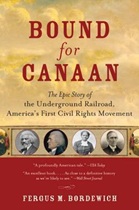
 The recent celebration of America’s two-hundred fiftieth anniversary was a milestone celebration, but it also gave rise to deep discussions about the nation’s history and what it means to different demographics. The contradictions between the principles the nation was founded on and what transpired are stark and the system of slavery remains a dark chapter in the story. For Black Americans it is a painful reminder of a time when human beings were characterized as chattel and the idea of all men were created equal was not equally applied. The system was doomed and eventually fell. And before the Emancipation Proclamation by President Abraham Lincoln (1809-1865), Whites, Blacks and Native Americans found ways to liberate slaves from the dehumanizing system of manual labor. In the process, they created a complex network of trails, passageways, safe houses, and clandestine contacts known as the Underground Railroad. This book by author Fergus M. Bordewich dissects the riveting system and how it changed history in the United States.
Early last year, I read Catherine Clinton’s ‘Harriet Tubman: The Road to Freedom‘ which is a fascinating look into Tubman’s extraordinary life. She is well-known as a “conductor” on the Underground Railroad, but Clinton’s book which covers far more than just her role in liberating the enslaved and activities on behalf of the Union during the American Civil War (1861-1865). As expected, she is a part of the story here as well as John Brown (1800-1859), Frederick Douglass (1818-1895) and others with whom I was not familiar. And despite the system’s title, there were times when it was as “underground” as we may think. It was a hybrid system based on covert activity and direct confrontation when necessary. And to make it work, countless men and women put their lives on the line for the sake of humanity.
This book will make some readers uncomfortable due to the subject matter and the frankness with which the history is explained. Today, events which transpire in the book seem surreal, but this was the reality of life in the United States as if expanded and confronted its faults. The issue of slavery has haunted America since its inception, and the glaring contradiction between the nation’s founding principles and the brutal life of slaves was one that politicians struggled to address. In the book, former President Thomas Jefferson (1743-1826) serves as a case study as both a slave owner and one who saw the evils of slavery. His statements and ideas about slavery and its victims are both interesting and disturbing. However, Jefferson was not the only one to struggle with the demon and throughout the book, the issue of morality takes center stage.
As I read the book, I found myself in awe of the people who are major figures in the story being told. There were several names I was not aware of, and I was speechless as their lives played out. The names of David Ruggles (1810-1849), Levi Coffin (1798-1877), Jonathan Walker (1799-1878) and Seth Concklin (1802-1851) are etched into my memory, and their stories are crucial to the history of the Underground Railroad. Of course, they were assisted by a network of people who believed in the eradication of slavery and freedom for the enslaved. And while there are bright moments in the story, there are dark moments too where abolition failed and slave hunters prevailed, and the fate of those captured remains unknown.
While the “railroad” is known to have assisted enslaved people as they escape to the North, the role of Canada is another interesting aspect of the story. In fact, our northern neighbor played a significant role in the lives of former slaves, a role much larger than I knew of previously. And the story of Canada’s participation cannot be told without including Josiah Henson (1789-1883) whose story is told by the author, and it is nothing short of incredible. His role in assisting former slaves and the creation of the Dawn Settlement are examples of the unwavering spirit within abolitionists committed to their cause. And their stories are revisited beautifully by the author in a book which stirred emotion and adjusted the way I view American history.
The Underground Railroad is a critical part of the nation’s history, yet it is often misunderstood and underrated. What I learned in this book has broadened my perspective on the system and how integral it became to slaves facing life and death situations. Further, the narrative commands a deeper respect for those who risked their lives to help the enslaved, and they came from all levels of society. The beauty in this book is that despite the horrors of human bondage, there is a story of common bonds between people from diverse backgrounds who saw an evil they could not accept. It is textbook example of how we are stronger when united. The subject matter is not “easy”, but it is history and the author tells with the right amount of respect for the deceased, adulation for the heroes and contempt for those who deserve it. And the result is a well-written, well-researched and informative book that fills in the gaps regarding the story of the Underground Railroad. Highly recommended.
ASIN : B000WCWV08
Publisher : HarperCollins e-books, March 17, 2009


You must be logged in to post a comment.