
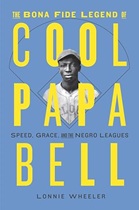
Recently, I found a pleasant surprise in my regular book recommendations list and when I saw the cover, I did a double take and smiled. The story of the Negro Leagues is as important to American history as Major League Baseball. Among the talented players in the league was the James “Cool Papa” Bell (1903-1991), widely considered to be one of the fastest players in baseball history. This is a look at his life by author Lonnie Wheeler. Prior to reading the book, I did not have any pre-conceived ideas about Bell’s life and admittedly knew little about him. This allowed me to digest the story for the first time and learn about Bell’s life. I was aware of the Negro Leagues and other stars such as Leroy Robert “Satchel” Paige (1906-1982) and Joshua “Josh” Gibson (1911-1947), both of whom appear in the story, but this was Bell’s time to shine and I jumped right in to learn about a baseball legend.
The story begins in Starkville, Mississippi in 1903, during the reign of Jim Crow. I can only imagine what a young James Bell saw during his childhood in Mississippi, but we learn in the story that his desire to leave the South is related to a racial incident involving his uncle who did not survive. But for black person, opportunities were limited and traveling to various sections of the country could be deadly. However, Bells finds his place in sports and through a series of events, finds himself as a player in the Negro Leagues. His life also changes in other ways, and the story of how he met his wife Clara is unusual, but they were married from 1928 to 1991. Although Bell makes a name for himself in the Negro Leagues, he also played baseball in Mexico and the Dominican Republic, and these parts of the story are fascinating and only add to Bell’s legacy.
Bell was not the only player to find work outside of the United States. In fact, I was surprised to learn that scores of players left America to play in integrated leagues due to the racially restrictive policies of Major League Baseball. The Bells’s time in Mexico is an uplifting part of the story, but it is clear early on that their time south of the border would be limited. But his time in the Dominican Republic is where the story takes a sharp turn which I did not see coming and left me speechless. While he found success, there were other issues at play while the country was in the vice grip of dictator Rafael Leónidas Trujillo Molina (1891-1961). This part of the biography is wild, and I am not surprised that Bell decided to exit stage left after proving his merits on the field. Bell eventually makes it back to America which is beginning to change significantly but that change is bittersweet.
On April 15, 1947, a young baseball player named Jack “Jackie” Roosevelt Robinson (1919-1972) took the field for the Brooklyn Dodgers and broke the color line in Major League Baseball. Robinson’s entry in the majors was the culmination of the challenging work by Bell and others who proved they were as good as the pros. The years of restrictive travel, segregated hotels and restaurants were slowly fading away but the humiliating experiences could never be forgotten. However, there was no guaranteed transition from the Negro Leagues to the majors and father time could not be ignored. This experience is captured by the author and explained by Bell himself as mainstream society finally begins to explore the stories of the Negro Leagues. And even when Cooperstown comes calling for induction in the Hall of Fame, Bell is long past his playing days. Bell did live long enough to see his induction which is uplifting. The same cannot be said for Josh Gibson whose departure in the story sent a chill down my spine.
Bell finally receives the acknowledgement which eluded him and other Negro League stars, but the story is far from over. In fact, his fame would produce unsetting encounters and on one occasion his life was in danger as Wheeler explains. And as an aging senior citizen, the speed of Bell’s youth is no longer there to protect but throughout the story Clara remains his devoted wife and guardian angel whose eagle eyes helped preserve items which may have been lost to history. And under her watch, no one would take advantage of her husband. It is no surprise that Bell’s life reaches its conclusion on several weeks after Clara’s death. Papa Bell is long gone but his legacy is rightfully preserved. And this biography by Lonnie Wheeler is a thorough account of his life and the importance of the Negro Leagues. From start to finish I enjoyed reading it and I am sure that you will too.
ASIN : B084ZJSKB3
Publisher : ABRAMS Press, February 9, 2021


You must be logged in to post a comment.