
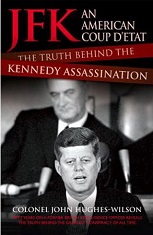
 Last week I was debating what book to read next and realized that I had not covered anything on the assassination of President John F. Kennedy (1917-1963) in quite some time. To many Americans, his death is in America’s past, and a crime never to be solved. With that being said, his murder is a reminder of how easy it once was to remove a sitting president from the highest office in the land. Kennedy’s death endures as one of America’s darkest moments and the unanswered questions surrounding the events in Dealey Plaza still send chills down the spines of even the most seasoned researchers. Colonel John Hughes-Wilson has taken another look at the crime and lays out his case for what he believes was a coup d’état on November 22, 1963. In the fifty-years since JFK’s death, researchers have been able to compile a staggering amount of revealing evidence throughout independent research and the release of government files under the Freedom of Information Act and the President John F. Kennedy Assassination Records Collection Act of 1992. Incredibly, Hughes-Wilson has managed to compress thousands of pages of information into a book that is less than 400 pages. But contained within the pages of this book is an excellent summary of what happened before, during and after Kennedy’s murder.
Some readers may be independent researchers in the crime or simply someone that has never believed the official story put forth by the government. I warn the reader to be prepared for many shocking revelations and the introduction of facts that are simply unbelievable. If you believe that Lee Harvey Oswald (1939-1963) was the lone killer, you may find this book hard to accept. But I do think that the author provides an incredibly strong position to support his believe that Kennedy’s murder was in effect a change in government by powerful sources hidden behind the scenes. One of the book’s most interest parts is how the author sets the stage for Kennedy’s murder. So much focus is often placed on November 22 but it is critical to understand the forces that raged against his administration and their culmination into a deadly web of enemies determined to have the president removed at all costs. Author James Douglass does a great job of covering topic in his book on the murder “JFK and the Unspeakable: Why He Died and Why it Matters“. The information provided therein if plentiful and highly enlightening. Hughes-Wilson takes a similar approach but streamlines the information to keep the pace moving at a sufficient pace.
Any book on Kennedy’s murder is sure to contain a long list of characters relevant to the story at hand. This book is no different and as one would expect, figures such as Lyndon B. Johnson (1908-1973) and J. Edgar Hoover (1895-1972) are discussed throughout the book. We also learn about the various groups that came to loathe the president such as Cuban exiles, Texas oil barons, Wall Street bankers, the government of Israel and the Italian American Mafia. The connections between the various groups will raise eyebrows and cause mouths to drop open in surprise. But what may truly shock many readers, is their connection to the White House, in particularly Kennedy himself. I warn some that what is also revealed about Kennedy’s private life may change the way they see the former president. But if you have read Seymour Hersh’s “The Dark Side of Camelot“, some of the information may be repetitive. Kennedy is long gone so we will never known what made him do some of the things that he did. The author here does provide clues to his sometimes strange behavior but to a point, even his views are somewhat speculative. Regardless, his assessment of the late president, puts the murder into clear context and also reveals that many great political figures also had a very dark side that the public was not privy to in the age before cell phones and social media.
Hughes-Wilson did an incredible job of staying focused and not straying too far from the main goal of the book. One can easily spend hours on just one part of the murder. Whether it is Oswald’s life or the murder of Dallas Police Officer J.D. Tippitt (1924-1963), the amount of information to cover is exhausting. The author here never lets the reader become overwhelmed with information but wisely keeps things moving along and provides enough information for the reader to continue to piece together the entire puzzle. In short, I found the book to a collection of information covered separately in other books but told in a way that keeps the reader deeply intrigued. And even for myself, the book was thoroughly enjoyable even though I have read at least a dozen books and several articles on the crime.
Someone asked me one day if Kennedy’s murder would ever be solved. Well Jim Marrs once said that we already know who did it, but we just need to look closely at the evidence. I think that we have many of the answers that have long been sought through the hard work of researchers and the deathbed confessions of individuals long suspected of being part of the plot. The real question is whether Americans are ready to accept information that will change the way the see the United States Government and politicians many of them have long admired. It is said that no one who was alive when Kennedy’s murder took place will forget where they were that day. My father has told me the same thing many times and can easily recall that day from start to finish even at the age of 66. For my generation, none of us will forget where we were on September 11th. The future generation will have their own moment in history but what that is remains to be seen. No matter how many generations pass, the murder of John F. Kenney will remain the biggest unsolved mystery in American history. But with books such as this by Col. John Hughes-Wilson, we already have many of the answers needed to eventually find the truth.
For readers that are discovering new territory, I strongly recommend reading the late Jim Marrs’ (1943-2017) “Crossfire: The Plot That Killed Kennedy“. It remains one of the best sources for information on the assassination. Having discovered this gem, I also strongly recommend this compendium as well for those who truly want to know what really happened.
ISBN-10: 1782198547
ISBN-13: 978-1782198543
ASIN: B00GF3MVUS
 I find that as I age, I am more focused on historical events that changed the course of America, in particular from Black Americans. It has been said that in order to know where you are going, you have to know where you come from. For millions of Black Americans, the question of identity has been a difficult one to answer. Some prefer the term African-American while others prefer Black-American. And there are some who prefer Afro-American or just simply Black. Regardless of the label, there is a shared history of pain, struggle and the never ending goal for full integration American society. Over the past fifty years, tremendous progress has been made in the United States but there is still much work to be done. But one of the greatest things about America is our ability to correct and learn from mistakes that have lingered for too long. The young generation of today lives in a world far removed from only twenty years ago. Their world is one in which technology is ingrained and life moves at an even faster pace. My father often thinks back to the period of integration and the times where it seemed as if America was going to tear itself apart. Even to him, as a kid it seemed as if the accomplishments by Black Americans over the years were just a pipe dream.
 I have often wondered why my uncle and many other veterans that I have met, were sent to Vietnam. He and others never speak of the war, choosing instead to internalize their memories and feelings. But from the few things about being Vietnam that my uncle has told me, I cannot image what it was like to be fighting a war in a jungle 13,000 miles away from home. Today he is seventy-two years old and his memories of Vietnam are as sharp today as they were when he left the country to return home. And there is a part of him that still remains in Vietnam, never to leave its soil. He is one of five-hundred thousand Americans that served in a war that claimed fifty-eight thousand lives.
 The murder of John F. Kennedy (1917-1963) continues to maintain its place among the greatest crimes in American history. The official story as published by the Warren Commission is that former Marine Lee Harvey Oswald (1939-1963) fired three shots in six seconds from the sixty floor of the Texas School Book Depository, fatally wounding Kennedy and severely wounding Texas Governor John Connally (1917-1993). To many, including the author of this book, David Lifton, the government version seemed to be the best and final explanation. But over time Lifton came to doubt the official story and after obtaining a set of the twenty-six volumes that composed the Commission’s investigation, his doubt turned into disbelief and lead him down the path that culminated with this national bestseller.
 On August 5, 1962, newspapers around the world relayed the news of the death of Hollywood star Marilyn Monroe (1926-1962) the night before at her home in the Brentwood section of Los Angeles, California at the age of thirty-six. The cause of death was listed as suicide from an overdose of the drugs Pentobarbital and chloral hydrate. However, decades after her death, several question still remain regarding that tragic night of August 4, 1962. What really happened that night and why was she paid a visit by then Attorney General Robert F. Kennedy (1925-1968) and his brother-in-law Peter Lawford (1923-1984)?
 On January 23, 2007, E. Howard Hunt died in Miami, Florida at the age of 88. Hunt is best remembered for his conviction as a result of his role in the Watergate scandal that helped end the presidency of Richard M. Nixon. Hunt was also a prime suspect in the murder of John F. Kennedy. His son St. John, spoke with his father prior to his death and their discussion is referred to as his deathbed confession about what he knew about the events in Dallas, Texas. In the years following his death, truths about his role in the Central Intelligence Agency and the events in Dallas disproving his claim to be just a ‘bench warmer” in the crime. Next to Hunt throughout the Watergate crisis was his first wife Dorothy who perished when United Flight 553 crashed on December 8, 1972 as it approached Chicago Midway Airport to make its landing. The NTSB attributed the crash to pilot error but researchers have long suspected sabotage in the crash and have alluded to a long number of disturbing facts surrounding the crash. On the surface, it seems to be just a tragic accident that killed a housewife en route to visit acquaintances. But upon deeper examination of the crash and her life as revealed by her son in this book, the real story of the life of Dorothy Hunt is nearly as intriguing as that of her husband.
 America is often referred to as the land of opportunity for anyone wishing to start a new life far away from home. Since the days of Amerigo Vespucci, the territory we now call the United States has been a primary destination for world travelers. In recent years, legislation regarding immigration has been an important topic which provokes fierce debate. Every country has its issues with immigration and none has a perfect regarding the same. However America has been the place where millions of immigrants have made a new home. The late John F. Kennedy, formerly the Thirty-Fifth President of the United States, left us with many writings, interviews and speeches before his untimely death in Dallas, Texas. His sharp wit, uncanny foresight and fierce independence catapulted him to the top of the list of Americans whose names live on forever. As the descendants of Irish settlers from Ireland escaping the potato famine, his family came to America in search of a new life. Their journey was long and their assimilation into a new society rough, with prejudice and xenophobia forming substantial obstacles to peace and happiness. Their plight was never forgotten and is told again in this short but engaging book that clarifies his position that America truly is a nation of immigrants.
 On September 1, 1939, Adolf Hitler’s Third Reich invaded Poland and started the Second World War. In violation of the terms of the Treaty of Versailles, Germany had rearmed itself and under the determination of Hitler, set its eyes upon conquering all of Europe. The looming threat of German domination had been lingering for quite some time before the outbreak of the war. But sadly, many of the nations that would later be opposed to Germany did not think that Hitler would be brazen enough or have the resources to initiate a world conflict. In hindsight, we know that way of thinking was short-sighted and later highly regrettable. The actions of the British government in response to Hitler’s annexation of Czechoslovakia, resulted in the condemnation of Prime Minister Neville Chamberlain and established Germany as a legitimate threat to world peace. The episode has been recalled in history books and documentaries and continues to provoke discussion about how Hitler could have been stopped before his army invaded neighboring Poland.
 The election of Barack Obama to the office of President of the United States marked a turning point in American history. His successful campaign and subsequent eight years in office vindicated the late Robert F. Kennedy who in 1961 said he believed that in forty years a negro could be president. At the time the thought seemed absurd as American struggle with social division fueled by ethnic discrimination. But if we look back on his words, we can see that his foresight was not only accurate but uncanny. From time to time I think back on the many quotes from him regarding his views on society. His assassination during the 1968 presidential race left a void in the United States that has never been filled. He remains one of the most popular, unpopular and tragic figures in the history of this nation.
 FREETHINKING BIBLIOPHILE
You must be logged in to post a comment.