
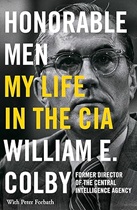
On July 26, 1947, United States President Harry S. Truman (1884-1972) signed the National Security Act, establishing the national security framework currently in place today. This signature piece of legislation paved the way for the creation of the Central Intelligence Agency (“CIA”) which over time, morphed into an agency far different from Truman’s vision in 1947. In September 1973, President Richard M. Nixon (1913-1994) appointed William Colby (1920-1996) as Director of the agency and Colby found himself in charge of an intelligence apparatus he had duly served and knew inside out. He served as director from 1973 to 1976 and during those three years he would submit to congressional hearings and be forced to answer tough questions about past CIA actions that raised public awareness and suspicion. In 1978 he authored this book about his life and time in the CIA which has now been republished in electronic format. It is a fascinating look at the life of a career military and intelligence officer who was a crucial part of America’s national defense.
When I bought the book, I was not sure what to expect. Of course, I knew that Colby had a storied past but the idea of a former CIA director authoring a book still seemed unusual. However, I found his story to be interesting and candid at times. And while he undoubtedly held some things close to the chest, he is frank regarding his time in the intelligence community. But before we reach his induction into the CIA, we learn about his upbringing and prior government service as part of the Office of Strategic Services during which played a critical role in the victory by allied forces in World War II (1939-1945). Like other former OSS operatives, Colby eventually found his way to the CIA. But his path was not direct, and he explains how ended up in Langley, VA following a brief period working for the American Civil Liberties Union. Once he joins the agency, the story takes unexpected turns as he and his family move from one foreign post to the next. The time abroad would shape Colby’s views of the world and domestic issues including women in the workforce and the lack of minorities in the agency. Both issues come back later in the story and Colby identifies the problems which existed and how he set out to correct them. However, as he became more valuable to the agency, he also had a first-hand seat at pivotal events which shocked America and the world.
The story shifts gears when President John F. Kennedy (1917-1963) settles into the White House in January 1961. The Bay of Pigs Invasion, Cuban Missile Crisis and looming threat of war in Vietnam (1965-1975) become hotbed issues which place Kennedy on the defensive and plunged the CIA into the heart of each. Colby explains the agency’s actions and positions, and issues firm clarifications on anything he felt was incorrect about CIA participation, particularly Kennedy’s assassination on November 22, 1963. His comments on the events in Dallas are brief, and he does not discuss the investigation or any conspiracy theories. However, regarding South Vietnam, Colby talks extensively of his visits to the country and the policies enacted to the help the people maintain a separate democratic republic. Following Kennedy’s murder, Lyndon B. Johnson (1908-1973) becomes the next Commander-in-Chief, and within a year, America was at war, with North Vietnam. I do not believe it is necessary to re-hash the conflict, and there are dozens of books on the war which explain it extensively. The war does takes a step back when Nixon assumes office an this section of the book is by far the most interesting and the most volatile.
I was surprised while reading at how direct Colby was in his words. The Nixon presidency soon goes off the rails as he orders CIA intervention in Chile and deals with the fallout of the Watergate scandal created by his own paranoia. Colby does a thorough job of explaining each crisis and how the CIA became ensnared in both. Chile is haunting and is often referred to as the “other 9/11”. The fall of Salvadore Allende (1908-1973) on September 11, 1973, remains one of the darkest chapters in CIA history and is a prime example of the fears Harry Truman had ow what the CIA had become. Watergate is an extensive story on its own, and Colby explains what was known at the time, but this is not intended to be a full examination of the scandal. But what he does say highlights the insanity inside of the Nixon White House. And the section regarding Nixon’s meeting with former CIA Director Richard Helms (1913-2002) is chilling. It soon becomes clear why he resigned from office. Nixon left a mess in his wake, and Colby would be called to appear on Capitol Hill following devastating press releases by journalist Seymour Hersh. He manages each situation gracefully, explaining his position as director while weighing the implications of his words as he walks the fine line between compliance and protecting covert operations critical to the nation’s security. Colby was aware that the agency’s reputation had been severely damaged during the Cold War and that rehabilitation was needed. This did not sit well with everyone such as former Counterintelligence Chief James J. Angleton (1917-1987) whose reputation is controversial on its own. Colby addresses the role of Angleton in the agency and how he viewed the mysterious spy whom no one seemed to understand. We also learn of his friendship with former Secretary of State Henry Kissinger (1923-2023) who is another controversial figure in history. The author does not cast any judgment on Kissinger but does discuss the secrecy surrounding him which made the job of the CIA more difficult. Colby’s account is filled with a who is who cast of figures from the past who have shaped American foreign policy.
In 1976, Colby is relieved of his post, and you can feel the sadness and relief in his words. No longer tasked with running the agency, he had more time for first wife Barbara (1920-2015) and their children. The couple’s story is overshadowed by the larger discussion of the CIA but should not be overlooked. Colby and his family endured immense personal sacrifice and tragedy, as he explains. But he had no regrets about his career and time as director. I did not have any expectations before I started this book, but I can say that I enjoyed reading it. I do not doubt that Colby took secrets with him to his grave and left some things out of the book due to the threat of litigation from the U.S. Government should classified or top-secret information be revealed. However, despite the restrictions on discussing sensitive agency operations, he does not avoid difficult or controversial topics within the agency’s history in the name of transparency. If you are curious about the CIA, how it functioned internally, and some of the most important events in American history, this book may be what you are looking for.
ASIN : B0G1FSJ2RD
Publisher : Open Road Media, January 13, 2026

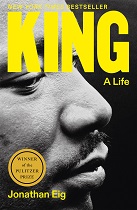
 On January 17, 1961, United States President
  On January 28, 1986, Americans watched in horror as the Space Shuttle Challenger suffered a catastrophic rupture in its rocket booster shortly after liftoff. Among the seven crew members who perished was Ronald McNair (1950-1986) and African American astronaut who had joined a diverse crew of individuals who were making history. As a student, I remember being in awe of McNair and the mission he was on. Naturally, my fellow students and I also had an affinity for Christa McAuliffe (1948-1986) a schoolteacher whose hometown was watching that day as well. To millions of young black children, McNair was a remarkable sight, but he was not the first to break NASA’s color barrier. In fact, NASA had begun to integrate the space program decades before, during the administration of President John F. Kennedy (1917-1963), whose initiative to travel to the moon led to NASA changing itself and playing a significant role in the Civil Rights Movement.
 On January 6, 2021, I and millions of people in America and abroad watched the events at the U.S. Capitol in which thousands of individuals breached security and entered the historic building in the belief that the 2020 Presidential Election had been stolen from Donald J. Trump. As I watched the video footage, a sense of gloom came over me due to the realization that the pillars of our vision of democracy were under siege. Personally, I have no political affiliation and regardless of which party we belong to, none of them are above reproach when our government is threatened from within or abroad. By evening, the dust had settled over Washington and officials began to piece together the chain of events that left several dead, dozens injured, and hundreds detained or the target of criminal investigation. Messages from family members and friends started to arrive on my phone with nearly if I had seen the events in Washington, D.C. The insurrection forced many of us to confront unsettling realities and acknowledge that threats exist all around us. Further, the day also showed how far America has strayed from the principles it professes to believe in.
 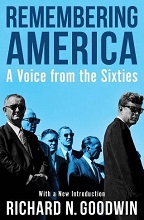 On more than one occasion my father has commented that the 1960s was the scariest decade of his life. The threat of Nuclear War, increasing tensions in Southeast Asia and the growing Civil Rights Movement captivated American society and the world. During one conversation he turned and said to me “at the time of the Cuban Missile Crisis, we didn’t know if we would live to see tomorrow or die in a nuclear exchange with the Soviet Union”. The assassinations of several activists and politicians spread fear across the nation and to many, it seemed as if America was on the verge of total anarchy. Richard N. Goodwin (1931-2018) worked in the administrations of Presidents John F. Kennedy (1917-1963) and Lyndon B. Johnson (1908-1973) and helped draft some of the most memorable speeches given by the iconic figures. In 1988 he completed this memoir which was re-published in 2014, of the decade he spent in politics with two presidents and two presidential candidates. And the result is a spellbinding account of a critical time in American history during which the country underwent profound heartache and change.
 When we think of political dynasties in America, perhaps no other name has had as big of an impact as the Kennedys. They are both admired and loathed but their importance to the American experience cannot be understated. The patriarch, Joseph (“Joe”) P. Kennedy, Sr. (1888-1969) was once one of the wealthiest men in America. Yet for all of his financial success, controversy followed him and his family for years after his death. The family’s success undoubtedly reached its highest peak with second son John F. (“Jack”) Kennedy (1917-1963) was elected in 1960 as the next President of the United States. For Joe, it was a dream come true and reaffirmed his mantra that “Kennedys don’t lose”. To most of the public, the Kennedys seemed like figures out of a story book and the media’s creation of the term “Camelot” that was given to the Kennedy White House, further enhanced the family’s mythical status. The image presented to the public gave the impression of a fairytale marriage that any single person would envy. Today, we know through the benefit of hindsight that the truth is far less glamarous and behind the scenes, there were dark storm clouds gathering as infidelity, old man Joe’s influence and one foreign crisis after another made life as the first family strenuous to say the least. Rumors have persisted over the years that Joe Kennedy provided the money for all of his sons’ political campaigns and that the money he provided was used in several places to swing the election to his son Jack. And while there has never been documented evidence of such, statements have been made by many individuals that action were taken to give Kennedy the election. All knowledge of what really did happen went with Joe Kennedy to the grave and I doubt that even his sons knew the whole story. He was a master at compartmentalization and for years, remained chameleon like figure. Ronald Kessler decided to take another at Kennedy’s life and what he found has been compiled into this book that peels back the layers that have shrouded the Kennedy family is mystique for several decades.
 I am constantly amazed that in spite of all of the things I learned in school and through my own studies, that there are endless stories from the Civil Rights Movement that are continuing to be told. Amazon recommended this biography of Ethel Lois Payne (1911-1991) and as I looked at the cover, I recalled the name but the face did not ring a bell. My curiousity continued to pull me in and I knew that I had to learn more about this intriguing woman. Author James McGrath Morris has called her the first lady of the Black press. It is quite the title but as I learned while reading the book, the title was not only earned but it may in fact may be an an understatement.
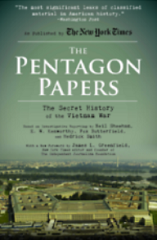 The names of the 58,000 Americans who died in the Vietnam War that are found on the memorial in Washington, D.C., are a reminder of a conflict deemed by many to be the worst the United States has ever been involved in. The withdrawal of U.S. forces in March, 1973, brought a sigh of relief to the American public which had long grown tired of a war with no end in sight. The dark truth which we now know is that we did not by any means accomplish the mission. And the mighty American war machine failed to secure a victory. I have met many veterans of the war and have an uncle who served. What I recall most about all of them is that they do not speak of their experiences while in combat. I know the memories are there and for some of them, they were unable to leave parts of the war behind. Today we call it PTSD, but back then you simply found a way to move forward in life. But why were they in Vietnam to being with? Was the domino effect really a threat to the United States?
 FREETHINKING BIBLIOPHILE
You must be logged in to post a comment.