
 The names of the 58,000 Americans who died in the Vietnam War that are found on the memorial in Washington, D.C., are a reminder of a conflict deemed by many to be the worst the United States has ever been involved in. The withdrawal of U.S. forces in March, 1973, brought a sigh of relief to the American public which had long grown tired of a war with no end in sight. The dark truth which we now know is that we did not by any means accomplish the mission. And the mighty American war machine failed to secure a victory. I have met many veterans of the war and have an uncle who served. What I recall most about all of them is that they do not speak of their experiences while in combat. I know the memories are there and for some of them, they were unable to leave parts of the war behind. Today we call it PTSD, but back then you simply found a way to move forward in life. But why were they in Vietnam to being with? Was the domino effect really a threat to the United States?
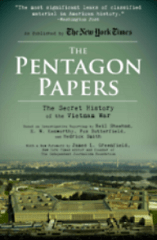
On May 11, 1973, Daniel Ellsberg found himself the talk of the town as charges pending against him for espionage were dismissed by U.S. District Judge William Byrne. He had been indicted for leaking what became known as The Pentagon Papers, the subject of this book and the topic of the movie The Post starring Tom Hanks and Meryl Streep. The New York Times, after several battles in court, was finally allowed to move forward with its plan to publish The Pentagon Papers and contained in the pages of this book are the documents that the U.S. Government tried in earnest to hide from the American public under the guise of “national security”. Ironically, the facts that are revealed in this book have absolutely nothing to do with national security but rather several presidential administrations that failed to find a workable solution to Indochina.
The late Secretary of Defense, Robert S. McNamara (1916-2009) has been called the architect of the war and was loathed by many because of it. However, the title is misleading and in some ways unfair. The war had many architects either by wishful thinking, uncontrolled ego or naiveté. What is truly ironic is that as the war waged on, McNamara became a strong voice of dissent. And in spite of what we have been led to believe, our existence in Indochina began many years before 1965. The story of U.S. involvement in Vietnam is a long tale, filled with hard truths, false truths, deception and ultimately failure. But this is how it happened and why.
The papers are divided into several sections which correspond to a different aspect of the conflict. The administrations of Eisenhower, Kennedy and Johnson are examined to understand what each cabinet did and did not do as it grappled with the growing headache. Step-by-step Southeast Asia opens up as black hole as more advisors are committed, instability rages in South Vietnam and war hawks finally get their wish as the United States jumped nearly feet first into a jungle conflict that proved to be nothing short of disastrous. Rolling Thunder, troop deployments and South Vietnamese politics are just some of the issues that antagonized Washington for nearly a decade.
If you served in Vietnam, I forewarn you that the book might anger you in many ways. For others, this is a critical source of information in order to understand the war from a behind the scenes view. We are often told that the military fights to protect the country and our freedoms that we take for granted. But did a nation over 13,000 miles from U.S. soil really pose a threat to the most powerful nation on earth at the time? And what would we have accomplished if we had in fact won the conflict? Perhaps Vietnam would have become a second Korea, partitioned between a communist controlled North-Vietnam and a U.S. controlled South-Vietnam. Following the U.S. withdrawal, Saigon fell and the North achieved its goal of reunification. Today the war is a distant memory for young Vietnamese but for the older generation, many painful memories remain. The figures in the book are long gone but their actions will stay with us and the Vietnam war will always be a regrettable example of U.S. foreign policy gone wrong.
ISBN-10: 1631582925
ISBN-13: 978-1631582929
 The resignation of Richard M. Nixon (1913-1994) as President of the United States on August 9, 1974, remains one of America’s darkest political moments. The revelation of the break-ins at the Democratic National Committee office in the Watergate complex and the subsequent attempted cover up, riveted American citizens and resulted in the downfall of a political icon. Through the years, myths and disinformation about the Watergate scandal have been propagated causing an aura of mystique over a crime of monumental proportions. I picked up this investigative account by Fred Emery to learn what really happened on June 17, 1972 and the process behind the scenes that led to Nixon’s resignation. And what I found is a book that dives deep into the Watergate scandal to show the reader what really happened from start to finish.
 On January 23, 2007, E. Howard Hunt died in Miami, Florida at the age of 88. Hunt is best remembered for his conviction as a result of his role in the Watergate scandal that helped end the presidency of Richard M. Nixon. Hunt was also a prime suspect in the murder of John F. Kennedy. His son St. John, spoke with his father prior to his death and their discussion is referred to as his deathbed confession about what he knew about the events in Dallas, Texas. In the years following his death, truths about his role in the Central Intelligence Agency and the events in Dallas disproving his claim to be just a ‘bench warmer” in the crime. Next to Hunt throughout the Watergate crisis was his first wife Dorothy who perished when United Flight 553 crashed on December 8, 1972 as it approached Chicago Midway Airport to make its landing. The NTSB attributed the crash to pilot error but researchers have long suspected sabotage in the crash and have alluded to a long number of disturbing facts surrounding the crash. On the surface, it seems to be just a tragic accident that killed a housewife en route to visit acquaintances. But upon deeper examination of the crash and her life as revealed by her son in this book, the real story of the life of Dorothy Hunt is nearly as intriguing as that of her husband.
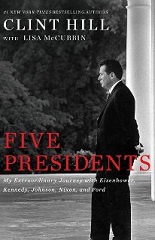 The 20th Century was filled with some of the most earth-shattering events the world has ever seen. The home video shot by Abraham Zapruder that recorded the assassination of John F. Kennedy stands as one of the most important pieces of motion picture ever captured. During that film, as former Firs Lady Jacqueline Bouvier Kennedy reaches to the trunk of the car to retrieve a portion of JFK’s skull, a secret service agent can be seen leaping on the trunk of the car as the motorcade sped down the Stemmons Freeway en route to Parkland Hospital. The agent, Clint Hill stands out in the film as only one of two agents to make any major movement to help the fatally wounded Kennedy and Gov. John Connally. Hill would go on to serve three more presidents and today is a best-selling author with several books published about his time working in the United States Secret Service.


You must be logged in to post a comment.