
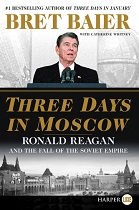
 Readers old enough to remember the Soviet Union will recall the shock and disbelief that came with the Union of Soviet Socialist Republics (U.S.S.R.) flag being lowered for the last time on December 25, 1991. The “Cold War” had come to an end, but a long road lay ahead between the United States and Russia in coming to terms with each other’s way of life. On May 29, 1988, United States President Ronald Reagan (1911-2004) and First Lady Nancy Reagan (1921-2016) arrived in Moscow for a three-day summit with Soviet General Secretary Mikhail Gorbachev and his wife Raisa (1932-1999). It has been held as a triumph in American foreign policy and as an example of strong leadership. In less than three years, the Soviet Union dissolved, and Reagan was vindicated in his predictions of its demise. During the summit, Reagan spoke to the people of the Soviet Union at Moscow University and to this day it stands as a breathtaking moment in world history. But as always, there is more than meets the eye. Fox News host Bret Baier revisits the summit in this book about three days that impacted world history.
Before I continue, I do have to acknowledge that the book may be viewed with skepticism depending on the reader’s political beliefs. Further, it is no secret that Reagan has long been the icon for conservatives. Ironically, he was once a liberal Democrat and as Baier explains, Regan’s parents had no tolerance for ignorance or bigotry. Exactly how Reagan became a conservative is not the point of the book and a full biography of him will better suit readers searching for that information. Baier does provide a short biography of Reagan tracing his roots in Tampico, Illinois, and the path he took to become Governor of California and the Republican candidate who unseated President James “Jimmy” Carter. The story picks up in pace once Reagan is sworn into office and moves into the White House. The chill in the air between the Carters and Reagans is evident in the book but a small part of the bigger picture. To anyone paying close attention, it was evident that all was not well within the Soviet Union. In fact, Baier correctly points out that:
“By the time of the Moscow summit, that fact was evident to everyone, including the Soviets themselves. Yes, they remained a world power. Yes, their arsenal of weapons was still great. But beneath the surface, the economy was in free fall, its citizenry was restless; the architect of perestroika was breaking down the remaining barriers. Reagan’s prediction was coming true, as he, if not others, had always known it would.”
Reagan did believe that the Soviet Union would fall but it should be noted that problems within the U.S.S.R. had been mounting for years, even before Reagan took office. Further, the fall of the Soviet empire is far more extensive and complicated than presented on the surface here. I vividly recall Reagan’s statement telling Gorbachev to “tear down this wall”. The Berlin Wall did fall, and it was a significant turning point in both German and world history. But even that goodwill gesture caused in part by weakening Soviet influence was not enough to stave off the inevitable. Gorbachev knew that trouble was brewing but also faced opposition within his own ranks. However, he had developed a strong relationship with Reagan and that is the crux of the book.
The visit by the Reagans had a profound effect on the Soviet Union and it was an extraordinary act by a U.S. President. Baier takes us deep behind the scenes as the two leaders seek to come to an understanding of key issues. As I read the book, I could see their relationship developing slowly but surely. It is a prime example of how people from diverse backgrounds can find common ground. That is not to say that all went well. In fact, in the book, we see more than one situation where the two leaders remain on opposite ends of a rope with each refusing to give ground. And the first ladies did not have a warm or jovial relationship themselves. Reagan and Gorbachev were leaders of the two most powerful governments on earth and needless to say the stakes were high. Before the book’s conclusion, Reagan leaves office and is succeeded by George H.W. Bush (1924-2018) who developed his own relationship and different relationship with Gorbachev. When Reagan leaves the White House for the last time, the sadness in Washington and in Moscow can be felt through the author’s words. Reagan emerges as a leader that is hard not to like. Of course, the Soviet story was far from over and Gorbachev had to defend himself from party members determined to see his downfall. Baier discusses how close the Soviet General Secretary came to being removed from office and the roles of Boris Yeltsin (1931-2007) and a young intelligence officer named Vladimir Putin who currently has the world watching his every move.
Undoubtedly, Reagan comes across beautifully in the book and I did notice that the darker moments of his president are discussed briefly. The Iran Contra scandal and Sandinista affair in Nicaragua are mentioned but Baier touches only the surface of those matters. The seriousness of each is not felt in the story at hand but I do implore readers to further research those topics to get a full understanding of Reagan’s presidency. To be fair, no administration is perfect, but the people of Central America will surely give you an interesting opinion of the Reagan era. His policies had a profound impact on Latin America that continues to be felt to this day. In the United States, the legacy of the jovial actor turned politician is permanently embedded in the Republican party’s core and he remains an icon of conservative values. If her were alive today, I am not sure if he would recognize what the GOP has become and I believe he would be both shocked and dismayed at world events. The world is a far different place today but the importance of this time in world history captured by Baier cannot be understated. In three days, Ronald Reagan accomplished what decades of U.S. foreign policy failed to do, he captured the attention and minds of the Soviet people. Readers with a thirst for historical information on U.S. and Russian relations will appreciate this book.
ASIN: B072LL4ZN2
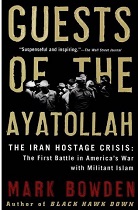 On November 4, 1979, university students seized the U.S. Embassy in Tehran, Iran and detained more than fifty U.S. Government employees. Though some were later released, the majority remained behind for four hundred forty-four days in what is known as the Iran Hostage Crisis. In 1953, Mohammad Mosaddegh (1882-1967) and the National Front Party gained political power in opposition to Mohammad Reza Shah (1919-1980). A twice elected member of Parliament, Mossadegh emerged as a popular figure but within days of the Shah’s exile in August of that year, Mossadegh was removed in a coup sponsored by the British Government and the United States. Mossadegh’s removal and the Shah’s return, inflamed tensions and in November 1979, Iranians decided that America must go. This is the story of the hostage crisis from start to finish in an account that provides a thorough discussion of America’s foreign policy mistakes and Iran’s inner struggle between traditionalism and modernity.
 On March 25, 1985, the 57th Academy Awards ceremony was held at the Dorothy Chandler Pavilion, Los Angeles. During the ceremony, the category of best supporting actor was called, and the winner was Haing S. Ngor (1940-1996), a doctor born and raised in Cambodia, who had survived the Khmer Rouge dictatorship under the notorious Pol Pot (1925-1998). Ngor had starred as Cambodian journalist Dith Pran (1942-2008) in the 1984 film
  The history of America is dark at times, and those moments have been omitted or neglected for many years. However, they are crucial to understanding how and why the United States developed into the nation that it is today. As an American, I am constantly seeking to understand my own country and clarify the myths that have propagated with regards to its past. I am learning uncomfortable truths, but they have not diminished the love that I have for America. In the history of this country, the name of Frederick Douglass (1818-1895) remains a reminder of the institution of slavery that degraded human beings, served as the backbone of an economic system, and led America towards a civil war. Douglass was born into the slave system and became a free man as an adult. This is his story of his time in bondage, freedom from oppression and evolution into a public speaker.

 If you have had the chance to view a map of North American Indian tribes prior to the formation of the United States, you may have been just as surprised as I was to see how many were in existence. The story of North America’s early inhabitants known simply as Native Americans, is deeply complex and ultimately tragic. In 2016, 20th Century Fox released Alejandro González Iñárritu’s
 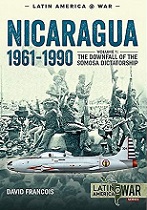 In June 1987, Lt. Col. Oliver North (Ret.) gave testimony in front of the Senate Select Committee on Secret Military Assistance to Iran and the Nicaraguan Opposition and the House Select Committee to Investigate Covert Arms Sales with Iran. The hearings had cast a dark cloud over Washington and the administration of President Ronald W. Reagan (1911-2004) doubled down on anything that could be conceived as illegal pursuant to United States law. I can still recall the shock on my father’s face when the news of the scandal broke across media outlets. The two of us watched the nightly news to learn more about a situation that had danger written all over it. Those who remember the Iran-Contra affair most likely have images in their minds of North testifying in his military dress before Congress. Details of the Reagan administration’s covert plans became unraveled but the full truth about the affair remained elusive for many years. The sale of weapons to foreign nations did not surprise me at all and military hardware has always been big business. But what did catch my attention was the atmosphere in Central America, a region that suffered extensively due to Washington’s support of dictatorships thirsty for blood and determined to crack down on all opposition.
 While reviewing my list of books to read, I did a double take as I read the title of this memoir by Pat Conroy. I had added it for a reason yet at the time, I could not recall why. But I put that aside and decided that there is no time like the present and it might be a hidden gem. It turns out that I was right in my assessment. However, I was not prepared for the incredible story within by Pat Conroy (1945-2016) that sheds light on the lives of those who have been forgotten even in the most powerful nation on earth. I knew that the story centered around education but of course, teaching is never as simple as writing on a blackboard. In fact, what is revealed in the book should remove all doubt that teaching is by any means as easy task. Some of us are naturally gifted to handle a classroom full of students, each with their own peculiar personality. In many ways, the teacher is conductor working the orchestra to fine tune all the instruments and produce a symphony that is pleasing to the ears. Conroy is the conductor here and what he accomplished on Yamacraw Island, South Carolina, will leave you sad, angry, and happy at the same time.
 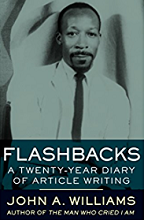 When I saw this book on sale, I felt a small sense of embarrassment because I did not know who John A. Williams (1925-2015) was. While it is true that he would be considered “before my time”, voices from the past are often as important as those of today. And any person that spends twenty years writing articles must have a significant number of experiences to reflect on. I gave in to my curiosity and decided to make the purchase. I can honestly say that I received more than I bargained for and have a newfound appreciation the late journalist. To be clear, the book is not an autobiography but more of a recollection of his most vivid memories about his early life, breaking into journalism and the numerous larger than life figures he had the chance to interview and, in some cases, form friendships with. Writers can tell you that composing an article is not always a simple as it seems and financially, it is not a way to get rich quick. In fact, the author removes all illusions of grandeur when he says:
 FREETHINKING BIBLIOPHILE
You must be logged in to post a comment.