
 “The soldier above all others prays for peace, for it is the soldier who must suffer and bear the deepest wounds and scars of war. ” – Gen. Douglas McArthur (1880-1964)
Seventy-eight years have passed since Japan surrendered to Allied forces, marking the end of World War II. The war’s brutal conclusion, culminating with the detonation of two atomic weapons, changed history. Although subsequent wars have been fought, World War II remains the deadliest conflict in human history. The European theater of combat during the war has received significant attention due to the existential threat to the world in the form of the Third Reich. However, in the Pacific, the Japanese military waged its own campaign of death and destruction across Asia. H. Robert Charles served as United States Marne about the USS Houston, and on February 28, 1942, he found himself among the survivors of a Japanese attack in the Sunda Strait that decimated their forces and vessel. The surviving soldiers were taken captive as Prisoners of War (“POW”) by the Japanese, who had every intention of making the Americans pay for the battle against Japan. The prisoners were forced to build the Burma-Thailand railway, and this is Charles’s story of the nightmare ordeal the POWs faced until liberation.
Before starting the story of his captivity, a foreword opens the book, followed by a prologue explaining the long road from war survivor to author. It is apparent that he returned home with what we call Post-Traumatic Stress Disorder (“PTSD”) today. But after being coaxed by a fellow veteran to seek counseling, he has a discussion with a therapist who helps break down the walls preventing him from telling his story. And with determination and a sense of purpose, he has left us with this story of a dark time in history which we should never wish to repeat.
As to be expected, the author recalls his early life in post-depression America before joining the United States Marines in 1940. On December 7, 1941, life for Americans changed when the Japanese army bombed the Pearl Harbor, Hawaii Naval Base. The act was in effect a call to arms for the United States. But for Charles and fellow soldiers aboard the USS Houston, the war took them in a different direction. Following their surrender to Japanese forces, the men are moved to Serang, Java and began their ordeal at the labor camp. There is no shortage of brutality by the Japanese, but the men eventually find a solace in a doctor who becomes a savior in the story: Dr. Henri Hekking (1903-1994) of the Royal Dutch Army. To say that he was a godsend would be an understatement. Admittedly, I had never heard of Hekking, but I am sure he is one of many unsung heroes of World War II.
Hekking was a physician well versed in standard practice, but he was also experienced in herbal treatments, often referred to as “unconventional”. As the story progresses, we witness the deterioration in the condition of the prisoners, who begin to suffer from the effects of malnutrition and lack of proper sanitary and hygienic protocols. Injuries are also an issue, and the lack of antiseptic tools made infection a prime concern. However, the doctor proves to be more resourceful than anyone could have imagined. But he was not without his detractors as we see in the story. Despite early misgivings, “Doc” as he is known, earns the trust of everyone as he brings back plants, roots and other items from the nearby jungles that help keep the men alive as the Japanese compel them into manual labor building the long-awaited railway they desired. Morale is low at times as physical exhaustion sets in, but Hekking never gives up and offers these words of advice which still hold true today:
“It is in the nature of things that without despair there can be no hope, without darkness no daylight,” Doc said. “There has to be meaning. Even if we can’t see it.”
Although Hekking emerges as a pivotal figure, the author is sure to tell his own story which becomes permanently linked to the experience of their Dutch savior who commands respect even from the Japanese, who are never short on cruelty. Unbeknownst to the soldiers, events outside the camp mandated their transfer across several camps, one as far as Saigon in French Indochina. And without warning, they are told that World War II is over, and deserted by evacuating Japanese troops. This is by far the most bizarre part of the book. However, the empire had fallen, and Japan reduced to shell of its former self. For Charles, Hekking and the survivors, their ordeals were far from over as they were faced with having to rebuild their lives in the wake of the war. The author returns to the Midwest and confronts his own demons. Hekking continued to search for his wife and children, with whom he is eventually reunited. And years later, the doctor makes his way to America to see the boys one more time. There is far more to the story contained in the book, which concludes on an uplifting note. If you need an enjoyable book about the Japanese aspect of World War II, this will be a welcomed addition to the library.
“Thanks to Dr. Hekking, only thirteen out of 194 were dead—less than seven percent. It was the best report of any of the doctors in the sixty-five slave labor camps along the railway.” – H. Robert Charles
ASIN : B005S741XW
 When I learned that
 In the 1989 film ‘
 In December 1963, one month after the assassination of U.S. President John F. Kennedy (1917-1963), former President Harry S. Truman (1884-1972) authored an op-ed piece in the December 22, 1963, edition of the Washington Post about the Central Intelligence Agency (CIA) and its role in America. While reflecting on what the CIA had become, he stated “there is something about the way the CIA has been functioning that is casting a shadow over our historic position and I feel that we need to correct it.” The agency had been established through the National Security Act of 1947 which was intended to both centralize and simplify national defense and the intelligence apparatus. Five years before the National Security Act was signed into law, President Franklin D. Roosevelt (1882-1945) had also addressed the need for foreign intelligence and through Executive Order 9128 on July 13, 1942, he formally established the Office of Strategic Services (OSS). And to lead the new agency, he turned to former director of the Coordination of Information (COI), the legendary William Joseph “Wild Bill” Donovan (1883-1959). Though he was never director of the CIA, Donovan is credited as being the father of intelligence. Author Richard Dunlop examines Donovan’s life in this intriguing biography and historical account of how the intelligence community came to exist.
 On January 15, 1953, President Harry S. Truman (1884-1972) gave his farewell address after serving as the Thirty-Third President of the United States. He had taken office on April 12, 1945, after the death of President Franklin D. Roosevelt (1882-1945). At the time of Roosevelt’s death, allied forces were pushing further into German territory to bring the Third Reich to its knees. In the Pacific, the war against Japan continued to rage but in less than six months, it too surrendered after the devastation left by two atomic bombs. In the first four months that Truman was in office, the entire world changed in ways no one could have imagined. Had Roosevelt lived, the war might have ended differently, and domestically, America might have moved forward at a different pace. He did not live to see his post-war plans come to light and for Truman, the title of president was thrust into his lap. He had never wanted the presidency but due to circumstance, he had become what author A.J. Baime calls the accidental president.
 More than seventy years have passed since the end of World War II, yet it still fascinates historians and students. The number of books written about Adolf Hitler (1889-1945) and the Third SS Reich are perhaps the most written about any conflict and leader in history. The former Austrian vagabond rose to power in Germany and plunged the entire world into the deadliest conflict in the history of mankind. The emergence and use of the atomic bomb by American forces ushered in the nuclear age and set the stage for the Cold-War which lasted until the dissolution of the Soviet Union in December 1991. In my list of recommendations, I saw this title regarding the expulsion of Germans following the war. At first, I was not sure which expulsion was being referred to but quickly realized that it was pertaining to the Germans that were living in Nazi occupied territories outside of Germany. During the war, many of them enjoyed security and a stable life but in the wake of Germany’s defeat, nationalist governments came to power in former occupied territories, and they turned their wrath towards the German people that had been living within their borders. A staggering number of Germans were forced from their homes and sent back to Germany with no clear or concise plan for reintegrating them into a Germany struggling to recover and rebuild. And this is one part of the war that is often not discussed but a topic that should be known.
 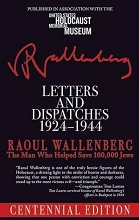 I am always on the lookout for stories that I have not yet heard and names of people I am not yet familiar with. When I saw the cover of this book, I tried to jog my memory with regards to the name of the author. I finally realized that I did not know of Raoul Wallenberg (1912 -1947?) but I knew instantly that I had to read this book. Admittedly, I am always interested in the personal correspondence of figures from the distant past to see how information was shared in the years before E-mails, SMS and social media. The cover of the book directly describes what is contained within which is a collection of the letters between Raoul, his grandfather Gustaf Wallenberg (1863-1937) and Raoul’s mother Maj von Dardel (1891-1979) whose replies to her son are not included.
  On June 6, 1944, American, British and Canadian troops stormed the beaches at Normandy, France and commenced an ground war against Nazi Germany. The European Theatre was marked by brutal fighting that saw high numbers of casualties on all sides of the conflict. In the end, Nazi Germany fell to allied forces and accepted an unconditional surrender on May 8, 1945, commonly known as VE Day. The Japanese military continued to fight and remained defiant until two atomic bombs forced it too into surrending to Allied forces. VJ Day marked the end to World War II and the world breathed a sign of relief. For the United States Army, the European Theatre was a hard fought campaign that no one ever wanted to see again. Author Stephen Ambrose has composed a breathtaking account of the Army’s mission from the beaches at Normandy until the Allies seized Berlin in May, 1945.
 A colleague gave me this book as a gift during the holiday season, mainly due to his knowledge of my fondness for history. I quickly made a mental note to give it a read in the near future. When I saw the title, I was slightly puzzled at the term “The Forgotten 500”. I have read books on World War II but none mentioned any 500 forgotten soldiers. Upon closer inspection, I soon began to realize why I had not heard the story. At the time the mission occurred, it was carefully hidden by the State Department and Office of Strategic Services who did not wish to jeopardize the lives of any remaining U.S. soldiers still trapped behind enemy lines. Further, in the years that followed, the the story faded into the annals of military history regarding the second world war. Even my father, who is an ardent World War II buff, has never mentioned this story. Our next discussion will certainly be interesting.

You must be logged in to post a comment.