
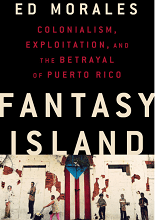
 Those of us who have traveled to Puerto Rico and have seen the island outside of San Juan, known why it is called the island of enchantment. There is no one word explanation for Puerto Rico and I firmly believe that it is a place you have to see to truly understand. Several years have passed since my last visit to the island but upon resolution of Covid-19, I do plan on returning to the place that holds a special place in my heart. Hurricane Maria arrived in Puerto Rico on September 20, 2017, and the devastation was nothing short catastrophic. The storm’s wake revealed the underlying infrastructure in dire need of upgrade that was unable to cope with the hurricane’s power. The electrical grid began to collapse, roads became blocked and residents had to rely on each other to survive each day. Currently, the island is still recovering from the storm’s effects and the Trump Administration’s response to the storm is seen by many as subpar. Some might call that a euphemism but I always refrain from coming as political in any posts. Further, a political discussion can be found within the pages of this incredible book that explains clearly and thoroughly what went wrong with Puerto Rico from the moment the United States launched its invasion in 1989. And I believe that the book will leave you with a very different view of the island’s problems and a range of emotions about how it reached its current state.
The book is not a history of the island itself but it does provide valuable information on important events in the island’s history. Readers who are in search of an explanation of Puerto Rico’s history should read Rudolph Adams Van Middeldyk’s The History of Puerto Rico: From the Spanish Discovery to the American Occupation, which provides a concise discussion of its origins and development. The book is tainted only by the author’s bigoted views towards the end. And if you feel the need to go back even further in time, Irving Rouse wrote a phenomenal account of the island’s original natives called The Tainos: The Rise and Fall of the People who Greeted Columbus. The story here begins after Puerto Rico is invaded by the U.S. Military. Puerto Ricans could not have imagined at the time that the occupation would last to this very day. In 1917, Congress enacted a piece of legislation that permanently changed the history of Puerto Rico. Three years prior, the Puerto Rican House of Delegates demanded independence and in 1917, a bipartisan bill in Congress called the Jones Act was passed. As relayed by the author, one of its key components was that:
“The Jones Act also provided for the triple-tax exemption from the sale of government bonds that helped create the current debt crisis. This was the crucial moment that presaged the future debt crisis: the exemption meant that no federal, local, or state taxes could be collected on the bonds, making them more attractive than those issued by the vast majority of US municipalities.”
Essentially the Jones Act, with its restriction of foreign vessels near Puerto Rican shores, placed the island under the yoke of U.S. business interests which enjoyed exemption from income tax on all levels. The corporations now had no other goal but to reap as many profits as possible while Puerto Ricans suffered in the most difficult of ways. And although U.S. Citizenship was granted to Puerto Ricans born after 1917, they are still legally restricted from freedoms that mainland Americans are granted at birth. The exclusion of Puerto Rico from Chapter 9 Bankruptcy protection further sealed its fate as debt continued to climb, immune to restructuring under bankruptcy protection. These key pieces of legislation are critical to understanding how Puerto Rico was set up to fail. These things did not go without notice and nationalism began to rise on the island. It eventually gave way to the discussion on complete independence or statehood, a conversation that continues today.
Morales takes us down memory lane to bear witness to the growing independence movement under figures such as Pedro Abizu Campos (1891-1965) whose struggle for Puerto Rican independence is well-known and documented. I do recommend that readers pick up Armando Pacheo Matos’s Biography of Dr. Ramón Emeterio Betances Alacan: Father of the Puerto Rican Motherland, a good read on the leader of the Lares uprising. Here the discussion focuses on the leaders who represented the Boricuas in search of true freedom. Others who struck a more conciliatory tone with Washington are also discussed such as Luis Muñoz Marín (1898-1980), whose name was given to the San Juan International Airport. Marin’s father, Luis Muñoz Rivera (1859-1916) is also discussed but took a slightly different approach than his son. Regardless, both remained committed to a Puerto Rico left to manage its own affairs.
Washington is never far away in the story and as financial interests increased on the island largely through the passage of Section 936 of the Internal Revenue Tax Code which gave corporations a glaring loophole to exploit the island even further while keeping the profits safely on mainland soil. Hauntingly, Congress never seems to know what to do with Puerto Rico. As Morales points out, the inability or refusal of Washington to actually fix Puerto Rico’s financial issues, is based in large part on racist beliefs and monetary gain. The island has been seen as a land mass of inferior people who should be dependent upon the graces of its U.S. overseer. The attitude is immoral, condescending and as we see in the book, tragic for it placed Puerto in an unwinnable position. And unlike Greece and Argentina which had the option of turning to the International Monetary Fund (IMF), Puerto Rico has no such option, leaving creditors salivating at the thought of recouping millions of dollars in foreign debt on the island.
Readers may be surprised to learn of the decisions taken by several presidential administrations. No single administration deserves all of the blame for the current state of Puerto Rico. However, the mistakes made along the way are clearly evident in the book. Yes, Donald Trump is central part of the story but so are Bill Clinton and Barack Obama. Conservatism and Liberalism clash and neither produces the desired effect for the people of Puerto Rico, except for those in positions of power eager to remain in the good graces of Washington. Morales does not shy away from calling them out and this part of the story is just as shocking as the actions by the U.S. Government in 1917 and later. Their actions, compounded by the formation of the Corporación del Fondo de Interés Apremiante (COFINA) and the Fiscal Oversight and Management Board (FOMB), only served to deepen the issues. And even the passing of the Puerto Rico Oversight, Management, and Economic Stability Act comes under scrutiny for its insufficient tools to actually help the people of Puerto Rico. In the wake of Hurricane Maria, the Puerto Rican Electric Power Authority (PREPA) came into focus as the horrendous state of the island’s power grid came to the surface. A discussion on the issue is included, showing the precarious state of the islands infrastructure still in dire need of complete overhaul and how nepotism creeped into the discussion of the restoration of the power grid.
There is far more to be found in the book than what I have discussed here. The story is simply unbelievable at times but the harsh reality of the exploitation employed by the United States against a small island that remains in an uncertain states. The question America needs to ask itself is what are we going to do with Puerto Rico? Its status as a commonwealth continues to keep it in limbo with a bleak financial outlook and restrictions not enforced on those born on the mainland. Whether Puerto Rico will eventually become a state or become independent remains to be seen but there are growing calls for action to be taken. And if in fact Donald Trump is no longer president in 2021, then it will be up to Joe Biden to take the ball and run with it. For the people of Puerto Rico, the president may change but the island’s problems do not and they can no longer afford to wait for Washington to truly help their island the way it helps the states in the union. Action is needed and the Puerto Rican people are mobilizing in the goal of one day living in a truly self-sufficient Puerto Rico. Highly recommended.
“Puerto Rico is, then, in a privileged position by virtue of our growing skepticism of the American Dream, one that was never really granted to us, that grows ever new tentacles of corruption, where human bodies are just vessels for capital expansion, feeding on themselves and betraying sacred human trusts. By being both on the inside of pseudo-citizenship and outside of sovereignty, Puerto Ricans have a unique incentive to explore new ways to get free.” – Ed Morales
ASIN : B07M77X12S
 On March 24, 1976, Army Commander General Jorge Videla launched a successful coup against the government of Isabel Peron. The coup marked an end the reign of the Peronist party, universally known from the era of former President Juan Perón (1895-1974) and wife Eva (1919-1952). For many Argentines, the departure of Isabel Peron was a sign that perhaps the country would truly be on the road to democracy. In fact, Berta observes the occurrences and remarks:
  On July 2, 1961, legendary author Ernest Hemingway (1899-1961), took his own life in the small town of Ketchum, Idaho at the age of sixty-one. His suicide shocked fans and even today, the details of his death are unsettling and puzzling. It seems unthinkable that the man who wrote For Whom the Bell Tolls and Old Man and the Sea, would end his life in such a tragic manner. However, what we see from the public view often stands in stark contrast the reality behind the scenes. And one of the best ways to understand the life of the departed is to learn from those that were closest to them as their lives came to an end. A. E. Hotchner (1917-2020) spent fourteen years with Hemingway as the author moved from one city to the next across the globe in what can only be described as an extraordinary life. This is his memoir of the time he spent with the man he called Papa.
 I saw this book in my list of recommendations but did not know the face on the cover. However, the high rating caused my interest to raise and I decided to see why it is so highly rated. The name Gauri Lankesh (1962-2017) did not sound familiar but I thought to myself that she must have been someone unique to have a memoir written about her life by ex-husband Chidanand Rajghatta. As he explains, they had been divorced for more than twenty-five years but had remained close friends to the day she died. On September 5, 2017, Lankesh was shot and killed at her home in Rajarajeshwari Nagar, Bangalore. She was fifty-five years old. Her death marked a very dark turn in the ongoing battle between extremism and rationalism. And as Rajghatta points out throughout the book, Lankesh was never one to hold her tongue. She stood by her beliefs and gave her life for what she believed in. This book is his tribute to his former wife, close friend and pioneer for a more tolerate and diverse India.
 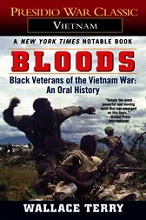 The last time I saw my Uncle William in person, we discussed his time in Vietnam and later discharge from the military in the 1960s. During a routine physical, it was discovered that he had suffered damage to hearing in one of his ears due to being too close to the 50-caliber machine gun while on patrol. As a result, his balance and coordination began to suffer, and he was declared not fit for active duty. He accepted the discharge and found work with the postal service before moving on to the private sector. Over the years he has only talked about Vietnam on a handful of occasions and the stories were typically very brief. He never went into too much detail but there are couple of stories that made the hair stand up on the back of my neck. His experiences are like those of other black veterans of the Vietnam War whose struggles have not received the full attention that they undoubtedly deserve. Wallace Terry (1938-2003) was a journalist and oral historian who conducted interviews with dozens of veterans and chose twenty of them which are the focus of this book. It is a detailed look at the life of black soldiers in a war that remains a dark memory in American history.
 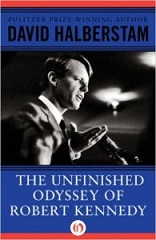 In the midst of what can only be described as a vitriol filled political climate, I decided to revisit this short but insightful book by the best-selling author David Halberstam (1934-2007), about the political transformation of the late Robert F. Kennedy (D-NY) (1925-1968). In 1968, the Vietnam War had become a nightmare for the administration of Lyndon B. Johnson (1908-1973) and calls for a change in American policy were growing louder. On the domestic front, social unrest began to peak as blacks and other minorities became increasingly frustrated with the lack of advancement in society that the Civil Rights Bill of 1964 and Great Society had failed to deliver. While blacks had equal rights under federal law, opportunity was still highly elusive. Johnson’s opponent, Richard M. Nixon (1913-1994) represented a shift to the right that alarmed those of the left and even moderate voters. And while Nixon did get elected, it took a series of events in 1968 to make that possible. And nearly all of them involved Robert Kennedy.
 On January 11, 2016, the music legend David Bowie (1947-2016) died peacefully at his home with his family by his side following a nearly two year battle with cancer. His passing deeply affected fans and he is fondly remembered as one of the most eccentric stars in music history. His high profile marriage to former model Iman, is one of the visions most recalled by fans of the late star. But prior to finding his soulmate in Iman, David Bowie had crafted a persona over the course of several decades and to say that it was a wild ride would be an understatement. Author Wendy Leigh takes a look at his life in this biography that is sure to keep you asking for more.
 FREETHINKING BIBLIOPHILE
You must be logged in to post a comment.