
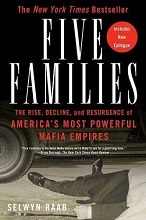
Between 1930 and 1931, rival factions of the crews headed by Joe “the Boss” Masseria (1886-1931) and Salvatore Maranzo (1886-1931) became entagled in a bitter feud that is known today as the Castellammarese War. The bloodshed and senseless violence convinced the younger mafioso composed of Charles “Lucky” Luciano (1897-1962), Meyer Lansky (1902-1983), Frank Costello (1891-1793) and Bugsy Siegel (1906-1947) among others, that the old guard would have be removed in order for business to flourish. Both bosses would be murdered in the conflict but Luciano had no interest in taking on the title of “Capo Di Tutti Capi” and instead created the Five Families with the boss of each to sit on a “Commission” that would mediate diasgrements, expand criminal plans and if necessary eliminate those who violated Mafia rules. Today they are known as the Gambino, Bonanno, Lucchese, Colombo and Genovese families. The organizations known as borgatas, established a stronghold of criminal empires over the Big Apple for several decades and its incredible story is chronicled hered by New York Times investigative journalist Selwyn Raab that is bound to leave readers spellbound.
Part of my childhood in Brooklyn was composed of news broadcasts reporting on the murders of Italian-American mobsters across the Five Boroughs. The grisly images of Paul Castellano (1915-1985) and his driver Thomas Bilotti (1940-1985) sprawled out on the pavement in front of Sparks Steakhouse on December 15, 1985, are still shocking nearly thirty-five years later. However, the pair were only two of hundreds of mobsters that met a grisly demise in a life of crime. The gritty details of the scores of gangland murdres are included here helping Raab drive hom the point of the murderous nature of Mafia members. Some readers will find the murdes disturbing but the stories are true and the images of fallen mafioso taken over the years confirm the violence that permeated through life in the mob.
The book is exhaustive researched and it shows in the staggering amount of information that will surely result in a significant number of notes. Readers highly familiar with Mafia history will know many of the facts in the book. Personally, I knew a good amount of the information provided but even learned some new things myself. As a native New Yorker, I have the benefit of remembering when stories of mob escapades were plastered across newspapers, radios and television screens, making them hard to forget. I vividly recall the multiple trials of John Gotti (1940-2002) whom the media began calling the “Teflon Don”. Readers who are learning about these events for the first time will be both shocked and appalled at what transpires over the the course of the story. But this is what did happen and all of the savagery and thirst for blood is included to drive home the point that there are no “good guys” in the mob. And inspite of the glamorization of their lives by Hollywood, being a mobster is akin to playing Russian roulette with nearly every cylinder loaded.
In the collection of films that I have at home, are the masterpieces The Godfather and The Godfather II . The films are simply breathaking in all aspects of production but not entirely accurate portrayals of everday day life in a crime family. They are great cinema but the actions of Joseph Colombo (1923-1928) while the film was in pre-production and the stark reality shown in the book, will undoubtedly prove to readers that the Mafia was far deadlier and that the films were largely smoke and mirrors. Real mobsters lived with the constant threat of death and most did not want their children in the life. In book, we witness an incident where Vincent “The Chin” Gigante (1928-2005) expressing disappointment that John Gotti’s son known was Junior had entered the life of crime..
I cannot stress enough just how much an influence the Mafia had over New York City. My father has told me stories from the times he worked in a printing shop that was infiltrated by mobsters. The parties he described were nothing short of jaw dropping. And what is even more surprising is that my father was not much older than 16 years of age at the time. He did say they paid well and he and my uncle asked no questions about anything. But what he remembers cleary is that money was not an issue and there was plenty to go around. Today he laughs about his experiences but as a 16 year-old teenager, I can only imagine how intimidating some of these figures must have been. They had power, money and frightening reputations but curiously, they remained carefully hidden from public light but during the 1950s the layers of secrecy were slowly peeled away revealing what many Americans were oblivious to.
For most of his time as director of the Federal Buurea of Investigation (“FBI”), J. Edgar Hoover (1895-1972) had publicy refuted any ideas of a “Mafia” operating in the United States. As we know now, he eventually changed his tune but for reasons even he could not control. Raab breaks down the Hoover aspect of the story and explains how the FBI eventually came to see the mob as an American menace. And as a primer to the discussion on Hoover, we revisit the formation of the United States Senate Select Committee on Improper Activities in Labor and Management led by Senator John L. McClellan (1896-1977). Commonly known as the McClellan Committee, the senator and his team that included future Attorney General Robert F. Kennedy (1925-1968), confronted the existence of a Mafia in America and at that point the genie was out of the bottle. However, many years would pass before the United States Government developed a tool to dismantle the Mafia but when it did, the fallout was catastrophic.
As the book moves towards the 1970s, the Mafia is moving full steam ahead and generating millions of dollars. The FBI does not have much of an arsenal to fight the growing threat and Hoover’s refusal to cooperated with Harry J. Anslinger (1892-1975) and his Bureau of Narcotics had left the agency in the dark. But the FBI proved to be a quick learner and the creation of a revolationary crime law changed the game completely. It is at this part of the book that the stage is being set and the United States Government declares that it is open season on La Costa Nostra. The pace of the story picks up when prosecutors become aware of the Racketeer Influence and Corrupt Organizations Act. This statute which is simply known as the RICO Act, proved to be the most damaging tool the government would use as it dismantled the Mafia piece by piece. Raab covers the investigations into the bosses and underlings, explaining in detail how each case developed over time. And like a domino effett, after the first major conviction by use of the RICO Act, prosecutors in both the Southern District of New York and Eastern District of New York hit the ground running. However, they would have their own feuds and Raab also discusses that backstory and how overzealous prosecutors bungled many things. Famed former federal prosecutors Rudolph Giuliani and Edward McDonald also make appearances in the story. But make no mistake, the RICO Act takes center stage and the as each mobsters turns into government witness, I found myself struggling to keep up with the number of defections. La Costa Nostra was coming apart at the seams.
The last chapter follows the downfall of the Chin, a mainstay since the formation of the Commission and one of the last old-school bosses to fall victim to federal proecutors. Following the conclusion, Raab provides a further discussion of each family and also provides a timeline of the bosses in power in each family over the years. I found it to be a great reference guide for names and times. The exhaustive amount of work that went into this book has resulted in one of the best books I have ever read about the Mafia. To be sure, there are others about the mob, some of which I have reviewed such as Colombo: The Unsolved Murder by Don Capria, Wiseguy by Nicholas Pileggi and Murder Machine by Gene Mustain and Jerry Capeci. I strongly recommend all three in addition to The Mafia Hitman’s Daughter by Linda Scarpa, For the Sins of My Father by Albert DeMeo and Deal with the Devil by Peter Lance. There are others of course, far too many to list here. However, the others are focused on either one person in particular or one family. Raab’s work here is by far the best widespread account of New York City’s Five Families. If there is one part of the book that I could take away from it is that with regards to the Lucchese Family, there is no discussion about Paul Vario’s (1914-1988) crew which included Henry Hill (1943-2012), James Burke (1931-1996) and Thomas DeSimone (1950-1979), all of whose lives were portrayed on screen in Goodfellas. However, I believe that if Raab had went into exensive detail about their exploits, he would have drifted off topic. Vario is mentioned in the book but only in passing. Further, other notorious figures such as Roy DeMeo (1940-1983) are mentioned in passing as well for obvious reasons. The main subjects here are the familes and the bosses. Discussions about each crew and their capos could easily be composed into a separate book. Raab makes sure to stay on course here and as a result, the story never drifts or stalls. I found that I could not put it down once I had started reading. For those who have a fondness for Mafia lore and true crime about the mob, this book is a must have.
ASIN: B003GY0KK2
 One of the things that I love about books is that there are so many that I have yet to read. Many of them will be classics that I will never forget. I had always been aware of Ralph Ellison (1914-1994) but remained in the dark about this classic book which was published in 1952. I noticed that I had it on my shelf and decided to see for myself why it remains so highly regarded. Having finished the book, I now understand why Ellison was ahead of his time and why this book is still relevant to this day.
 I am constantly amazed that in spite of all of the things I learned in school and through my own studies, that there are endless stories from the Civil Rights Movement that are continuing to be told. Amazon recommended this biography of Ethel Lois Payne (1911-1991) and as I looked at the cover, I recalled the name but the face did not ring a bell. My curiousity continued to pull me in and I knew that I had to learn more about this intriguing woman. Author James McGrath Morris has called her the first lady of the Black press. It is quite the title but as I learned while reading the book, the title was not only earned but it may in fact may be an an understatement.
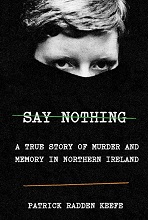 The eyes on the cover of this book are some of the most expressive I have seen although only half of the person’s face is exposed. As they stared back at me from the cover, I felt a chill because I knew they were the eyes of someone who did not fear death. I did not know who the person was but I found myself compelled to learn more. As I opened up the book and began to read, I soon learned the name of the woman on the cover whose story is one of several that are interwoven. Her name was Dolours Price (1951-2013) and this truly is a story of murder and memory.
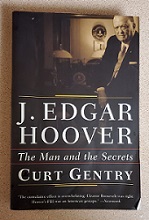 The mere mention of his name was enough to cause fear and apprehension. Politicans, film stars and celebrities of all sorts had learned that he knew all of their secrets. Exactly how many secrets he knew is still a mystery as his most sensitive files were destroyed when he died. But what is certain is that John Edgar Hoover (1895-1972) stands out as one of the most feared figures from his time as director of the Federal Bureau of Investigation (“FBI”). During his time in office, he witnessed six presidential administrations and three wars, the latter of which would continue after his death. His reign was supreme and no one deared to challenge it out of fear that they would wall fall victim to the wrath of one of America’s most powerful investigators. The public facade carefully crafted by Hoover, served him well in masking the many dark secrets he kept closely guarded. Curt Gentry peels back the layers in this look at the life of the legendary FBI director.
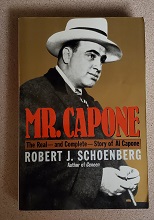 The City of Chicago has earned a reputation as being a tough metropolitan landscape in which winters are harsh, politics fierce and the streets are dangerous. In recent years, the rise in shootings on the south side of the city have made news headlines across America. The violence has been featured in documentaries and articles that are both eye-opening and horrific. No one yet knows if or when the violence will end but authorities in Chicago continue to grapple with gun violence that shows no signs of slowing down. The battles are reminiscent of another era in American history where blood flowed on Chicago’s streets as gangsters gunned each other down during the 1920s and 1930s. Of all the gangsters that called Chicago home, only one has retained a permanent place in American pop culture as the icon for organized crime. His name was Alphonse “Al” Capone (1899-1947) and this is the story of his life by author Robert J. Schoenberg.

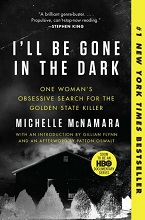 When I started reading this book, I was not sure if I should continue as I felt that the subject matter was darker than even I am used to. But something inside of me said to keep going and listen to what the author is saying. Less than ten minutes into the book, I realized that I would not be putting it down anytime soon. In fact, the book pulled me in so much that I finished it one day. I simply could not get enough of the story. Initially, the book came as a recommendation on Amazon. Like many others, I was aware of other killers in Californian history. The Zodiac? Check. Richard Ramirez? Check. Golden State Killer? I had no clue about this menace who terrorized southern California in the late 1970s and early 1980s. But as I read through the beginning of the book, I soon realized that author Michelle McNamara (1970-2016) was about to take me deep inside the story of the “Original Night Stalker”.
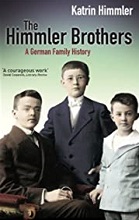 Learning one’s family history can be an enlightening and liberating experience. However, it can also reveal many truths that some wish to remain hidden. So what happens when you discover that your grandfather, the younger brother of a key architect in the “Final Solution” was not as innocent as you have been led to believe? Well, that is what happened to Katrin Himmler, whose grandfather Ernst Himmler (1905-1945), was the younger brother of Schutzstaffel Reichsführer Heinrich Himmler (1900-1945). Himmler’s father had asked her to search the Federal Archives in Berlin for information on his father Ernst and what she discovered was a trove of information not just on her grandfather, but on her uncles Heinrich and Gebhard Himmler (1898-1982). What started out as simple research request, evolved into the family history contained within the pages of this eye-opening account of the Himmler story.
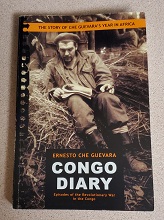 I have been taking advantage of the free time that I now have at my disposal and was reorganizing the book shelves when I came across this book which I had purchased quite some time ago. It is the translated diary of Dr. Ernesto “Che” Guevara (1928-1967), from the failed revoultion in the Democratic Republic of the Congo im 1965. The book was published in 2011 and through the joint efforts of the Che Guevara Studies Center and his widow Aleida March. In the years following the repatriation of Che’s remains to Cuba in 1997, there was a resurgance of interest in his work and this diary is just one of several regarding the revolutions in Cuba, the Congo and Bolivia where he met his untimely death.

You must be logged in to post a comment.