
 I have always wondered what happened to the family of former Lucchese family assoaciate Henry Hill (1943-2012) following their entry into the Witness Protection Program. Hill had been expelled from the program due to multiple arrests, including one in 1987 for narcotics trafficking. In the years that followed, he became somewhat of a celebrity, appearing on shows and giving interviews about his life in the mafia. His ex-wife Karen, has remained out of the public light, living her days peacefully under the cloak of anonymity. Their children Gregg and Gina have families of their own but do their best to also remain out the public light. Their father’s life was portrayed on screen by Martin Scorcese, whose film Goodfellas, is considered by some to the best film about the Italian-American Mafia ever made. Ray Liotta gave a great performance as Hill and what I found while watching the movie, is that for all his faults, Hill still comes in the film as a likable person. I had heard that the real Henry Hill was not as nice as portrayed on screen and the real story was far worse than what we see on film. Neither the film or Nicholas Pileggi’s book Wiseguy: Life in a Mafia Family, shed light on the relationship between Hill and his children so we are not given any hints as to what things were like at home. There is one scene in Goodfellas where Henry and Karen have a blowup fight and as Henry storms out, the camera zooms in on one of their daughters to capture her reaction. However, there is much that was not said. That is where this book by Gregg and Gina Hill comes into play. Written with Sean Flynn, the siblings tell their story of life with a mobster father and the realities of being in witness protection.
Hill’s arrest in 1980 by Nassau County narcotics officers officially marked the end of his life in the Lucchese family. As the reality of the charges settled in and the threat of murder by his former associates became strikingly clear, Hill made the decision to cooperate with federal prosecutors, forever changing the lives of his wife and children. We would expect to hear that the family was close knit and fully prepared for their new life together. But in fact, nothing could be further from the truth. I feel compelled to warn readers that this book does not have a typical happy ending. And what we learn about the Hill household both before and after Hill’s arrest in 1980 through the words of his children, is both eye-opening and mind-boggling. Karen Hill did not participate in the writing of this book but of course, she is in the story. And whether she will one day write her own memoir remains to be seen but if she has not done so by now, I doubt that she ever will.
Those of us familiar with other books by former mobsters and their family members know that the life is nowhere near as glamorous as movies portray. It is a dysfunctional and dangerous life that shatters lives. The Hill children ae frank about the off the wall experiences they had as the children of a man who was “always looking to score”. Hill’s addiction to drugs is portrayed accruately in the film but what his children describe here in the book puts things in a whole new light. And at some points I shuddered as I read Gina’s words about the parties held at their home. This part of the book was actually the most difficult to read and I felt an inner rage as what was a severe case of negligence. Their parents were caught up in the life and not even the words of their grandmother whom Gina calls “Gram”, were enough to get Hill to change. And Gregg’s description of their last day in New York before disappearing is truly hearbreaking. His his father had become increasingly bizarre and embarrassing and Hill’s inablity to live a normal life combined with his demons, created sharp divisions between parent and siblings. Gregg sums up his frustrations with his father in this simple yet pointed statement:
“What I really wanted was a father. Or maybe I wanted my mother to leave him, to stop visiting him in prison so we could move on with our lives. It was his mistake, his fuckup, that created all these problems, that made her work so hard, that made us rely on food stamps to eat, that got the electricity shut off because there wasn’t enough money to pay the bill. I didn’t know how to say that then, but I knew having a normal father would have been better than any present.” – Gregg Hill
The book picks up speed and intensity as they enter the Witness Protection Program under the care of the United States Government. They soon find themselves in a cycle of settling into a new place and then being uprooted unexpectedly. Omaha, Nebraska is the first stop, before moving on to Kentucky and eventually Redmond, Washington. But no matter where they went, Henry could not let go of his gangster past. Gregg and Gina have an endless supply of anecdotes about their father’s actions which put the family in danger on more than one occasion. In fact, Hill became so out of the control, that the the U.S. Government was forced to make a decision that Gregg only learned about years later while reading the Federal Bureau of Investigation’s (“FBI”) file on his father. The family’s life in Washington State simply spirals out of control as Henry embarks on a path of destruction that finally resulted Gregg and Gina making life changing decisions. Alcohol, drugs, gambling and infidelity surrounded enry and he was unwilling and maybe unable to face them once and for all. Throughout all Karen remained loyal and supportive but even she too reached her breaking point, divorcing Hill in the late 1980s. Following a very scary physical altercation with her father, Gina reflects on all that happens and remarks:
“I don’t know why I didn’t leave after that. I guess it was because I didn’t want to abandon my mom. I didn’t understand then the role she’d played in everything, how if it hadn’t been for her tolerating my father, always taking him back and believing his apologies, none of it ever would have happened. Maybe we never would have had to run from New York. Maybe we would have had a chance, a good chance, at the life I’d always wanted.” – Gina Hill
If you liked the film Goodfellas and want to know more about the family of Henry Hill, you cannot go wrong here. And although Uncle Jimmy (James Burke), Uncle Paulie, Tommy (Tommy DeSimone) and Stacks (Pernell “Stacks” Edwards) are mentioned in the book, it is only in a memory by one of the Hill children, Gregg more often than Gina. I am sure the book was painful to write and dredged up dark memories of life with an alcoholic and abusive father who could not leg go of “the life’. It is a sobering account of the real effects that a life of crime has on those we love.
ASIN: B001DAI79W
 Recently, I was browsing Netflix and saw that Martin Scorcese’s classic film
  On July 21, 1964, New Orleans police officers responded to a call about a mysterious fire in an apartment complex. When officers arrived and entered the apartment, they found the body of Dr. Mary Sherman (1913-1964), a noted orthopedic surgeon and cancer researcher. The details surrouning her grisly demise are hair raising, chilling and also mystifying. The murderer was never caught. Edward T. Haslem is a New Orleans native whose father was a close acquaintance of Sherman. In fact, his father was asked to identify her remains and the incident left him visibily shaken as Haslam captures the below passage:
 I decided to use the spare time at hand to reorganize my book case and other shelves upon which sit the other literature that I have come to love and appreciate. While perusing the books, I found this book by former New Orleans District Attorney James “Jim” Garrison (1921-1992) who is remembered for bringing the only public trial in the murder of President John F. Kennedy (1917-1963). In 1992, Warner Brothers released Oliver Stone’s
 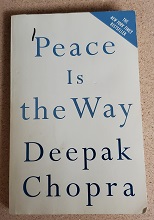 We hear the word peace often, typically while watching news broadcasts regarding ongoing conficts around the world. The search for peace remains the ultimate goal of mediators intent on resolving long standing feuds that have claimed lives and destroyed cities. Cease-fires and treaties are signed by which all parties agree to end hostilities. However, conflict resolution and geunine peace are two very different concepts. Many of us seek peace in our lives, away from those who have wronged us or others who remain a source of irritation. The American pacifist A.J. Muste (1885-1967) believe that there is no way to peace, but instead that peace is the way. That is the central theme of this book by Deepak Chopra, M.D., who along with brothe Sanjiv, wrote the beautiful memoir
  The unexpected increase in spare time that that I now have, has allowed me to catch up on books that I had planned to read over the next several weeks. Among them is this inspiring memoir by brothers Deepak and Sanjiv Chopra. I was familiar with Deepak, having seen him in interviews and on social media. Sanjiv was a bit more obscure but also just as accomplished as we learn in the book. But there is far more to the story than their known accomplishments. In fact, what I found is a story of the challenges a person faces when deciding to leave one home and make another in a place thousands of miles away. It is the story of immigration and two brothers finding the Amerian Dream, a concept which many today do not always believe in or in other cases, have come to misunderstand.
 One of the most important questions surrounding the assassination of President John F. Kennedy (1917-1963) has always been why was he murdered? We do have the official explanation that Lee Harvey Oswald (1939-1963), a former Marine and attempted defector to the Soviet Union, murdered Kennedy due to his own deranged thoughts which no one has been able to accurately explain. And although he was murdered before he could stand trial in a Texas courtroom, Oswald remains labeled as Kennedy’s assassin. But to understand the murder of any politician, it is necessary to examine the political and social climate in existance at the time. There are many clues to why Kennedy was murdered if we are willing to look. Douglas Horne served on the Assassination Records Review Board, the organization that was developed to examine the voluminous recorsds produced in response to the President John F. Kennedy Assassination Records Collection Act of 1992. The act was created as a result of Oliver Stone’s groundbreaking film
 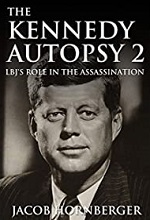 I recently reviewed Jacob Hornberger’s
  The unexpected increase in free time at my disposal has provided me with ample opporunity to increase the amount of reading material at my disposal. I decided to take another look at the murder of President John F. Kennedy (1917-1963), whose death remains one of most puzzling crimes in American history. The official narrative is that on November 22, 1963, lone gunman and former Marine Lee Harvey Oswald (1939-1963) fired three shots at Kennedy’s motorcade from the Texas School Book Depository, fatally wounding Kennedy and severly wounding Texas Governor John Connally (1917-1993). The case seemed open and shut with Oswald forever being labeled as the lone nut or lone gunman. On the surface, the case seems simple but there were many strange things that took place that day after Kennedy died that are not only mind boggling but also deeply disturbing. One of them is the handling of his body and the autopsy that was conducted at Bethesda Naval Hospital.
 Compton, California has earned a reputation over the last fifty years as a place where people are tough, life is dangerous and unless you are from there, you stay away. Gangs such as the Bloods and the Crips have proliferated across the city in the wake of the Civil Rights Movement and the dawn of the crack cocaine epidemic in the United States. In what could rightly be described as a civil war, thousands of black men, women and children have died on the streets of Comptom and in Los Angeles county as gang wars escalated. In 1888, the City of Comptom had formed its own police department to patrol city limits and at the time of the deadly gang wars erupted, it was pushed to its limit. Some officers would leave the department for much quieter neighborhoods with lower crime rates. Others would stay until it was disbanded in 2000. Among the two most well-known as respected officers were Tim Brennan and Robert Ladd. The duo have been interviewed numerous times in recent years, expressing their thoughts on Compton, the murder of Tupac Shakur (1971-1996) and his alleged killer Orlando Anderson (1974-1998). However, there is far more to their story than what we have come to learn on screen and here the two join with Lolita Files, whom some may recognize from the A & E multi-part series

You must be logged in to post a comment.