
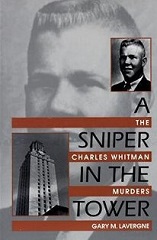
 On August 1, 1966, the citizens of Austin, Texas woke up to yet another brutally hot summer day. The heat was typical for the summer season but that day would be remembered for more than just the temperature. At 11:35 a.m., Charles Whitman (1941-1966), a former United States Marine and student at the University of Texas, ascended to the observation deck of the UT Tower and unleashed a deadly shooting assault on suspecting civilians below. In ninety-six minutes, Whitman murdered fourteen people and wounded at least thirty-one before he was shot and killed by responding law enforcement officers Houston McCloy and Ramiro Martinez who were joined by civilian Allen Crum. The shooting left the city shocked and ushered in a new concept in American history; the mass shooting spree.
Post-mortem, it was discovered that Whitman has a pecan sized tumor in his brain but whether it played in role in his actions of that day has not been conclusively determined. However there is strong evidence to believe that it did not as summarized concisely by Gary M. Lavergne (1955-) in this chilling account of Whitman’s life and his grisly crimes. The long standing question is why did Whitman do it? The truth shall never be known and went with Whitman to his grave. What we do know is that he carefully planned every step, in particular the murders of his mother Margaret and wife Katherine. Their deaths, combined with the rampage on the afternoon on August 1, left many who knew him in a state of bewilderment. The key to understanding a criminal is to study their past. Lavergne recounts Whitman’s life as we search to familiarize ourselves with Charles J. Whitman.
The book is thoroughly researched and reaches deep inside the dark side of Whitman’s mind. His childhood is explored and the system of chaos that ensued at home takes center stage as Whitman and his father become arch enemies. The elder Whitman could easily be the antagonist in the book but at no point does Lavergne attempt to cast blame on him for any of the actions of that day. He is spectator and so are we, to a father and son relationship driven by dysfunction and destined for destruction. And in a cruel twist of fate, the elder Whitman would outlive his wife and all three of his sons. Lavergne personally interviewed C.A. Whitman and even years after the tragedy he still came off as a most peculiar figure.
As we make our way to August 1 in the book, the suspense builds up and is enhanced by Whitman’s actions which are nothing sort of bizarre. Lavergne pulls no punches and all of the grisly details are relayed to the reader. And quite frankly, the remainder of the book is not for the faint at heart. The story approaches the verge of descending deeper into what could only be called hell on earth. With vivid detail and a play-by-play style of writing, Lavergne replays the events of that day in its entirety bringing the past alive. In fact, during the book, I found myself overcome with chills. Whitman’s ability to kill in cold blood and his deviously calculating mind have placed him high in the annals of American crime. However, his story would not be complete without the inclusion of the courageous officers who risked their own lives to put an end to the carnage. Lavergne has done a great service to former Austin Police Officers Houston McCoy (1940-2012) , Ramiro Martinez (1937-) and Billy Speed (1943-1966). None of them could have imagined that day would turn out as it did. And for Speed, he could not have imagined that it would be his last day on earth. In this book and the story of Whitman, their names live on.
In 1975, MGM Television aired The Deadly Tower starring Kurt Russell as Charles Whitman. Russell does a good job of portraying Whitman but regrettably, the producers of the film took several liberties that are in no way accurate to the real life story. Regardless, the film stands as the big screen adaptation of Whitman’s murder spree. Since that dreadful day in Austin more than fifty years ago, there have been other mass shootings in the United States that have cause nationwide grief and renewed the debate about the gun laws in America. The names of Columbine, Orlando and Sandy Hook have become embedded in the minds of Americans as reminders of the deadly consequences of mentally unstable and hateful individuals in the possession of weapons designed to kill. In the future, it is hoped that our response to such acts are swift and effective. The Austin police department found itself unable to accurate respond to a previously unknown threat on American soil. As we moved forward, it is imperative that history does not repeat itself. This is the story of Charles J. Whitman and one of America’s darkest days.
ISBN-10: 1574410296
ISBN-13: 978-1574410297

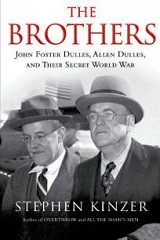 On July 26, 1947, President Harry S. Truman signs the National Security Act, establish a new intelligence agency to gather information deemed critical to the protection of the United States from foreign threats. The new agency is known as the Central Intelligence Agency and its initial members are former members of the Office of Strategic Services which had been discontinued following the allied Victory in World War II. As the Cold War heated up with the Soviet Union and new leaders came to light in several continents, the members of the new agency felt a surging sense to act preemptively to what was perceived to be direct threats to the safety and stability of the western hemisphere. Among the large number of those afraid of Communist infiltration and the end of U.S. business interest were two brothers who controlled an overwhelming majority of power over U.S. foreign policy whose names today are largely unknown to the younger generation. John Foster and Allen Welsh Dulles, the former Secretary of State and Director of the C.I.A., remain controversial and pivotal figures in 20th century American history. In this expose about their time in high posts within the U.S. government, author Stephen Kinzer reveals the dark side of the U.S. government as two brothers used the White House, military and Central Intelligence Agency to advance their financial agenda across several continents resulting in the overthrow of governments, assassination of foreign leaders and financial exploitation of smaller nations caught in the grip of U.S. occupation.
 On April 14, 1865, John Wilkes Booth changed the course of United History. The murder of Abraham Lincoln marked the first time a sitting U.S. President had been slain by an assassin. Tragically, Lincoln would not be the last to be assassinated. John F. Kennedy would meet his tragic fate on the streets of Dallas, Texas on November 22, 1963. Lincoln’s murder has become fodder for conspiracy theorist intent on proving that a web of deceit surrounded Lincoln paving the way for the tyrannical Booth to execute his plan. But just how much of a conspiracy was there? And did it involve members of the Confederacy? Was Edward Stanton complicit in pulling back Lincoln’s security detail? And was Mary Surratt rightfully convicted? Edward Steers, through painstaking research answers those questions and more in what is the definitive examination of the assassination of Abraham Lincoln.


You must be logged in to post a comment.