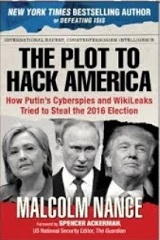
The Plot to Hack America: How Putin’s Cyberspies and WikiLeaks Tried to Steal the 2016 Election-Malcolm Nance

NanceThe 2016 presidential election remains an event that bordered on the surreal and shocked not just American citizens but people around the globe. Donald J. Trump, the political outsider and least likely candidate to win, secured the Republican nomination and the electoral votes needed to become the 45th President of the United States of America.  As we begin 2018 we can look back on his first year and office and reach various conclusions depending on our political outlook and beliefs about the state of the nation.   What is certain, is that from the start, his administration has been plagued with allegations of collusion with nefarious figures hailing from Russia.  Prior to his election, he often showed admiration for Vladimir Putin and since taking office, has taken a passive stance on the country that is believed by intelligence experts to have interfered in the elections of several nations.  Former FBI Director Robert Mueller has been appointed Special Counsel to investigate the Trump campaign’s ties to Russia and as of today, the investigation is still ongoing. And while there is no fire yet, there is a lot of smoke.
Malcolm Nance, a former U.S. Navy senior chief petty officer in Naval Cryptology with over thirty years in intelligence and counter-intelligence decided to put together a short book that puts the known pieces of the Russia hacking scandal together giving us a clear and concise picture of what did happen and when.   The book is not a smoking gun linking Trump directly to any Russian hackers and Nance does not imply such.    However, there is a lot of potentially incriminating evidence and we know today that at least four people of Trump’s inner circle have pleaded guilty to charges of lying to the Federal Bureau of Investigation and money laundering.  The recent news of the publication of Michael Wolff’s Fire and Fury in which he interviews former Chief Strategist Stephen Bannon has added more fuel to the fire and has mad the future grim for the 45th Commander-In-Chief.  But what exactly did happen prior to November 8, 2016?  And what did authorities know for certain? Further, Nance reveals a lot of interesting information, but how much more is there that is still unknown?

Nance takes us back to the beginning when officials realized that the servers of the Democratic National Convention had been hacked.  Unlike Watergate, there were no intruders with flashlights who would later stand trial and attempt to extort the White House.  This was all done through cyber warfare and the fallout would be staggering. Some may even say there is still more to come.  As an IT Administrator (IT), I have experienced cyber threats on several fronts and can say with certainty that if the average person knew just how many cyber threats there are in existence, they would be scared nearly to death.   To read the book, you do not need a background in Information Technology, Nance presents each topic in an easy to read format for the layman to follow.  If you do have experience in IT, then you will nod your head at many of the things that he discusses.  Regardless of your technical aptitude, what is revealed in this book should open the eyes of every American that cares about our electoral process.

Supporters of President Trump may be quick to dismiss the book as fake news or left-wing smear tactics.  However, Nance does not take any sides politically and makes no direct accusations against Trump. What he does declare is that without a doubt, Russian hackers interfered with the 2016 presidential election and there is strong evidence that the orders came from Putin himself.  At first it sounds like a very bold statement but Nance supports his conclusions with sound evidence that is thoroughly explained.  And throughout the book, he reminds us that more investigations are needed to see if there was in fact direct collusion and/or espionage between Trump’s team and Russia operatives.  According to Bannon, the answer is yes. But before we accept the proclamations of an individual that is as cunning as they come, it is imperative that a full investigation is conducted.  We may not like what we find and the truth is rarely pleasant.   No matter which party you belong to or how you voted in the election, what transpired prior to November 8, 2016, should be of grave concern to you for if it happened once, there is the fear that it could happen again.  Nance gives us a dire warning imploring us not to make the same mistake again and to proactively fight cyber attacks in the future.  But with a Commander-In-Chief who doesn’t believe in cyber attacks or seek to understand them, how safe will we be?

The title of the book sounds like it could be a television special or motion picture. But I assure you it is not fiction, this is a real as it gets.  The United States and its democratic institutions were attacked and the depth of the crime is something that many people still do not fully understand.   But with books such as this one by Nance, a clear picture emerges that can be used as a reference guide in understanding what really was the plot to hack America.

ISBN-10: 1510723323
ISBN-13: 978-1510723320

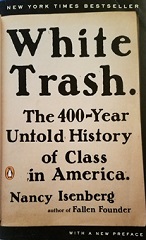
White Trash: The 400-Year Untold History of Class in America- Nancy Isenberg


white trashWhen I first saw the title of this book,  I felt my body slightly recoil. In fact, the book was recommended to me by my boss who is a White-American.  Previously, Amazon had placed the book on the list of recommended titles for my purchase but I had yet to take the plunge.  This time around, I gave in and decided to see what was contained in the pages of this book.  Having finished, I can say without a doubt that Nancy Isenberg has produced an eye-opening account of what truly is the untold 400- year history about class and race in America.  At first glance,  it may seem as if the book is a racist attack on people perceived to be of a lower social class.  But in fact, the opposite is true.  Isenberg brings light to the suffering and exploitation of a social class that is still disdained and mocked even today.  The 2016 Presidential election brought the subject back into the public light provoking fierce debates about the success of the Republican Party and the election of Donald J. Trump.  But the question truly remains, what does it mean to be called white trash?
History books typically portray the American Revolution as a movement bursting at the seams with a new-found patriotism as former colonies sought independence from Great Britain.   It is a graceful and inspiring story but the reality is that the truth is often uglier and stranger than fiction. The story at hand begins as America is in its infant stages and   Jamestown is established as the first settlement with immigrants formerly of England having made their way to North America.  But what is often forgotten or in some cases ignored, are the many levels of class distinctions that existed then and still exist now.  Slavery overshadows other dark parts of American history but as we see here, there was another class of people who were viewed just as poorly or in some cases, even worse than enslaved Africans.  These issues and several others pushed the United States to the breaking point resulting in the Civil War that split the country in half and gave rise to the South, the region that became home to Jim Crow legislation and some of the worst cases of racial violence ever witnesses by American citizens. Isenberg brings even more clarity to the issue taking us back in time to relive the past with figures such as Presidents Andrew Jackson, Thomas Jefferson,  Abraham Lincoln, Ulysses S. Grant and the infamous Andrew Johnson.  Other historical figures such as Davie Crockett, Elvis Presley, Dolly Parton and the Bakkers  (Jim and Tammy Faye) also make an appearance.

The book is presented in an easy flowing chronological format allowing us to follow the development of the United States and continued deplorable existence of the lowest class of White Americans.  As a Black-American, I am all too familiar with exploitation and discrimination.  It is part of the history of this nation and something that we still struggle to fully confront.   At times we have heard the term white trash, always used with a negative connotation.  But what we should seek to understand is how the term originated and why.   Further, it behooves us to understand how politicians, corporations and others with vested interests have manipulated, stoked fear and paranoia and ultimately exploited one of America’s most unwanted.  Eugenics, greed and pseudo-science became the tools of the trade as one class pulled out all the stops to eradicate another.

From start to finish I literally could not put the book down.  It pulls you and refuses to let go as the pages reveal a side of America you may be unfamiliar with.   Breaking the facade of all White Americans being well-off,  Isenberg brings the reality home that class is as important as race and is fully intertwined. This is a book I wish I had read in history classes in school.  For an unfiltered and brutally honest look at the social structure of the United States, this is a good place to start.  You will not only learn more about America but about yourself as well and what prejudice and exploitation really mean to those who employ it and those who suffer from it.

ISBN-10: 0143129678
ISBN-13: 978-0143129677

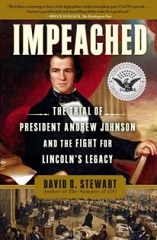
Impeached: The Trial of President Andrew Johnson and the Fight for Lincoln’s Legacy-David O. Stewart

ImpeachedThe American Civil War remains a key turning point in United States history.  The nation nearly tore itself apart as the Union and Confederacy engaged in deadly conflict over several issues including States’ rights, secession, and the system of slavery.  Prior to its conclusion, President Abraham Lincoln (1809-1865) met his tragic end on April 15, 1965, falling victim to assassin John Wilkes Booth at Ford’s Theater in Washington, D.C.  Andrew Johnson, then Vice-President and Democrat, succeeded Lincoln as the 17th President of the Unite States of America.  He would only serve in office through 1869 when Lincoln’s term would have ended, but in that short period, his administration would be the center of one of the most critical trials in United States history.

David O. Stewart takes a look back in this well-researched and well-presented investigative account of the trial of Andrew Johnson, who faced impeachment by the Radical Republicans led by U.S. House of Representative Thaddeus Stevens (1792-1868).  From start to finish the book is spellbinding and Stewart writes in a style that never bores the reader while presenting the material in an easy to read and streamlined format.  And as a result of his work, we now have one of the finest books on the attempted impeachment of a President who nearly pushed the nation into a second Civil War.

The book begins after Lincoln has passed and Johnson has become the next Commander-In-Chief.  And nearly instantly, the dark side of Johnson is put on full display as he commits the first of several acts that will turn the Radical Republicans against him and dictate the course of history for the deep south for decades to come.  It is not enough to say that Johnson was unfit for office.  Stewart realizes this and details the nefarious policies which Johnson advocated.   In time they would come to be viewed as the end of the legacy of Lincoln and an insult to those who truly believe that all men are created equal.   Further,  we come to learn about the personal side of Johnson or lack of it.  Generally viewed as cold and rarely in good spirits,  Johnson comes off as vindictive and in some cases delusional and out of his mind.  Actions such as circumventing Congress to deal directly with southern states, vetoing the Reconstruction Acts and Civil rights bill of Lyman Trumbull (1813-1896), are just several of many that earned Johnson the wrath of many Americans.  But his attempted removal of Secretary of War Edwin Stanton (1814-1869) was the straw that broke the camel’s back and resulted in the Radical Republicans commencing impeachment proceedings against the despised President.

The impeachment trial is one of the best parts of the book.   Johnson came extremely close to impeachment from office, saved only by one vote.   Stewart revisits the trial and the events leading up to the trial as each Senator mulls over which way he will vote in deciding Johnson’s fate.   For some of them, we see why they voted in the way that they did and for others, the question remains, did they really feel that way or were the allegations of bribery true?  It may seem shocking to some to even think that bribery occurred.  And while Stewart does not convict anyone with his words, he examines the evidence available reaching a quite startling conclusion.

Today it would be fair to say that the Civil War still haunts America.  In the south, it is sometimes referred to as the war of “Northern aggression”.  The tearing down of Confederate monuments and the tragedy in Charlottesville remind us of the struggle we continue to deal with in confronting the war that divided our nation.  Reconstruction can been seen as a missed opportunity in American history. Millions of freed slaves and White Americans had their lives changed permanently by the Emancipation Proclamation and the Confederacy’s defeat. Congress realizing the opportunity before it,  attempted to seize the opportunity but was confronted by a President deeply prejudiced and intent on maintaining the social structure of the south.   His efforts would eventually come to pass in the system of Jim Crow that took decades and a Civil Rights Movement to finally defeat.   We can only guess what would have happened if Johnson had not only complied but encouraged Congress to pass more legislation to move the nation forward after a brutal conflict and protected the lives of newly freed and disenfranchised Americans.

America now finds itself at a crossroad as we grapple with a political climate that borders on surreal at times.  But regardless of what happens, America will survive as it always has.   But while we continue to maintain the nation that we have, it is imperative that we do not forget the dark legacy of Andrew Johnson and remember why it is imperative to have a President that is able to unify us all and serve each and every citizen of the United States of America.  Stewart’s book is an excellent place to start in understanding the rise and fall of Andrew Johnson.

ISBN-10: 1416547509
ISBN-13: 978-1416547501

Watergate: The Corruption Of American Politics And The Fall Of Richard Nixon-Fred Emery

20180603_003341The resignation of Richard M. Nixon (1913-1994) as President of the United States on August 9, 1974,  remains one of America’s darkest political moments.  The revelation of the break-ins at the Democratic National Committee office in the Watergate complex and the subsequent attempted cover up, riveted American citizens and resulted in the downfall of a political icon.   Through the years, myths and disinformation about the Watergate scandal have been propagated causing an aura of mystique over a crime of monumental proportions.  I picked up this investigative account by Fred Emery to learn what really happened on June 17, 1972 and the process behind the scenes that led to Nixon’s resignation.  And what I found is a book that dives deep into the Watergate scandal to show the reader what really happened from start to finish.

The story about Watergate, as we learn in the book, begins far in advance of the actual break-in and was rooted in retribution, paranoia, arrogance and greed.  It shook the foundation of American politics and caused many to question their own Commander-in-Chief.  Throughout the book, we are introduced to a steady stream of characters whose names became permanently etched in history due to their involvement in the Watergate affair.  Many of them will be familiar to most readers but others forgotten over time.  In the story at hand, they are resurrected with their deeds and mis-deeds on full display.  The plot, crime and cover-up formed a complex nexus of covert activity that fit together like a jigsaw puzzle.  Emery does a masterful job of putting the pieces together in a narrative that is easy to follow but deeply engaging.  And throughout the book,  there were times where I could not believe what I was reading.

It is well-known that Nixon recorded nearly all of his conversations in the oval office. The very tapes which he created would later be used to force his resignation and result in the indictments and convictions of several co-conspirators, several of whom will be known to those familiar with the secrets of the CIA and the administration of John F. Kennedy, who by this time had been deceased for nine years.  Nixon’s obsession with Kennedy is deeply disturbing and raises more questions than answers.  And as to why Nixon would record himself discussing the cover up of a crime is a secret he took with him to his grave. The tapes become the crux of the book as the battle between the White House and John Sirica evolves into clash of the titans. Incredibly, for all of the hours that are on the tapes that were released, there are thousands of minutes that have been hidden from the public.   And perhaps it will never be known what they contain.

As the walls around Nixon began to collapse, attention shifted to John Dean (1938- ), who served as Nixon’s White House Counsel.  He plays a prominent role in the story and the unavoidable fallout was largely the result of his decisions to cooperated with investigators.  But as we see in the book, Dean was not the only person who realized what was at stake and decided to change their tune. Inadvertent comments, disgruntled operatives and eagle-eyed investigators combined to slowly peel the lid of the scandal turning Nixon’s fears into nightmares.  And while Dean was in fact, largely responsible for the downfall of Nixon, there are many parts of the story that are either forgotten or ignored. In fact, the importance of Alexander Butterfield (1926-) cannot be overstated.  He and Dean were just two members of a group of individuals who would eventually provide investigators with the facts that they needed to open Pandora’s box. And what they found changed the course of American political history.   Nixon was eventually pardoned by his successor Gerald Ford, on September 8, 1974 but the damage had been done and he would live with the cloud of Watergate over his head until his death.   His action and decisions remain somewhat mystifying and there are still many unanswered questions that will probably never be answered.   And among all of them, the one that continues to stand out is what did the President know and when did he know it?

For anyone wishing to learn about the Watergate scandal and the sad ending of a President’s time in office, this is a great place to start. Highly recommended.

ISBN-10: 0684813238
ISBN-13: 978-0684813233

The Strength Of The Wolf: The Secret History Of America’s War On Drugs-Douglas Valentine

wolfCurrently, in the Midwestern United States, Opioid addiction is causing the deaths of hundreds of men and women. Their deaths and the rise of Heroin use is a direct affront to the long-standing war on drugs. Former First Lady Nancy Reagan is fondly remembered for her eternal slogan “just say no”. Narcotics are still largely illegal but more states have begun to decriminalize the recreational use of marijuana which has allowed entrepreneurs to invest their savings into a new and profitable industry. The story of America’s war on drugs is long and often misunderstood. Allegations , rumors and explosive revelations have all contributed to cast the dark cloud over the battle against narcotics. Douglas Valentine decided to explore the history of the war on drugs and in this eye-opening book, he tells the story of the history of America’s battle against drugs and the rise and fall of the legendary and infamous Federal Bureau of Narcotics (FBN).

Students of history will be familiar with the story of Charles “Lucky” Luciano (1897-1962) and his participation with the U.S. Government to defeat the Axis powers during World War II. The story on the surface sounds simple enough, but as Valentine shows us, Luciano was only a small part of the puzzle and there was more to his role than meets the eye. Further, the relationship between Washington and the Italian American mafia would take on monstrous proportions an in the process taint the FBN’s reputation. The bureau was under the guidance of the later Harry Anslinger (1892-1975) and rivaled the Federal Bureau of Investigation, led by John Edgar Hoover (1895-1972). Anslinger made a name for himself as a director whose agents made cases that resulted in convictions but whose personal racial prejudices and desire for recognition caused him to make decisions that would have far-reaching effects for years to come. Valentine did an impeccable task of researching the topic and the revelations contained in the book are nothing short of jaw-dropping. And the interviews with former agents of the FBN are shocking to say the least but provide valuable insight into what made the FBN a success and what ultimately led to its failure.

Anslinger plays a prominent role in the book but the story heats up and takes on a life of its own as the Central Intelligence Agency (CIA) makes its appearance. Organized in 1947 through the National Security Act signed into law by President Harry Truman, the Agency, as its known, grew into an uncontrollable secret apparatus of the Unites Government that engaged in espionage, assassinations and as we learn in this book, narcotics trafficking. Rumors of the Agency’s involvement in the rise of drugs of America have held in place for decades. In fact, the allegations proved to be true and the story was broken by late journalist Gary Webb (1955-2004). But what many people did not know then and perhaps now, is that the story was far deeper and much uglier that most would be willing to accept. The FBI also plays a large role in the story of the FBN and Valentine brings the three together exposing the complicated and tension filled relationship between the three organizations.

Before beginning this book, it is necessary for the reader to accept that many unpleasant truths will be revealed. A complicated web of deceit and complicity was constructed that allowed thousands of people to profit off the misery of millions. But more frightening is are ways in which narcotics were able to enter the country with the help of those in high places and the impossibility we now face of their removal. The story is filled with legendary names such as Meyer Lansky (1902-1983), Vito Genovese (1897-1968), Tibor Rosenbaum, James Angleton (1917-1987), Richard Helms (1913-2002) and Chiang Kai-Shek (1887-1975), among others. But what is paramount is that Valentine has put together an extraordinary jigsaw puzzle that allows the reader to see the dark side of governments and the reality of war as highlighted in the conflict in Vietnam. The revelations about the CIA’s role in the war alone are enough to earn the wrath of veterans still with us today. Valentine spares nothing and gives us the facts, as ugly as they are. The beauty of the book however, is the author’s genius is connecting the characters and providing a mental map of the endless connections between law enforcement, politicians, mobsters, intelligence officers and rebels of all sorts. The information is staggering and at times during the book, I literally could not believe what I was reading. And I do not believe Valentine did either as he was writing this book. I forewarn readers that as an American citizen, this book may cause grief and outrage at the actions of the United States Government domestically and abroad. It is not an easy pill to swallow but the truth is rarely enjoyable.

The FBN earned a legacy as the most successful drug enforcement agency in American history, but paranoia of corruption and an internal investigation by Andy Tartaglino, devastated the bureau and changed the course of history forever. The story of the demise of the bureau is told here in the book from start to finish and it is sure to leave readers shaking their heads. Today the Drug Enforcement Agency (DEA) is the premier federal organization responsible for investigating narcotics trafficking. Time will tell if the bureau will reach the heights of the famed FBN but as we can see very well, drugs are here to stay. As we look back through Valentine’s work, we can only hope that history does not repeat itself. This book is the place to start in understanding the true nature of the business of narcotics and how it propagated throughout our world.

ISBN-10: 1844675645
ISBN-13: 978-1844675647

Dorothy, “An Amoral and Dangerous Woman”: The Murder of E. Howard Hunt’s Wife – Watergate’s Darkest Secret

25246114On January 23, 2007, E. Howard Hunt died in Miami, Florida at the age of 88.  Hunt is best remembered for his conviction as a result of his role in the Watergate scandal that helped end the presidency of Richard M. Nixon.  Hunt was also a prime suspect in the murder of John F. Kennedy. His son St. John, spoke with his father prior to his death and their discussion is referred to as his deathbed confession about what he knew about the events in Dallas, Texas.  In the years following his death, truths about his role in the Central Intelligence Agency and the events in Dallas disproving his claim to be just a ‘bench warmer” in the crime.   Next to Hunt throughout the Watergate crisis was his first wife Dorothy who perished when United Flight 553 crashed on December 8, 1972 as it approached Chicago Midway Airport to make its landing.   The NTSB attributed the crash to pilot error but researchers have long suspected sabotage in the crash and have alluded to a long number of disturbing facts surrounding the crash.  On the surface, it seems to be just a tragic accident that killed a housewife en route to visit acquaintances.  But upon deeper examination of the crash and her life as revealed by her son in this book, the real story of the life of Dorothy Hunt is nearly as intriguing as that of her husband.
St. John Hunt has made himself known in JFK assassination circles.   His prior book. Bond of Secrecy: My Life with CIA Spy and Watergate Conspirator E. Howard Hunt, looks into the life of his father and the effects of his profession on their family.  Here, the focus is on his mother and her untimely demise.   No stranger to the world of covert operations, Dorothy also has a past with intelligence work, having been station in Europe on more than one occasion.  Her marriage to the blossoming operative Hunt, was a bond between two intelligence assets deeply involved the back channels of Washington and tied to a president facing a dark fate.

The early parts of their lives reads like a great novel; two young adults, meet, fall in love, start a family and move from one country to the next as their father is reassigned from one post to another.  Enter Watergate and the scandal that turned their lives upside down.  It is at this point in the book that the rug is pulled right out from under our feet and the dark side of Richard Nixon and Washington politics is revealed.  Those old enough to remember Watergate will not be surprised in what is contained in this book. In fact, the book is not a complete source on the investigation as St. John himself points out.  This is purely what he saw his parents go through as his father faced criminal prosecution and the impact his mother’s dad had on his life and those of his siblings. What is evidently clear from taped conversations at the Nixon White House and St. John’s account, is that his father’s legal defense was being paid for by Nixon and the money was also intended to keep Hunt quiet.  Following her death, Hunt ended up being convicted and served thirty-three months in prison for his role in the Watergate scandal.

The lives of St. John and his siblings would never be the same again.  Fallout from Watergate and the loss of their mother caused splits between siblings as each struggled to put their lives back together and come to terms with what they had been through.  I do not believe they will ever get over what happened but have learned to cope with it on a daily basis.  It is clear that  St. John, the first son of the family had a special bond with his mother.  The heartache and grief he experienced is evident in the pages of this book. And through his words, her memory continues to live on.

At the conclusion of the book, there is a section on the crash itself and the investigation by Sherman Skolnick (1930-2006), a noted conspiracy theorist and activist who challenged the NTSB’s position of pilot error.  This part of the book is an added bonus and reveals a ton of incredible and troubling information about the crash.  And what was once believed to be an open and shut case is revealed to be far more complicated and sinister.  While it is not inconclusively proven that Dorothy Hunt died as a result of homicide, there are dozens of deeply disturbing facts about the incident that should have raised the eyebrows of anyone investigating the crime. And next to 9/11, it is the only case I can think of where the FBI preempted an investigation by the NTSB, removing key evidence from the scene while preventing emergency personnel from completing their assigned tasks.  The complete story of what really happened that day may never be known but what we do know is that many strange things were occurring that had nothing to do with pilot error.

JFK Assassination researchers may be looking for a smoking gun but it will not be found here. In fact, not much about Dallas is discussed.   In St. John’s defense, that was not the purpose of the book.  His intention was to bring his mother’s story to light which he succeeds in doing.  And although he did get some factual information wrong,  the story is still a good read about a family caught up in one of the greatest crimes in American political history.

ISBN-10: 1634240375
ISBN-13: 978-1634240376

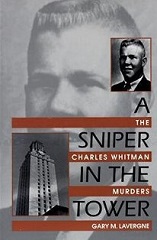
A Sniper In The Tower: The Charles Whitman Murders-Gary M. Lavergne

whitmanOn August 1, 1966, the citizens of Austin, Texas woke up to yet another brutally hot summer day.   The heat was typical for the summer season but that day would be remembered for more than just the temperature.  At 11:35 a.m., Charles Whitman (1941-1966), a former United States Marine and student at the University of Texas, ascended to the observation deck of the UT Tower and unleashed a deadly shooting assault on suspecting civilians below.  In ninety-six minutes, Whitman murdered fourteen people and wounded at least thirty-one before he was shot and killed by responding law enforcement officers Houston McCloy and Ramiro Martinez who were joined by civilian Allen Crum. The shooting left the city shocked and ushered in a new concept in American history; the mass shooting spree.
Post-mortem, it was discovered that Whitman has a pecan sized tumor in his brain but whether it played in role in his actions of that day has not been conclusively determined. However there is strong evidence to believe that it did not as summarized concisely by Gary M. Lavergne (1955-) in this chilling account of Whitman’s life and his grisly crimes.  The long standing question is why did Whitman do it? The truth shall never be known and went with Whitman to his grave. What we do know is that he carefully planned every step, in particular the murders of his mother Margaret and wife Katherine.  Their deaths, combined with the rampage on the afternoon on August 1, left many who knew him in a state of bewilderment.  The key to understanding a criminal is to study their past.  Lavergne recounts Whitman’s life as we search to familiarize ourselves with Charles J. Whitman.

The book is thoroughly researched and reaches deep inside the dark side of Whitman’s mind.  His childhood is explored and the system of chaos that ensued at home takes center stage as Whitman and his father become arch enemies. The elder Whitman could easily be the antagonist in the book but at no point does Lavergne attempt to cast blame on him for any of the actions of that day.  He is spectator and so are we, to a father and son relationship driven by dysfunction and destined for destruction. And in a cruel twist of fate, the elder Whitman would outlive his wife and all three of his sons.  Lavergne personally interviewed C.A. Whitman and even years after the tragedy he still came off as a most peculiar figure.

As we make our way to August 1 in the book,  the suspense builds up and is enhanced by Whitman’s actions which are nothing sort of bizarre.  Lavergne pulls no punches and all of the grisly details are relayed to the reader.  And quite frankly, the remainder of the book is not for the faint at heart.  The story approaches the verge of descending deeper into what could only be called hell on earth.  With vivid detail and a play-by-play style of writing, Lavergne replays the events of that day in its entirety bringing the past alive.  In fact, during the book, I found myself overcome with chills. Whitman’s ability to kill in cold blood and his deviously calculating mind have placed him high in the annals of American crime.  However, his story would not be complete without the inclusion of the courageous officers who risked their own lives to put an end to the carnage.  Lavergne has done a great service to former Austin Police Officers Houston McCoy (1940-2012) , Ramiro Martinez (1937-) and Billy Speed (1943-1966).  None of them could have imagined that day would turn out as it did. And for Speed, he could not have imagined that it would be his last day on earth.  In this book and the story of Whitman, their names live on.

In 1975, MGM Television aired The Deadly Tower starring Kurt Russell as  Charles Whitman.  Russell does a good job of portraying Whitman but regrettably, the producers of the film took several liberties that are in no way accurate to the real life story. Regardless, the film stands as the big screen adaptation of Whitman’s murder spree.   Since that dreadful day in Austin more than fifty years ago, there have been other mass shootings in the United States that have cause nationwide grief and renewed the debate about the gun laws in America.  The names of Columbine, Orlando and Sandy Hook have become embedded in the minds of Americans as reminders of the deadly consequences of mentally unstable and hateful individuals in the possession of weapons designed to kill.  In the future, it is hoped that our response to such acts are swift and effective.  The Austin police department found itself unable to accurate respond to a previously unknown threat on American soil. As we moved forward, it is imperative that history does not repeat itself.  This is the story of Charles J. Whitman and one of America’s darkest days.

ISBN-10: 1574410296
ISBN-13: 978-1574410297

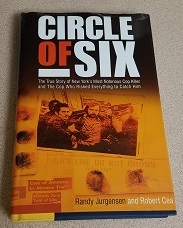
Circle of Six: The True Story of New York’s Most Notorious Cop Killer and the Cop Who Risked Everything to Catch Him-Randy Jurgensen

six

April 14, 1972-The New York City Police Department’s 28th Precinct receives a ten-thirteen, the code for an officer in distress.  Units are dispatched and responding officers enter the location given by the caller,  West 116th Street and Malcolm X. Blvd. The building is the Nation of Islam’s Muslim Mosque No. 7, then under the control of Minister Louis Farrakhan.  The officers are locked inside, beaten severely and Officer Philip Cardillo is mortally wounded in the sternum and later dies from his wounds.  The responding officers are ordered out of the mosque by superiors and members of the Nation of Islam begin to clean the building, contaminating crucial evidence and rendering future investigations nearly impossible.  Cardillo’s killer remained hidden for several years and it seemed as if his identity would never  be known. However one New York City Police Detective refused to give up and risked his entire career to see the killer brought to justice. This is the story of Det. Randy Jurgensen (Ret.) and his never-ending efforts to catch the murderer of Philip Cardillo.

Jurgensen was one of the many officers that responded to the scene and gives us a play-by-play description of the events as they transpired.  He was critically wounded himself that day and the encounter between the police and the NOI nearly resulted in  a complete riot. Upon his recovery he is tasked with investigating Cardillo’s murder, but as we see in the book, it was nearly an impossible feat as he faced obstruction on all fronts and incredibly, within the NYPD.  Political aspirations and social concerns resulted in NYPD brass instituting strict controls over the ensuing investigation and a potential mutiny by patrol officers with the backing of the PBA, threatened to bring New York City to a complete halt. The submission of power by the NYPD and public officials to the NOI under Farrakhan’s control served to demoralized the detectives pursuing Cardillo’s killer and the officers that stood near his side on that tragic day in April, 1972.

Jurgensen purposely changed the name of some of the individuals in the book for obvious reasons. But their actions and the wall of stone he encounters throughout the book will cause the reader to question the value placed upon those who put their lives on the line every day in service to the City of New York.  A brush with death is sometimes hidden behind the next corner and every call has the potential to be the last. But nonetheless, the men and women of the NYPD continue to do their   Jurgensen refuses to give up and his efforts pay off in the apprehension of Cardillo’s killer.  The arrest and subsequent trial are bittersweet moments highlighting the precarious nature of a jury in trial with strong racial overtones. We are forced to examine ourselves and our beliefs towards law enforcement and the concept of right and wrong.   The end result may not be what the reader will expect but shining moment in the book is the truth surrounding Cardillo’s murder being revealed at last.  It is a moment that will cause pride to surface in the heart of every New York City Police Officer.  Today the City hardly resembles its 1972 version.  The Nation of Islam is still prevalent but the  Muslim Mosque No. 7 has since relocated.  Minister Louis Farrakhan continues to remain the in the public light although he has advanced into his senior years. Randy Jurgensen  entered Hollywood following his retirement and worked as a technical consultant on ‘The French Connection’, ‘The Cruiser’ and ‘Donnie Brasco’.   He continues to honor Cardillo’s memory and has pushed for the renaming of a street in the late officer’s name.   Jurgensen will  even make a return to Hollywood as this book is set to be adapted by the silver screen.  Cardillo will never been forgotten and for Jurgensen, Farrakhan and the others present on April 14, 1972, the events of that day will remain firmly implanted in their memories until their last day.  This is an invaluable part of New York City history as told through the incredible story of the circle of six.

ISBN-10: 1932857850
ISBN-13: 978-1932857856

Lies My Teacher Told Me: Everything Your American History Textbook Got Wrong-James W. Loewen

lies-my-teacher-told-me-web

“There is nothing new in the world except the history you do not know ” – President Harry S. Truman

In comparison to many countries around the world, America is still a young nation.  Our history dates back several centuries which is far shorter than the thousands of years of history claimed by countries such as Greece and China. However, in the short time the United States has been in existence,  the world has witnessed its development and transformation into a world superpower. The image that is projected is of the land of the free and the home of the brave.  The battle for independence against Great Britain and the Declaration of Independence are considered to be hallmark moments that defined the future course of the United States.  But if we take time to examine our history here, we will find that much of what we have learned is not only wrong but has also caused many of us to live in ignorance, unaware of how our country became what it is today.

In two days, Columbus Day is upon us yet again.  In New York City, the Columbus Day Parade will march down 5th Avenue.  On October 4, the city of Denver, Colorado did something no other state has ever done before when the city council voted 12-0 to remove Columbus Day as an official holiday. The city has renamed the day Indigenous People’s Day.  Denver joins several other cities that have taken similar measures to pay homage to the plight of America’s Native American ancestors.  As a kid, I was taught that Christopher Columbus “discovered” America and without him, America would not exist.  I continued to believe that as I  grew up until several years ago when I came across an article that revealed the truth surrounding the arrival of Columbus, his brother Diego and their entourage in the Caribbean.  As the truth became clearer and the veil of deceit was lifted, I was forced to think not only about the myth of Columbus but about hundreds of other things I learned in history classes throughout the years.  My brother, aware of my love of history, picked up this book for me by James W. Loewen.  The cover alone is enough to provoke interest and suspicion but what’s inside the book is truly invaluable.

The idea that a teacher has lied about a historical event sounds preposterous to some. But as I made my way through this book, I began to see that the failure of teachers to teach the truth about America’s past is a small part of a larger problem, a system wide defect that has plagued classrooms for decades.  The poor vetting of information contained within history books and the desire to show our history in the best light possible has resulted in generation after generation being misinformed.  In fact, there are times at which our knowledge of our own history is so inferior that foreigners have a deeper wealth of knowledge as to how America was founded.  Our patriotism and sensitivity to criticism has caused many of us to automatically reject any notion that what we have been taught in school could possibly be completely wrong.  But if we are to learn the truth, then the first step is admit that we have been wrong. And with this book, James W. Loewen leads the way.

I cannot imagine that a book of this nature was easy to write for a number of reasons.  But I have always felt that true patriots love their country but never excuse its wrongdoings. Just as we take to task our siblings and friends for their transgressions, we bear the responsibility to ourselves and our fellow citizens to acknowledge  that our past has not always been glamorous and has a very dark side.  The demographics of America continue to change and we truly are a nation of immigrants.  However  class division, racial discrimination, genocide and domineering foreign policy became staples of the foundation of the United States.  Acknowledging this does not make any of us less patriotic but it helps us to understand how are we have come and how far we still have to go.  All Americans should read this book and I belive it would be highly beneficial to make this book mandatory reading in all schools.  And even for those who are not American, it might confirm what you already knew or enlighten you to other things you do not yet know

ISBN-10: 0743296281
ISBN-13: 978-0743296281

America’s Deadliest Export-Democracy: The Truth About US Foreign Policy and Everything Else-William Blum

hqdefault

The recent terror attack in Manhattan’s Chelsea neighborhood highlighted the concern many Americans have about fellow citizens of the Islamic faith that have originated in or spent considerable time in the Middle East.   The oft-asked question is usually “why do they hate us?”. Iraq, Afghanistan and Syria, are only a few out of many nations in which the United States has involved itself in the nation’s politics.  To many Americans, the dislike and/or intense hatred of America displayed from the region boggles the mind and is utterly incomprehensible. But if we take a closer look at things from another point of view, we come to see there is more than meets the eye as author William Blum points out in this book that is guaranteed to make you question everything you thought you knew about American foreign policy.

From the start, this book will be hard for many Americans to accept.   Blum pulls no punches but instead goes full steam ahead, methodically showing how U.S. foreign policy has destabilized nations resulting in the removal of dozens of foreign leaders and political turmoil which continues to haunt many of those nations to this day.  David Talbot, author of ‘The Devil’s Chessboard‘, revealed the dark rise of the CIA and its actions which influenced American foreign policy following World War II.  Similar to Talbot, Blum brings to light many dark secrets that the average American would rather not know.  Almost all of us born in America were raised to believe that the United States is the leader when it comes to democracy, justice, liberty and freedom for all.  Throughout the years, we have enforced our system of government around the world, or as Blum puts it, exporting democracy.  But a critical question arises.  In the nations to which  we exported democracy, was it needed or asked for?  As Blum shows us, U.S. foreign policy dictated that it was. But in many countries nations, it wasn’t needed  and as a result, millions of people around the world have suffered at the hands of U.S. foreign policy.  Air raids, propaganda and economic penalties are just some of the methods used against those nations which do not comply with the agenda of the U.S.  From Mossadegh in Iran in 1954 to the current war on terror, many important facts have been hidden from the American public, allowing us to believe that all actions carried out in the name of freedom have been in the best interests of the people of the United States.  On a regular basis, the media shows us a purported new “threat” from a number of foreign nations.  But as Blum asks us, “who is really going to attack the US?”.

Some will read this book and believe that Blum is unpatriotic, cynical and even treasonous. But I believe that thoughts of that nature are severely misguided.  Contrary to what many may think, it is possible to be patriotic but still question and even expose the wrongdoings by our own government.  And as Jesse “The Body’ Ventura recently said in a video regarding Colin Kaepernick, the government has to earn patriotism.  In the eyes of many around the world, we are seen as the big brother that exerts his influence wherever he goes. But our most tragic mistake is to believe that everyone desires to live as we do.   No government is perfect and every country has its regrettable moments.  But is the duty of every American to acknowledge when our country is wrong and/or misguided and see things from the eyes of those who we persecute either intentionally or inadvertently.  I’ve always felt that people who are the most critical of this nation are also some of the most patriotic.  It is their belief in the good of the nation that forces them to confront its shortcomings.  People such as William Blum are doing their part to show other Americans what has been occurring right under our noses.  You don’t have to agree with everything he says, but if you open your mind and digest what he’s written, you may find that you have a new understanding of the pitfalls of a misguided foreign policy and why it brings shame on the United States of America.

ISBN-10: 1783601671
ISBN-13: 978-1783601677