
Category: American History
Empire of the Summer Moon: Quanah Parker and the Rise and Fall of the Comanches, the Most Powerful Indian Tribe in American History – S.C. Gwynne
 If you have had the chance to view a map of North American Indian tribes prior to the formation of the United States, you may have been just as surprised as I was to see how many were in existence. The story of North America’s early inhabitants known simply as Native Americans, is deeply complex and ultimately tragic. In 2016, 20th Century Fox released Alejandro González Iñárritu’s The Revenant in which Leonardo DiCaprio assumed the role of real-life fur trapper and trader Hugh Glass (1783-1833). The film is hauntingly beautiful with a musical score that adds the right touch of emotion and suspense. Parts of the story are fictionalized but it is largely based on true events. The movie accurately portrayed life in North America in the early 1800s as the United States was continuing to expand well into Native American territories. The violence on screen is shocking but also an accurate depiction of the savageness in the battles that did occur. What is not shown in the film are the wars that had been taking place between tribes. The absence of widespread hegemony between tribes meant that territory was of the utmost importance and the threat of attack from enemies was constant. Some tribes were known to be more dangerous than others and none were as deadly and feared as the Comanches. Their large numbers and presence across large portions of land in the western half of North America made them a threat to anyone who ventured into parts unknown. In this spellbinding book, author S.C. Gwynne tells the incredible story of the Comanche Indians’ rise and fall, and the life story of their last big chief, Quanah Parker (1845-1911).
Before I proceed, I must warn readers that the book is not for the faint at heart. It is an unfiltered look into North America’s violent past and shatters any illusions about white settlers being welcomed with open arms by natives eager to accept the white man’s way of life. In fact, it was quite the opposite. The Comanches had no intention of living the “white way” and were content with their lives. And anyone who threatened that way of life or intruded upon it was fair game. The Comanches commenced raids upon white settlements and against other tribes, pillaging, and plundering. Readers sensitive to descriptions of violence will find some parts of the story difficult to accept. In 1836, the Parker family found themselves victims of the Comanches and during a raid, a nine-year-old girl named Cynthia Ann Parker (1827-1871) was kidnapped with her brother John Richard Parker (1830-1915) and integrated into the Comanche tribe. And as Gwynne explains, this act ignited a four-decade war between whites and the Comanches. And during those forty years, there was bloodshed, heartbreak and a Civil War that changed American history. The Comanches could not have known at the time that the young girl would have more of an impact on the future of their tribe than anyone knew. Gwynne drives home the point with this explanation:
“The kidnapping of a blue-eyed, nine-year-old Cynthia Ann in 1836 marked the start of the white man’s forty-year war with the Comanches, in which Quanah would play a leading role. In one sense, the Parkers are the beginning and end of the Comanches in U.S. history.”
As a primer to the main story, Gwynne provides thorough explanations regarding other tribes important to the story and the involvement of Mexico. The image of life that comes into focus is of one that was short and brutally hard. The introduction of diseases to native tribes decimated populations. Today, smallpox and cholera are well understood and prevented but in the early 1800s they were deadly killers. And those unfamiliar to these viruses almost always faced a certain death. As I read the book, I found myself speechless at times due to the descriptions of daily life. From one day to the next, nothing was guaranteed and the threat of violence from other tribes and bandits was always on the mind of many. And it is imperative to recall that at the time Parker was taken in May 1836, there were only twenty-four states in the Union. Territory west and north was unorganized and further south, the land was part of Mexico. Comanches fiercely roamed these territories and even made raids into what is now the State of Texas. And it is here that the story heats up as the Parker family is torn apart during the Fort Parker Massacre. Some readers might wonder if Washington should have expected such an attack. The truth is that there was much Washington did not know and Texas had been placed in a precarious position as Gwynne explains in this passage:
“Texas was thus left alone, broke and militarily punchless, for ten years to confront two implacable enemies: Mexico on the south, and the Comanche nation on the west and north. The fledgling country would never know peace. Mexican incursions persisted; the city of San Antonio was captured twice by large Mexican armies in 1842.”
The harsh reality is that Washington had no clear answer for the Indians and things in Texas were about to take a deadlier turn. The tragedy of the Parkers deeply concerned Texans and Washington but they were not the only settlers that suffered. Gwynne includes accounts of other settlers who met dark fates as they ventured into unknown territory. Raiding, pillaging, rape and scalping were the tools of the trade and the Comanches did not hesitate to use them. Because of the horrific acts of sexual violence, parents might want to use discretion should they decide to purchase this book for minors. What I learned about the Comanche raids on the settles and other tribes, is interesting for it shows the acrimony that existed between the natives, and it also explains why the U.S. Government had no choice but to find a way to turn the tide in the conflict with the Indians.
Following the massacre, the book is essentially two stories in one. The mission to find Cynthia and John Parker comes into focus but finding them would not be easy. And it is not until the entry of former Texas Governor Lawrence Sullivan “Sul” Ross (1838-1898) into the story that major success occurs. Finding the Parkers was a priority but dealing with the Comanches and other Indians became priority number one. In the process, thousands of men died at the hands of the Comanches. Troops and even the Texas Rangers had never faced a similar enemy and were at times lost in their approach. To drive home the point about the power behind the Comanches, Gwynne sums up their dominance and states that:
” Comanches fought entirely on horseback and in a way no soldier or citizen in North America had ever seen.”
Battles between whites and the natives increase in frequency and some notable figures appear whose names are cemented in American history such as Christopher Houston “Kit” Carson (1809-1868), Samuel Colt (1914-1862) and John Coffee Hays (1817-1883). Carson and Hays learned first-hand that the United States was not prepared to do battle with the Indias. Their opponents possessed skills and knowledge of the terrain that white settlers had not yet obtained. However, Colt invents an equalizer in the form of a weapon that became synonymous with the wild west. And as technology improves, the natives soon find themselves struggling for survival. Further, the United States later employed a powerful asset named Ranald S. McKenzie (1840-1889) who has largely faded into history. His story and later acquaintance with Quanah Parker are discussed here and provide an interesting back drop to the main story being told. McKenzie became integral to the battle against the Comanches but never gained the fame and recognition one would expect. His own tragic life story is revisited bringing home the horrors of war. Cynthia Parker does reappear in the story and her life is equally as tragic and also surreal. Her marriage to former Comanche Chief Pete Nacona (1820-1964) and their children was highly unusual and at the time that knowledge came to light, a majority of people could not believe it. But this is her story which includes separation from her birth family and integration on the Comanche nation which she remained loyal to for the rest of her life. Her son Quanah becomes the focus of the remaining parts of the book as he assumes the mantel over a tribe facing its own demise. But Quanah is not a fool and makes a surprising decision that had an enormous impact on the Comanches. His actions were not isolated but taken typically after all other options had been exhausted. It could be said that his actions sealed the fate for the Comanches.
It is easy to see the Comanches as bloodthirsty savages, but Gwynne is careful not to make that mistake. In fact, he does make himself clear that multiple factors were at play that led to the Fort Parker Massacre and conflict with the American Government. And there was horrific acts of violence committed by all asides. Ignorance of the native tribes and territorial boundaries undoubtedly added to the tensions that simmered. The Comanches wanted to live their way of life on land they believed was theirs. Their ancestors had lived on the land and they believed it was theirs for life. They were fine with their existence and did not desire to become “civilized”. White settlers and government officials often made the mistake of seeing the natives as “savages’ that needed to convert to Christianity and the ways of the white man. But what they did not understand is that the natives had no concept of that, nor did they want to. The Comanches committed unspeakable acts upon many but as shocking as it for me as New Yorker in 2021 to understand, for them it was life as they knew it. Violence played itself out over and over again across this continent and it was accepted by many and employed by others. It is unsettling but it is also part of the history that created the country I call home. S.C. Gwynne has done an incredible job here and this book is excellent. It may be hard to read at times, but this is the story of the Comanches that Americans should know.
ASIN: B003KN3MDG
Billy the Kid: An Autobiography – Daniel A. Edwards
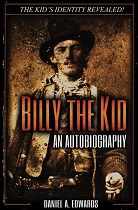 I vividly recall the first time I saw the 1988 Hollywood film Young Guns in which Emilio Estevez played the role of William H. Bonney also known as Bill the Kid (1859-1881). The film was sensational and for many years it was the sole source I had for what Bonney’s life was like. Of course, as a kid I was naive to the way Hollywood works and the liberties that filmmakers take. Today, I know that the story of Billy the Kid is far less glamorous. And while it is true that the Kid did commit several murders, he was not a psychopathic killer or reckless outlaw. Researchers have done their best to set the record straight about the Kid’s violent life. Daniel A. Edwards has thrown his hat into the mix and in this intriguing book, he examines the claim of William “Brushy Bill” Roberts (1879-1950) that he is Billy the Kid and had not been shot by Pat Garrett (1850-1908) on July 14, 1881, in Fort Sumner, New Mexico. Brushy’s claim was quite bold, and he has been written off by some as a crackpot. By all accounts, Brushy was born in 1879 and if so, his claim to be the Kid holds no weight due to the fact that it is generally accepted that the Kid was born in 1859, twenty years earlier. However, Roberts did have knowledge of important events that was not widely known in an era before the internet, social media, and the ease of access to information we have today. His claims are eye catching but is he really the Kid? There is much in the book that could lead readers in either direction. I came away with mixed feelings.
In all fairness, Edwards is aware that Brushy’s claims were quite extraordinary. Anyone claiming to be Billy the Kid must have known what would come with that revelation. Further, after the Kid’s death, he was still being placed on wanted posters across the southwest. The Kid had earned a reputation as a gunslinger and was certainly known to the region. I do find it a little hard to believe that Roberts was able to slip away from Garrett’s trap and continue to live under the radar as he claims. But on the other hand, how did Robert know such critical information not widely available? Edwards does his best to rectify the matter and I do believe he presents a compelling case that Garrett might have shot the wrong man in 1881. His attempt to prove Roberts was the Kid does not come off as strong and at times is a little difficult to believe.
The author does provide a good explanation of the Kid’s early life based off of what is known. Historians have never had extensive material to use, and details of the Kid’s childhood are sketchy. The exact month and day of the Kid’s birth are unknown and likely lost to history as record keeping then was not as efficient or present as it is now. What is clear is that the Kid did not live an ordinary life and moved frequently during his childhood. The film was correct about his closeness to John Tunstall (1853-1878) and his participation in the Lincoln County Wars. Edwards revisits the feud providing a clear and concise narrative that does not glorify the Kid nor demonize him. I did take notice of the figures that wore badges at the time. And I believe this is a critical part of the Kid’s story that explains some of his actions. Today it might be hard to picture corrupt lawmen, but it was uncommon in Billy’s time and money talked. This is not an excuse for murder but rather it allows the reader to understand the climate in which the Kid and others deemed to be “outlaws” lived in. It was called the “wild west” for good reason.
The crux of the book is the alleged murder of the Kid by Garrett. I believe there is strong evidence that Garrett may have shot the wrong person that night. The official story of the Kid’s death comes from one major source: Garrett himself. His description is at odds with the Kid we learn of in the book. Added to this are statements by several individuals who were very firm in their belief that Garrett did not kill Billy that night. These statements include sworn affidavits in which the affiants also swear to seeing the Kid in person years after his alleged death. I have no reason to suspect that they were not being honest but is it possible that the Kid did survive but that Roberts was not him? I think it is very possible and that many details about the Kid’s life and death will never be known. It is an issue that has stirred researchers into action for decades but this article might be of interest to those who read this book. The article clears up a few things that are discussed in the book, in particular the absence of a death record for the Kid. The reason for the absence of the document is actually quite simple and makes perfect sense as per the article.
I believe that Edwards had an impossible task in proving without a doubt that Roberts was the Kid. But where he succeeds is in casting doubt on a story that has been widely accepted for over one hundred years. Of course, Garrett may have shot the Kid that night and his story tells exactly what happened. There is the chance that Garrett was mistaken due to the darkness in the room. Sadly, DNA examination is not possible as the Kid’s resting place was washed away in a flood in 1904. There is a tomb at Fort Sumner cemetery today which might contain some of his remains. But without exhumation it will be impossible to know.
In death, Billy the Kid became an American icon and a symbol of the old west. The fascination with his life continues but the reality is that the Kid was one of many men who carried and used a gun in an era filled with lawlessness. There were other gunslingers, some just as dangerous as or even deadlier than the Kid. I am sure that a good number met their fates at the gallows. The Kid would have joined them had he not been handy with a pistol. He took lives but lived in a world that operated on violence and corruption. We are forced to asked if the Kid a cold-blooded killer or product of his environment? You be the judge. The story presented here in interesting and will raise eyebrows but is it accurate? And did Billy the Kid die at the hands of Pat Garrett? Edwards leaves it up to you to decide.
ASIN: B00P44T42M
Flashbacks: A Twenty-Year Diary of Article Writing – John A. Williams
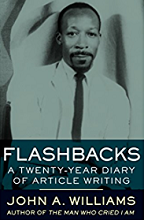 When I saw this book on sale, I felt a small sense of embarrassment because I did not know who John A. Williams (1925-2015) was. While it is true that he would be considered “before my time”, voices from the past are often as important as those of today. And any person that spends twenty years writing articles must have a significant number of experiences to reflect on. I gave in to my curiosity and decided to make the purchase. I can honestly say that I received more than I bargained for and have a newfound appreciation the late journalist. To be clear, the book is not an autobiography but more of a recollection of his most vivid memories about his early life, breaking into journalism and the numerous larger than life figures he had the chance to interview and, in some cases, form friendships with. Writers can tell you that composing an article is not always a simple as it seems and financially, it is not a way to get rich quick. In fact, the author removes all illusions of grandeur when he says:
“I’ve written all that time and if I’ve ever come to one single, positive conclusion it is that writing articles is no sane way for a man to make his living. Article Writing Highway is littered with wrecks, maimed and dead.”
Despite his gloomy summation of his trade, Williams wrote extensively, and his talents did pay the bills. But riches were never his goal and at no time in the book does he allude to fortune as his motive. He explains how he got into journalism in a time when Black Americans were prohibited from entering and being served at many establishments across America. Jim Crow was alive and strong and those fighting against it knew that it would die a slow death resisting all opposition to the very end. Williams did not let that deter him and travels domestically and abroad from one assignment to the next. And along the way, he observes things about America that even those who lived within its borders may not have seen. Those memories are presented in an engaging format and Williams pulls no punches in his assessment of the land of the free.
A significant portion of the book is devoted to Williams’ writings about the lives of figures who have their places in history such as Marcus Garvey (1887-1940), Charles “Bird” Parker, Jr. (1920-1955) and Malcolm X (1925-1965). Readers familiar with all three will know their stories but the section on Parker is deeply moving and disturbing as the late musician’s short and tragic life comes into focus. In just thirty-five years, Bird grew into the man who changed jazz forever and after his death, his former bandmate named Miles Davis (1926-1991) changed jazz again. Williams did conduct interviews with some of the subjects and his discussions with artist Romare Bearden (1911-1988) and writer Chester Himes (1909-1984) offer a frank analysis on the situation in America at that time. Some might argue that the same discussions are being held today. I can say that the past truly is prologue.
Some readers may find the sections about his travels across America to be quite shocking. But it is imperative to remember that much of it took place before and around the passing of the Civil Rights Bill in 1964. The landmark legislation had been passed but America did not change overnight. As Williams drove from one state to the next, the threat of death is never far away, and he had some very hair-raising encounters while on the road. And the treatment he received at various establishments is nothing short of shameful. Those parts of his story will cause some to wonder how that type of behavior had been normalized in a nation that prided itself on democracy, liberty, and freedom. Williams was only one person, but his trials and tribulations were common to minorities who had come to realize that civil and equality could wait no more.
As I read the book, he reminded me of James Baldwin in the way he discusses America. Baldwin had visibility due to his status as a published author and activist. Williams may not have had the same level of popularity, but his observations of daily life are right out of the Baldwin play book. And like Baldwin, he loved America dearly despite his experiences in the military and later as a traveling journalist. He remains optimistic for true change in America and the society we see today has come a long way. There is still more work to be done but I am sure that if Williams were alive today, he would remind us that those much younger than he cannot imagine what life was like during his time. This book is a cold and hard look at the real America and how life was for millions of its invisible citizens.
ASIN : B01AJ7Z0CQ
The Sins of the Father: Joseph P. Kennedy and the Dynasty He Founded – Ronald Kessler
 When we think of political dynasties in America, perhaps no other name has had as big of an impact as the Kennedys. They are both admired and loathed but their importance to the American experience cannot be understated. The patriarch, Joseph (“Joe”) P. Kennedy, Sr. (1888-1969) was once one of the wealthiest men in America. Yet for all of his financial success, controversy followed him and his family for years after his death. The family’s success undoubtedly reached its highest peak with second son John F. (“Jack”) Kennedy (1917-1963) was elected in 1960 as the next President of the United States. For Joe, it was a dream come true and reaffirmed his mantra that “Kennedys don’t lose”. To most of the public, the Kennedys seemed like figures out of a story book and the media’s creation of the term “Camelot” that was given to the Kennedy White House, further enhanced the family’s mythical status. The image presented to the public gave the impression of a fairytale marriage that any single person would envy. Today, we know through the benefit of hindsight that the truth is far less glamarous and behind the scenes, there were dark storm clouds gathering as infidelity, old man Joe’s influence and one foreign crisis after another made life as the first family strenuous to say the least. Rumors have persisted over the years that Joe Kennedy provided the money for all of his sons’ political campaigns and that the money he provided was used in several places to swing the election to his son Jack. And while there has never been documented evidence of such, statements have been made by many individuals that action were taken to give Kennedy the election. All knowledge of what really did happen went with Joe Kennedy to the grave and I doubt that even his sons knew the whole story. He was a master at compartmentalization and for years, remained chameleon like figure. Ronald Kessler decided to take another at Kennedy’s life and what he found has been compiled into this book that peels back the layers that have shrouded the Kennedy family is mystique for several decades.
I should point out that the book is not about the Kennedy presidency nor is it focused on Jack’s assassination in Dallas, Texas. In fact, the murder receives only a small section in the story. Joe Kennedy is the center of the story and the author takes us deep inside his world in a time before Adolf Hitler (1889-1945) started a second world war. the stock market was less regulated, Hollywood was for the taking and the 1919 National Prohibition Act (Volstead Act) turned bootleggers into millionaires. Joe’s numerous ventures both legal and illegal are discussed in the book and show that he was not above defying the law in order to reap hugh profits. After providing background information on the Kennedy and Fitzgerald families, Kessler shifts gears and the story picks up pace as Joe begins to implement his vision for financial success and political fame. Kennedy had always portrayed himself as the Irishman who overcame bias and adversity to rise high in American society. It is a moving story but there were many things he left out and Kessler leaves no stone unturned. The real Joe Kennedy is revealed here and what we learn may prove to be more than some readers have bargained for. If you hold the Kennedy family in high regard, then this book might cause you to re-evaluate your views of them while inducing feelings of bewilderment, sympathy and in some cases, pity.
There is no question that Kennedy was shrewd and domineering businessman, never afraid to throw his weight around. And those abilities would bring him into the circle of President Franklin D. Roosevelt (1882-1945) whose relationship with Joe takes up a significant portion of the book. Historians know very well the story of the “appeasement at Munich” where Czechoslovakia was carved up on a silver platter for Adolft Hitler by former British Prime Minister Neville Chamberlain (1869-1940) with the full support of U.S. Ambassador Kennedy. But when Hitler decided to invade neighboring Poland on September 1, 1939, it became hauntingly clear that the appeasement was a distraction from Germany’s master plan. Kennedy’s view that England would lose the war by 1940 caused consternation and outrage in Britain and Washington. And it would put a deep strain to develop in the relationship between Kennedy and Roosevelt. Drawing upon written correspondence and statements by those with knowledge, the book reveals the high level of contempt in which Kennedy was held by many in government. Roosevelt himself does not spare Kennedy his wrath and it is an interesting look behind the scenes as the German army rolled across Europe. Some readers might be puzzled by Kennedy’s behavior. One possible explanation can be found in Gordon Thomas and Max Morgan-Witts’ The Day the Bubble Burst: A Social History of the Wall Street Crash of 1929, which discusses the link between Nazi Germany and American bankers and investors. I personally wondered why Roosevelt tolerated Kennedy as long as he did. There is a good explanation for that as well which is provided within the story, further highlighting the fact that politics is a ruthless business. As the war rages on, Kennedy eventually moves back to the United States and like a piece of chessboard, he is moved from one position to another but never attains a position within the White House. He would live vicariously through Jack who’s victory over Richard Nixon (1913-1994) was the moment Joe had been waiting for.
I have often heard of the Kennedy curse and tragedy did follow the family constantly. The deaths of Joe and Rose Kennedy’s (1890-1995) children affect both deeply and the mantra of “Kennedys don’t cry” comes off more as a slogan than a way of life. In spite of Joe’s antics throughout the book, there did exist a very personal side to him that was often unseen and rarely revealed. The memories provided by his former mistress Janet DesRosiers shows him in his most humble state and also provokes more questions about the marriage between Joe and Rose which comes off as more than unorthodox. What we learn about their union sheds light on the difference between liberal and puritanical views. Stories of the Kennedy men and their love lives is nothing new and in the case of Joe, he certainly had his fun. But while reading the book, I asked myself if he would have behaved in the same manner had his marriage to Rose taken a different course? We can only speculate but what is clear is that “love” is not always what we think it is and many secrets always exist behind closed doors. On occasion in the book, statements by their children regarding their childhood provide a very sobering picture of life at home and there are very few positive comments about their mother Rose, who is more like a visiting relative than full-time mother. They do however, show the utmost respect and admiration dad Joe who emerges as the glue that holds the family together.
Far from being “Camelot”, the family was more like an episode of reality television gone wrong. However, there is no question that the Kennedy possessed enormous ambition and it propelled them to high places. For them, losing was not an option. And John F. Kennedy remains one of America’s most beloved presidents. Aside from Joe, the author does discuss incidents that arise in the lives of the children, most of which are highly serious. Ted (1932-2009) as the family called him, has a series of incidents that severely injured or took the life of someone in his company. Yet his accidents are only a few in a long series of events in the Kennedy family that involved tragedy due to recklessness or substance abuse. And no story about the family is complete without a discussion regarding the missing sister, Rosemary (1918-2005) who outlived all but one of her brothers. Her story is perhaps one of the most tear-jerking parts of the story and I warn readers who are sensitive or may know someone labeled as having a mental disability that this part of the book might be difficult. But, the discussion presented by Kessler points out some things about Rosemary’s intellect that show just how primitive the mental health field in the 1940s. Today, I believe that had she been born in another era, she would have lived a far different and close to normal life. But sadly, she was born in a time where most doctors did not understand what her condition actually was and resorted to drastic measures that changed her life permanently and served as a major source of regret throughout Rose’s life.
To say that the story by Kessler is unbelievable would be an understatement. This is a raw and unfiltered look at the life of Joe Kennedy and his family whose name is a crucial part in the our nation’s past. Some readers may be surprised at what Kessler reveals and others may feel indifference. As time moves forward, the Kennedys will be remembered at best, a dynasty from another era that continues to fade into the distance. Admittedly, I was aware of a good number of the facts revealed by the author and had no illusions about how fierce and ruthelss Joe Kennedy could be. I believe it is for that reason that I was never shocked while reading the story. However, I did learn more about the the level of dysfunction that existed within the home and how unusual family ties were. For further reading, I do recommend that readers consider Seymour Hersh’s The Dark Side of Camelot , in which the author explores many alleged family secrets. The book is controversial but overall very well written and I do believe Hersh was right about some things but not about everything. However, it is still a good read and completely breaks down the myth of “Camelot”. I have no doubt that there are many family secrets that remain carefully guarded. In the end, no family or individual is perfect and this story is proof of that. Further, we can have all the material items we want in life and still suffer from loneliness. Joe comes to understand this quite well and his unguarded moments show that even those of us with a strong facade are at times highly vulnerable on the inside. Regardless of your opinion of him, Joe Kennedy remains firmly entrenched in American history as the founder of a dynasty that once captivated an entire world. And if you decide to read this book, be aware that there is far more to the man you may have ever imagined.
ASIN : B006YC7AH4
The Devil Is Here in These Hills: West Virginia’s Coal Miners and Their Battle for Freedom – James Green
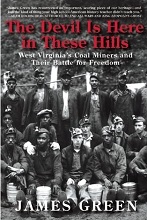 The United States is considered by many historians to be “young nation” due to it being in existence since 1776. While it is true that my nation’s history is not as extensive as Ancient Greece or Egypt, in the time since its creation, America has been the source of some of the most groundbreaking events in world history. Incredibly, there are dozens of smaller events that have taken place which many Americans have forgotten about or are not aware of. When President Donald Trump ran for office in 2016, he made it clear he wanted to bring jobs back to the Appalachian region known simply as “coal country”. It was profound promise to make and some might go as far as to say it was deception on the part of the candidate. Four years later the situation in Appalachia has not changed much and coal is widely considered to be an older energy source to be exported rather than used domestically. Natural gas and nuclear power have substituted coal as America continues to employ cleaner sources of energy. West Virginia is seen as the heart of Appalachia and has made headlines in recent years due to the surge in opioid addiction. I watched the 2013 documentary Oxyana and it provides a glimpse into the lives of some West Virginians but surely, it does serve as the example for the entire state. But what we do see in the film continues to exist and is cause for concern. One question I have always had is what exactly happened during the time in which coal was so widely desired? I had read Henry Caudill’s Night Comes to the Cumberlands: A Biography of a Depressed Area and therein the author provides a thorough explanation of the coal story in Cumberland County, Kentucky. James Green shifts the focus here to West Virginia and tells the story of its coal miners who waged a battle that helped changed labor practice in America.
Before starting this book, I believe that it is imperative for you to clear your mind of any pre-conceived notions about West Virginia. As I began to read, I reminded myself that there was much about West Virginian history I did not know and this book is solid proof of that belief. Green takes us back in time to the middle to late 1800s as mining companies begin to realize the enormous potential for profits in West Virginia. Dozens of corporations soon set up shop and began hiring miners to engage in backbreaking and deadly work. Sadly, the workers are essentially viewed as “tenants” of the coal company which is recognized as a “landlord” by the law. Further, it is clearly explained in the book how miners had very little rights and were financially dependent on the coal company in every part of their lives making the system nothing more than a hotbed of slave labor. The work was long and dangerous with explosions and the caving in of mines a very real threat. In the early 1900s, miners began to wake up and their voices would be amplified by critical events and iconic figures who remain legends in miner lore. The formation of the United Mine Workers of America (UMWA) was the first step in miners taking back control from the coal companies and obtaining protections in what was becoming an increasing deadly profession. Unionization was new to coal country and the coal companies did not give in without a fight. What took place in the wake of its formation, provides us with an incredible story told beautifully here by the author. However, the formation of the UMWA is only one part of the story and there were many faces and events taking place around it that are important pieces to the larger picture.
Every movement needs leaders and there is no shortage of them here. The guiding figures we learn of in the story are Mary Jones (1837-1930) known publicly as “Mother Jones”. She emerges as a powerful voice for the miners and is joined in the struggle by Frank Keeney (1882-1970) and Fred Mooney (1888-1952), whose efforts to protect the miners are critical to the story being told. Admittedly, I did not know the names of these figures nor of the battles between coal companies and miners in both Paint Creek and Cabin Creek. The violence became so bad that Governor William E. Glasscock (1862-1925) declared martial law on more than one occasion. West Virginia was hot and the battle was just heating up. More figures soon enter the story including both former Governor Harry Hatfield (1875-1962) and Matewan, West Virginia Police Chief William Sidney “Sid” Hatfield (1893-1921), whose actions against the Baldwin-Felts Detective Agency earned him the admiration of thousands of miners. Interestingly, both are related to the Hatfield family and the author does discuss the Hatfield-McCoy “feud” that has become a pop reference in American culture. Readers who want to know what really happened during the alleged feud should read Thomas Dotson’s The Hatfield and McCoy Feud after Kevin Costner: Rescuing History, which clears up many long-standing rumors and non-factual statements that have persisted for years.
I found myself surprised to learn of the large number of immigrants that lived and worked in the West Virginian mines. In contrast to a prevailing image of a largely white Anglo-Saxon demographic, immigrants from Europe and Black Americans settled in the area where the men found work in the mines. McDowell county stands out in the story for its black citizens and importance to the growth of the UMWA. And just as Mother Jones realized, they were the key to achieving both unionization and true change for the miners in West Virginia. In fact, the Italian immigrants played a much larger role than many people may realize. And some might be surprised at the large number of Italian settlers but what is often left out of the Italian immigrant story is their arrival in the south, in particulars New Orleans, Louisiana. From the south, many Italians also moved across the United States and settled in areas that provided the new lives they sought in America. It could be said that Green’s book is not just a story on West Virginia’s mines, but also the immigrant experience in America which continues to play itself out as politicians use the matter for political gain.
While reading the book, I quickly realized that was took place in West Virginia was really a small-scale civil war. It may sound like an exaggeration but I am convinced that readers will see just how deadly and fierce the fighting became as coal companies began to use outside enforcers to evict miners off company property. Albert Felts and Don Chafin (1887-1944) emerge as the story’s villains. The battles were deadly and the miners essentially form their own army to take on the corporations. It was nothing short of a war which has received scant attention in discussions focused on American history. Green is fully conscious of this and early on he points out that:
The West Virginia coal miners’ story has never been recounted in full from its origins in 1892, when the first UMWA organizers appeared in the coal camps, to those thrilling days in the first spring of the New Deal, when union forces emerged victorious after forty years of struggle.4 The Devil Is Here in These Hills is a history of that enduring struggle and of the diverse community of working people who carried it on for so long.
Washington was aware of the events taking place in West Virginia but had repeatedly resisted calls from state officials to send in federal troops, believe that the matter could be resolved through negotiation. The stalemate continue through the early 1900s until a key piece of legislation was passed that changed America. The New Deal programs enacted by President Franklin D. Roosevelt (1882-1945) between 1933 and 1939 were critical in repairing the American economy in the wake of the Great Depression. A key component of the program ushered in a new course for American labor. Its significance will not be lost on readers. However, there are sad moments in the book and what happens in the aftermath of the New Deal may in fact be the saddest part of the story despite the law’s impact. I say this because the removal of the need for a united front changed not only the demographics in West Virginia but also gave rise to darker aspects of America’s troubled past. The author explains each in detail and I am sure readers will be shaking their heads by this point in the book.
Jones, Keeney and Mooney are long gone but their actions and commitment to miners’ cause will never be forgotten. The story of West Virginia’s mines and its workers is an example of the bloody and protracted struggle for workers’ rights that continues to this day. Further, it is a part of American history that every citizen should know. If you are curious about coal country and its long history, this book is a must read.
ASIN : B00OV9D9RM
Lincoln Assassinated!! The Firsthand Story of the Murder, Manhunt, Trial and Mourning: A Library of America Special Publication – Harol Holzer
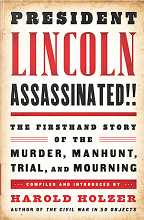 The assassination of President Abraham Lincoln (1809-1865), remains a pivotal moment in American history when the nation was truly at a crossroads. A brutal civil war had just ended and millions of former slaves found themselves unsure of their future post-bondage. The former Confederacy was left in shambles and the Radical Republicans were intent on reconstructing the south in the model of the Union as a whole. Lincoln, was either loved or hated depending on who you asked. In the Confederacy, there was no love lost when he was murdered and as Jefferson Davis (1809-1889) bluntly stated: “Well, General, I don’t know; if it were to be done at all, it were better that it were well done; and if the same had been done to Andy Johnson, the beast, and to Secretary Stanton, the job would then be complete.” Investigators had tried to link Davis to the assassination but the former Confederate leader was never tried or convicted for Lincoln’s murder. The crime cast a dark cloud over the nation and millions of American went into mourning at the loss of the fallen leader. Author Harold Holzer takes us back in time as we re-live the murder and events that followed as they happened in 1865.
The author opens with a brief description of events at Ford’s Theater as Lincoln and his wife Mary Todd Lincoln (1818-1882) watched the play Our American Cousin. Around 10:15 p.m, a stage actor named John Wilkes Booth (1838-1865) fired a single shot sending a derringer bullet barreling into the back of Lincoln’s head, mortally wounding him and changing American history. The assassin made a quick escape as he jumped down to the stage and uttered the infamous words “sic semper tyrannus”. Pandemonium ensued as doctors and guards rushed to Lincoln’s side. But doctors quickly realized that the president was beyond help. He was moved to the dwelling of William A. Petersen and at 7:22 a.m. on April 15, 1865, Lincoln succumbed to his wounds. The shocking murder of the president sent shockwaves across the city and nation but before long, authorities knew the identity of the man they were looking forward and his conspirators including Lewis Powell (1844-1865) who had also attacked Secretary of State William Seward (1801-1872). The chain of events comes roaring back to life through cables to Washington, newspaper articles and statements from witnesses and the even the officer who shot and fatally wounded Booth, Sgt. Boston Corbett (1832-1894), whose own life story is beyond puzzling.
At the beginning of the chapter’s the author provides relevant information to help the reader keep things in context but lets the writer of the letter or article presented do the talking. A majority of the statements are from those who knew Lincoln and loved him while at least who are from Southern sympatizers who rejoiced at the news of his death. Their statements are also included and some readers may find themselves filling with anger at the words. Remarkably, even those who had once mocked Lincoln, found the appropriate words of endearment for the fallen president. Journalists and politicians alike make amends in the book while offering their words to Lincoln’s memory. Today it may be hard for some to appreciate how loved Lincoln was by many during his time even in spite of his detractors. Included in the book is this statement by historian George Bancroft (1800-1891) that truly captures the majority of opinions at the time:
How shall the nation most completely show its sorrow at Mr. Lincoln’s death? How shall it best honor his memory? There can be but one answer. He was struck down when he was highest in its service, and in strict conformity with duty was engaged in carrying out principles affecting its life, its good name, and its relations to the cause of freedom and the progress of mankind. Grief must take the character of action, and breathe itself forth in the assertion of the policy to which he fell a victim. The standard which he held in his hand must be uplifted again higher and more firmly than before, and must be carried on to triumph. – George Bancroft (1800-1891)
What I did notice in many of the statements provided is that the issue of slavery always remained prevalent. Some speakers addressed it head on while others included as an addition to their main point. But what is clear in the book is that the issue continued to be a hot topic of discussion with many wondering how the United States would move forward with millions of freed black men and women. Reconstruction was the goal of Lincoln and his associates in Congress but their efforts would be undermined by Lincoln’s successor Andrew Johnson (1808-1865) who narrowly escaped impeachment in 1868.
The constitution was weighing heavily on the hearts and minds of prominent figures who sought to carry on Lincoln’s legacy and make America’s black population a legitimate part of the American experience. But first, Lincoln’s funeral needed to be held and sadly, even with him lying in state and on his way to the grave, blacks would feel the wrath of discrimination as they were initially barred from the funeral procession. It truly is mind-boggling but did actually happen and the criticism leveled at the Common Council in New York City is included as well. The order was defied and reversed but left a sour taste in the mouths of blacks who had already experienced their share of indignations at the hands of bigots. Outrage ran so high that even the Secretary of War Edward Stanton (1814-1869) stepped in and personally ordered that blacks be permitted to march in the funeral procession. As I read this part of the book, I shook my head in disbelief. But this was America in 1865.
The amount of speakers who appear in the book is extensive and include Frederick Douglass (1818-1895) and Confederate Vice-President Alexander H. Stephens (1812-1883) whose statements in tribute to Lincoln may surprise some readers. As to how sincere Stephens was in his words regarding slavery, we shall never truly know. However, he did show Lincoln the utmost respect in death even if they were at odds during the war and made the following proclamation:
“Indulge me a moment upon this subject of the institution of slavery, so called, in the Southern States. Well, Mr. President and Mr. Speaker, it was not an unmitigated evil. It was not, thus much I can say, without its compensations. It is my purpose now, however, to bury, not to praise, to laud, “nor aught extenuate.” – Alexander H. Stephens (1812-1883)
The above quote is just a sample of the extensive amount of statements in the book that are crucial in American history. They are voices in history who were guiding the republic as America split in half and nearly destroyed itself. Lincoln sought to preserve the Union and had preferred to avoid conflict but was left with no choice but to wage war. The conflict had been a long and brutal campaign but the president had his eyes set on the future and how to move America forward. But on April 14, 1865, an assassin’s bullet put an end to his goals. The world would see a similar event take place in Dallas, Texas on November 22, 1963. Old Abe as he was sometimes called is fondly remember as the first Republican President and an astute politician who came from a simple background in Kentucky. And at the time of his death, he stood ready to move America forward. His death was a profound loss to the nation and that sorrow is captured here perfectly. As I read the book I felt as if I stepped back in time and had been provided with a ring side seat as a president was mourned and the hunt for an assassin was on.
The focus remains mostly on Lincoln but Holzer does discuss the arrests and fates of the conspirators Lewis Powell, David Herold (1842-1865), George Azterodt (1835-1965), John Surratt (1844-1916), Mary Surratt (1823-1865) and Dr. Samuel Mudd (1833-1883). Of the group, Powell, Herold, Atzerodt and Mary Surratt were sentenced to death and she became the first woman in American history to be executed. The group mounted their defenses and the statements by their attorneys are included as part of the author’s discussion on the investigation and convictions that followed. The attempts by defense lawyers were admirable if not also quite ludicrous. Authorities had the guilty parties and left no stone unturned as they hunted Lincoln’s killers. It was a conspiracy in the making from the beginning and the trail of evidence is presented out in the book. However, neither at that time or in the years that followed, has there been any evidence conclusively linking anyone in the Confederacy’s highest level of government to the crime.
America continues to grapple with race and equality but we have the tools and the will to continue the goal of improvement life for all. And as we embark on our path for true equality we can look back at the life and death Abraham Lincoln as a reminder of just how far we have come as a nation and where we should want to go. Old Abe’s ghost will always be with us and he will continue to be lauded as one of the greatest presidents in Unites States history. Great book.
ASIN : B00SW8BNVM
American Holocaust: Columbus and the Conquest of the New World – David E. Stannard
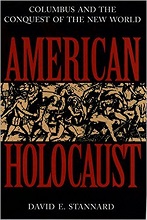 Earlier this week, my boss mentioned during a Zoom office meeting that Columbus Day needed to be re-examined. He had learned of many dark aspects of Christopher Columbus’ (1451-1506) arrival in the Caribbean. The movement to end the celebration of Columbus’ life has gained considerable traction over the past several years. Some states in America have renamed the Columbus Day to “Indigenous People’s Day”, in honor of the Native Americans who sufferend immensly at the hands of Spanish and other European explorers. It is a sound recommendation and one that may even happen here in New York City as it becomes harder for people to ignore the disturbing actions by Columbus and his group of marauders. Many of us learned in school that he was the man who “discovered America”. But is that what really happened? An uncontested fact is that Columbus never set foot on North American soil, making the claim of discovering America misleading. And we know today after many years of neglect by mainstream media, is that indigenous populations were decimated when exposed to the new visitors from abroad. The true story however, goes far beyond Columbus, who was just one of many bloodthirsty religious fanatics who favored violence over peaceful assimilation. David E. Stannard revisits the Columbus story in this eye-opening and chilling account that resulted in a stiff drink and a long moment of silence after I had finished reading.
I need to point out from the start that this book is not for the faint at heart. If you are easily upset by graphic descriptions of barbaric actions, then this book may not be for you. It is dark, chilling and beyond tragic. And that is exactly why the way history is taught in the United States is in need of change. Although the cover of the book gives the impression that the story is solely about Columbus, there is actually far more included in the book regarding the arrival of Spanish and English explorers whose wave of destruction spread across North America, the Caribbean, Central America and South America.
One question that has always typically been asked about the Americas is how long did the native population live there? It is a good question and Stannard does provide a discussion about the original inhabitants of the Americas. And what he says might suprise some readers. I found the topic of Berengia to be highly interesting. The Berengia theory for human migration into the Americas is plausbible and the Bering Land Bridge which no longer exist, gives credence to the author’s point. However, what is clear is that what we call the Americas had been populated by anicent civilizations thousands of years ago. Creationists may believe differently but to completely diregard the science at hand would be highly unfortunate as the author provides a thorough discussion of humanity’s existence.
The story picks up pace as the Spanish arrive in the New World. in August of 1492, Columbus and his crew wasted no time in implementing their program of terror upon the natives. The violence is nothing short of gratuitous and disease proved to be just a deadly. The combination of the two as detailed in the book, had long reaching and long-term effects from which the Americas have never fully recovered. And in case defenders of Columbus and other explorers point to disease as the major killer, Stannard has this to say:
However, by focusing almost entirely on disease, by displacing responsibility for the mass killing onto an army of invading microbes, contemporary authors increasingly have created the impression that the eradication of those tens of millions of people was inadvertent—a sad, but both inevitable and “unintended consequence” of human migration and progress.
The names of the tribes that suffered so much destruction are voluminous and I learned the name of several that I had no prior knowledge of. Their names are almost endless and I am sure that only a fraction of the true number of indigenous tribes that called the Americas home are covered here. In North America alone there were hundreds of tribes, some of which are now extinct including the Canarsie, who have a neighborhood and high school dedicated in their honor right here in my hometown of Brooklyn, New York. Sadly, most do not know the true story of the Canarise but this book certainly does provide an idea.
Aside from the grim account at hand, Stannard takes yet another approach and explores the reasons behind the Spanish exploration across the ocean. The true reason for Columbus’ voyage should cause readers to take notice about how much he knew about navigation and the position of the Spain in the European hierarchy. Putting that aside, there is a much darker aspect to the Spanish missions and this is where religion enters the story. Many of us know of the Crusades and the horrors of Christianity but in regards to Columbus, there is far more than meets the eye. The mind-boggling details are included in Stannard’s account revealing yet another side of Columbus that will make many stare in disbelief at the words they are reading. And if that is not enough, there were yet other reasons for the Spanish conquest and the end result left me shaking my head.
Halfway through the book I felt as if I needed a break but pressed on as I knew there was much more to learn about extermination of Native Americans in what is today called the United States. Stannard keeps the discussion streamlines but does mention the Trial of Tears and Wounded Knee. Each of those topics would require a separate book to fully go into the stories behind the tragedies. The purpose here is to show the different ideologies behind Spanish and British actions in the Americas which both led to the same result for native populations. The atrocities committed against Native Americans by the United States Government aare beyond upsetting and amount of gore found in recollections of the events might cause some readers to revolt in disgust. Quite frankly, the European arrival in North America was just as deadly as the Spanish pillaging of Central and South America. Each empire had its own reasons but for both, religious ideology, finanical motives and beliefs in racial superiority resulted in what Stannard believes to be the worst genocide in world history. In fact, he states pointedly: “the destruction of the Indians of the Americas was, far and away, the most massive act of genocide in the history of the world.¨
After I finished the book, I had to sit in silence for a while to digest what I had just taken in. Columbus’ actions were not a surprise to me as I had already known of his dark legacy. What I did not know were the names of the numerous forgotten tribes of the Americas who no longer exist today. The systematic destruction and eradication of their lives and culture is indefensible and nothing short of genocide, sexual exploitation and the plundering of territory inhabited by others whose way of life was completely changed by new faces upon their shores. If this book does only thing, I hope that is to shatter the myth of the new settlers in the Americas arriving with open arms and becoming fast friends with the native peoples. Revisiting the past is often painful and reveals many disturbing facts that we would rather not know. But if we are to have a frank and honest discussion about the people we have long called “heroic” and trailblazing” then all of their deeds should be open to examination. This book is masterfully written, haunting but yet eerily relevant even today.
ASIN: B004TFXREI
I Am Perhaps Dying: The Medical Backstory of Spinal Tuberculosis Hidden in the Civil War Diary of LeRoy Wiley Gresham – Dennis A. Rasbach MD FACS (Author), Janet Elizabeth Croon (Editor)
 In November, 2019, I had the opportunity to read “The War Outside My Window: The Civil War Diary of LeRoy Wiley Gresham 1860-1865” by author Janet E. Croon. The book is a collection of the diary entries made by LeRoy Wiley Gresham (1847-1868) during the American Civil War. He lived in Macon, Georgia and was born into a slave-owning family committed to the Confederacy. Before reading the book I had no idea who Gresham was. But what I found after reading his diary, is that he was a bright young man whose intellect improves as the journal progresses. However, I also noticed that throughout the book he is in poor health that does not improve but instead declines as the diary moves towards 1863 and beyond. LeRoy did not know he was dying until nearly right before his passing. His parents and older sibling Thomas, most likely knew how severe his condition was but kept it hidden from him probably with the thought that telling him would break the will he had left following the devastating injury in 1856 that resulted in his left leg being crushed by a falling chimney. We know that tuberculosis is what eventually took his life but at the time, there was much about his condition that doctors did not know and were unable to treat. Dennis A. Rasbach, M.D., F.A.C.S., has taken a look at LeRoy’s medical history to understand how his condition progressed and the various treatments prescribed to him by his treating physicians.
Dr. Rasbach has concluded that Mycobacterium tuberculosis is what ultimately took Leroy’s life. It is formally known as Pott’s Disease, name after the late English surgeon Percival Pott (1714-1788). Today, tuberculosis is rarely heard of and a diagnosis y would raise eyebrows and result in reactions of shock and surprise. But during the time in which LeRoy lived, tuberculosis was the world’s deadliest killer and a diagnosis such as the one received by LeRoy, almost always resulted in death. Dr. Rasbach elaborates further with the following statement:
“In the second half of the nineteenth century, tuberculosis was the deadliest disease in the world, accounting for one-third of all deaths. Even today, a quarter of the world’s population is infected with TB, and the disease remains one of the top ten causes of death, claiming 1.7 million lives annually, mostly in poor and underdeveloped countries.”
Throughout the diary, LeRoy utilizes a number of medications and remedies to combat his deteriorating condition. Each are examined in detail to see why doctors resorted to those specific remedies and how they affected his daily condition. Readers might express surprise at some of the things LeRoy was given to take, most notably significant servings of alcohol. Today, we would not even think of giving a teenage alcohol to treat a condition but in the 1800s, it was a widely accepted method of treatment. Incredibly, some of the things LeRoy used are still used today. Dr. Rasbach mentions where and some readers might be surprised to see exactly where.
The second half of the book is a collection of journal entries related mainly to his health which he notes is declining rapidly. The descriptions are graphic and I can only imagine how difficult it must have been for those around him to tend to him daily. He often complains of his back, headaches, upset stomach and contracted legs making it impossible for him to even think of walking. The pain is so bad that in one entry, he writes “saw off my leg”. This young man lived in daily pain and sadly, his doctors and family were powerless to help as the medicines we have today did not exist at the time. For LeRoy, it was a slow and agonizing death. But he gave us plenty of clues about his health and in hindsight, Dr. Rasbach has connected all of the dots, revealing the culprit behind LeRoy’s death at just eighteen years of age.
If you have read LeRoy’s journal and want to know more about the health condition that plagued him throughout the book, this is a must read. And even if you have not read it but want to know more about the deadly history of tuberculosis, this book will be a valuable addition to any library.
ASIN: B07D7G7RJ8


You must be logged in to post a comment.