
 In the midst of what can only be described as a vitriol filled political climate, I decided to revisit this short but insightful book by the best-selling author David Halberstam (1934-2007), about the political transformation of the late Robert F. Kennedy (D-NY) (1925-1968). In 1968, the Vietnam War had become a nightmare for the administration of Lyndon B. Johnson (1908-1973) and calls for a change in American policy were growing louder. On the domestic front, social unrest began to peak as blacks and other minorities became increasingly frustrated with the lack of advancement in society that the Civil Rights Bill of 1964 and Great Society had failed to deliver. While blacks had equal rights under federal law, opportunity was still highly elusive. Johnson’s opponent, Richard M. Nixon (1913-1994) represented a shift to the right that alarmed those of the left and even moderate voters. And while Nixon did get elected, it took a series of events in 1968 to make that possible. And nearly all of them involved Robert Kennedy.
Today, Kennedy is a hero to the liberal voters and the poster boy for what liberalism is supposed to be. Curiously, it was not a label he would have given to himself and in younger years he was more the conservative side. But by the time he won the California primary on that fateful June night in 1968, he had morphed into a different candidate whose vision was becoming embraced by a growing numbers of American, many of them younger voters disillusioned by Washington. Kennedy has begun to embrace his new popularity and Halberstam captures the change in this short remark:
“Kennedy, once a conservative, then an unannounced and reluctant liberal whose credentials were regularly challenged by more orthodox liberals, was by 1967 pursuing a course of increasing radicalism-proffering more radical ideas and taking on, from people like Lowenstein, more radical advice.”
We learn in the book that initially Kennedy was reluctant to enter the presidential race and was essentially talked into it by many people. Some thought he should wait until 1972 but others felt that just as 1960 was his brother Jack’s time, 1968 was the year for Bobby to retake the throne from Johnson and secure it from the hands of Nixon. Eventually Bobby caved and as the campaign picked up steam, Halberstam was there along the way to capture the hits and misses while providing an expert analysis of where the campaign had scored and where it had miscalculated. And what we see is the evolution of a figure in American political history that has no comparison.
Readers in search of a biography of Kennedy will not find it here and should instead take a look at Arthur M. Schlesinger, Jr.’s Robert Kennedy and His Times, which is a intimate and extensive account of Kennedy’s life. The 1968 battle for president is the focus and Kennedy is the latecomer who completely changes the game. Lyndon Johnson’s decision to suddenly withdraw his name for consideration remains one of the most shocking presidential moments in American history. Whether he did it because of Kennedy’s intention to run we may never know for sure but there is a high probability that the announcement by Kennedy did play a part in Johnson’s final decision. Halberstam explores the issue here and while he believed that Johnson did step down instead of facing Kennedy, it is also clear that by 1968, the Johnson Administration was in rough shape. And although he was still popular across America, Johnson did not have the aura that surrounded Bobby.
With Johnson cast to a minor role, the book shifts focus on to the battle between Bobby and Eugene McCarthy (1916-2005). It is here that we see the true transformation of Bobby as he goes to head to head with a seasoned politician whom some thought to be the successor to Lyndon Johnson. Bobby comes in armed with familiar faces still loyal to fallen brother Jack and the Kennedy name. McCarthy is no lightweight and the battle heats up quickly. Halberstam does a masterful job of reporting first hand but when necessary, letting the figures speak for themselves through public statements and off-hand quotes in the heat of the moment. It is a step back in time when America was at a crossroads as a war and civil rights were the most important and most dividing issues in households across the country.
The issue of race is found throughout the book and it is no secret that Kennedy became a fierce defender of civil rights in later years. He was outspoken in his criticism of the American way of life that had treated blacks negatively for too many years. And while this stance did cost him politically in some regions, it also earned him the support of millions of others. Halberstam brings the past to live as we see just how tense America had become in the 1960s as young men died in Vietnam, racial violence escalated and prominent figures were gunned down. As my dad always says “the 60s were scary son”.
A truly tragic part of the book is the realization that America is still fighting some of the same battles today domestically. Social unrest and civil rights have not gone away as we have seen this year. But I do believe that we can correct course and point out country in the right direction. Kennedy also believed this and was determined to see this happen had he been elected. Sadly, he did not live long enough and his murder remains one of the darkest moments in American history. The book ends before his murder but Halberstam writes more than enough to capture Kennedy’s unfinished odyssey. Robert Kennedy once said that Kennedy once said that tragedy was a tool for the living to learn from, not by which to live. I carry those words with me always as a reminder that we do have to be the change we wish to see. Highly recommended.
ISBN-10: 0394450256
ISBN-13: 978-0394450254
 I have had many discussions with my father wherein he recalled his memories of the Cuban Missile Crisis in October, 1962. He explained with vivid detail how he and his classmates had to take part in daily air raid drills due to the increasing threat of a nuclear holocaust. The discovery by U.S. intelligence of Soviet missiles on Cuban soil, accelerated what was already a tense conflict. Today we refer to it as the Cold War but there were many things taking place that were anything but cold. And as former Secretary of Defense Robert S. McNamara remarked in Errol Morris’
 June 5, 1968 – Senator Robert F. Kennedy (1925-1968) (D-New York) concludes his speech at the Ambassador Hotel in Los Angeles, California after scoring a critical primary victory in his quest for the Democratic nomination for President of the United States. As he walked through the pantry while exiting the hotel, he was shot and mortally wounded. Twenty-six hours later in the early morning hours of June 6, 1968, his life and the dream he inspired came to a tragic conclusion. He is survived by his widow Ethel and eleven children, the youngest of whom was born after his death. Her name is Kerry Kennedy and along with brother Robert, Jr., she keeps her father’s memory alive and well. Her book
  Recently, I watched the Netflix series
  On July 18, 1969, Senator Edward M. “Ted” Kennedy (1932-2009) lost control of his vehicle while crossing the Dike Bridge on Chappaquiddick Island, Massachusetts. In the passenger seat was a twenty-eight old former staff member of Robert F. Kennedy’s (1929-1968) presidential campaign and member of a group of women known as the “Boiler Room Girls”. She was later identified as Mary Jo Kopechne. In death she became a permanent part of the history of Chappaquiddick and a reminder of what happens when we are negligent in our actions. Over time she has been largely forgotten, having been overshadowed by the lives of the Kennedy family. And with regards to Chappaquiddick, she has been known as the “woman in Kennedy’s car”. But the real Mary Jo Kopechne has an interesting story of her own that was cut short at only twenty-eight years of age.
 The election of Barack Obama to the office of President of the United States marked a turning point in American history. His successful campaign and subsequent eight years in office vindicated the late Robert F. Kennedy who in 1961 said he believed that in forty years a negro could be president. At the time the thought seemed absurd as American struggle with social division fueled by ethnic discrimination. But if we look back on his words, we can see that his foresight was not only accurate but uncanny. From time to time I think back on the many quotes from him regarding his views on society. His assassination during the 1968 presidential race left a void in the United States that has never been filled. He remains one of the most popular, unpopular and tragic figures in the history of this nation.
 Each time I drive across the Robert F. Kennedy memorial bridge as I pass from Queens to the Bronx and sometimes Manhattan, I think about his importance to the State of New York and the United States. The former attorney general, senator and presidential candidate was one of the most polarizing figures of his time. His murder on June 5, 1968, shocked the world leaving millions of people speechless about what they had just learned. A young Jordanian immigrant named Sirhan Sirhan was later tried and convicted for the murder and the case is considered solved in Los Angeles County. Similar to the murder of John F. Kennedy 5 years earlier in Dallas, Texas, upon closer examination, many disturbing facts emerge that cast a chilling doubt over the official story.
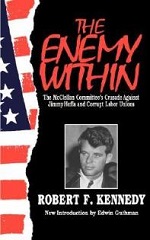 On January 30, 1957 the United States Senate Select Committee on Improper Activities in Labor and Management was created to investigate corruption in American labor unions. Designated with the role of Chief Counsel was a young attorney who later went on to become attorney general and 1968 democratic presidential hopeful, Robert F. Kennedy. In this memoir of his time on the committee, Kennedy recounts the exhaustive investigative efforts of those who served on the committee in an effort to shed light on the nefarious dealings of union and labor officials and effect reform throughout the United States. At the center of the committee’s target lay James R. Hoffa and his International Brotherhood of Teamsters. Starting with Dave Beck, Kennedy carefully reconstructs the deeply seated mismanagement of union funds resulting in the most opulent lifestyles for top officials. Facing a culture in place for many years, Kennedy and his staff are met with opposition and resistance to efforts to probe into the dark side of American labor unions. It’s no secret that Kennedy and Hoffa had a strong distaste for each other and on more than one occasion, Hoffa threatened the future attorney general with physical violence. Kennedy would respond with his “get Hoffa squad” in an attempt to bring down the man who Kennedy believed was a menace to the American way of life.
 FREETHINKING BIBLIOPHILE
You must be logged in to post a comment.