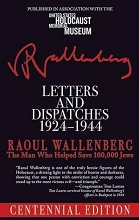
Letters and Dispatches 1924-1944: The Man Who Saved Over 100,000 Jews, Centennial Edition – Wallenberg, Raoul

WellenbergI am always on the lookout for stories that I have not yet heard and names of people I am not yet familiar with.  When I saw the cover of this book, I tried to jog my memory with regards to the name of the author.  I finally realized that I did not know of Raoul Wallenberg (1912 -1947?) but I knew instantly that I had to read this book.  Admittedly, I am always interested in the personal correspondence of figures from the distant past to see how information was shared in the years before E-mails, SMS and social media.  The cover of the book directly describes what is contained within which is a collection of the letters between Raoul, his grandfather Gustaf Wallenberg (1863-1937) and Raoul’s mother Maj von Dardel (1891-1979) whose replies to her son are not included. The bulk of the letters are between grandfather and grandson and what is truly remarkable about them, is the amount of knowledge that is shared between the two.  Raoul embarks on a long journey and I found myself glued to the book. But aside from that, there are other things in the book that make it an enjoyable read.  
Gustaf is the undoubtedly the domineering force in the family structure.   He is Raoul’s guiding light in the absence of Gustaf’s son and Raoul’s father Raoul Oscar Wallenberg (1888-1912) who died of cancer before his son’s birth.  Raoul finds himself blessed to have a very supportive family and his grandfather both encourages and finances his studies abroad.  America is the destination of choice for young Raoul.  Gustaf himself had visited America and explains to Raoul why he feels so strongly about studying in the United States: 

“It is because of what both my father and I found in America that makes me so eager for you to get your direction in life there. No one has ever understood as well as I have, because I saw it in my youth, how decisive his time there was for my father…. I use the expression direction in life and not “education” on purpose. ” 

The first stop for Raoul is Ann Arbor, Michigan where he enrolls in college to earn an advanced degree.  But, it is only the first stop and the young Swede would take advantage of being a young bachelor to travel across the United States meeting people from all walks of life while Gustaf continues to send words of encouragement and enlightenment. I do want to comment on Gustaf’s views on women which might cause consternation in some readers.  I think today we would call him misogynistic but in that era, he would most likely have not received any reprimand.  His comments to Raoul about romance are both interesting and quite blunt.  And while he truly wanted the best for his grandson, I believe that some readers may take some offense to the words he writes.  However, Gustaf is incredibly brilliant and refined in regards to world affairs.  The knowledge contained in his letters can be of value to both men and women. Further, Gustaf’s command of words gives his letters a more potent affect and I found myself amazed at his sentence structure and grammar which is nothing short of clear and concise. 

Raoul comes across as a competent writer himself and relays to his grandfather, plenty of anecdotes from his travels abroad.  The journey goes from America, Central America, Africa and back to Europe.  Along the way, the young student learns valuable lessons about life and as I read his letters I could see his level of maturity increase with each destination.  The insight with which Raoul writes provides food for thought regarding America and other countries seen through the eyes of the traveling student.  And throughout his travels, Raoul remains firmly in awe of Gustaf, whom he looks up to with unconditional admiration.  Their relationship reminded me of the bond between my myself and my great-grandfather William, who was similar in nature to Gustaf and equally as frank in his choice of words.  Putting aside his bluntness, we all loved and respected him deeply because we knew that he loved us in return and never hesitated to show it. 

After graduating, Raoul made his way back to Europe and through a series of events, was introduced to Kàlmàn Lauer, a Hungarian Jew who was the director of the Central European Trading Company, Inc, a business that specialized in exports. This encounter changed his life permanently and as a result of it, Wallenberg accepted a post with the War Refugee Board through the invitation of Iver Olsen, a representative with the board. His new destination was Hungary which had become the target of the Germany army and a hotbed of anti-Semitism. 

The implementation of the “Final Solution” by Adolf Hitler’s (1889-1945) Third Reich, sent chills across Europe and removed any doubt that there existed a “safe haven” for Jews.  During his time in Budapest, Wallenberg committed himself to saving as many Jews as possible.  In the final part of the book, we are allowed to see his dispatches regarding efforts to deport Hungarian Jews and his willingness to confront both German officials and the Arrow Cross Party, led by despot Ferenc Szálasi (1897-1946).  He was relentless in his efforts and through them, it is estimated that he saved the lives of at least 100,000 Jewish people.  When a friend asked about his determination to save everyone he remarked: ““I’d never be able to go back to Stockholm without knowing that I’d done all a man could do to save as many Jews as possible.”  The exact number of Jews that he saved may never be known but what is certain, is that Wallenberg did prevent thousands from being deported before he was detained by the Soviet Army.   And this is what we learn in the book about his final moments in Budapest: 

“[The Soviet Army’s siege of Budapest began on December 8, 1944, the day this letter was written. Soviet authorities took RW into their ‘protective custody” and sent him to Lubyanka Prison in Moscow on January 17, 1945. He was never heard from again. The Soviets denied any knowledge of his whereabouts until 1957, when Andrei Gromyko, then foreign minister, announced that RW had died of a heart attack in 1947, in Lubyanka. There is ample but inconclusive evidence that this was not the case, and efforts to determine his fate continue.]” 

The truth regarding Wallenberg’s fate remains a mystery as explained in this article in the Israeli journal Haaretz.  The date of his death most likely remains a carefully guarded Russian secret.  Officially, it is believed that he disappeared into the Soviet gulag system in January, 1945 and was never heard from again.  His disappearance adds even more confusion to his story as he was a liberator and should have been seen as such by the invading Red Army.  The reasons for his detainment and subsequent imprisonment are not exactly clear.  And this adds a tragic ending to a remarkable story that should be part of any discussion about World War II and the Holocaust. 

“Across the United States and throughout the world there are Raoul Wallenberg committees and individuals who work tirelessly to educate the public about this compassionate and nonviolent hero, and to assist in solving the mystery of his fate. By introducing the man behind the cause, Letters and Dispatches will help us all remember.” – Rachel Oestreicher Haspel, President of the Raoul Wallenberg Committee of the United States

ASIN : B006OALKJK


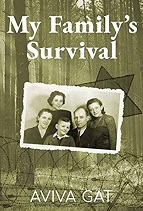
My Family’s Survival: The true story of how the Shwartz family escaped the Nazis and survived the Holocaust – Aviva Gat

gat

The rise of anti-Semitism that is occurring across parts of Europe and here in the United States is both troubling and disheartening.  Throughout history, the Jewish people have been persecuted on the basis of their faith and during World War II, they were subjected to systematic extermination fueled by racist ideology and pseudo-science.  Adolf Hitler’s quest for power and dominance brought death and destruction across Europe and nearly brought Germany to its knees before Allied forces.   To this day, World War II is seen by many as the worst conflict mankind has ever fought.  As the German Army rolled across Europe taking control of cities, towns and razing small villages, Jews were forced to flee for their lives or risk being sent to ghettos and concentration camps through the Third Reich’s “Final Solution”.  Among the Jews that did flee was the Shwartz family which resided in Butla, Poland. This book is their story of their survival as they fled their home and traveled across Europe to escape the looming Nazi threat to everything deemed to be “Juden”.  

Aviva Gat is a descendant of the Shwartz family and through a series of interviews regarding the family history, she was able to compose this inspiration story of survival during a very dark time in world history.  By her own admission some of the story is fictionalize and I am inclined to believe that this in fact refers to some of the dialogue that may have taken place between the central characters. Regardless she does affirm that the experiences described in the book did in fact take place as the family moved from Poland, to Hungary and Romania where the book ends.  And while the story does provide the typical “happy ending”,  it does not end on a tragic note. 

The story begins in the small village of Butla which remains largely shielded from the events taking place inside of Germany.  They are aware of Hitler but have yet to see first hand the effects of the war.  But when Hitler invaded Poland on September 1, 1939, their lives changed forever and Poland was never the same again. The first visitors to Butla are Russian soldiers who make make themselves at home. But they are gone as fast as they came leaving the people of Butla wondering what will come next.  They did not have to wait long as Ukranian soldiers arrive and commit an act of violence that brings home the reality of what is taking place.  It becomes clear to the Shwartz family that their time in Butla is limited.  The family is led by the patriarch who dies early in the story.  Their mother is already deceased and is mentioned only briefly.  The responsibility to care for the family falls on David, who leaves the town with wife Hinda, children Abi and Sarah, and younger sister Rachel.   The other brothers Shlomo, Meir, Itzik, Zelig and Chaim had previously left the town.  This small group embarked on a journey that is simply unbelievable and highlights just how dangerous it was to be Jewish in Eastern Europe during World War II.  

As the book progresses, we are introduced to numerous characters who play crucial roles in the story.  What I found to be very interesting is the sense of unity that exists among the Jewish characters in the story and it also shows that without this hidden network, many of them would have perished. And while the journey was not easy,  there are moments in the book where the kindness of others shines brilliantly.  But sadly, as refugees from Poland, they were subject to discrimination both in Hungary and Romania. And some of the discrimination was at the hands of other Jews.  Those parts of the book were hard to read and the scene in which Abi finds a Synagogue might resonate with and infuriate readers who are Jewish. I personally stared in disbelief at what transpires between him and the Rabbis.   

Because the book is centered around the family and their journey across three countries there is very little mention of what is taking place in the actual war. The main characters in the story do relay some things they learned as they were fleeing for their lives. Hitler’s name does come up but only a few occasions and none of the other notorious figures in the Reich make an appearance. This book is strictly the Shwartz story.  However, towards the end of the book the war does become a bigger part of the story, in particular when Allied bombing raids come too close for comfort. The scene in which David is in the hospital shows how a moment’s notice and sheer luck sometimes meant the difference between life and death. The story is full of close calls, some of which will make the hair on the back of your neck stand up.  Many guardian angels appear in the story at just the right moment, preventing certain death and a far more tragic outcome.  Some characters in the story are cruel and take advantage of the Jews’ plight.  However, the are far and few in between and unable to overcome the vast network of support that the Shwartzs and others have available to them.  It is a classic example of how unity overcomes adversity.  

The final act in the act occurs through the actions of Abi who grows up quickly during the war.  His decision to reach Palestina as they know it, changes the lives of all for good.  That part of the book is a story all in itself and the journey is one that many Jews were forced to take as they escaped the growing Nazi menace.  Back in Eastern Europe, David makes the decision that he and Hinda will also go to Palestina while Rachel’s like takes a slightly different path albeit with the same destination.  Victor emerges as a critical part of the story’s finale and helps to bring their struggle full circle. However in the epilogue, we learn some dark facts about the fates of the other members in the Shwartz family.  I will not go into it here but will say that we all know what happened to many Jews who did not flee Europe.  Their fates and that of the other Shwartz brothers provide the dark cloud that hangs over the story because of the subject matter. Further, the extermination of the Jews is a topic for another discussion at another time. But if you are in search of a good book about the costs that were paid to endure the nightmare that was World War II, this book is a good addition to anyone’s library.

ASIN : B07MZ2ZL56


Voices From Iraq: A People’s History 2003-2009 – Mark Kukis

Kukis

When the United States Armed Forces invaded the country of Iraq in March, 2003, I had a very uneasy feeling in my stomach with regards to the future of that Islamic Republic. Occupation by a foreign army is never a process that goes smoothly and even the best military commanders are unable to predict the final outcome.  Yes, Saddam Hussein (1937-2006) was removed from power, subsequently captured and forced to stand trial wherein he was convicted and sentenced to death.  And although he is gone from power in Iraq, his ghost continues to haunt the country and there are many Iraqis who continue to live with mental, emotional and physical scars from the days of his regime and memories of the invasion by American forces.  As a person who lives in the Western Hemisphere, there is much about the Middle East that I have still have yet to learn.  When I saw this book as a recommendation on Amazon, I immediately jumped at the chance to read it.  Mark Kukis covered the conflict from 2006 to 2009 as a correspondent for Time Magazine and saw firsthand the devastation from the invasion.  Appropriately titled Voices From Iraq, it provides readers with the opportunity to read the words spoken by Iraqis who survived one of history’s deadliest regimes and a military invasion by the United States of America.

Readers should be aware that the book is not for the faint at heart. Also, it is not a discussion focused on Hussein himself.  Some of the speakers do mention his name as they remember his reign of terror, but the focus remains on the aftermath of his removal from power.  Be prepared for a graphic descriptions of violence and tragic stories that involve murder, kidnapping and bombings that left paths of devastation in their wakes.  The men and women who sat for the interviews presented in the book are everyday people who had their entire lives turned upside down in a conflict that none of them asked for or desired.  Kukis provides a brief description of their lives and turns the floor over to them so they can tell us exactly what they remember from those dark times in their nation’s history.  And what will happen is that your emotions will embark on a roller coaster ride as you learn the truth about the “liberation” of Iraq.

I believe that it may be of some benefit to readers to learn the back-story of the conflict between Shi’ite and Sunni Muslims, which forms the basis for a lot of the sectarian violence that becomes commonplace without a centralized Iraqi government. In the wake of Hussein’s departure, the Shi’ites soon found themselves the targets of Sunnis who had formerly been party of the Baath party in the Hussein’s Administration.  The vengeance with which they go after the Shi’ites is both alarming and heartbreaking, and through the words of the speakers in the book we can see how many individuals were targeted by Sunni militias determined to eliminate those they determined to be enemies of true Islam under the Sunni ideology.

The rise in sectarian violence and sudden disappearances that occur throughout the book sent chills down my spine.  Nearly all of the victims are men, many of them husbands with large families at home.  Further, there is often no explanation given for their abductions and their families typically learn of their fates through third parties or unfortunately, a trip to the morgue. In some instances we do learn as to what exactly did happen but even then there are parts of the story that even the surviving family members have never figured out.   Some of the speakers became translators for American forces and had joined with them in order to eradicate the menace of al-Qaeda.  In a country where smaller cities are occupied by people of the same sects of Islam, keeping one’s identity secret was not always easy. The level of danger involved in this line of work is captured in their stories highlighting just how close some of them came to having in their lives taken from them because of their efforts to assist the Americans. But make no mistake, those who did help the Americans firmly believed in removing Al-Qaeda from Iraq’s soil. However, the American way and Iraqi way are fundamentally different as explained in this quote by Sheik Hamid al-Hais:

“If the Americans found people from al-Qaeda, they arrested them. We killed them. That’s the difference. That’s why we were able to start defeating al-Qaeda in a matter of months where the Americans had struggled to beat them for years. These people, al-Qaeda, are not human. ” – Sheik Hamid al-Hais

It should be noted that not all of the Iraqis interviewed were thrilled to see the Americans arrived and some picked up arms in defense of the country from those they saw as occupiers.  I think it is important for American readers to understand that there are many things we did not see on television here at home.  As I read through the stories, I began to form a more accurate picture in my mind of the daily reality of life in Iraq after Saddam Hussein.  The fallen dictator’s legacy is largely negative but some supporters did remain and in spite of the terror he inflicted upon Iraqis, he was seen by some as the lesser of two evils.  Azhar Abdul-Karim Abudl-Wahab is a former instructor who firmly believed in the American mission, yet his students offered varying views of the invasion.  He emphasizes that:

“Of course you cannot discuss Iraqi history without mentioning Saddam, whom I viewed as a kind of occupier. I tried to put it in those terms to my students. Saddam stole freedoms from Iraq. He stole money from Iraq. He brought wars on Iraq. All the bad things an occupier might do Saddam actually did. I told them this. For the most part their reply to me was the same. At least he was an Iraqi, they would say. At least he was an Iraqi ” – Azhar Abdul-Karim Abudl-Wahab

Other were more forceful in their views of the Americans whom they viewed with suspicion and in some cases anger.  Regardless of Hussein’s tyrannical reign, the country did have a central power structure. But with the tyrant gone, a free for all commenced during the development of a power vacuum.  And for the people of Iraq, the violence escalated to levels that none of them wanted or could have ever conceived.  Sheik Abdul Sattar Abu Risha is quite blunt in his assessment of the American effort:

“Yes, they are to blame. The first thing the Americans did when they entered Iraq was to disband the Army. They opened up the borders and allowed people to come in. They did not work with us, the people, in the beginning. Al-Qaeda was able to come in and gain influence with the people instead. I don’t think there is any American who can deny that, because that’s the truth.” – Sheik Abdul Sattar Abu Risha

If you have decided to pick up this book then I believe I do not have to tell you that there are no “happy endings”.  Every story is a tragedy on its own and will require sensitive readers to take a break while reading. I personally had to take moment to gather my thoughts while reading some of the stories.  The recollections presented show a lifestyle that is more than any person should bear.  Death lurks around the corner for everyone and even the suspicion of helping the Americans or not practicing what extremist call “true Islam” was an instant death sentence. Quite frankly, this book fully shows why war truly is hell. As an American, I was forced to ask myself: did we truly succeed in Iraq? And if so, at what cost was it to the Iraqi people?

The 2003 Iraq War has largely faded into distant memory for the average American.  Yet, it was less than twenty years ago that an entire country was destabilize in the name of democracy.  A brutal tyrant was removed from power but in the process, the people he left behind were forced to endure hell on earth.  These are the voices from Iraq that tell the truth about a war that continues to haunt two countries.  Highly recommended.

ASIN : B007QXW76Y

The Sins of the Father: Joseph P. Kennedy and the Dynasty He Founded – Ronald Kessler

Kessler-sinsoffatherWhen we think of political dynasties in America, perhaps no other name has had as big of an impact as the Kennedys.  They are both admired and loathed but their importance to  the American experience cannot be understated. The patriarch, Joseph (“Joe”) P. Kennedy, Sr. (1888-1969) was once one of the wealthiest men in America.  Yet for all of his financial success, controversy followed him and his family for years after his death.  The family’s success undoubtedly reached its highest peak with second son John F. (“Jack”) Kennedy (1917-1963) was elected in 1960 as the next President of the United States.  For Joe, it was a dream come true and reaffirmed his mantra that “Kennedys don’t lose”.  To most of the public, the Kennedys seemed like figures out of a story book and the media’s creation of the term “Camelot” that was given to the Kennedy White House, further enhanced the family’s mythical status.  The image presented to the public gave the impression of a fairytale marriage that any single person would envy.  Today, we know through the benefit of hindsight that the truth is far less glamarous and behind the scenes, there were dark storm clouds gathering as infidelity, old man Joe’s influence and one foreign crisis after another made life as the first family strenuous to say the least.  Rumors have persisted over the years that Joe Kennedy provided the money for all of his sons’ political campaigns and that the money he provided was used in several places to swing the election to his son Jack.  And while there has never been documented evidence of such, statements have been made by many individuals that action were taken to give Kennedy the election.  All knowledge of what really did happen went with Joe Kennedy to the grave and I doubt that even his sons knew the whole story.  He was a master at compartmentalization and for years, remained chameleon like figure.  Ronald Kessler decided to take another at Kennedy’s life and what he found has been compiled into this book that peels back the layers that have shrouded the Kennedy family is mystique for several decades.
I should point out that the book is not about the Kennedy presidency nor is it focused on Jack’s assassination in Dallas, Texas. In fact, the murder receives only a small section in the story.  Joe Kennedy is the center of the story and the author takes us deep inside his world in a time before Adolf Hitler (1889-1945) started a second world war. the stock market was less regulated, Hollywood was for the taking and the 1919 National Prohibition Act (Volstead Act) turned bootleggers into millionaires.  Joe’s numerous ventures both legal and illegal are discussed in the book and show that he was not above defying the law in order to reap hugh profits.  After providing background information on the Kennedy and Fitzgerald families, Kessler shifts gears and the story picks up pace as Joe begins to implement his vision for financial success and political fame.  Kennedy had always portrayed himself as the Irishman who overcame bias and adversity to rise high in American society.  It is a moving story but there were many things he left out and Kessler leaves no stone unturned.  The real Joe Kennedy is revealed here and what we learn may prove to be more than some readers have bargained for.  If you hold the Kennedy family in high regard, then this book might cause you to re-evaluate your views of them while inducing feelings of bewilderment, sympathy and in some cases, pity.

There is no question that Kennedy was shrewd and domineering businessman, never afraid to throw his weight around.  And those abilities would bring him into the circle of President Franklin D. Roosevelt (1882-1945) whose relationship with Joe takes up a significant portion of the book.  Historians know very well the story of the “appeasement at Munich” where Czechoslovakia was carved up on a silver platter for Adolft Hitler by former British Prime Minister Neville Chamberlain (1869-1940) with the full support of U.S. Ambassador Kennedy.  But when Hitler decided to invade neighboring Poland on September 1, 1939, it became hauntingly clear that the appeasement was a distraction from Germany’s master plan.  Kennedy’s view that England would lose the war by 1940 caused consternation and outrage in Britain and Washington.  And it would put a deep strain to develop in the relationship between Kennedy and Roosevelt. Drawing upon written correspondence and statements by those with knowledge, the book reveals the high level of contempt in which Kennedy was held by many in government. Roosevelt himself does not spare Kennedy his wrath and it is an interesting look behind the scenes as the German army rolled across Europe.  Some readers might be puzzled by Kennedy’s behavior.  One possible explanation can be found in Gordon Thomas and Max Morgan-Witts’ The Day the Bubble Burst: A Social History of the Wall Street Crash of 1929, which discusses the link between Nazi Germany and American bankers and investors.   I personally wondered why Roosevelt tolerated Kennedy as long as he did.  There is a good explanation for that as well which is provided within the story, further highlighting the fact that politics is a ruthless business.   As the war rages on, Kennedy eventually moves back to the United States and like a piece of chessboard, he is moved from one position to another but never attains a position within the White House. He would live vicariously through Jack who’s victory over Richard Nixon (1913-1994) was the moment Joe had been waiting for.

I have often heard of the Kennedy curse and tragedy did follow the family constantly.  The deaths of Joe and Rose Kennedy’s (1890-1995) children affect both deeply and the mantra of “Kennedys don’t cry” comes off more as a slogan than a way of life.  In spite of Joe’s antics throughout the book, there did exist a very personal side to him that was often unseen and rarely revealed.  The memories provided by his former mistress Janet DesRosiers shows him in his most humble state and also provokes more questions about the marriage between Joe and Rose which comes off as more than unorthodox.  What we learn about their union sheds light on the difference between liberal and puritanical views.  Stories of the Kennedy men and their love lives is nothing new and in the case of Joe, he certainly had his fun.  But while reading the book, I asked myself if he would have behaved in the same manner had his marriage to Rose taken a different course? We can only speculate but what is clear is that “love” is not always what we think it is and many secrets always exist behind closed doors. On occasion in the book, statements by their children regarding their childhood provide a very sobering picture of life at home and there are very few positive comments about their mother Rose, who is more like a visiting relative than full-time mother.  They do however, show the utmost respect and admiration dad Joe who emerges as the glue that holds the family together.

Far from being “Camelot”, the family was more like an episode of reality television gone wrong. However, there is no question that the Kennedy possessed enormous ambition and it propelled them to high places.  For them, losing was not an option.  And John F. Kennedy remains one of America’s most beloved presidents.  Aside from Joe, the author does discuss incidents that arise in the lives of the children, most of which are highly serious.  Ted (1932-2009) as the family called him, has a series of incidents that severely injured or took the life of someone in his company.  Yet his accidents are only a few in a long series of events in the Kennedy family that involved tragedy due to recklessness or substance abuse. And no story about the family is complete without a discussion regarding the missing sister, Rosemary (1918-2005) who outlived all but one of her brothers.  Her story is perhaps one of the most tear-jerking parts of the story and I warn readers who are sensitive or may know someone labeled as having a mental disability that this part of the book might be difficult.  But, the discussion presented by Kessler points out some things about Rosemary’s intellect that show just how primitive the mental health field in the 1940s. Today, I believe that had she been born in another era, she would have lived a far different and close to normal life. But sadly, she was born in a time where most doctors did not understand what her condition actually was and resorted to drastic measures that changed her life permanently and served as a major source of regret throughout Rose’s life.

To say that the story by Kessler is unbelievable would be an understatement. This is a raw and unfiltered look at the life of Joe Kennedy and his family whose name is a crucial part in the our nation’s past. Some readers may be surprised at what Kessler reveals and others may feel indifference.  As time moves forward, the  Kennedys will be remembered at best, a dynasty from another era that continues to fade into the distance.  Admittedly, I was aware of a good number of the facts revealed by the author and had no illusions about how fierce and ruthelss Joe Kennedy could be.  I believe it is for that reason that I was never shocked while reading the story.  However, I did learn more about the the level of dysfunction that existed within the home and how unusual family ties were.  For further reading, I do recommend that readers consider Seymour Hersh’s The Dark Side of Camelot  , in which the author explores many alleged family secrets. The book is controversial but overall very well written and I do believe Hersh was right about some things but not about everything. However, it is still a good read and completely breaks down the myth of “Camelot”. I have no doubt that there are many family secrets that remain carefully guarded.  In the end, no family or individual is perfect and this story is proof of that.  Further, we can have all the material items we want in life and still suffer from loneliness.  Joe comes to understand this quite well and his unguarded moments show that even those of us with a strong facade are at times highly vulnerable on the inside.  Regardless of your opinion of him, Joe Kennedy remains firmly entrenched in American history as the founder of a dynasty that once captivated an entire world.  And if you decide to read this book, be aware that there is far more to the man you may have ever imagined.

ASIN : B006YC7AH4

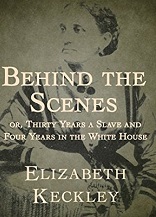
Behind the Scenes: Or, Thirty Years a Slave and Four Years in the White House – Elizabeth Keckley

keckleyThe assassination of President Abraham Lincoln remains one of the most important historical events in American history.  Honest Abe, as he was known, had been elected as the first Republican president to serve in the highest office in the land.   The Grand Old Party (GOP) had been founded in 1854 and Lincoln was the icon for what the party stood for.  In the wake of his death, John Wilkes Booth (1838-1865) was shot and killed by law enforcement officers and several of his co-conspirators went the gallows including the first woman to be executed by the United States Government, Mary Surratt (1823-1865). Lincoln’s widow, Mary Todd Lincoln (1818-1882) grieved deeply for her husband but what I was not aware of, was her close friendship with a former slave and dress owner by the name of Elizabeth Keckley (1818-1907).  When I saw the title of the book, I had to do a double-take and quickly realized that I needed to read this book.  And I can after having finished it, that it is an incredible story from a first-hand witness to the personal lives of Abraham Lincoln, his family and important figures in Washington who do not escape Mary’s skeptical eye.
Keckley was born a slave and she recalls her early life which is quite tragic.  Readers who are sensitive to material about slavery in the United States and acts of violence might find the early part of the book slightly difficult to read through but I promise you that it does get better in some ways.  Keckley’s story picks up pace after she earns her freedom due largely in part to the generosity of Mrs. Anne Garland who helps her raise the twelve hundred dollars required by her owner.  After satisfying the price and repaying her debt, she is free to move on in life but I am sure that she could never have imagined that she would not only serve the Lincoln family but also the family of Confederacy President Jefferson Davis (1808-1889).  I was not prepared for this part of the story and I believe it is one of the most curious moments as well.  The section on Jefferson Davis is brief, mainly because she did not spend much time with them as it occurred before the war broke out and the Davis family moved south.  And Mrs. Davis makes some comments that are quite interesting about the impending conflict.  History proved her wrong but her comments are revealing.  Keckley had gained fame as a dress maker whose skills were in high demand and it is because of this that she came into the life of the Lincolns.

Mary Lincoln takes on Keckley as sort of a personal assistant who assumes many roles, even confidant.  Keckley is full of endless memories of many private aspects of the first family’s life.  The death of Willie Lincoln (1850-1862) hits hard and we are allowed to bear witness to their enormous grief.  It is a very intimate portrait of the Lincolns that the public did not see. And when Lincoln himself is assassinated, it is Keckley who comes to Mary’s aid in her time of grief.  But, that is only half the story as the two develop a deeper friendship.  Each moves around the country, often with Keckley meeting Lincoln in yet another city.  But in the end, they were separated by distance and reliant upon written correspondence. Regardless, it is a touching story of friendship in a time where relations between blacks and whites was largely that of upper and persecuted lower class.

I did find Mary’s comments about members of Lincoln’s cabinet to be interesting and in some cases, she was vindicated.  Keckley absorbs all and makes her own comments on occasion about those figures.  The Vice-President Andrew Johnson (1808-1875) is shrouded in infamy through Keckley’s revelations about his non-actions as Lincoln lays dying.  His actions are direct proof in regards to the negative view held by Keckley and others of the man who succeeded Lincoln.  The author does not encounter him herself but does meet members of his family who stand in stark contrast to him.  Johnson’s actions during the Reconstruction Era nearly resulted in his impeachment. The vote of a single senator saved him from eternal embarrassment. Some might say that he did that before impeachment but I leave that to readers to decide.

As Mary and family move on from Washington, Keckley goes out west with them as Robert and Todd continue to grow without their late father. We see some of the lighthearted moments between mother and sons but Abe’s ghost is never far away.   And Mary has a secret about finances that Keckley reveals which may cause readers to stare in disbelief.  That secret also sets the stage for the remainder of the book, in particular the duo’s trip to New York City.   Mary is determined to regain financial stability due to the loss of her husband and status as first lady.  Keckley becomes her crutch and does her best to help Mary in her financial endeavors.  And to show Mary’s increasing concern for money, Keckley includes transcripts of the letters that she received from Mary.  In them, we can see the change in her mental state and concern for her pending transactions as time continues to move forward.  We do not see Keckley’s replies (photocopying as we know it did not exist so it is understandable) but it is clear from Mary’s letters that she does receive replies from Keckley.  The book ends without a final word on Mary, who is dependent on her dear Lizzie, as Keckley is known to those who are fond of her.  In later years, Mary was institutionalized and lived her final years moving around both domestically and internationally.  She died at the age of sixty-three on July 16, 1882 after suffering a stroke the previous day.  Keckley died in May, 1907 and rest at National Harmony Memorial Park in Landover, Maryland.

The book is short but it is a great story by a woman who lived in a horrible system of human explanation and through luck, fortune and destiny, rose above it and found a home in the White House with a president whose actions changed the course of American history.  There are some sad moments in Keckley’s own life although she does not go into deep detail about them. She keeps the focus on those she encounters, undoubtedly to show the incredible journey she found herself on.  If you have the time, I think you will find this to be a great selection and I do feel that it should be part of any library which contains literature on the life and death of Abraham Lincoln.  This is a good account from an incredible woman.

ASIN : B01CD4O772

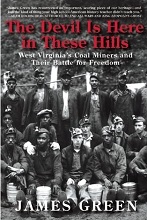
The Devil Is Here in These Hills: West Virginia’s Coal Miners and Their Battle for Freedom – James Green

green-devilThe United States is considered by many historians to be “young nation” due to it being in existence since 1776.  While it is true that my nation’s history is not as extensive as Ancient Greece or Egypt, in the time since its creation, America has been the source of some of the most groundbreaking events in world history.  Incredibly, there are dozens of smaller events that have taken place which many Americans have forgotten about or are not aware of.  When President Donald Trump ran for office in 2016, he made it clear he wanted to bring jobs back to the Appalachian region known simply as “coal country”.  It was profound promise to make and some might go as far as to say it was deception on the part of the candidate.  Four years later the situation in Appalachia has not changed much and coal is widely considered to be an older energy source to be exported rather than used domestically. Natural gas and nuclear power have substituted coal as America continues to employ cleaner sources of energy.   West Virginia is seen as the heart of Appalachia and has made headlines in recent years due to the surge in opioid addiction.  I watched the 2013 documentary Oxyana and it provides a glimpse into the lives of some West Virginians but surely, it does serve as the example for the entire state. But what we do see in the film continues to exist and is cause for concern.  One question I have always had is what exactly happened during the time in which coal was so widely desired?  I had read Henry Caudill’s Night Comes to the Cumberlands: A Biography of a Depressed Area and therein the author provides a thorough explanation of the coal story in Cumberland County, Kentucky.  James Green shifts the focus here to West Virginia and tells the story of its coal miners who waged a battle that helped changed labor practice in America. 

Before starting this book, I believe that it is imperative for you to clear your mind of any pre-conceived notions about West Virginia.  As I began to read, I reminded myself that there was much about West Virginian history I did not know and this book is solid proof of that belief.  Green takes us back in time to the middle to late 1800s as mining companies begin to realize the enormous potential for profits in West Virginia.  Dozens of corporations soon set up shop and began hiring miners to engage in backbreaking and deadly work. Sadly, the workers are essentially viewed as “tenants” of the coal company which is recognized as a “landlord” by the law.  Further, it is clearly explained in the book how miners had very little rights and were financially dependent on the coal company in every part of their lives making the system nothing more than a hotbed of slave labor.  The work was long and dangerous with explosions and the caving in of mines a very real threat. In the early 1900s, miners began to wake up and their voices would be amplified by critical events and iconic figures who remain legends in miner lore.  The formation of the United Mine Workers of America (UMWA) was the first step in miners taking back control from the coal companies and obtaining protections in what was becoming an increasing deadly profession.  Unionization was new to coal country and the coal companies did not give in without a fight. What took place in the wake of its formation, provides us with an incredible story told beautifully here by the author.  However, the formation of the UMWA is only one part of the story and there were many faces and events taking place around it that are important pieces to the larger picture. 

Every movement needs leaders and there is no shortage of them here.  The guiding figures we learn of in the story are Mary Jones (1837-1930) known publicly as “Mother Jones”. She emerges as a powerful voice for the miners and is joined in the struggle by Frank Keeney (1882-1970) and Fred Mooney (1888-1952), whose efforts to protect the miners are critical to the story being told.  Admittedly, I did not know the names of these figures nor of the battles between coal companies and miners in both Paint Creek and Cabin Creek.  The violence became so bad that Governor William E. Glasscock (1862-1925) declared martial law on more than one occasion.  West Virginia was hot and the battle was just heating up.  More figures soon enter the story including both former Governor Harry Hatfield (1875-1962) and Matewan, West Virginia Police Chief William Sidney “Sid” Hatfield (1893-1921), whose actions against the Baldwin-Felts Detective Agency earned him the admiration of thousands of miners.  Interestingly, both are related to the Hatfield family and the author does discuss the Hatfield-McCoy “feud” that has become a pop reference in American culture. Readers who want to know what really happened during the alleged feud should read Thomas Dotson’s The Hatfield and McCoy Feud after Kevin Costner: Rescuing History, which clears up many long-standing rumors and non-factual statements that have persisted for years.  

I found myself surprised to learn of the large number of immigrants that lived and worked in the West Virginian mines.  In contrast to a prevailing image of a largely white Anglo-Saxon demographic, immigrants from Europe and Black Americans settled in the area where the men found work in the mines. McDowell county stands out in the story for its black citizens and importance to the growth of the UMWA.  And just as Mother Jones realized, they were the key to achieving both unionization and true change for the miners in West Virginia. In fact, the Italian immigrants played a much larger role than many people may realize.  And some might be surprised at the large number of Italian settlers but what is often left out of the Italian immigrant story is their arrival in the south, in particulars New Orleans, Louisiana.  From the south, many Italians also moved across the United States and settled in areas that provided the new lives they sought in America.  It could be said that Green’s book is not just a story on West Virginia’s mines, but also the immigrant experience in America which continues to play itself out as politicians use the matter for political gain. 

While reading the book, I quickly realized that was took place in West Virginia was really a small-scale civil war.  It may sound like an exaggeration but I am convinced that readers will see just how deadly and fierce the fighting became as coal companies began to use outside enforcers to evict miners off company property.  Albert Felts and Don Chafin (1887-1944) emerge as the story’s villains.  The battles were deadly and the miners essentially form their own army to take on the corporations. It was nothing short of a war which has received scant attention in discussions focused on American history.   Green is fully conscious of this and early on he points out that: 

The West Virginia coal miners’ story has never been recounted in full from its origins in 1892, when the first UMWA organizers appeared in the coal camps, to those thrilling days in the first spring of the New Deal, when union forces emerged victorious after forty years of struggle.4 The Devil Is Here in These Hills is a history of that enduring struggle and of the diverse community of working people who carried it on for so long.

Washington was aware of the events taking place in West Virginia but had repeatedly resisted calls from state officials to send in federal troops, believe that the matter could be resolved through negotiation. The stalemate continue through the early 1900s until a key piece of legislation was passed that changed America. The New Deal programs enacted by President Franklin D. Roosevelt (1882-1945) between 1933 and 1939 were critical in repairing the American economy in the wake of the Great Depression.  A key component of the program ushered in a new course for American labor.  Its significance will not be lost on readers.  However, there are sad moments in the book and what happens in the aftermath of the New Deal may in fact be the saddest part of the story despite the law’s impact.  I say this because the removal of the need for a united front changed not only the demographics in West Virginia but also gave rise to darker aspects of America’s troubled past.  The author explains each in detail and I am sure readers will be shaking their heads by this point in the book.  

Jones, Keeney and Mooney are long gone but their actions and commitment to miners’ cause will never be forgotten.  The story of West Virginia’s mines and its workers is an example of the bloody and protracted struggle for workers’ rights that continues to this day.  Further, it is a part of American history that every citizen should know.  If you are curious about coal country and its long history, this book is a must read. 

ASIN : B00OV9D9RM

The Day the Bubble Burst: A Social History of the Wall Street Crash of 1929 – Gordon Thomas and Max Morgan-Witts

Morgan-burstIn the autumn of 1929, between the months of September and October, the world was plunged into financial uncertainty as stock markets in New York City and other places saw a massive devaluation of stocks and bonds.  Some investors lost millions in the crash and others less financially secure, saw nearly their entire market portfolio crumble before their eyes.  In the wake of the crash, America plunged into the great depression that spread misery and despair across the nation for several more years.  The crash remains to this day, one of the greatest financial disasters in history.  However, its causes are still up for debate and there is no single reason for the catastrophe but numerous factors did combine to bring the economy to a grinding halt.  Authors Gordon Thomas and Max Morgan-Witts have studied the crash and tell the story here about the “day the bubble burst”.

Prior to reading the book, I was familiar with some of the names that are critical in the story. For example, I knew of William C. Durant (1861-1947), the founder of General Motors and the legendary Joseph P. Kennedy, Sr. (1888-1969), former owner of RKO Studios and Ambassador to Great Britain. Incredibly, Kennedy comes out of the crash with minimal loss and would go to establish his own dynasty that catapulted his son John F. Kennedy (1917-1963) to the White House in the 1960 election.  But there are many others crucial to the story and their lives and actions are intertwined in the fabric of American society both past and present.

I forewarn readers that the story moves from one person to the next and then back again.  And although the book does follow a chronological order, it is actually several stories woven into one. Next to Durant, the life of Charles Stewart Mott (1875-1973) comes into focus as the authors examine his role at General Motors and actions at the Union Industrial Bank which plays a very important role in the story.   The authors also take a look as A.P. Giannini (1870-1949) the founder of Transamerica known today as Bank of America. Continuing on, Jesse Livermore (1877-1940) enters the picture as the poster-boy for the successful stock trader.  Charles E. Mitchell (1877-1955) joins the cast of characters as chairman of National City Bank, known simply today as Citi Bank.  His financial policies are believed by many to be one of the direct causes for the crash of the market. John Pierpont “Jack” Morgan Jr., (Jack Morgan) is a strong presence as well and readers will take note of a key situation involving Morgan and Joseph Kennedy that seemed to grind the latter’s gears and set him on due course to become a financial titan of his own. And finally for the New Yorkers, John J. Raskob (1879-1950) will be of high interest for his enduring contribution to the New York skyline: the Empire State Building.

One of the book’s major strengths is the explanation of the stock market provided by the authors, which is helpful to readers seeking to get an understanding of how the traders were manipulating and playing the market. Of course, the book is not intended to be a stock market guide but simple enough for the everday reader to understand in relation to the story being told.  Today, the market is just a competitive but back then, less regulation existed and traders were far more willing to engage in dubious and illegal activity as can be seen in the story.  The thirst for wealth was so contagious that traders in other countries would also play a role in the crash such as British investor Clarence Hatry (1888-1965), who some blame for ingiting the spark that caused the panic resulting in the plummeting of stock values across world markets.  The authors do not convict him in the book but leave it up to readers to decide. However, they do say this to make their point clear:

“To say that Hatry caused the Wall Street Crash would be to put it far too strongly. But to say that his downfall played no part in it whatsoever would possibly be equally misleading.” 

Undoubtedly, the crash had many causes and the number of people who deserve blame is quite significant. Greed and disregard for financial risk, allowed unrestrained investing into a market, held together by carefully adjusted interest rates and the exchange of foreign currency and other commercial goods. And a ripple in that temperamental network of world markets resulted in a crash no one thought possible yet everyone feared. From housewives to savvy Wall Street players, the impact was brutal and drove some to the brink of suicide. And today that risk is present as the market fluctuates constantly. However, in the wake of the crash, the Federal Government stepped in and imposed tougher regulations to prevent a replay of 1929.  And if there is any doubt as to the severity of the crash, this quote sets the record straight in the most sobering of ways:

“In the five hours the market had gone mad on October 29, it was later estimated that almost as much money in capital value vanished into thin air as the United States had spent on World War I. The loss was around ten times the budget of the Union in the entire Civil War.” 

Towards the end of the book the discussion shifts slightly away from New York and on to Berlin where a young Austrian named Adolf Hitler (1889-1945) is making a name for himself and using Germany’s dire situation and the crash to consolidate his power and grip of the Fatherland.  The connection between the market’s crash and Hitler’s rise to power will be of high interest to history buffs and aficionados of World War II.   And what the authors reveal about the relationship between Wall Street and Germany might leave some shaking their heads in disbelief.  There is far more to the story than I could possibly discuss here but what is disclosed explains why some elements of American society were hesitant to get involved in World War II.  The saying “follow the money” certainly does apply.

In the afterword to the book, the fates of those involved with the crash are detailed by the authors, and here we see how they ended up after devastating financial fallout.  The end result is often sad and in some cases involved criminal prosecution.  The government left no stone unturned and hardly any of the major places was ever the same again.  A few did rebound and fair quite well in later years but they are forever linked to that fateful autumn of 1929.  Some may wonder if another market crash could happen.I believe so but under extraordinary circumstances.  Regulations are far more stringent today and watchdog organizations keep a carefully trained eye on the market.  However, it is also true that if we do not know our history, we are condemned to repeat it.  The 1929 crash was nothing short of earth shattering and the repercussions were felt for decades.  This is the story of how and why it happened.  Highly recommended.

ASIN : B00KQZY1JU

The First Jet Pilot: The Story of German Test Pilot Erich Warsitz – Lutz Warsitz and Geoffrey Brooks

WarsitzEvery time I board a flight at New York’s John F. Kennedy International Airport, I am amazed at the concept of flight. And while I do understand how an aircraft works from a technical standpoint, the process of taking off, cruising and landing still fascinates us and captivates our attention. Today, we reap enormous benefits from the trials and errors of those before us who sometimes gave their lives in the pursuit of flight. In June, 1939, a German pilot named Erich Warsitz (1906-1983) flew an aircraft named the Heinkel He – 176, equipped with a rocket booster for extra lift and speed. The flight was successful and the result of many years of dangerous tests.   The pilot and the engineers around him had just changed history forever and ushered the world into the jet engine era.  This book is a look back at that miraculous time and Warsitz’s life as presented by his son Lutz. 

Instead of writing a standard biography of his father from a third-person point of view, Lutz sat down with his father in the years before his death and conducted numerous interviews with him about his life.  The result is Erich presenting his story as the narrator, taking us back in time before Adolf Hitler (1889-1945) started World War II and led Germany to the brink of total destruction.  And although Hitler does appear in the story, those appearances are few.  The majority of the story takes place at the development facility at Neuhardenberg, where he forms a trio of dedicated flight personnel with Walter Künzel and Wernher von Braun (1912-1977).  Warsitz was a bachelor at the time and as a result, the story remains highly focused on the developments taking place as the engineers get closer to achieving their dream.  He does however, make reference to his personal life on occasion but as readers will learn at the book’s conclusion, his personal life picked up and changed following his release from Soviet control.  Here, we become fully immersed in the world of flight engineering in what could be called an inside look into the development of the He 176. 

What I noticed as I read was the level of danger that the pilots courted each day.  Accidents did happen and in some cases, death was the end result.  Warsitz had his own brushes with danger and describes them in detail as he tells his story.  But with each experience, we see his knowledge as a pilot increase tenfold and by the time the He 176 was ready for final production, he was ready to take the skies.  It is also clear that flying was his passion and he makes this perfectly clear in the book.  His companions in the project also shared his enthusiasm and the success of the He 176 was lost on no one. In fact, the feeling among the crew is summed up by Walter Künzel:

“None of those involved will ever forget the great impression which this maiden flight made on us all. As regards myself personally, who had overall responsibility for the preparation, and gave permission for the take-off, I may say that though outwardly calm, after the successful landing I was absolutely bathed in sweat, and several of us, myself included, had tears in our eyes once the aircraft came to a stop on the ground.”

Because the Third Reich was in power at the time, the work on the He 176 was subjected to scrutiny and approval by the Reichsluftfahrtministerium (RLM).  Officials pay visit on several occasions to take note of the plane’s development.  Politics come into play and Warsitz duly notes the maneuvers required to keep the project afloat as eagle-eyed officials look for any reason to stop all work on the project.  Today, we have the benefit of hindsight to look back on the project’s success, but at that time, Warsitz and the other pilots and engineers walked a very fine line as they pursued jet flight and some of those close calls are described by the narrator. They provide the right amount of suspense in a story that is fascinating at its base. 

The collapse of the Third Reich saw the complete acquisition of Germany by Allied forces. Warsitz recalls his actions as the war came to a close, including his capture and incarceration by the Soviet Union.  He also mentions an interesting fact about German research and where it went after the war.  Upon his release from Soviet hands, he reconstructed his life and explains the path his life took as a former German pilot. But curiously, Warsitz was never officially in the German Air Force. In fact, he makes it clear that he had no interest in politics and regretted Hitler’s decision to ignite a war: 

“It is a dreadful period to look back on. The war took on a peculiar form and Hitler’s leadership became the purest madness. The worst was the deportation of the Jews: I had many working for me in Amsterdam and when I received the deportation orders I was able to help many by giving them ‘indispensable for the work’ status. I employed others intentionally in the hope of offering them protection. Money was the decisive factor. I could help many, but not in all cases and not all the time, and I had to be very cautious, for the Gestapo was present everywhere and always!”

Aside from this statement, there is no mention of the Final Solution or other nefarious acts by the Third Reich. This could be due to his isolation at the development facility and the fact that he was not in the “chain of command” so to speak. Whether he knew more and refrained from saying is lost to history.  But the focus here is on the aircraft and the story does stay on track. Further, there are plenty of books on the Third Reich and its horrible actions in World War II.  The story here is solely about the jet engine age which we all take for granted each time we board a flight at the airport.  Warsitz and others around him, realized the effect their success would have on the world and the importance of their mission was never far from their minds. But with determination, skill and brilliant minds, they changed world history in a way no one thought possible.  Good read. 

“At the time of writing in 1982, forty-three years have elapsed since the world’s first jet flight, and in the intervening years I have often been asked if I realized at that time that the German rocket and jet test programme would be the decisive step forward. We knew – from our technical espionage service – that the British and Americans had such a project but were not so far advanced as we were.”  – Erich Warsitz 

ASIN : B00AE7DHFY

Red Star Over China: The Classic Account of the Birth of Chinese Communism – Edgar Snow

snow On October 1, 1949, the People’s Republic of China was officially established as the ruling party in the nation. Mao Zedong (Mao Tse Tung) 1893-1976) assumed the position of Chairman, a title he held until his death in 1976. The Chinese Communist Party continues to rule the country and imposes its will on Hong Kong. Taiwan remains independent but is often the source of friction between Beijing and western powers. The story of the Chinese communists is a highly intricate tale that is often left out of discussions regarding the aftermath of World War II (1939-1945). Edgar Snow (1905-1972) spent twelve years in China and was able to observe the emergence of the Communist Red Army determined to liberate China both from Japanese imperialism and the control of the White Army, led by the Kuomintang Government (KMT) headed by the Generalissimo Chiang Kai-Shek (1887-1975).  This book is a collection of those memories that take readers back in time to the era when Mao Zedong was beginning to establish himself as a leader and China found itself in the middle of political, economic and social turmoil.

The book was originally published in 1937 but Snow made several revisions.  The Kindle version is the Grove Press Revised edition as of December 1, 2007.  Putting that aside, the crucial text remains and Snow lets us take a look at what he saw and heard as Chinese communism came into existence.  At the beginning of the book, readers will find a good chronology of Chinese history from the mid-1800s onward.  It is not intended to be the final list of dates in China’s history as that is still being written. But it is a good reference source regarding important dates as the world continued to move forward.  It is important to remember that Snow left China in 1936, three years before Adolf Hitler (1889-1945) decided to unleash the German military on Poland and ignite World War II.  The focus here is on the situation within China’s borders as Tokyo set its sights on establishing firm control over the country.  At the same time, the KMT is mounting a resistance but a smaller group of Marxists, called “rebels” by Chiang, want an entirely new course for China, modeled on the Soviet way of life.  As a result, a three-way dance ensues in which all three take shots at each other with the Chinese people serving as collateral damage.

Within the story are numerous figures and keeping track of their names may prove to be quite tedious.  Some may stand out to readers while others will be unfamiliar. Each plays a role in the story at hand but undoubtedly, the stars in China are Chiang Kai-Shek and Mao.  Their influences and prestige cannot be overlooked and Snow provides transcriptions of the numerous discussions that took place with Mao as the Red Army built its base.  Further, Snow found himself in a unique position in history, as he explains with this statement:

“Mao was of interest as a personality, apart from his political life, because, although his name was as familiar to many Chinese as that of Chiang Kai-shek, very little was known about him, and all sorts of strange legends existed about him. I was the first foreign newspaperman to interview him.”

Mao beings to speak freely, about his childhood, China’s occupation by Japan and the vision of Dr. Sun Yet-Sen (1866-1925) whose vision for an independent China was the basis for the Red Army’s mission.

The beauty in this book is not only Mao’s statements but the way in which author explains the formation of the Red Army and the inevitable battle with Chiang Kai-Shek, which curiously could have possibly been avoided.  In fact, Mao himself informed Snow that the main focus of the communist was to see the removal of Japan, even if that mean cooperation with the KMT.  However, the Generalissimo had no intention of cooperating with the rebels. For Mao and the Red Army, Japan had to be removed at all costs but when pressed with Nanking’s involvement in freeing then nation, Chiang’s response set the stage for the future battle to come:

“Chiang Kai-shek replied, “I will never talk about this until every Red soldier in China is exterminated, and every Communist is in prison. Only then would it be possible to cooperate with Russia.”

Today we know that Mao eventually had the last laugh but not before Chiang struck one final blow in establishing the independent nation of Taiwan where he remained in seclusion after exile.  And to this day, the small nation remains a source of tension as the United States and other allies remained committed to its independence from Beijing.

No discussion about communist China is complete without the role of the Soviet Union, led by the infamous Joseph Stalin (1878-1953). And while he does play a minor role in the story, he appears at crucial points, most notably the Chinese Revolution.  Stalin’s support for Mao and the Red Army is critical in the struggle but the partnership was not always at ease and prior to the revolution, Russia played both sides of the fence as it made pacts with Japan while later resisting Asian and German expansion.  Stalin was shrewd leader but also full of paranoia and suspicion.  Regardless, Mao and the Red Army had their own vision for China and as Snow shows us, they were determined to accomplish their goal.  And not even the KMT would be able to stop their advance.  Mao’s destiny was to lead China and when discussing the future with Snow, he remarks:

“The Chinese revolution is a key factor in the world situation. … When the Chinese revolution comes into full power the masses of many colonial countries will follow the example of China and win a similar victory of their own. But I emphasize again that the seizure of power is not our (immediate) aim. We want to stop civil war, create a people’s democratic government with the Kuomintang and other parties, and fight for our independence against Japan.” 

The story is simply incredible and a must read for anyone interested in the history of the Chinese Communist Party.  Because Snow left China in 1936, the later events of World War II and the final battle with the KMT is not discussed in detail.  And there are other books which do focus on that era.  Snow’s purpose here is to enlighten us about the rise of Chinese communism and why it came into existence.  Admittedly, the author provides extensive information not just on Mao but on others equally important.  And readers may find it challenging keeping up with the names of those who enter the story. But what is paramount to remember is that each played their role in the Red Army’s rise and success, and their memories live on in the annals of China’s history.  And to put the finishing touch on their accomplishment’s Mao provides one final statement to Snow that says it all:

“Another reason for its [the Party’s] invincibility lies in the extraordinary ability and courage and loyalty of the human material, the revolutionary cadres. Comrades Chu Teh, Wang Ming, Lo Fu, Chou En-lai, Po Ku, Wang Chia-hsiang, P’eng Teh-huai, Lo Man, Teng Fa, Hsiang Ying, Hsu Hai-tung, Ch’en Yun, Lin Piao, Chang Kuo-t’ao, Hsu Hsiang-ch’ien, Ch’en Chang-hao, Ho Lung, Hsiao K’eh—and many, many excellent comrades who gave their lives for the revolution—all these, working together for a single purpose, have made the Red Army and the soviet movement. And these and others yet to come will lead us to ultimate victory. ” –

Great read and highly recommended.

ASIN : B005012G0G

The Hoffa Wars: The Rise and Fall of Jimmy Hoffa – Dan E. Moldea

Hoffawars The disappearance of James Riddle Hoffa (1913-1975) still captivates audiences as shown by the success of Martin Scorcese’s The Irishman starring Robert Dinero as Frank Sheeran (1920-2003) and Al Pacino as Hoffa.  The film shows Scorcese at his best but the story told by Sheeran is known to be full of discrepancies.  Further, the Federal Bureau of Investigation (FBI) has never acknowledge Sheeran as being one of Hoffa’s killers.  Putting that aside, the movie is done very well and one of the rare times when Robert Dinero and Pacino have appeared on screen together.  But there is far more to the Hoffa story that is typically remember because of his fall from grace and disappearance on July 30, 1975.  I personally do not believe his body will ever be found and those who know what happened to him are either deceased or taking that secret with them to their graves.  However, in examining the Hoffa case,  we can focus on why he was killed which is just an important as how he might have been killed.  Dan Moldea has spent years covering the Hoffa case and is considered to be one of the best sources of information on the former leader of the International Brotherhood of Teamsters (“the Teamsters”).  And the result is a spellbinding story that peels the layers back uncovering a story that is nothing short of clash of the titans. 

I find that even today there is still a lot of confusion regarding the Teamsters and what exactly did happen when Hoffa was in power. In the preface to the book, we get a fitting summary that sets the tone for what is to follow:

“The Hoffa Wars tells an important story: how a potentially great force for good—the unionization of America’s truckers and warehouse laborers—was captured by gangsters and converted into a monster that robbed its members of their right to a fair wage and pension, robbed businessmen of their right to a free marketplace and clamped a high tax on American consumers every time they went to the cash register.”

When I first read these words, I admit that I had to reconcile them with the image I have had in my head of Hoffa who is typically portrayed as a benevolent figure that only wanted the best for Teamster members.  And while I have no doubt that he truly believed in the union, I also have to acknowledge that there was many dark secrets about the Teamsters hidden from public light.  As readers will see in the book, behind the scenes there was a power struggle taking place as the deposed king tried to reclaim his thrown.  Moldea leaves no stone unturned and the more unsavory facts about Hoffa’s reign come to light, shattering the myth of the “clean as a whistle”  union president who simply loves ice cream as portrayed by Pacino on screen.  The real Hoffa was a hard-nosed leader who had been through his share of battles in the process of unionization.  And the infiltration of organized crime and politicians proved to be too seductive even for him. The author untangles the complicated web so that we can see just how deep in bed the Teamsters found itself with the Italian-American  Mafia. 

Hoffa was in the process of writing his autobiography at the time of his death. I previously reviewed that book called Hoffa: The Real Story.  Therein, Hoffa does portray himself a fairly positive light. Moldea is not a fan of the book and views it as nothing more than a self-serving account.  I will leave it to readers to decide on their own but I can say that it is a good read to learn more about Hoffa’s early life.  What is clear here, is that Hoffa’s death removed any chance of him completing what surely would have been an explosive best-seller.  And it undoubtedly would have earned him even more enemies who wanted him removed from Teamster affairs permanently. 

The nexus of the book is Hoffa’s battles with Rolland McMaster (1914-2017) and Frank Fitzsimmons (1908-1981).  Moldea takes a close look at Local 299, which dragged Hoffa into an ugly power struggled that developed in the wake of Hoffa’s convictions for fraud by the U.S. Department of Justice.  The verdicts were the culmination of the “Get Hoffa Squad” organized by former United States Attorney General Robert F. Kennedy (1925-1968). The author provides a recap of their battle which was nothing short of savage.  McMaster, who had his own dark past, figures prominently into the story and provides valuable information to Moldea regarding what was happening as Hoffa became the tyrant who would not let go of power. And Hoffa’s successor, Fitzsimmons, has always been a person of high interest not only for taking over the Teamsters in Hoffa’s absence but also for his close alignment with the administration of President Richard M. Nixon (1913-1994), whose connections to the underworld are interesting to say the least. 

Historians are well aware of the bad blood between the Kennedys and Hoffa. And it has been suggested that Hoffa was part of the plot that took John F. Kennedy’s (1917-1963) life in Dallas, Texas on November 22, 1963.  And although there is no smoking gun to be found here, Hoffa was not sad to hear that Kennedy had been shot. Whether he actively participated in the plot to kill Kennedy will always be up for debate.  Much of the information revealed in this sotry comes from Ed Partin (1924-1990) whose testimony was once used to convict Hoffa.  And on an even darker note, Robert Kennedy was also the target of assassins, years before his murder on June 5, 1968 at the Ambassador Hotel in Los Angeles, California.  The story here by Moldea is quite disturbing and apparently, John Kennedy himself had been told of Hoffa’s thirst for revenge.  Exactly how Kennedy found out is not known but he did disclose it to reporter Ben Bradlee (1921-2014) as we learn in the book:  

“The President’s close friend, Benjamin Bradlee, who was then with Newsweek, noted in an entry in his journal for February 11 that the night before, at a private dinner party, the President had confided that Hoffa’s Teamsters had planned to send an assassin to Washington to kill his brother.” 

We know today that Robert Kennedy was not murdered while in Washington but the threat was very real. Robert Kennedy ultimately got his man and Hoffa was forced to stew in prison while the union he felt belonged to him, fell under the control of others.  And it was a position that Hoffa could not accept.  His obssesion with reclaiming the throne would have deadly repercussions later as Hoffa became suspicious of nearly all of his former subordinates. The list of enemies he had made continued to grow and dissent had resulted in splinter groups opposed to his dominance. Their stories are also included here as the story develops, showing that Hoffa was not idolized by all who knew him. 

The Hoffa story is further complicated by the association between the Central Intelligence Agency (CIA) and organized crime figures.  This part of the book may surprise some readers and as Moldea hints, it might have played a role in Hoffa’s death for reasons that have flown under the radar for years.  At this point in the book, we step into different waters as Jack Ruby (1911-1967), David Ferrie (1918-1967) and Sam Giancana (1908-1975) take center stage in plots to remove Cuban President Fidel Castro (1926-2016) from power.  There is a wealth of information but I feel that it is only the tip of the iceberg.  But Moldea did a good job of keeping the story streamlined and focused on Hoffa as the CIA-Mafia plot to kill Castro can easily be a book on its own.  This is Hoffa’ story and these events are only part of the full account. 

Readers should be prepared for many revelations about Hoffa’s life and the Teamsters.  And to be clear, there is no happy ending here.  This is a dark story filled with imposing figures whose lust for power and money knew no bounds. It is a story of paranoia, betrayal and murder.  And as Hoffa, McMaster and Fitzsimmons engage in their three-way dance, the Teamsters’ is forced to hold on while the saga plays out.   Unquestionably, Hoffa’s murder changed everything and Moldea goes through that day to piece together Hoffa’s final moments.  He does not profess to know who killed Hoffa but does explore possible scenarios.  Charles ‘Chucky” O’Brien (1933-2020) had been the focus of attention for decades after it was alleged he drove Hoffa to his final meeting where he was killed. O’Brien always maintained innocence and the jury is still out on whether he set up his former mentor.  Moldea explores his possible role as well but stops short of making accusations against O’Brien.  It is possible that the FBI knows who did kill Hoffa but has never said due to lack of physical evidence and a corpse. The Hoffa disappearance will never fade away as researchers continue to revisit the life of a man who cemented his place in American labor history.  If you are looking for a balanced report of the Teamsters, Jimmy Hoffa and his downfall, this is a good place to start.  Good read. 

ASIN : B00S7EFYRU