
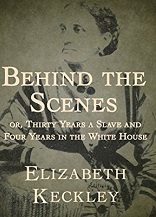
 The assassination of President Abraham Lincoln remains one of the most important historical events in American history. Honest Abe, as he was known, had been elected as the first Republican president to serve in the highest office in the land. The Grand Old Party (GOP) had been founded in 1854 and Lincoln was the icon for what the party stood for. In the wake of his death, John Wilkes Booth (1838-1865) was shot and killed by law enforcement officers and several of his co-conspirators went the gallows including the first woman to be executed by the United States Government, Mary Surratt (1823-1865). Lincoln’s widow, Mary Todd Lincoln (1818-1882) grieved deeply for her husband but what I was not aware of, was her close friendship with a former slave and dress owner by the name of Elizabeth Keckley (1818-1907). When I saw the title of the book, I had to do a double-take and quickly realized that I needed to read this book. And I can after having finished it, that it is an incredible story from a first-hand witness to the personal lives of Abraham Lincoln, his family and important figures in Washington who do not escape Mary’s skeptical eye.
Keckley was born a slave and she recalls her early life which is quite tragic. Readers who are sensitive to material about slavery in the United States and acts of violence might find the early part of the book slightly difficult to read through but I promise you that it does get better in some ways. Keckley’s story picks up pace after she earns her freedom due largely in part to the generosity of Mrs. Anne Garland who helps her raise the twelve hundred dollars required by her owner. After satisfying the price and repaying her debt, she is free to move on in life but I am sure that she could never have imagined that she would not only serve the Lincoln family but also the family of Confederacy President Jefferson Davis (1808-1889). I was not prepared for this part of the story and I believe it is one of the most curious moments as well. The section on Jefferson Davis is brief, mainly because she did not spend much time with them as it occurred before the war broke out and the Davis family moved south. And Mrs. Davis makes some comments that are quite interesting about the impending conflict. History proved her wrong but her comments are revealing. Keckley had gained fame as a dress maker whose skills were in high demand and it is because of this that she came into the life of the Lincolns.
Mary Lincoln takes on Keckley as sort of a personal assistant who assumes many roles, even confidant. Keckley is full of endless memories of many private aspects of the first family’s life. The death of Willie Lincoln (1850-1862) hits hard and we are allowed to bear witness to their enormous grief. It is a very intimate portrait of the Lincolns that the public did not see. And when Lincoln himself is assassinated, it is Keckley who comes to Mary’s aid in her time of grief. But, that is only half the story as the two develop a deeper friendship. Each moves around the country, often with Keckley meeting Lincoln in yet another city. But in the end, they were separated by distance and reliant upon written correspondence. Regardless, it is a touching story of friendship in a time where relations between blacks and whites was largely that of upper and persecuted lower class.
I did find Mary’s comments about members of Lincoln’s cabinet to be interesting and in some cases, she was vindicated. Keckley absorbs all and makes her own comments on occasion about those figures. The Vice-President Andrew Johnson (1808-1875) is shrouded in infamy through Keckley’s revelations about his non-actions as Lincoln lays dying. His actions are direct proof in regards to the negative view held by Keckley and others of the man who succeeded Lincoln. The author does not encounter him herself but does meet members of his family who stand in stark contrast to him. Johnson’s actions during the Reconstruction Era nearly resulted in his impeachment. The vote of a single senator saved him from eternal embarrassment. Some might say that he did that before impeachment but I leave that to readers to decide.
As Mary and family move on from Washington, Keckley goes out west with them as Robert and Todd continue to grow without their late father. We see some of the lighthearted moments between mother and sons but Abe’s ghost is never far away. And Mary has a secret about finances that Keckley reveals which may cause readers to stare in disbelief. That secret also sets the stage for the remainder of the book, in particular the duo’s trip to New York City. Mary is determined to regain financial stability due to the loss of her husband and status as first lady. Keckley becomes her crutch and does her best to help Mary in her financial endeavors. And to show Mary’s increasing concern for money, Keckley includes transcripts of the letters that she received from Mary. In them, we can see the change in her mental state and concern for her pending transactions as time continues to move forward. We do not see Keckley’s replies (photocopying as we know it did not exist so it is understandable) but it is clear from Mary’s letters that she does receive replies from Keckley. The book ends without a final word on Mary, who is dependent on her dear Lizzie, as Keckley is known to those who are fond of her. In later years, Mary was institutionalized and lived her final years moving around both domestically and internationally. She died at the age of sixty-three on July 16, 1882 after suffering a stroke the previous day. Keckley died in May, 1907 and rest at National Harmony Memorial Park in Landover, Maryland.
The book is short but it is a great story by a woman who lived in a horrible system of human explanation and through luck, fortune and destiny, rose above it and found a home in the White House with a president whose actions changed the course of American history. There are some sad moments in Keckley’s own life although she does not go into deep detail about them. She keeps the focus on those she encounters, undoubtedly to show the incredible journey she found herself on. If you have the time, I think you will find this to be a great selection and I do feel that it should be part of any library which contains literature on the life and death of Abraham Lincoln. This is a good account from an incredible woman.
ASIN : B01CD4O772
 The United States is considered by many historians to be “young nation” due to it being in existence since 1776. While it is true that my nation’s history is not as extensive as Ancient Greece or Egypt, in the time since its creation, America has been the source of some of the most groundbreaking events in world history. Incredibly, there are dozens of smaller events that have taken place which many Americans have forgotten about or are not aware of. When President Donald Trump ran for office in 2016, he made it clear he wanted to bring jobs back to the Appalachian region known simply as “coal country”. It was profound promise to make and some might go as far as to say it was deception on the part of the candidate. Four years later the situation in Appalachia has not changed much and coal is widely considered to be an older energy source to be exported rather than used domestically. Natural gas and nuclear power have substituted coal as America continues to employ cleaner sources of energy. West Virginia is seen as the heart of Appalachia and has made headlines in recent years due to the surge in opioid addiction. I watched the 2013 documentary Oxyana and it provides a glimpse into the lives of some West Virginians but surely, it does serve as the example for the entire state. But what we do see in the film continues to exist and is cause for concern. One question I have always had is what exactly happened during the time in which coal was so widely desired? I had read Henry Caudill’s
 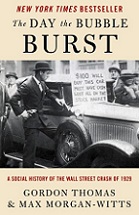 In the autumn of 1929, between the months of September and October, the world was plunged into financial uncertainty as stock markets in New York City and other places saw a massive devaluation of stocks and bonds. Some investors lost millions in the crash and others less financially secure, saw nearly their entire market portfolio crumble before their eyes. In the wake of the crash, America plunged into the great depression that spread misery and despair across the nation for several more years. The crash remains to this day, one of the greatest financial disasters in history. However, its causes are still up for debate and there is no single reason for the catastrophe but numerous factors did combine to bring the economy to a grinding halt. Authors Gordon Thomas and Max Morgan-Witts have studied the crash and tell the story here about the “day the bubble burst”.
 Every time I board a flight at New York’s John F. Kennedy International Airport, I am amazed at the concept of flight. And while I do understand how an aircraft works from a technical standpoint, the process of taking off, cruising and landing still fascinates us and captivates our attention. Today, we reap enormous benefits from the trials and errors of those before us who sometimes gave their lives in the pursuit of flight. In June, 1939, a German pilot named Erich Warsitz (1906-1983) flew an aircraft named the Heinkel He – 176, equipped with a rocket booster for extra lift and speed. The flight was successful and the result of many years of dangerous tests. The pilot and the engineers around him had just changed history forever and ushered the world into the jet engine era. This book is a look back at that miraculous time and Warsitz’s life as presented by his son Lutz.
 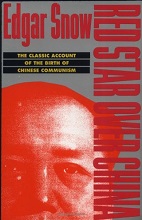 On October 1, 1949, the People’s Republic of China was officially established as the ruling party in the nation. Mao Zedong (Mao Tse Tung) 1893-1976) assumed the position of Chairman, a title he held until his death in 1976. The Chinese Communist Party continues to rule the country and imposes its will on Hong Kong. Taiwan remains independent but is often the source of friction between Beijing and western powers. The story of the Chinese communists is a highly intricate tale that is often left out of discussions regarding the aftermath of World War II (1939-1945). Edgar Snow (1905-1972) spent twelve years in China and was able to observe the emergence of the Communist Red Army determined to liberate China both from Japanese imperialism and the control of the White Army, led by the Kuomintang Government (KMT) headed by the Generalissimo Chiang Kai-Shek (1887-1975). This book is a collection of those memories that take readers back in time to the era when Mao Zedong was beginning to establish himself as a leader and China found itself in the middle of political, economic and social turmoil.
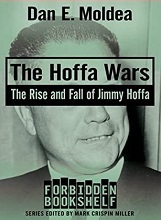 The disappearance of James Riddle Hoffa (1913-1975) still captivates audiences as shown by the success of Martin Scorcese’s
  If you look at cover of this book, you will see of deeply concentrated eyes staring back at you and it becomes instantly clear that behind those eyes is a long story yearning to be told. When I saw this book in my list of recommendations on Amazon, I did not recognize the face. I had heard the name but admittedly, did not know anything about his life. Those of us who find solace and deep interest in the arts are probably familiar with the life of Jean-Michel Basquiat (1960-1988), who in death has earned a place on the list of the best artists from the 1980s. In this stunning biography, author Phoebe Hoban explores Basquiat’s brief and unorthodox life. And it is a story that is both hard to accept and difficult to ignore.
  Those of us who have traveled to Puerto Rico and have seen the island outside of San Juan, known why it is called the island of enchantment. There is no one word explanation for Puerto Rico and I firmly believe that it is a place you have to see to truly understand. Several years have passed since my last visit to the island but upon resolution of Covid-19, I do plan on returning to the place that holds a special place in my heart. Hurricane Maria arrived in Puerto Rico on September 20, 2017, and the devastation was nothing short catastrophic. The storm’s wake revealed the underlying infrastructure in dire need of upgrade that was unable to cope with the hurricane’s power. The electrical grid began to collapse, roads became blocked and residents had to rely on each other to survive each day. Currently, the island is still recovering from the storm’s effects and the Trump Administration’s response to the storm is seen by many as subpar. Some might call that a euphemism but I always refrain from coming as political in any posts. Further, a political discussion can be found within the pages of this incredible book that explains clearly and thoroughly what went wrong with Puerto Rico from the moment the United States launched its invasion in 1989. And I believe that the book will leave you with a very different view of the island’s problems and a range of emotions about how it reached its current state.
 On March 24, 1976, Army Commander General Jorge Videla launched a successful coup against the government of Isabel Peron. The coup marked an end the reign of the Peronist party, universally known from the era of former President Juan Perón (1895-1974) and wife Eva (1919-1952). For many Argentines, the departure of Isabel Peron was a sign that perhaps the country would truly be on the road to democracy. In fact, Berta observes the occurrences and remarks:
  On July 2, 1961, legendary author Ernest Hemingway (1899-1961), took his own life in the small town of Ketchum, Idaho at the age of sixty-one. His suicide shocked fans and even today, the details of his death are unsettling and puzzling. It seems unthinkable that the man who wrote For Whom the Bell Tolls and Old Man and the Sea, would end his life in such a tragic manner. However, what we see from the public view often stands in stark contrast the reality behind the scenes. And one of the best ways to understand the life of the departed is to learn from those that were closest to them as their lives came to an end. A. E. Hotchner (1917-2020) spent fourteen years with Hemingway as the author moved from one city to the next across the globe in what can only be described as an extraordinary life. This is his memoir of the time he spent with the man he called Papa.

You must be logged in to post a comment.