
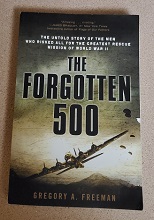
 A colleague gave me this book as a gift during the holiday season, mainly due to his knowledge of my fondness for history. I quickly made a mental note to give it a read in the near future. When I saw the title, I was slightly puzzled at the term “The Forgotten 500”. I have read books on World War II but none mentioned any 500 forgotten soldiers. Upon closer inspection, I soon began to realize why I had not heard the story. At the time the mission occurred, it was carefully hidden by the State Department and Office of Strategic Services who did not wish to jeopardize the lives of any remaining U.S. soldiers still trapped behind enemy lines. Further, in the years that followed, the the story faded into the annals of military history regarding the second world war. Even my father, who is an ardent World War II buff, has never mentioned this story. Our next discussion will certainly be interesting.
So who exactly were the forgotten 500? Well, the story takes place in Yugoslavia, where American, British and French airmen have been provided refuge by the local men and women who are fiercely anti-Nazi after Adolf Hitler ordered the Germany Wehrmacht to occupy their country. The airmen had been sent out on bombing missions to eliminate the German fuel supply lines in Ploesti, Romania. Berlin knew the value of the supply lines and carefully mounted anti-aircraft batteries around the supply stations in anticipation of Allied attacks. American crews were typically successful in attacking the lines but suffered heavy damage to aircraft and high number of casualties. Those who abandoned ship upon orders of the pilot, typically landed in the Yugoslavian countryside and were quickly taken in by peasants and farmers. This is the story of their survival behind enemy lines 0and the incredible mission to rescue them from German occupied territory.
Today, many of the soldiers who served in World War II are deceased and they took with them to their graves, many untold stories of heroism and heartbreak during the war. Their names are only remembered by those who knew them closely and for the forgotten 500, the same story would apply if not for this book. The role of Yugoslavia in World War II is underrepresented in the larger narrative of the conflict. By 1992, it had broken apart in the wake of a bitter civil war that saw the loss of over two-hundred thousand lives. Tensions between Serbians, Croatians and other ethnic groups had reached a tipping point in 1989 and could no longer be contained. in 1995, peace was formally restored but to this day, tensions continue to simmer underneath the surface. Several decades prior, Yugoslavia was seen a prized possession by both Germany and the Soviet Union and the invasion by German forces served as an impediment to its full independence. As a result, the people came to the aid of downed airmen and protected them fiercely in spite of the looming German military.
The author introduces us in the beginning of the book to the airmen who have been assigned the task of attacking Ploesti. Each mission is doomed from the start, forcing all on board to grab their parachutes and jump to whatever fate lies ahead. Miraculously, they are each found by the locals, embraced and given shelter. However, as more Allied planes fall victim to German weaponry, it soon becomes evident that the large number of airmen will have to find a way out of the country and back to Italy, where American bases have been established. The only problem is that the area is surrounded by German troops who will surely notice a major extraction mission. Washington knows it must do something but is pressed for ideas. The Office of Strategic Services enters the picture and the story changes gears completely.
The author does a fantastic job of providing enough back story to set the stage for the eventual rescue mission. To understand the situation in Yugoslavia, he provides a thorough discussion of the struggle for power between Adolf Hitler (1889-1945), Joseph Stalin (1878-1953) and Washington over the the small Baltic nation. Inside the country, German forces are opposed by the Communist Josip Tito (1892-1980) and pro-western Draza Mihailovich (1893-1946). Tito and Mihailovich are engaged in their own power struggle but determined to defeat the Nazi menace. However, there were other events and agendas taking place outside of Yugoslavia that dictated the course of the war and came to haunt Winston Churchill (1874-1965), who later called Yugoslavia his biggest mistake of the war. The three-way dance that ensued and the deception that occurred are covered here and will undoubtedly surprise many. I found myself shaking my head at the series of mis-steps by Allied forces that seemed to be unaware of Stalin’s true and barely hidden agenda.
Those familiar with World War II history will know about the role of the Office of Strategic Services, under the direction of its first director, the legendary William Donovan (1883-1959). The agency boasted such recruits as future Central Intelligence Director Allen Dulles (1893-1969) and celebrity chef Julia Child (1912-2004). Today it might seem surprising that even civilians were recruited by intelligence agencies but during World War II, all bets were off. The OSS dad a job to do and as we see in the book, they were determined not to fail. Donovan’s ability to get President Franklin Roosevelt (1882-1945) to agree to the mission is one of the best anecdotes in the book and shows how urgent it became to rescue the stranded airmen.
The approval of Donovan’s request set into a motion a series of events that brought together several different departments and two governments in an effort to pull of a rescue mission that no one had ever attempted before. The logistics are all covered in the book showing the high amount of risk that came with it. The margin for error was virtually non-existent but the people involved rose to the call of duty and this part of the book is uplifting and also high on suspense. One mistake could result in falling into German hands and an international diplomatic nightmare. But surprisingly not everyone was on the same page and the smaller battle between Washington and London is beyond surreal. It is a story you do have to read to believe.
Following the mission, the airmen return to civilian life but are dismayed to see how the international game of chess continues to be played. Tito’s rise and Mihailovich’s demise are some of the darker moments in the book. The airmen voice their disapproval with the official narrative and Freeman retraces their steps showing their never-ending commitment to honoring the legacy of their Yugoslavian hosts. At the end of the book, he provides an update on the airmen, some of whom were alive at the time the book was published in 2008. Now that twelve years have passed, I do not believe that they are still living but their memory is preserved eternally in this story that is simply unbelievable. For all of you World War II buffs, this book is a must have. Highly recommended.
ISBN-10: 0451224957
ISBN-13: 978-0451224958
 I was in search of a quick read and saw this book which I had added previously to my list of books to buy. In my neighborhood, there is a building with a mural dedicated to Frida Kahlo (1907-1954) and as I walk past each time, I think of the fact that so many years after her death, she is still revered by millions of people both in the United States and in her native Mexico. In September, 1925, Frida was a passenger on a bus with her boyfriend Alejandro Gómez Arias. Their bus collided with a street car and left Kahlo with devastating injuries. She suffered broken bones in several parts of her body and the accident displaced three vertebrae in her back. She never fully recovered from the accident and was plagued with constant pain until her death on July 13, 1954. On August 21, 1929, she married Diego Rivera (1886-1957) and accompanied him to the United States, first landing in San Francisco, while he worked as painter. Over course of her time living in the United States and later visiting, she received medical treatment for the lingering effects of the 1925 bus accident. She never failed to write home to her mother whom she loved deeply. Those letters have been translated into English and are composed here to show readers the very intimate relationship between mother and daughter.
 When this book came up as a recommendation, I thought back to the movie ‘
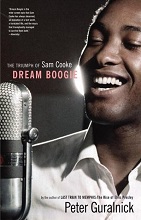 If you have ever listened to a song by Sam Cooke (1931-1964), then I am sure you can agree that no one is ever the same after hearing his voice. My parents and grandparents played his albums and knew many of his songs by memory, singing them with as much passion as Cooke did while on stage. For millions of black Americans, Sam Cooke was the best singer of his time and his death on December 11, 1964, sent music fans into mourning as one of the most beloved singers in America was laid to rest. Today, almost fifty-six years after his death, the songs he produced sound as if they were recorded yesterday. In fact, earlier today, I listened yet again to ‘A Change is Gonna Come’ which many people believe to be his best recording. Spike Lee opted to use it in the 1992 film ‘Malcolm X’, in the scene where Malcolm (Denzel Washington) walks toward the Audubon Ballroom and his fate after parking his car. Cooke’s music has stood the test of time and will continue to do so. But just who was the real Sam Cooke?
 June 30, 1960, the Democratic Republic of the Congo was formed after fifty-two years of Belgian colonization. Its charismatic leader, Patrice Lumumba (1925-1961), served as an inspiration and hope for the people of Congo, who wished to govern themselves and move their country into a new direction. Less than one year later on January 17, 1961, Lumumba was executed in Katanga as a result of a coup by military colonel Joseph Mobutu (1930-1997). The assassination and seizure of power by Mobutu, set in motion a cycle of violence that has continued for more than five decades. Between 1994 and 2003, the conflict known as “Africa’s first world war” ravaged the country and caused the deaths of an estimated five million people. Rebel groups continue to operate in various regions of the country, continuing the system of violence. In 2005, Anjan Sundaram was finishing his final semester at Yale University, where he graduated with a degree in advanced mathematics. After forming a friendship with a cashier, he made the decision to abandon a career in corporate American and move to the Congo, where he would ply his trade as a foreign correspondent in one of the most tumultuous places on earth. This book titled “Stringer’ is a memoir of his time in the Congo and the many people that became a part of his life.
 On Easter Sunday, my mother would have my brother and I watched the epid Hollywoof Film ‘The Ten Commandements’. It is one Chartlon Heston’s (1923-2008) best roles and his agtonist in the film, Yul Brynner (1920-1985), delivers an equally compelling performance a Ramesses II. In fact, it remains the film by which I have always recognized Brynner. However, like most great stars of his era, often called the “Golden Era of Hollywood”, there was more to his life than the public was able to see. His son Rock Brynner decided to turn memories of his childhood into this memoir of the time he spent with his father, one of Hollywood’s leading men.
 Many years have passed since I studied philosophy in college. Names such as Kant and Freud were part of my regularly assigned reading. However, one name I was not particularly exposed to was Carl Gustav Jung (1875-1961), the late Swiss psychiatrist and psychoanalyst who is widely held high regard as a pioneer in the field of psychology. I saw this biography on Amazon and decided to take another look at his life and beliefs. When starting the book I had no judgments about Jung but was sure I would learn a new way of looking at the human mind and what lies behind our thoughts and actions. And while I did find some very interesting concepts put forth by Jung, there is far more to the book than meets the eye.
 President John F. Kennedy (1917-1963) is known primarily from his time in the White House and untimely death but many forget that he was also an accomplished writer. In the well-received “
 When I saw this book on Amazon, I was a skeptical as to what I found find inside of it. However, the nearly five star reviews convinced me to inspect it a bit further. I took the plunge and ordered it to see exactly what Shelby Steele had to say about race, a topic that continues to either unite or divide people in America. The phrase “content of our character” is known to many of us. It was the pivotal moment of Dr. Martin Luther King, Jr.’s (1929-1968) “I Have a Dream” speech on August 28, 1963. Fifty-seven years have passed since that monumental moment in American history and the question remains, do we judge each other on the content of our character? Further, have we progressed as a society or is America still the same place it was when Jim Crow made life miserable for millions of black Americans and others who emigrated to the United States in search of opportunity?
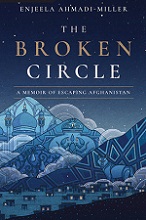 On December 25, 1979, the armed forces of the Soviet Union invaded Afghanistan in support of pro-Communist forces engaged in a power struggle with insurgent forces known as the mujahideen. Soviet forces marched into the capital city of Kabul and later succeeded in staging a coup in which President Hafizullah Amin (1929-1979) was removed and replaced with Soviet loyalist Babrak Karmal (1929-1966). Thousands of Afghan citizens were rendered homeless as bombs fells and brutal fighting produced collateral damage. For Enjeela Ahmadi-Miller, the war changed her life in ways she could have never imagined.
 FREETHINKING BIBLIOPHILE
You must be logged in to post a comment.