The Future Is History: How Totalitarianism Reclaimed Russia – Masha Gessen

GessenIn December, 1991,  the unthinkable happened as the Union of Soviet Socialist Republics (USSR) dissolved into fifteen separate countries.   Known informally as the Soviet Union, the USSR seemed at times indestructible to those viewing the union from abroad.  But within dissension had been brewing for many years in the wake of the tyrannical reign of Joseph Stalin (1878-1953).  His successors embarked on a period of de-Stalinization that thrived under the administration of Nikita Sergeyevich Khrushchev (1894-1971).  The Soviet Union remained a superpower and in direct competition with arch-rival the United States.  It dissolution shocked the world and left the future of the former Soviet republics in limbo.  In the aftermath of the monumental and historic collapse, the individual republics established their own rights to self-governance and in some cases, completely rejected Russian rule. Tensions between many of the nations continues to this day.  Currently, Vladimir Vladimirovich Putin serves as the President of Russia, and is as much of a controversial figure as many of his predecessors.  His appointment by late President Boris Nikolayevich Yeltsin (1931-2007) gave many Russians hope that a new direction was in store for the beloved country.   Today, as we look back at the time that has passed since he was chosen to lead Russia, we can see a tortured nation still suffering from systematic oppression and what is rightly described in this book as totalitarianism.

In 2017, Gessen was hired by The New Yorker magazine as a stiff writer and she continues to be a leading voice for LGBT causes in her homeland of Russia.   She hails from Moscow and is acutely aware of the persecution that she and many others face because of their sexual orientation.  In Russia, the government embarked on a crusade against the LGBT community that began to flourish in the 1990s with the passing legislation against “homosexual propaganda”.  The change in society which gave license to open discrimination of LGBT citizens is nothing short of barbaric.  The murder of Vladislav Tornovoy marked a point of no return and although outrage at the crime was widespread, homophobia continued to increase.  There are many ugly truths to be told and this phenomenal book that reveals the dark side behind the Iron Curtain, we can see first hand how Russia missed its opportunity to move away from the iron grip of Leninism and embrace democratic ideas. Some Russians undoubtedly wish to return to the Soviet days while younger Russians wish to move forward and transform Russia into a country of which they can be proud.  To understand life in the Soviet Union and in new Russian society, Gessen interviewed several individuals, each with their own story to tell that will prove to be riveting to readers.  Their names are Lyosha, Masha, Seryozha, and Zhanna and they each devoted a year of their time to tell Gessen about the Russia they know and in some cases, have left.  Zhanna may be familiar to some readers as the daughter of  Boris Yefimovich Nemtsov (1959-2015) who served as the First Deputy Prime Minister of Russia under Boris Yeltsin.

Gessen takes up deep inside their lives in post-Cold War Russia as Perestroika becomes of the official policy of Moscow.  It is cited as one of the reasons of the fall of the USSR and a major factor in the resurgence of totalitarianism.  The debate will continue for years but what is clearly apparent is that life in the Soviet Union was one of hardship, poverty and the loss of hope.  These stories should remove any illusions readers may have of a high quality of life for the average Russian citizen.  This is a sobering look at the daily struggles Russians face and the relentless abolition of individual liberties.  Homosexuals became easy scapegoats and in the book, we follow Lyosha and his struggle to maintain a stable life in the midst of fierce homophobia supported and encouraged by official government policy.  Masha and Zhanna would later become voices for the opposition while Seryozha would come to learn about the privileges attached to his family’s residence in “Czar Village”.   Each faced their own struggles and their anecdotes reveal the dark transformation of Russian society as the departing Boris Yeltsin hands over the reigns to the former director of the Federal Security Service of the Russian Federation (FSB).  Putin wasted no time as President of Russia and has placed the country in a vice grip, showing no signs of relinquishing his hold on power.

Where this book truly excels, is the author’s clarity in explaining the failures of Moscow post-Stalin and the importance of neighboring Crimea and Ukraine.  Both territories have become hotbed issues during Putin’s presidency and increased tensions between Moscow and Washington, with the latter establishing punishing sanctions.  The promise of hope, which existed for a brief time in Russia, seems to be receding on a regular basis as the Kremlin extends its totalitarian grip as far as it possibly can.  Many have fled Russia, making a home in other parts of Europe and Brighton Beach, a small enclave in my hometown of Brooklyn, New York.  As the author points out, Seryozha stopped responding to her messages in 2015, but the others have each made the tough decision to leave the places they called home in search of a better life, free from the grip of Putin’s regime.  Slander, political oppression and even assassination, are hallmarks of Putin’s tactics to stifle the voices of perceived enemies of the state.  Large numbers of expats will not return to Russia as long as Vladimir Putin remains determined to keep the men and women of their homeland held firmly in subjugation.  Gessen has dared to speak out, risking persecution that has plagued other brave voices that have done their best to expose the facade created to cover the realities of Russian society.   Opposition of any kind is not tolerated and the descriptions in the book of the actions towards those who dared to speak out have the markings of the classic police state.

Many misconceptions about Russia exist, mainly due to incorrect reporting and propaganda released by the Kremlin.  But as we can see through Gessen’s work, life in Russia is quite different from the image the has been projected by officials. Persecution, oppression and famine are just some of the daily factors that make life in Russia a hard one to live.  Deception and mistrust have become widespread and are eerily similar to the climate of suspicion created the Third Reich.  The Soviet Union is long gone and in spite of Putin’s agenda,  it will never again rise to the heights that it reached during the Cold War.  And as the younger generation of Russians continue to find ways to make their voices heard, Russia will be faced again with a moment of monumental change.  But in order for it to move forward, the people will have to ask what kind of Russia do they want for future generations?  Do they want a true democracy or do they wish to endure several decades of rule by Vladimir Putin?  The voices in the book have made their positions clear.  It remains to be seen if anyone truly listens.   They know the Russia that you and I have only read about.  The Russia they know is a cold place, mostly closed off from the outside world and a nation that can never shake the ghost of Joseph Stalin and his mentor Vladimir Ilyich Ulyanov (1870-1924), known to the world as Vladimir Lenin.   But if Russia chooses to listen, the message is loud and clear that the future is history.

ASIN: B06XQZPVDD
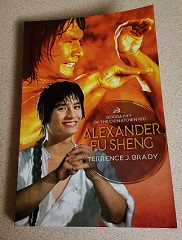
Alexander Fu Sheng: A Biography of the Chinatown Kid – Terrence J. Brady

Fu ShengLegends never die, that is an absolute fact.  Some legends never live past fifty years of age, often leaving their mortal coil through tragedy or illness.  For Alexander Fu Sheng (1954-1983), a single car accident was the cause of his demise and in the early morning hours of July 7, 1983, he died at the young age of twenty-eight.  He left behind grieving parents, siblings and his widow Jenny Tseng, an accomplished Hong Kong singer who has also performed abroad. At the time of his death, he had risen to become one of the most popular stars to come out of the legendary Shaw Brothers Studio.  Before ceasing film production in late 1985, Shaw Brothers had released several hundred films which had been locked away until Celestial Pictures bought the rights to the films and digitally remastered the majority of the collection. As a long-term fan of the martial-arts film genre, I had amassed a large collection of films which included all of Fu Sheng’s movies.  My favorite is the film that catapulted him to international stardom, The Chinatown Kid (1977). Terrence J. Brady gave this biography the perfect finishing touch by included the name of that film in the title of this book. His exhaustive efforts have resulted in the only known biography of the late film star.

If you have no idea who Fu Sheng was, I do recommend that you watch some of his films, a full list of which can be found here.  It should be noted that the list does not contain The Mark of the Eagle which was being filmed at the time of his death.  The project was shelved permanently.  Readers familiar with Black Belt Theater will feel a sense of nostalgia as memories of Saturday afternoons filled with Shaw classics then distributed by the World Northal Corporation.  It truly is an era that we will never again see.  Today, CGI and fancy camerawork has replaced the old-school method of filming that relied heavily on coordination, training and relentless stamina.  Many Shaw Brothers stars are still alive, well into their 60s, 70s and even 80s.  The Shaw studio is long gone, but the magic they created will last a lifetime.  Fu Sheng was part of that magic and Terrence J. Brady has finally put together the true story of his short and extraordinary life.

The book is without question a biography, but the author did a great job of providing a tremendous amount of back-story for the topics at hand. In fact, throughout the book, snippets of Chinese military and literary history are included showing the link between China’s past and what the filmmakers had intended to capture on-screen.  Undoubtedly, Fu Sheng is the star of this story and Brady carefully retraces his steps from film extra to superstar.  And along the way, he was surrounded by cinema greats who became mentors, friends and mourners.  Their stories and their relationships with Fu Sheng  show the very personal side to the individuals who helped create the films that I and scores of others have come to cherish dearly.

His widow Jenny is also a central part of the story and I firmly believe Brady lays to rest any rumors that have persisted about their lives together up until the time of Fu Sheng’s death.  And following his demise, Jenny has a surprise of her own which I had never known of.  Her revelation, whether it is true or not, adds to the tragedy of his life.  But what is evidently clear, is the love they had for each other, which the late Chang Cheh (1923-2002) showcased in his most eccentric film Heaven & Hell (1980).  The film has been written off as Cheh’s most bizarre work but personally, I found it to be highly entertaining.  In the film, the couple performs a duet that complements the prior act perfectly.  But there was more to their singing partnership than many might have known or remember. Brady covers that as well here and his research provides a steady stream of incredible information about the couple during their several year courtship and subsequent marriage.  Of note, Tseng never remarried after Fu Sheng’s death.

Fans of the Shaw Brothers will absolutely love this book.  It is an insider’s look into how the studio created its hit films and a good reference guide for a quick background information on some of the biggest names to work there.  In this story, nearly all of the legends make an appearance including Ti Lung, David Chiang and the late Lau Kar Leung (1934-2013). A who’s who of stars is put on display and as I read the book, I could feel the Shaw Brothers studio come back to life again during what could only be described as a classic era in the Hong Kong film industry. In fact, this book has encouraged me to revisit the Shaw classics, some of which I haven’t watched in nearly two years  I still have my entire collection which started in 1995 when my father took me up to 42nd Street.  There, I purchased my own VHS English dubbed copy of the Five Masters of Death. The original Hong Kong title is The Five Shaolin Masters.  Fu Sheng had a starring role in the film and it was in this movie that I first became a fan.  It is just one of many great masterpieces he contributed to during his storied career.

This book truly is a blessing and I am forever grateful for Brady’s monumental effort. Fu Sheng is long gone, having died nearly thirty-six years ago, but his memory and legacy live on not only in Hong Kong but across the world.  During his time at the Shaw Brothers studio, he rightfully earned the nickname of the Chinatown Kid.

ISBN-10: 1717363679
ISBN-13: 978-1717363671

Deliver Us: Three Decades of Murder and Redemption in the Infamous I-45/Texas Killing Fields – Kathryn Casey

Casey - Deliver uSIn spite of their infamous reputations, there is something about serial killers that compels society to revisit their crimes and re-live what could best be described as nightmares by the families of victims, survivors of the crimes and law enforcement who worked countless hours in their attempts to bring the killers to justice. Netflix recently premiered Conversations with a Killer: The Ted Bundy Tapes, allowing viewers to hear Bundy in his own words as we continue to seek explanations for the actions of one of America’s most prolific serial killers.  He is far from the only one and is joined in infamy both dozens of other killers whose actions revealed the extremely dark side of human nature.  In the State of Texas, between Galveston and Houston, lies Interstate Highway 45 (I-45).  Between the years 1971 and 1996, the bodies of 30 women were recovered in what became known as the Texas Killing Fields.  Some of the murders were solved but the majority have remained unsolved and currently classified as cold cases.  The barbarity of the crimes coupled with the mysterious circumstances surrounding the disappearances of the victims, have cast an ever darker cloud on some of Texas’ worst murders. Author Katheryn Casey has revisited the killing fields and this is her account of what she learned as she stepped back into time and explored the serious of murdered that rocked Texas and caused many to wonder if any young woman was safe.

On Thursday, June 17, 1971, Colette Anise Wilson was a typical thirteen year-old girl in Alvin, Texas, but she could not have known that it would be her last day alive.  Her remains were found several months later in November of that year. Her disappearance and murder became a de facto script that would be played out over and over again as more young women met a similar fate, leaving families looking for answers that made sense and detectives under enormous pressure to solve crimes that had never before affected the towns along I-45.  The grief that engulfed the families is captured movingly by Casey and reveals the innocence of the young women, robbed of a full life through a chance encounter that had deadly consequences.  A common theme that I saw in the book and one that was to be expected, is that none of the families were ever the same again.  Each surviving family member handled the grief in their own way with some becoming committed activists in helping other parents of murdered children and others sinking further into misery.  In this book, Casey keeps their daughters’ legacies alive and gives the families a voice that needs to heard and remembered.

Readers who are sensitive to this type subject matter should beware that the descriptions of the crimes are graphic. Forensics is crucial to the murders and through Casey,  we revisit the crime scenes in order to understand what detectives faced as they came to understand that a deadly epidemic had commenced on the I-45.   At certain points in the book, I felt a slight chill come over me as I read the stories of the murders.  And what was more chilling, is the anonymity of the killer(s).  Authorities have long believed that many of the murders were the work of one person, a serial killer that had picked Texas as his killing field. In truth, we do not know for sure how many killers did in fact roam the I-45.  It is quite possible that several claimed the lives of multiple women over the course of more than twenty-five years. Casey does not attempt to answer that question but the narrative does leave the question open.

Towards the end of the book, there was one section that stood out in particular in which Casey recalls a conversation with retired FBI profiler Mark Young.  During their discussion about the I-45 murders, he remarked “at any one time, there are about six hundred serial killers in the U.S.. Of those, maybe half are active. The others have aged and stopped killing, or they’ve stopped for other reasons, like sickness, or they’re in prison for other crimes.” Considering the population of the United States is well above 300 million people, that does not add up to significant portion of the population. But I believe that even one serial killer is far too many.  But as Casey explores in the book, how do we know who is a serial killer?  By her own admission, she might have let Kevin Edison Smith come into her home if he had presented himself in a non-threatening manner.  His conviction for the murder of Krystal Jean Baker highlights the fact that we do not know who among us has the capability to be a stone cold killer.  Further, there is a chance that at least once in our lives, we have crossed paths with someone who has killed or has the ability to commit premeditated murder.

There is always the possibility that one or more of the I-45 cold cases will one day be solved.  However, the passage of time and the loss of critical evidence may prove to be too much for even the most seasoned investigators.   But for anyone who is making an effort to understand what did happen during that twenty-five year stretch when the Texas Killing Fields ran red with blood, a blueprint is needed to provide a map of where and when to look.  Kathryn Casey has done that and more in this eye-opening and hair-raising account of serial murder in the Lone Star State.

ASIN: B00I7V3UG0

Victor: An Unfinished Song – Joan Jara

20190302_202131On January 11, 2019, Netflix released ReMastered: Massacre at the Stadium, a look back at the violent coup in September, 1973 in which President Salvador Allende (1908-1973) was overthrown by the Chilean military.  In his place, General Augusto Pinochet (1915-2006) assumed power and unleashed a reign of tyranny that lasted sixteen years and caused the deaths of thousands of Chileans.  His reign came to an end when Patricio Aylwin (1918-2016) was elected as the next President of the Republic of Chile. Pinochet was arrested in October, 1998, by British intelligence and repatriated to Chile on March 3, 2000.  He died on December 10, 2006, without having served a day in prison for the human rights violations that occurred during his time in office.  Today he is largely recognized as one of Latin America’s most infamous tyrants.  The story of his rise to power and fall are covered beautifully in Peter Kornbluh’s The Pinochet File: A Declassified Dossier on Atrocity and Accountability .  His ruthlessness knew no bounds that tragic September day, and the military engaged in a purge of all perceived enemies of the new regime.  Among the endless number of victims was former activist, playwright and singer, Victor Lidio Jara Martínez  (1932-1978), known to the world as Victor Jara.

Jara’s widow Joan, is now 92 and has never ceased in her efforts to promote Victor’s legacy and find justice for his murder.  In the Netflix documentary, his brutal death and the successful lawsuit against former Chilean soldier Pablo Barrientos, take center stage in the mission to unravel Jara’s final moments at the stadium. The film is thought-provoking and I do believe there is more to his death that remains hidden.  After I finished the film, I became determined to learn as much as I could about Jara and his importance in Chilean history.  I found this book by Joan Jara, wherein she discusses the Victor she knew and her life in Chile, a place that became her home away from home.  British by birth, life took her across the Atlantic and to Santiago, where she continued to perfect her craft as a performer.  Soon she was divorced with a young daughter trying to find her purpose far away from the bustling city life in London.  Soon, a young charismatic singer crossed her path and before long, the story of Victor and Joan Jara had begun.

The beauty in this book is that Joan allows us into their home, to learn about Victor’s private life and his rise from the poverty-stricken town of Lonquén to become one of Chile’s most vocal supporters of Allende’s government.  She provides a short biography on Victor and herself, filled with anecdotes that show how the basis for their political beliefs.  As she admits, at first she had no fondness for anything communist but after witnessing the poverty and inequality in Chile and other parts of Latin America, she became more accepting of  communist ideology.  These beliefs would have far-reaching and tragic implications up until the time she fled Chile with Manuela and Amanda, her daughter with Jara.  Today, it seems unreal that someone should be physically assaulted or even murdered for political affiliation, but this was the atmosphere that existed in Chile under Allende’s administration.   Joan captures the atmosphere, recalling tense situations in which anarchy could have prevailed at the drop of a hat.  Her analysis is a prime example for anyone seeking to understand how and why the coup had formed.

Joan takes us through the development of their relationship, their new daughter and success in the theater, a place she and Victor have always called home.  Life is good and the girls are growing up nicely, but there is an undercurrent of dissent among the right-wing faction, determined to end Allende’s rule by any means necessary.   The involvement of the Central Intelligence Agency (CIA) in Allende’s downfall is well-documented.  And the further fracture of Chilean society is critically examined in A Nation of Enemies: Chile Under Pinochet by Pamela A. Constable and Arturo Valenzuela. I found myself startled as I read the book, at the revelations that it was openly assumed  by many Allende supporters that the CIA was actively working to bring down Allende.  It seems as if it was the secret that was not no secret.  Perhaps the events in Cuba, Guatemala and Vietnam had provided fuel for the suspicion.  The political turmoil that later engulfed the nation had started to build nearly the day that Allende was sworn in.  The right-wing extremists failed to get the two-thirds vote to remove him from office and it was clear to Allende’s detractors that his removal would only come through violence.  Allende was not oblivious to his precarious situation and even gave an unofficial last address to the nation in the days leading up to the coup.   Little by little, dissension grew and the stage was set for September 11, 1973.

Open contempt by opposing parties had reached toxic levels in the week leading up to the coup and the audacity exemplified by enemies is recounted here by Joan.  Some of the behavior might shock some readers. The descriptions of the brutality inflicted upon political opponents is reprehensible and as a woman states in the book, the coup taught Chileans how to hate.  Similar to the Netflix film, Joan discusses that day in detail and how she came to learn about Victor’s death, her retrieval of his remains and her actions in the wake of his untimely demise.  The story is riveting and Victor’s death silenced a voice of hope in a country that later endured a tyranny that soon spread across the continent, making its mark in places such Argentina and Uruguay under the regimes of Juan Perón and Juan María Bordaberry.  Today, the dictatorships are a dark reminder of the past and the perils of extremism.

In January, 2019, I visited Chile and it has found a place in my heart as a true gem.   It is hard to put into the words, the feeling that comes over the body upon the arrival on Chilean soil.   To many of its neighbors, Chile is the black sheep of Latin America.  But similar to its neighbors, it too has suffered through and survived its own history of military rule under right-wing dictatorship.  Victor Jara was one of many voices who spoke out and took action to transform society in the hope of correctly many of mankind’s mistakes.  His belief in his actions made him a marked man but Jara refused to abandoned his position and stood by his beliefs until the end.  Joan has kept her husband’s memory alive in both the Netflix documentary and his book about their time together and the man she simply knew as Victor and his life which truly is an unfinished song.

ISBN-10: 0747539944
ISBN-13: 978-0747539940

Prisoner: My 544 Days in an Iranian Prison—Solitary Confinement, a Sham Trial, High-Stakes Diplomacy, and the Extraordinary Efforts It Took to Get Me Out – Jason Rezaian

Jason RezaianThe United States and Iran share a long and storied past, defined in moments that changed world history.   The removal of Mohammad Mossadegh in 1953, followed by the reinstatement of the Shah and the Iran Hostage Crisis in 1979, set the stage for decades of tension between the two nations.  And incredibly, it was under this tension that the administration of U.S. President Barack H. Obama engaged in talks that resulted in the The Joint Comprehensive Plan of Action, simply known as the Iran Nuclear Deal.  The deal was both heralded as a landmark achievement and a kowtow of the worst kind.  But what many Americans did not know, was that there was far more taking place behind the scenes, including the release of U.S. prisoners held in Iranian jails.  Among those prisoners, was American born  journalist Jason Rezaian, of The Washington Post.  You may remember him from his appearance on Anthony Bourdain’s (1956-2018) hit show No Reservations.  The episode was beautifully done and Rezaian and his wife Yeganeh, appear as voices of insight into Iranian culture.  At the conclusion of the episode, there is a message on the screen that they both had been taken by Iranian intelligence.  The episode is my second favorite, the first is Vietnam in which President Obama makes a surprise appearance and enjoys a meal with Bourdain in Ho Chih Minh City.  On January 16, 2016, Rezaian was released was repatriated to the United States. Joining him were his Iranian born wife and his mother who never stopped fighting for her son’s release.
The book came to me as a recommendation from Amazon and I have to say, it was right on the money with this one.  I easily recognized Rezaian and was curious to know exactly what did take place during his incarceration.  The goods are all here and at times, I had to shake my head at the words and actions of his captors.   The Twilight Zone atmosphere, as Rezaian once describes it, is periodically broken by his recollections of his early life and his family’s history.  He explains his reasons for leaving America in his early thirties and moving to Iran, the place of his late father’s birth.  At first, the book reads like a typical story of a young man who found a home away from home.   He meets the love of his life, Yeganeh and the two begin to build their life together as a married couple. But on July 22, 2014, that all changed when they were arrested, blindfolded and transported to the Evin Prison in Tehran.

Authorities are convinced Rezaian is conduction “spionage”, as they call it and have labeled him a master spy who has come to spread revolution in Iran, through the import of “avocados”.   At first I could not believe my eyes but the insanity only increases.   Interrogators employ endless mind tricks in order to get Rezaian to “cooperate” and “admit” his wrongdoings, even without being able to say for certain what they were.  They assure him that they are there to “help”.  Rezaian’s sharp wit, adds a level of comedy to the story that lightens the mood and keeps the reader glued to the book, anticipating the next page. But the reality is that the charges were serious, in fact, deadly serious.  More than once he is threatened with execution.  The jury is still out whether the Iranians ever intended to actually commit such an act or if it was strictly a scare tactic that they knew would have backfired publicly and politically.   Their attempts to interrogate him and their obsession with American films and politics, has the effect of turning the affair into a three-ring circus in which Rezaian is the only one with a sane mind.  How he kept his sanity, sense or humor and composure, many of us will never truly know.  Perhaps it is the human will to survive which at times can be stronger than most would expect.  Rezaian admits that he nearly gave in on more than one occasion but the world was rooting for him and the support of his family, in particular his brother, help provide the inspiration he needed to remain stoic and defiant, until he once again walked the streets as a free man.

As to be expected, the Iran Nuclear Deal is a significant back story to the book and integral to his eventual release.  As a prison inside Iran, Rezaian was given an insider’s view into Iranian society and the mood in Tehran as its leaders and Washington hammered out an agreement that had been reached with the hope that the two nations could begin open dialogue which could eventually end in peace that has eluded both for nearly forty years.  Rezaian discusses the process and the difficulties of reaching an agreement which also included himself and other prisoners.  But even he admits that at the time, he had no idea of how many people were at work, doing everything in their power to secure his release and several others.   The ending of the book plays out as if Hollywood sent its best writers but this is not fiction.  It was a show of diplomatic power at its finest and a story in which the good guy does win.

Sadly, hopes of peace between Iran and America faded with the announcement of President Donald J. Trump that the United States would withdraw from the Iran Nuclear Deal.  On May 8, 2018, the withdrawal went into effect and only time will tell what will happen but I sincerely hope that peace does prevail.  For Jason Rezaian, peace came in a different form and his freedom from the Evin Prison, has given him an even deeper perspective of where Iran continues to go wrong.  He also explains the many areas in which non-Iranians fail in understanding how and why its society  operates in the manner that it does.  But make no mistake, this is his story and how he survived incarceration in the Islamic Republic of Iran.

ISBN-10: 0062691570
ISBN-13: 978-0062691576

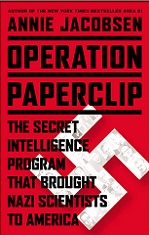
Operation Paperclip: The Secret Intelligence Program that Brought Nazi Scientists to America – Annie Jacobsen

paperclipOn April 30, 1945, Adolf Hitler fatally shot his wife Eva Braun and then turned the gun on himself as it became evidently clear that allied forces were closing on the führerbunker.  The fear of falling into Russian hands and a subsequent trial for war crimes proved to be too much for the top echelon of the Third Reich that remained in Berlin.  Many top-ranking officials  had previously fled and others had left Germany after realizing that all hope for a victory in the war had been lost.  As allied forces move in and occupied the country, the true horrors of the Nazi reign became clear and soldiers were faced with the grim discoveries of concentration camps, emaciated and dead prisoners.  The Final Solution had been revealed for the entire world to see.  In the aftermath of the war, several hundred Nazi party members were executed by allied forces. Others were acquitted or had their death sentences commuted to long-term imprisonment.  Another group consisting of scientists and doctors, found their way to America with the help of the United States Government in what became known as Operation Paperclip.  Their story is the focus of this incredible book by author Annie Jacobsen.

Government files regarding the secret operation had been marked classified and would have remained hidden if not for the Freedom of Information Act (FOIA) which gave Americans a tool to learn the truth about many of the Government’s secrets. This tool was thoroughly employed by Jacobsen in discovering the truth of this story that was first disclosed by the New York Times.  Jacobsen explains herself that some of her FOIA requests are still pending and it is unknown if or when they will be answered.  Nevertheless, she has written the story that will shock anyone who decides to open the pages of this book.   Her focus is on selected former doctors and scientists of the Reich who had worked on the V-2 rocket program at Nordhausen and concentration camps in which medical and biological experiments had been conducted, with Auschwitz and Ravensbrück being high on the list.  I warn readers that this book is not for the faint at heart .  The atrocities that are revealed defy logic and reveal the very dark side of human nature.  And as the book progresses, the names of the former scientist and doctors will be seared into the reader’s memory as a reminder of the many secrets the Third Reich tried to hide as the military collapsed.   As horrible as the actions of the Reich were, the crux of the book is the courting and resettlement of former Nazis by the United States Government through a program that will cause consternation, shock and even anger in some readers.

The book begins as the German military collapses in defeat and allied forces are scouring Berlin and other parts of Germany on intelligence missions to discover the secrets of the Reich.  Britain and Russia are also conducting their own intelligence missions and a race against time develops as the three nations each seek to obtain as much information as they can from their defeated enemy.   As the author explains, the Cold War was looming in the distance and in the name of “national security”, government officials were more than willing to recruit former Nazis out of fears they would be recruited and resettled in the Soviet Union.  The V-2 rocket and nerve agents Tabun and Sarin, became hot items as superpowers prepared for the next world war which they believed would include the use of biological weapons.  The United States spared no expense and would not let Joseph Stalin have the upper hand.  The brilliant German minds behind innovations that exceeded allied capacity were to be recruited at all costs, even at the expense of morality.  Annie Jacobsen has captured the emotion and tense battles that raged as the State Department battled the military over a program that it found to be appalling.  The American public slowly became aware of this nefarious program and mounting opposition forced the Government to act in what could described as a war against itself.

The main focus is rightly on the secret intelligence operation but the author also includes a stead stream of facts about other members of the Reich and actions that were being taken behind the scenes throughout Germany as the tide of the war changed and defeat became a stark reality.  The entire cast of characters makes an appearance in the story. Some would escape Germany, fleeing to South America and others took their own lives rather than be tried, convicted and executed in a military trial.  Before the collapse of the Reich, officials went to great lengths to hide as much information as possible from the allied forces.  Today there is a strong possibility that secret tombs exist containing secrets of the Reich are still hidden across Germany.  Time will tell if all of them will be discovered or if they will continue to fade from public consciousness.

The amount of research that was conducted in order to produce this book is staggering.  Yet, there is still much we do not know about Operation paperclip as the Government claims files were lost or destroyed.  Some are still classified with no release date on the horizon.  At some point in time, someone will find out the truth about what truly did happened in the wake of World War II as America embraced German talent.  By then, anyone who participated in World War II will be long gone, rendering any type of prosecution or accountability null.  But the public will finally know just how complicit American officials and the White House were in recruiting war criminals for the technological advancement of the United States.  Jacobsen has given us a detailed roadmap with which to start and this book will undoubtedly stand the test of times as one of the finest works on the Third Reich.  My only complaint about this book is that I wished it had never ended.  I found myself glued to the book from the beginning and was unable to put it down.  The is the true story of Operation Paperclip, one of World War II’s darkest secrets.

ASIN: B00BAXFBI

Holy Terror: Andy Warhol Close Up – Bob Colacello

colacelloThose of us who have visited the Museum of Modern Art in New York City, can testify to its seduction of visitors with a passion for treasured art.  The second floor is home to Campbell’s Soup Cans and Other Works, 1953–1967, a collection of thirty-two pieces by the late Andy Warhol (1928-1987).  February 22 will mark thirty-two years since his untimely death at the age of fifty-eight.  Art students and museum aficionados have long studied his work as the shining example of the Pop Art movement that swept across the United Kingdom and United States during the 1950s.  Warhol undoubtedly became the poster child for the movement with his sleek frame, white wig, large frame glasses and black sweater.  His personal life, carefully hidden from the public, became a mystery to those seeking to know just who is and who was the real Andy Warhol?  Bob Colacello worked for Warhol on their  publication Interview, for twelve years and in this intriguing account of their time together, he reveals the Andy Warhol he knew with all his quirks, ingenuity and fears in life.
The book is not an autobiography and Colacello does not try to assess Warhol’s psyche.  Further, this is Colacello’s story from start to finish but Warhol does play a critical role to the events that transpired in his life for obvious reasons.  From the start, it is apparent that Andy is not the typical boss and writing for Interview will be no easy task.  As Colacello explains, it was usually a test of wills with Andy believing everyone had a hidden story or “problem” and that Colacello should proposition them with the offer of a cover shot and even change his name to “Bob Cola” to sound more appealing.   Their contrasting personalities and those of the other members of what Colacello refers to as the “factory”, created a magazine that grew into a serious contender and in the process, made Warhol’s name synonymous with modern pop art. His successes took him and his staff across several continents and  through endless cities.  Colacello was dutifully by his side along with a dedicated team of collaborators, each of whom would wage their own battles with Warhol over his eccentric behavior and domineering personality.  They all recognized that within their boss was a visionary who straddled the fine line between genius and insanity.

Anyone who decides to read this book, probably has some inkling of who Andy Warhol was.  His carefully crafted public facade, gave off an aura of chic that tabloids found irresistible. But behind the facade was a different person, and Colacello was there to witness those revealing moments when Andy let down his guard.  The anecdotes from Colacello are amusing and in some cases puzzling as Andy’s behavior typically bordered on the surreal. Armed with his tape recorder which he called Sony and hindered by his social awkwardness,  Andy sometimes became a square trying to fit into a circle.  But yet, most could not resist being around him as his name grew in popularity.  That fame resulted in a steady stream of  film stars, foreign dignitaries and politicians giving Interview and Warhol the publicity they constantly needed.  It was an unbelievable ride for the young artist from Pittsburgh, Pennsylvania, born to immigrant parents from the small region of Ruthenia.  Some of you may be wondering, where on earth is Ruthenia?  It is located in the Carpathian Mountains, sitting between the meeting point of the borders of Poland, Czechoslovakia, Hungary, Romania, and Russia.  Sadly, Warhol never addresses his family’s ancestry and often said that “I come from nowhere”.   Perhaps it was just Andy being Andy or was a sign of a deeper inner struggle that manifested itself in his work.   We will never know for sure as Andy took that and many other secrets with him to his grave.

Every story about a famous figure has the proverbial “elephant in the room”.  For Andy, it was sexuality, a theme that was found in many of his works and which fueled his belief that everyone had a juicy sexual secret they were hiding.  As Colacello reveals, Warhol was entranced by gossip and in particular, the sex lives of celebrities. But was this a defense mechanism to deflect from his own love life?   Colacello provides great insight into Andy’s love life or lack of it.  And even with his revelations,  many questions still linger about what type of love life he actually had.  Maybe that was Andy’s plan, to keep everyone guessing, on their toes and confused.  But there are two people who appear in the story and Colacello explains their importance thoroughly and how they affected Andy’s personal life.  One of them, Jed Johnson, tragically perished on TWA Flight 800 in 1996, which exploded shortly after takeoff from New York City’s JFK International Airport.  The flight was bound for Paris and all 230 passengers perished in the accident.  Johnson was with Andy the longest and their relationship provides some clues as to why Warhol behaved as he did.

Towards the latter part of the book, Colacello focuses on his increasing dissatisfaction working for Warhol and the impact upon the lives of his colleagues as a result of their boss’s behavior.  Like a master manipulator, Warhol would push their buttons and then later soothe their egos, dangling them on strings in the process.  Alcohol and drugs became coping mechanisms and flowed freely in their circle that consisted of Hollywood stars, music stars and the famous Studio 54, where Andy became a fixture.  The image that appears as Colacello discusses working conditions at the factory, is one in which Andy keeps his subordinates in check, at odds and never in a position to amass too much influence in affairs.  This system of dysfunction pushed many to brink and over time, nearly all left to escape from Andy’s off-handed and in some cases, callous treatment.  However they remained loyal to him and his legacy, even when they no longer worked for him.  Their commitment to Interview, the factory and Andy’s films, created a bond that could never be broken, not even with his death on February 22, 1987.  Theirs is a story of a family with a broken parent that many of them tried to diagnose and piece back together.  But Andy could never be the same after being shot several times on June 3, 1968.  Valerie Solanas nearly ended his life that day but Andy survived and carried with him the scars from multiple surgeries and a life-long fear of being in public.  His physical condition and paranoia of being attacked again, nearly crippled his social life, resulting in him needed a chaperone for nearly everything.  More often than not, Colacello was assigned this task.  However, the role he assumed gave him a very intimate look into the fractured life of his boss.

The mystery of Andy Warhol will continue for years to come.  I do not believe there is one simple explanation for his life.  Colacello even states that although he was close to Andy, he’s not sure if they were really that close as personal friends.  Andy carefully kept everyone at a guarded distance.  He avoided hospitals and even funerals, including that of his own mother Julia.  His lovers had separate lives and seemed to come and go as they pleased.  Andy threw himself into his work, pressuring all that worked for him to make sacrifices that at times were unrealistic.   We can only assume that his constant drive to work, accumulate gossip with Sony and his prevention of letting anyone become close to him, may have been his way of protecting himself.   Before his death, he said to close friends that he did not want to go into the hospital because you do not come out.  But as his gallbladder became inflamed to the point of possibly rupturing, he was faced with having no other choice but going into the one place that he dreaded.  And tragically, his prediction came true.  But there is far more to Andy’s life and death, covered beautifully by his former employee and star writer.  And fittingly Colacello has given us a very-welcomed portrait of what he calls the holy terror.  Warhol fans will love this book.

ASIN: B00GQAOL8A

Why I Love to Read

20190206_230007I decided to take a break from the reviews and address a question that I am often asked.  “Why do you love to read?”, is the question I am presented with by people who are aware of my passion for books.  I could offer a cliché answer but the truth is more intricate than that. I firmly believe that each bookworm, as we are often referred to, has their own personal reasons for reading and the category of material that he/she prefers.  Regardless of the reason, their love of books is something that unites us.

Next to writing, reading is one of the most basic skills that a person can possess.  I go as far as to say that at times, our lives can depend on it.  Through the passage of time and a growing collection of books,  I have come to realize that reading needs more promotion in the age of digital communication.  Social media, online news and smartphones have permanently changed the ways in which humans communicate with one another.  Hours long talks on the phone and in person have in some cases, been reduced to a “wall post”, SMS or a “Facebook like”.  Our minds are constantly flooded with small snippets of information but the allure and satisfaction of a good book can never be replaced nor duplicated.

As bibliophiles, we are indeed a rare breed.  We are looked upon with envy as our peers wonder how we can read as much as we do.  Our passion to keep reading and learning is what sets us apart and increases our attractiveness to others.  Personally, I read to satisfy my own hunger for knowledge and have never sought approval or envy from anyone.  Each book that I read is a challenge to myself to see just how much more additional information my mind can process.  And if I had to give just one reason why I read, it is simply because I love books.  However, I do have other reasons and I share them below.  Some you have probably seen before and if that is the case, I will reinforce them here.

Knowledge is Infinite

The human mind is an incredible invention that is still a mystery to even the smartest doctors and therapists.  The development of the world over the course of the last two hundred years is a testament to the ability of humans to push the mind beyond limits that were believed to have been possible.  Our brains crave new information and are eager to use that information in ways that advance our own lives and that of the societies in which we live.  The greatest minds in history knew that reading was a mandatory skill.  We are familiar with the stereotypical image of an old professor with a library of hundreds of books in the background but that image certainly is grounded in a fair amount of truth.  Books have always been the key to knowledge that cannot be learned in the streets.  As I begin each book, I find solace in the fact that I will be learning something new and like a sponge, my mind will soak up the material, resulting in a trove of facts and other bits of information that I may possibly use at a later time. But the real treasure, is knowing that knowledge is not finite. In fact, it is the exact opposite which means that there will always be something new to learn.

The Past Comes Alive

History has always been my passion and was one of my best subjects throughout my teen and adults years in school.  That passion has resulted in my clearly obvious tendency to read non-fiction.   Books have allowed me to travel back in time to endless destinations such as Ford’s Theater in 1865, San Francisco in 1977 and Havana, Cuba in 1959. Some of the places that I have read about, I have been fortunate to see in person.  For others, I have been there mentally, transported by the words of passionate authors blessed with the ability to captivate their audience.  Some might say that is better to leave the past in the past.  But what I am reminded of, is George Santayana’s quote that “those who do not remember the past are condemned to repeat it.”  History shows us where we have come from so that we will know where we want to go but without making the same mistakes as those before us.

The Art of Conversation

Life today moves at an incredibly fast pace.  Emails, text messages, instant messages and social media notifications have become ingrained into many of our lives, rarely giving us a reprieve.  For some of us, electronic communication has become our preferred method of interaction. Yet I am old enough to remember a time in which not looking a person in the eye during a conversation was enough for a reprimand.  My great-grandfather called every family member nearly nightly up until the time he became severely ill before his death.   I shudder to think what he would feel about a text message as opposed to a formal hello in person at his apartment or on the telephone.  In public, there are times in which I see a severe social awkwardness as two individuals struggle to have a discussion.  The art of conversation has declined and some believe that it might become a lost art.  For book-worms, we always have something to discuss and can start a conversation from any number of the books that we have read.   Quite frankly, we never run out of things to discuss and always have an ice breaker on hand during new conversations.

Vocabulary Improves

A hallmark of a good author is to know when to use a certain word and why.   In fact, a body of text can be completely re-written just by substituting certain words, giving it new life and a renewed interest.  My growing library of books has resulted in a constantly expanding vocabulary which I call upon not only when I write blog posts but while at work and in discussions.  I do not expect to know every word in the English language but I do intend to try.  And in the process I can continue to improve and broaden my vocabulary which will serve me well for years to come.

Confidence in Writing and Speaking

An older friend who is a retired lawyer once told me that my tongue was also a muscle that needed exercise. He further advised that pronunciation was critical and when speaking to someone,  the voice should be the right volume and clarity was essential.  I was seventeen at the time and at times,  I spoke so low that I was barely audible.  Looking back, I realize that I did not have the confidence that I do now.  Of course, most teenagers have yet to figure out who they are and where they want their lives to go so I do not punish myself younger self too much.   I took his words to heart, practicing my speech and even taking a speech course in college which finally cured me of my mild stage fright. Today when I am speaking, I project the words in my mind, envisioning how they would read in written text.  This allows me to make mental edits before I make any further statements, resulting in a clear presentation of my thoughts.  And those same thoughts eventually become part of this blog which as been one of the decisions I have made in my life.

Travel Without a Passport

Travel is good for the soul, mind and body.  It provides us with opportunities to learn about our world and ourselves.  But realistically, not everyone has the means to travel the world.  The internet has provided an avenue by which hopeful travelers can traverse as they embrace other parts of the planet.  Books  have always been a means to see the world without leaving home. Recently I learned of Ruthenia, a place I had no idea existed but through an excellent biography of Andy Warhol, which I am currently engrossed in, I learned about an entirely new culture that I am sure most of us have never heard of.  Whether I can see it person remains to be seen but at least now I know that it exist.  And if I do happen to visit, I have a small arsenal of facts to make the visit far more memorable.

You Might Be Inspired to Become an Author

It should come as no surprise that many great authors are avid readers.  Their love of writing undoubtedly walks hand in hand with a love of reading.   Inspiration, ideas and satisfaction are products of reading regularly.  Young readers who are amassing their own libraries may one day become authors and will always remember the books that became their favorites.  Personally, S.E. Hinton still stands tall and her classic The Outsiders, remains one of my prized possessions.  Time will tell if I write a book of my own but what I can say for certain is that writing this blog has given me the confidence required to even attempt such a feat.

Your Health Will Benefit From It

Doctors have advised that the best way to prevent Alzheimer’s is to keep the brain stimulated.  Reading is still one of the best ways to keep the mind sharp, long into our elderly years.   I have always feared slowing down as I age but think of my great-aunt who is over ninety years of age and still goes on vacation.  Her mind is still sharp and her words are crystal clear.   She is an inspiration to our entire family and a reminder that there is rule that says elderly people cannot continue to enjoy all that life has to offer.  Further, similar to other parts of our bodies, our minds also age but it is imperative that we do what we can to make sure that is never slows down.  A good book is just what the doctor ordered.

Conclusion

These are the main reasons why I love to read.  There are plenty of other reasons which I have not discussed as they take a backseat to the above.  Other bloggers and book-worms who embrace their bibliophilism may agree with my reasons and I am sure that they each have their own.  WordPress has given me the opportunity to cross-paths with others who love books and it is welcoming to see that they have followed their passion in maintaining their own blogs dedicated to the written word.  If anyone ever ask you why you love reading, maybe some of these ideas will resonate with you and produce more than enough answers for inquiring minds.


Child Killer: The True Story of the Atlanta Child Murders – Jack Rosewood

42844479._UY500_SS500_On July 21, 1979, the bodies of fourteen year-old Edward Smith and thirteen year-old Alfred Evans were found in Southwest Atlanta.   Both had been murdered and authorities struggled to find a motive for the senseless killings.   Over the course of the next two years, more than twenty children, adolescents and adults were found murdered in Atlanta.  The homicides were dubbed by the media as the Atlanta Child Murders.  Today, the crimes are a distant memory for many Americans but Atlantans will vividly recall the time period in which the primarily African-American areas of the city  lived in fear as a killer was on the loose, preying upon young children, teens and adults.  Less than forty years ago, a homicidal maniac terrorized the famed Southern Georgia city that served as the home of the 1996 Olympic Games.
When Wayne Bertram Williams was arrested on June 21,1981, the City of Atlanta breathed a collective sigh of relief.  It now seemed as if Atlanta’s children could once again venture outdoors without fear of death.  Authorities had been watching Williams for some time before taking him into custody and officially charging him with the murders of Nathaniel Cater and Jimmy Payne, both of whom were adults at the time of their deaths.  Williams was later convicted and sentenced to life in prison.   To this day he continues to profess his innocence with defiant statements and baseless theories as to how the murders occurred.  Eerily,  prosecutors knew that their chances of convicting him on all of the murders were nearly impossible and to this day, some of them are technically unresolved.  Williams was the main suspect but because he was never convicted of them, there is no formal sense of closure to those open homicides. Authorities had suspected Williams had help but were never able to prove it conclusively.  Myths and rumors have plagued the Atlanta Child Murders nearly from the beginning, clouding the truth.  But author Jack Rosewood has sought out to dis-spell these myths, telling the true story of Wayne Williams and the deaths in the City of Atlanta between 1979 and 1981.

The book is more a compendium than a biography of Williams or detailed examination of his trial and subsequent conviction. Rosewood’s purpose is strictly to relate what is fact and discard what is fiction. And the result is a chronological examination of the case from start to finish, giving readers the most complete picture of what really happened.  The authors spares the reader from any bias and ridiculous fodder for gossip. The presentation in the book is streamlined with a steady but not too quick pace, keeping the reader engaged as the story picks up pace and Williams enters the cross-hairs of the Atlanta Police Department.  Those who decide to make notes will find that the paragraphs are formatted perfectly for highlighting information to be retained for a later date. Rosewood covers each victim, not just as another number but as young kid or adult, driving home the savageness of the murders.

Major crimes have the tendency to cause speculation among investigators and citizens alike.  All sorts of theories arose as to who was responsible for the murders. Rosewood covers those theories, as outlandish as they were and still are, and breaks them down until they no longer have any semblance of reality.   Race has always had a large role in Atlanta, a city which was at one time was a hotbed of Ku Klux Clan activity.  The city’s dark racial history reared its head again, becoming a political pawn in the mission to bring the killer to justice.  And even today, the murders continue to bring up discussions about race, politics and law enforcement in Atlanta.  Rosewood handles the subject perfectly and clears up any misconceptions that may exist.

Towards the end of the book, Rosewood gives interesting descriptions of other notable or perhaps forgotten African-American serial killers in the United States.  Their names will undoubtedly be unfamiliar to many readers.  And for others, the idea of black serial killer seems too surreal to believe.  But Rosewood has done his homework and these killers are just as deadly or even more so than Williams. Curiously, after he was arrested, tried and convicted, the murders stopped.  The cessation of the homicides led many to firmly believe that Williams was the right man.   He has never admitted to killing anyone and will surely go this grave professing his innocence.  But forensic evidence,  damning witness testimony and Williams’ own implosion on the witness stand, sealed his fate and led to his confinement for life behind bars.  His appeals have been exhausted and it is nearly certain that Wayne Williams will spend the rest of his life in prison.  History may one day absolve him of some of the crimes attributed to him, but until then, the Atlanta Child Murders lays squarely on the shoulders of Wayne Williams.

ASIN: B07KKPRSCX

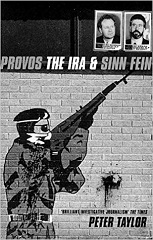
Provos: The IRA and Sinn Fein – Peter Taylor

Sinn fein2Britain is steadily moving towards the anticipated and dreaded exit from the European Union on March 29, 2019. For Ireland, the move comes with a mix of emotions, including fears of the re-ignition of a conflict that resulted in several thousands deaths over the span of several decades. The IRA has long been recognized as the extreme group responsible for dozens of bombs and acts of terrorism across Norther Ireland and London.  But the reality is that many groups were involved in one of the world’s deadliest conflicts.  I have been following Brexit since the referendum was held on June 23, 2016. The vote to leave the European Union sent shock waves throughout the world and left many wondering what would happen to both England and Ireland in its wake?  I wanted to know more about the conflict in Northern Ireland and decided on this book by author Peter Taylor.  And what I found inside its pages, has opened my eyes to a feud that would have dire consequences should it commence again.

Taylor explains early in the book that his first challenge was to decide on where to begin.  He decides on 1916, when Patrick Pearse and his “Irish Volunteers” laid siege on the General Post Office in Dublin, proclaiming the Provisional Government of the Irish Republic.  Their philosophy was modeled after Sinn Fein, created in 1905 by Arthur Griffith, a journalist in Dublin.  Six days of fighting ensued before Pearse gave orders to surrender.  On May 3, 2016, he was executed at the age of thirty-six. His life and legacy continue to live on after his death but I do not believe even he could have predicted the events that followed in Northern Ireland.

Taylor is beyond reproach in telling the story of the rise of the Catholic movement for Irish independence from British Rule.  In 1919, the Irish Volunteers became the Irish Republican Army (IRA), the name it carries to this day and in 2910, the Government of Ireland Act of 1920 officially partitioned the country into Norther Ireland and Southern Ireland, allotting six counties to the north and the remain twenty-six to the south. In the north, Protestants are the majority and live comfortably under British rule.  The Catholics are the minority and seek to be free of the control by the Government in London.  Discrimination becomes a tool of the trade, relegating the Catholics the lowest level in society.   Tensions begin to build and it is not long before both sides engage in violence.  Fianna Fail was established in 1927 after breaking away from Sinn Fein and in 1996, the Ulster Volunteer Force (UVF) was created in response to the growing threat from the IRA.   London soon realizes that Northern Ireland is a powder keg and sends in British troops to restore order.  These various groups became entangled in a battle that was nothing short of all out war.  And as we see through Taylor’s words, it nearly tore the entire country apart.

I warn the reader that violence is prevalent in the book.  However, no story about the IRA, UVF and British Army conflict can be told without discussing it.  Here, Taylor does not mince words and the acts of violence might even disturb the most hardened of readers.  What I found to be even more shocking aside from the acts alone, were the ages of the young men and women involved, some of whom were no more than twenty years old.  But they believed in their causes and were determined to fight to the death in support.  As an American, it is with some difficulty that I was able to put myself in their position.  I have visited Ireland, seeing the General Post Office in Dublin while embracing all that the Irish have to offer.  But this story is not about the Irish breakfast or a pint of Guinness.  This is the bloody story of sectarianism in its most violent form.

Many of the fighters on all sides are no longer alive having succumbed to death, old age and in some cases a hunger strike, as was the case in 1981 at Long Kesh, now known as HM Prison Maze.  But in this excellent account of the conflict, their stories come back to life allowing the reader to go deep inside the mindset of the IRA and its followers.  In hindsight, we have the privilege of examining the actions of all involved.  But at the time, all believed that they were acting in good faith.  And even in some of the interviews that Taylor conducts, the soldiers and activists stand firm in their convictions.  The tense atmosphere, intimidation and fear that engulfed a nation is captured brilliantly by the author.

The British Government plays a huge role in the story for obvious reasons.  And although London is slow to react to the building tension, but once it does, the story picks up pace and its intervention adds another layer of tension of the already explosive conflict.  The administrations of Harold Wilson (1916-1995), Edward Heath (1916-2005), James Callaghan (1912-2005) and Margaret Thatcher (1923-2013) all tried their hand at moving the conflict towards peace. Thatcher would prove why she had been nicknamed the “Iron Lady” following the hunger strikes at Long Kesh in which Provisional IRA member Bobby Sands (1954-1981) died after being on strike for sixty-six days.  The failures of London and the eventual success at achieving peace are covered extensively by Taylor in full detail, putting together all the pieces of a tragic story.   One of the highlights of the book is that in his interviews, he was not afraid to ask the difficult questions of the interviewed.  His approach and the unfiltered answers, give the book even more authenticity as Taylor takes us back in time, recounting a story that should never be forgotten.

Today, Ireland seems peaceful but beneath the surface, old tensions exist and in Northern Ireland, sharp divisions remain between Protestant and Catholic.  Time will tell if the old rivalries will be resurrected and the IRA and UVF re-engage in deadly conflict. The hope is that calm prevails and he world can breathe a sigh of relief in a united Ireland.  What is certain, is that a willingness to maintain peace will be needed by all sides. Wisdom and foresight will prove to be invaluable tools along with unwavering patience.  The people of Ireland face an uncertain future but I remain confident that peace will prevail in the hope that all involved do not wish to see a return to the past.  For anyone who is trying to understand the Northern Ireland conflict, this is a great book to start with.

ASIN: B00K4SC5UG